Catalogue Connection: 21375

  • Ritmo Alexandrov Piano Sonatas Review

    Anatomy of an Unknown Man

    Aside from a handful of recordings by Victor Bunin released on LP by Melodiya and various partial releases on labels such as Hyperion, Toccata, and Caro Mitis, the discographic record dedicated to the Moscow composer Anatoly Alexandrov (1888–1982) is as meager as our knowledge of his work. In this regard, this much-appreciated triple CD from the Divine Art label not only remarkably fills certain gaps but also sheds light and provides a diachronic perspective on the musical thought of Alexandrov, a musician not particularly attached to the avant-garde, within the context before and after the Russian Revolution. Furthermore, this edition also exemplifies a way of approaching the interpretation of music that, apart from a couple of symphonies and a piano concerto, expands into song cycles and, above all, a varied piano corpus, from which the cycle of fourteen sonatas, composed between 1914 and 1915, stands out. 1971.

    With a hermeneutical approach, Singaporean Clarisse Teo presents this cycle as one of the most significant contributions to Soviet piano music, especially since socialist realism favored simpler music with a more defined semantics, as opposed to abstract formulations like sonata form, which Alexandrov considered the best vehicle for expressing his organic musical signature. Drawing from contradictory aesthetics, the Russian-Soviet musician combines the melodicism of Rachmaninoff and the canonical romanticism of Taneyev or Medtner (with whom he frequently debated his futurist romanticism) with a certain post-Criabinian expressionism that alternates with refined neoclassical creations in his Sonatas Nos. 1 to 7, praised in their time by Myaskovsky. Stripped of more exaggerated chromaticism and elaborate ornamentation, the Apollonian central Sonatas, Nos. 8, 9, and 10, are characterized by their more refined neoclassical style. Ten of the Sonatas reach a certain forward-thinking compromise with the established style by adding folkloric references and a more austere rhythmic gesture. The hazy sound of Sonata No. 11, Sonata-Fantasy, draws us into a personal post-impressionism, rich in meandering developments, which looks back to the Scriabin of his youth before launching into a chromatic and synthetic future in which he adopts simpler structures, as seen in the more turbulent Sonata No. 12, the brief and stylized Sonata No. 13, and the bipartite and final Sonata No. 14.

    With a convincing, well-articulated technique, broad Romantic phrasing when needed, and a clear yet warm textural clarity in the more chromatic passages, Clarisse Teo establishes herself as an authority on works that, from the 21st century onward, she has made her own, placing herself above the South Korean composer Kyung-Ah Noh in the selection of early sonatas. recorded in Toccata, and on par with a more urgent Hamish Milne in his atmospheric Hyperion recording of Sonatas Nos. 3 and 4, although Teo offers versatility, a broader perspective, and the benefit of a recording with greater definition and spatialization.
  • Alexandrov Complete Piano Sonatas Fanfare

    Anatoly Alexandrov (1888–1982) was a Russian composer, pianist, and academic who studied with Taneyev, among others. This is the first complete recording of his 14 piano sonatas, although individual ones have been recorded before. Nos. 7, 9, and 12 are receiving their recorded premieres here. Singaporean pianist Clarisse Teo has made a study of Alexandrov’s music and wrote her doctoral dissertation on these sonatas. Her understanding of, and affection for, them is apparent in the colorful and deeply invested performances on these three CDs.

    The 14 piano sonatas span most of Alexandrov’s expansive creative lifespan. The first, a brief one-movement work, was composed in 1914, the last in 1971. He began writing in a somewhat modernist vein during the early years of the Soviet Union, but as modernism turned more experimental, Alexandrov retreated to a conservative, late Romantic style that didn’t challenge Socialist Realism. He was most clearly influenced by Scriabin, but one also hears echoes of Prokofiev, Medtner, and Rachmaninoff in his music. His harmonic language also is similar to Shostakovich’s, but without the sarcastic wit and darkness that infiltrate much of Shostakovich’s output.

    Echoes of Medtner are particularly strong in Alexandrov’s first four sonatas. These works also demonstrate considerable skill in contrapuntal writing and a genuine melodic gift. Alexandrov shows an affection for dramatic contrast, juxtaposing lyrical and turbulent sections, sometimes with minimal transitional material.

    The Fifth Sonata was composed in 1923 and revised in 1938. Most of the changes, according to Teo’s superb notes, involved removing some of its modernist material that would have been objectionable to the authorities. Alexandrov’s move to a late Romantic language becomes apparent not only in these revisions, but also in the Sixth and Seventh Sonatas. In 1932 he heard some of Prokofiev’s piano music, which had the occasional effect of lightening the mood of Alexandrov’s style. He also began simplifying his textures, using less complex counterpoint.

    Alexandrov could not escape the requirements of the Soviet government, particularly after the attack on Shostakovich in (“muddle instead of music”) in 1936. In that era the Communist leaders demanded music that was accessible and incorporated folk songs and dances. One hears Alexandrov’s response in the wartime Piano Sonata No. 8 composed between 1939 and 1944, with its catchy, lighthearted first movement, a darker second movement, and a dance-like finale that is one of the few examples here that closely recalls Shostakovich.

    Sonata No. 9 from 1945 was originally conceived as a one-movement work for children, but it grew into three movements. Clearly Alexandrov was drawn to contrast here. Tension is often resolved quickly but then might soon restart again. The finale provides a good example: A lovely central lyrical section is surrounded by energetic music whose tension is underlined by the use of a Dies irae theme.

    Piano Sonata No. 10 from 1951 seems to have been designed to satisfy the authorities’ requirement for celebratory and triumphant music. It uses popular songs from the period, but Alexandrov retains his compositional integrity by keeping both contrapuntal density and some harmonic adventurousness.

    The last four sonatas were all composed after the death of Stalin in 1953, a time when much of the fear under which Soviet artists lived was eased. Sonata No. 11, titled “Sonata-Fantasia,” was composed in 1955 and is the gentlest of the set. It is clearly influenced by the Impressionists, particularly Debussy. After a somewhat intense, driven second movement, the finale is calm and reflective. In all these works (albeit Sonata No. 13 is a revision of the First Sonata), we hear a composer further simplifying his musical language, writing in a more lyrical and emotionally direct manner. Sonata No 12 has some turbulence about it, particularly in the first movement, but textures are transparent, and there is a lighter, more lighthearted mood to much of the score.

    Describing that line between the good and the great in music is always tricky, and I have never been comfortable attempting it with any degree of specificity. I do not believe that Alexandrov’s piano sonatas achieve the level of greatness found in the finest of Prokofiev’s and Scriabin’s sonatas, but they comprise a significant body of work in Russian history deserving of greater exposure. This first integral recording is an achievement that any listener with an attraction to Russian and Eastern European piano music will find of interest. The recorded sound captures the full richness of Teo’s Steinway. 

  • Alexandrov Piano Sonatas Charlottesville Classical Review

    Anatoly Alexandrov was a pianist and composer who worked in the Soviet Union. His music isn’t as well-known in the West as those of his colleagues (like Shostakovich and Prokofiev). 

    Alexandrov wrote in a variety of genres. But his most important works were his fourteen piano sonatas. They’re also his most deeply personal works. 

    This three CD set includes all fourteen sonatas. And it gives three of them world recording premieres. Clarisse Teo plays with sensitivity and expression. Her interpretations explore the emotional depths of these works.

    Alexandrov was a talented pianist. And these sonatas show the full range of his abilities. Teo ably brings out the complex inner voices of Alexandrov’s music.    

    Like Scriabin, Alexandrov’s music has a mystic quality to it. During the Stalin era, he downplayed that characteristic. But it was always present. And Teo draws it out of the scores.

    Divine Art sequences the sonatas in chronological order. And that’s a great way to listen to them (at least initially). It’s easy to hear the development of Alexandrov’s compositional skill. And at the same time hear the spiritual foundations that tie these works together. 

    Highly recommended.

  • Alexandrov: Complete Piano Sonatas International Piano Review

    The 14 piano sonatas by the Soviet composer Anatoly Alexandrov (1888-1982) were written between 1914 and 1971. The earliest of them show the influence of Scriabin and Medtner, while in his later sonatas Alexandrov maintained a traditionalist (and rather anachronistic) voice: occasional moments of chromaticism (the start of Sonata No 13) sit alongside the benign diatonic writing of Alexandrov’s last sonata – No 14 – composed in 1971.

    The most interesting sonatas are those from the 1920s. As an example, the dramatic opening of the Fourth Sonata (1922) is hugely impressive, as is the whole of the first movement, full of strong ideas, imaginatively developed. Clarisse Teo’s performance is excellent, if lacking something of the headlong momentum of Hamish Milne (Hyperion) or Victor Bunin (Melodiya LP) in the same work. But the important thing about this set is that it gives us the opportunity to hear all of Alexandrov’s sonatas – a substantial body of work – and to chart his stylistic evolution from Medtner disciple to his most striking pieces from the 1920s (Sonatas Nos 3-6), the fine Sonata No 8 (1939-44), which sounds like an escape from (rather than exploration of) the horrors of war, and then to the more modest late works. The set is well recorded, and comes with detailed notes by Teo herself. Connoisseurs of Soviet-era piano sonatas should not hesitate.

  • Alexandrov Complete Piano Sonatas Classical Music Daily Review

    I had never heard of Anatoly Alexandrov (1888-1982) before, but I had heard Clarisse Teo before, so my interest was raised when I heard of this new release, which is the first of the complete sonatas of Anatoly Alexandrov, comprising fourteen sonatas in all, written over much of the composer’s productive life. I don’t really understand why this important composer of the Soviet Union would fall so dramatically into obscurity. Perhaps it was because he was a Soviet composer? In any case, he is quite a remarkable composer, particularly of piano music, because this was his chosen instrument and he was an acclaimed performer.

    Alexandrov studied with Nikolai Zhilyayev, Sergei Taneyev and Sergei Vasilenko (theory), Alexander Ilyinsky (composition) and Konstantin Igumnov (pianoforte) and later went on to teach at the Moscow Conservatory, and taught Aram Khachaturian and Samuil Feinberg, amongst others. He had a somewhat retiring personality and preferred to live a quiet life.

    As well as being a very fine pianist, Singaporean Clarisse Teo also plays violin and viola and has invested much time and effort to write very comprehensive notes about the composer and each of the piano sonatas she presents over three CDs. This is laudable indeed, and shows what high regard she has for this composer.

    As I said, the recordings are presented on three CDs and they appear in numerical order. The composer, though, tended to revise works, so some of the earlier ones appear in later versions.

    The first three sonatas are in one-movement, the fourth is in three movements, as are most of the remaining sonatas, with the exception of No 5 (with the second movement being a theme and variations), and the final sonata, both of which are in two movements.

    Alexandrov’s main early influences were probably Rachmaninov, Scriabin and perhaps Nikolai Medtner, but his style did evolve and his student Samuil Feinberg also became a major influence. The early sonatas seem to owe much to Scriabin, those in his middle period would be harder to categorise – perhaps Medtner would be more of an influence – but he was a composer who charted his own course and while each sonata is consigned a key, and the music is quite tonal, chromaticism is also an important aspect of his music too.

    I regard this as a very important release of a fine and sadly neglected composer. His piano music is very listenable, fresh sounding, and often impressively virtuosic, yet never in a cheap flashy sense, and three of the sonatas – 7, 9 and 12 – are recorded here for the very first time. Technically and musically, Clarisse Teo is certainly up to the demands of the music, the recording quality warm but clear, and if you are a lover of piano music, particularly of Eastern European composers, you are going to enjoy this release.

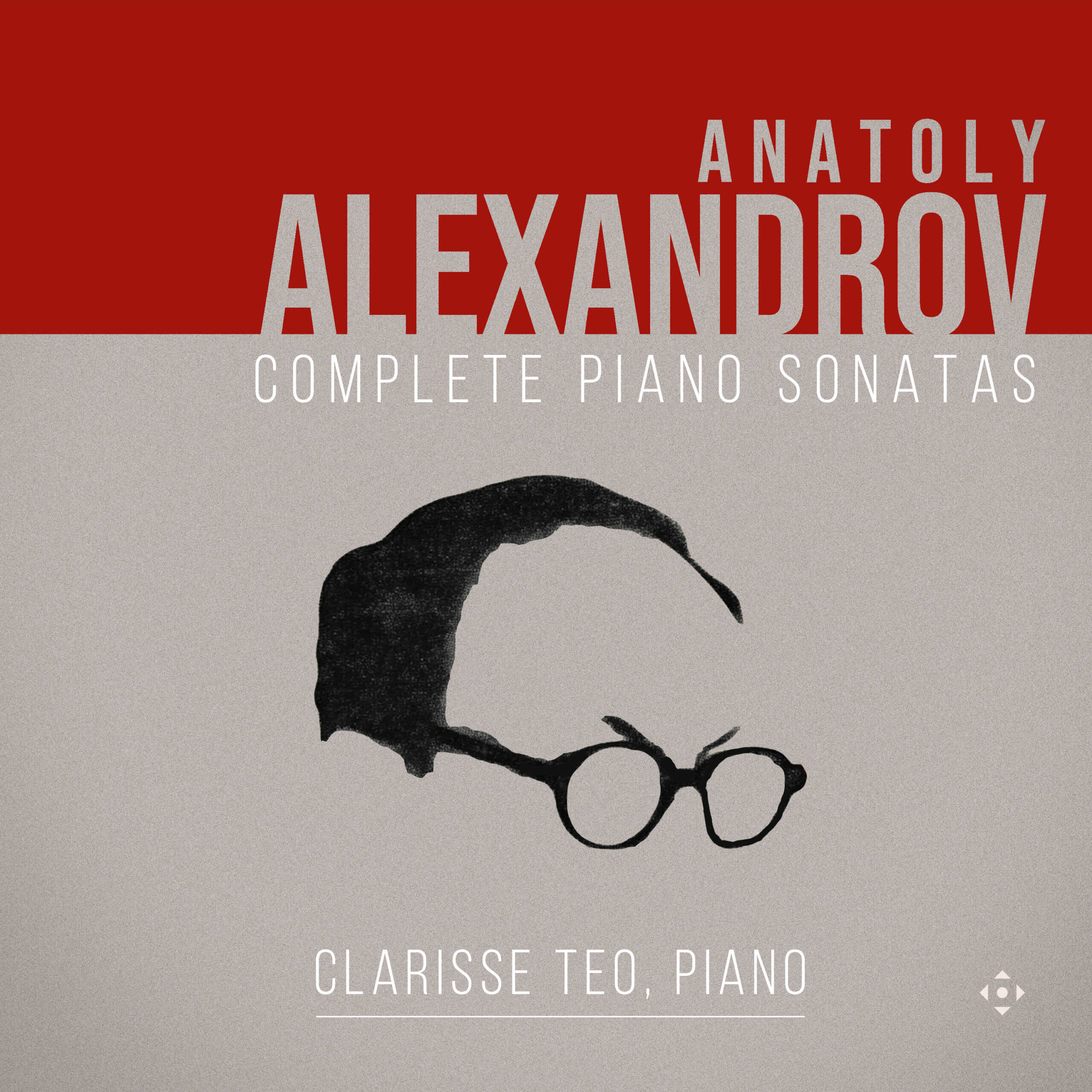
  • Anatoly Alexandrov: Complete Piano Sonatas

    Anatoly Alexandrov: Complete Piano Sonatas

    For the first time, all fourteen piano sonatas by the enigmatic Soviet composer Anatoly Alexandrov (1888–1982) are brought together in a single recording. Known for his richly lyrical style, Alexandrov’s music resonates with the spirit of his contemporaries Nikolai Medtner and Sergei Rachmaninov while charting a distinctive artistic path.

    A prolific composer of solo piano and vocal works, Alexandrov’s œuvre has remained on the periphery of the repertoire, cherished by pianophiles but largely overlooked by broader audiences. His sonatas, written over the course of six decades, reflect a fascinating stylistic evolution shaped by the sweeping socio-political transformations of the 20th century.

    This landmark recording sheds new light on Alexandrov’s place within Soviet music, offering a nuanced perspective that reaches beyond the familiar giants of Prokofiev and Shostakovich. It is both a celebration of Alexandrov’s artistry and an invitation to explore the depth and complexity of a musical legacy ripe for rediscovery.

    Through this ambitious project, pianist Clarisse Teo offers an eloquent and compelling case for Alexandrov’s sonatas as essential listening for lovers of 20th-century music, revealing a forgotten corner of the piano repertoire that brims with emotional depth and historical resonance.

    Singaporean pianist Clarisse Teo is renowned for her bold exploration of lesser-known and contemporary repertoire, earning praise for her “confidently eclectic tastes” (The Straits Times, 2022). Her international career spans solo and chamber performances, including a featured appearance on the acclaimed album Rarities of Piano Music at ‘Schloss vor Husum’ from the 2019 Festival (Danacord Records). Trained in piano, violin, and viola, she holds multiple distinctions, including the FRSM in piano, and completed her Master of Music at the Royal Conservatoire of Scotland on a partial scholarship.

    Clarisse’s groundbreaking Doctor of Performing Arts degree from the University of St Andrews, supported by the Royal Conservatoire of Scotland Trust and Trailblazer Foundation Ltd (Singapore), focused on the fourteen piano sonatas of Soviet composer Anatoly Alexandrov. Passionate about reshaping the classical canon, she brings fresh insight and vibrant artistry to the stage, redefining what it means to champion overlooked music.