Catalogue Connection: 25007

  • Fanfare – Michael Carter – 25007

    Over the years, there have been occasional releases of keyboard sonatas and concertos by precursors and contemporaries of Mozart, including a smattering of the sonatas composed by Baldassare Galuppi (1706-1785). Galuppi is another of those figures whose contemporary reputation was far-reaching but in the intervening centuries his name has been relegated to the darker recesses of music history. Considered by some to be the father of comic opera, Galuppi’s music has been in and out of the catalogs over the years and has also been championed by a number of performers, including conductor Diego Fasolis who recording of Galuppi’s comic masterpiece Il mondo alla roversa was relased by Chandos in 2001. But by and large Galuppi’s music – be it vocal or instrumental – has failed to gain a secure foothold in the active repertoire.

    Be it right or wrong one generally succumbs to the temptation is to compare the unfamiliar to the familiar and this usually results in the unfamiliar getting the short end of the stick. But if this approach is eschewed, an objective listener can – as here – encounter an occasional diamond long sequestered amid the galaxies of sapphires.

    These are not sonatas in the sense of those penned by Mozart and Clementi. Instead they lie somewhere between those of Scarlatti and his Iberian disciples, e.g., Padre Antonio Soler, and the mature examples of the genre that seemed to flow in a steady stream from the quills of the masters of Classicism. Schizophrenic via the employment of distinctive stylistic traits of both eras, Galuppi’s sonatas are usually written with the melodic interest falling to the right hand and the left hand providing the essential underpinning, frequently in the form of an Alberti bass. They do not consistently approach the level of virtuosity found in the single-movement works of Scarlatti but the lack of unfettered virtuosity is offset by Galuppi’s unfailing lyricism and his ability to create cogent and engaging musical ideas that are dotted with an occasional structural or harmonic idiosyncrasy.

    There is much melodic beauty in these relatively brief and generally bipartite works and they descend gracefully on the ear, eliciting a wholly positive response from the auditor. My favorites include the first of sonatas in F and the one in D Minor whose first movement melodic content seems to embrace they dying Baroque and could easily have been written by Handel or Bach.

    Volume 1 of this series drew much critical acclaim for Sievewright’s advocacy of this reperoire, much of which remains unpublished. The sonatas recorded here represent the second installment in the projected cycle of Galuppi’s 90 sonatas by Sievewright and the British firm Divine Art and the music could not have a more sophisticated or dedicated advocate. In each sonata he unwraps a musical gift of exquisite beauty, gently embracing and caressing the slow movements with Italianate grace and lyrical expression that border upon the romantic while the more lively sections are permeated with a delightful and appropriate bounce and spontaneity. Seivewright’s gentle coaxing produces a kaleidoscopic array of dynamics and a rainbow of colors. These sonatas may never challenge the place of honor held by those of Mozart, but Sievewright pleads both an elegant and eloquent case for a reexamination of his shadowy repertoire.
  • Musical Opinion – Geoffrey Crankshaw – 25007

    This well recorded disc offers a generous view of a Venetian composer once thought to be a serious rival to Vivaldi. He had what was a long life in those days. Born in 1706 and dying in 1785, Galuppi turned out a wealth of music in all the fashionable forms.

    Here we have a representative selection of keyboard sonatas. These are more extensive than the single movement works of Domenico Scarlatti, but the individual pieces lack the character and sparkling invention so typical of Scarlatti. However the disc fills a gap, and the music is well played by Peter Seivewright.

  • International Piano Magazine – Max Harrison – 25007

    Baldassare Galuppi’s place in music history rests chiefly on his role in the development of opera buffa ,yet he composed much other music besides. He also travelled widely, spending time, among other places, in London, Paris and Russia, and it was in the last of these that his reputation as a brilliant keyboard player was mainly established. Grove lists “125 or more sonatas, toccatas, divertimentos, lessons, etc” by him, and these must have been written for the harpsichord although they are described on the above CD as being piano sonatas. It seems these were mostly written form 1755 onwards (Galuppi’s dates are 1706-85) and they are in two or occasionally three movements. Most of the movements are in major keys and they are in binary form with repeat marks. The style is similar, given the differences in the mediums, to the arias in Galuppi’s operas. Certainly the keyboard writing is entirely idiomatic, with figures passing from one hand to another, arpeggios in both hands and a fair amount of hand-crossing. The form of these little movements, none of which on the above CD lasts more than a few minutes, is concise and Galuppi’s treatment of his thematic material is concentrated – which is more than can be said of many of his Italian contemporaries.

    Peter Seivewright recorded all these sonatas in the Matt Thomson Concert Hall at the Royal Scottish Academy of Music and Drama in 1999 and his absolutely immaculate execution is matched by the clarity of the recorded sound. He also provides a most interesting note on the relationship between Galuppi, his music, and the Counter-Enlightenment. It is difficult to imagine this particular repertoire being presented to better advantage.

  • Northern Echo – David Robson – 25007

    The second in Peter Seivewright’s complete piano sonatas by Baldassare Galuppi takes us further into the period charms and delights of the composers who carried the music of his age in France forward towards the romantics that followed.

  • ClassicalNet – Gerald Fenech – 25007

    This is the second volume in Divine Art’s complete survey of Galuppi piano sonatas, an important area of compositions that have been overlooked in favour of other more popular keyboard masters such as Scarlatti et al.

    Seivwright is an enthusiastic and technically accomplished pianist and he plays with great conviction and flair in all the sonatas presented here. Most are two movement works with the F minor and F major in three movements. This is pleasant listening from first note to last and followers of piano literature will obviously have a ball istening to the works unfold one after the other.

    As usual, Stephen Sutton’s production and general ‘feel’ has imparted a top class product. The fastidiously detailed notes by Seivwright himself make for essential reading for all pianophiles and the recording, at the Matt Thomson Concert Hall in Surrey is beyond reproach. Those who have bought Volume 1 will obviously grab this and for newcomers to Galuppi, just grab both volumes and await the third with relish!

  • MusicWeb – Kevin Sutton – 25007

    Baldassare Galuppi was a Venetian who enjoyed a long career as a composer of chamber and keyboard music as well as a great deal of music for the church and stage. A reactionary to the pervading Enlightenment philosophies of his day, Galuppi was heavily influenced by the writings of those who stood in opposition to the likes of Voltaire and Diderot. Rather he espoused the less utilitarian and more romantic views of men like Giambattista Vico (1668-1774), Johann Georg Hamman (1730-1788) and Johann Gottfried von Herder (1744-1803).

    Peter Seivewright is as much the scholar as he is the performer, providing us with a provocative essay on the so-called Counter-Enlightenment, and the effects that the wars and political machinations of Galuppi’s time had on the composer, indeed, had on music history itself. The essay is well written, and I have to stop to give it special praise in light of the ever-diminishing quality of program notes for classical recordings.

    The music is elegant, with hints of the past and predictions of the future. As Hans Keller put it, “Great composers link the past with the present. The greatest composers link the past with the future.” I believe that Galuppi succeeds in being an original, if not always interesting voice, leaving us with a framework, the architecture of which was patterned after Scarlatti’s blueprint, and upon which greater lights such as Mendelssohn, Schubert and Schumann would later build.

    The music here is charming, but not necessarily memorable. I didn’t find myself whistling any tunes after the pieces were finished. I did, however, find myself stopping to listen again to some elegant turns of phrase and some harmonic progressions that were certainly advanced for their time.

    Mr. Seivewright obviously admires this music. His scholarship into the composer’s life and times bears witness to a passion for his work, and a scholarly ethic that commands respect. Alas, I wish that I could be as enthusiastic about his piano playing.

    Let’s start first with the instrument itself. Although it is billed as a Steinway “D” model piano, it sounds to my ears as though it is in serious need of refurbishing. The upper registers are clangy and brittle, and overall we never get a truly warm sound. Further, the recording is close, and the sound immediately makes me think that I am listening to a giant piano in a closet. The sound quality becomes a major distraction early on.

    Further, I found that I was listening to a very opinionated performance. It is evident that Seivewright has his own ideas about what this music is supposed to sound like. The halting playing, lack of line tension and the image that I was listening to a pianist playing over, rather than through a composer continually disturbed me. (Glenn Gould would have been proud.)

    Mr. Seivewright must however be applauded for bringing this composer to light. This is indeed worthy music, and as ever, one can hope that these sonatas might occasionally show up on a recital program. It would be a shame if these elegant sonatas were consigned forever into the specialist’s repertoire. And it is too bad that we have only this interpretation to go on. Valiant as the effort is, and informed and enthusiastic as this performer seems to be, there it too much in the performance to make the listener uncomfortable for me to give this disc an unqualified recommendation.

    Should you buy it? If you are a fan of unusual keyboard music, then yes indeed. But it might be more fun to go out and buy the scores and see what you can come up with on your own. I think that the latter experience would be more rewarding than repeated listenings to this recording.

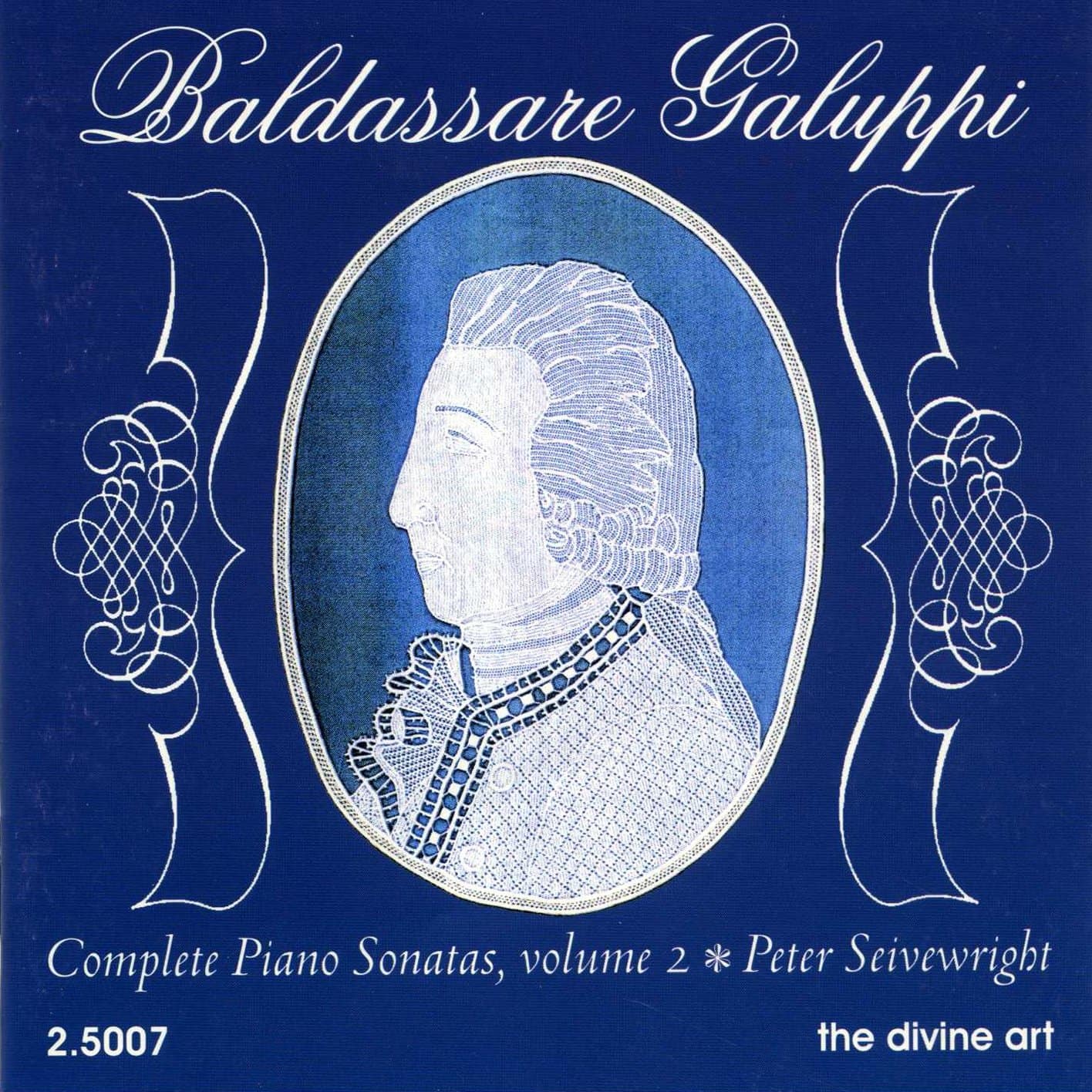
  • Galuppi Piano Sonatas, Vol. 2

    Galuppi Piano Sonatas, Vol. 2

    In the second of a series of CD’s containing Galuppi’s sonatas, we present a further nine of these masterpieces. All music lovers should sample these seminal works, which made Galuppi one of the greatest composers of his day; all the more strange that he should have fallen into such obscurity.

    Peter Seivewright has spent a good deal of time on a research mission to Venice and other European cities, retrieving the unpublished manuscript scores and preparing performing editions. One of the great revelations brought about by this work is that Galuppi, far from being a straightforward baroque composer writing for the traditional keyboard instruments (harpsichord and clavichord), which have been employed in all previous recordings, actually waited until the piano had been developed before creating most of his phenomenal output. Many of the original manuscripts are titled “Sonata for Pianoforte”, and much of the writing, making substantial use of the sustain pedal, simply do not work on the earlier instruments.

    Also see:
    Volume 1
    Volume 3
    Volume 4