Catalogue Connection: 25030

  • Fanfare – Michael Cameron – 25030

    In the notes to his fine new disc of Bach’s keyboard concertos, pianist Peter Seivewright launches into a spirited and lengthy essay regarding the works. The reader might suspect that he is about to begin a defense of the use of piano over the harpsichord in performance, since he uses the former in this recording. Instead, the topic is the origin of the concertos in Bach’s oeuvre, specifically Seivewright’s strongly held belief that four of the seven concertos were in fact originally keyboard works, not transcriptions of lost violin concertos as many musicologists have suggested. He has some interesting points to make, not so much in the form of hard evidence to support his claim as criticism of the weak case made by scholars. I won’t take a firm position here, although I should note that he fails to mention that the emerging consensus these days is that two of them were composed as woodwind concertos, not violin concertos. Ultimately the argument seems, well, academic, since none question the existence of the concertos in Bach’s hand, whether they are his first thoughts or not.

    Tempos are on the moderate side, a bit slower than average in the outer movements and a tad quicker in the middle movements. The pianist’s readings are clear, precise, and exhibit an admirably cogent structural overview. He keeps the textures light, uses scant pedal, and isn’t afraid to submerge himself in the orchestral fabric, most notably in the second movement of the D-Minor Concerto. My favorite is the perky A-Major Concerto, which proceeds with good humor and lyrical charm, minus the caffeinated rush that has been the style the last decade or two.

    Since the exact scoring of Baroque concertos (especially with regard to number of players on a part) involves a bit of guesswork, the personnel is always worth noting from the outset. The Scottish Baroque Soloists is a small chamber group rather than a chamber orchestra, with single string players on modern instruments and guitar on the basso continuo part. The result is a transparency normally heard only in Baroque instruments, but transferred to a modern setting. Since the guitar is relatively quiet and one of the five strings is a double bass, the balance might strike some as shy in the middle range. It is a surprising but workable effect, though the listener shouldn’t expect much dynamic contrast from the six-person “orchestra” in the tuttis. More importantly, all the players are sensitive and fully committed to Seivewright’s vision. If you are a fan of these works (who isn’t?) and enjoy sampling a wide spectrum of realizations, you’ll want this disc for your collection.

  • Music & Vision – Robert Anderson – 25030

    The accomplished soloist in these concertos, Peter Seivewright, spends much of his booklet essay refuting the long -accepted view that Bach ‘s seven keyboard concertos are mostly arrangements of violin works . Since three of them certainly are (most notably the Fourth Brandenburg Concerto ), I am dubious of his case. The keyboard part in the Fifth Brandenburg, with its extended ‘ cadenza ‘, shows Bach in full virtuoso flight . There is nothing comparable here. The middle concertos on this CD both played their part in three church cantata adaptations, further evidence of Bach’s hoarding of good ideas, whatever the change of medium.

    The identity of Seivewright’s solo instrument has not been revealed by Divine Art . Bach was not enamoured of the newfangled ‘ forte and piano ‘, though he certainly played one when visiting Frederick the Great at Potsdam (the king had fifteen such instruments , made by Gottfried Silbermann). Harpsichord , fortepiano and indeed modern piano are equally grist to Bach’s mill. Everything depends on the player ‘s sensitivity. This can be sampled at the start of the G minor concerto , once all thought of the violin original has been banished.

    The best-known of these concertos is the powerful D minor. When the first two movements were dragooned into Cantata No 146, the solo part was transferred to the organ , a keyboard instrument but with yet more sustaining power than the violin. The same applies to the whole of the E major concerto, which reappeared in Cantatas 169 and 49. In this case the original was almost certainly for keyboard. The enchanting Siciliano could survive any words it might be saddled with, even such depressing sentiments as ‘Die in me, World ‘.

    There are those who have thought that an original for the A major concerto might have been for oboe d’amore , a wonderfully expressive instrument, and a favourite of Bach’s. Perhaps so; but the sonorous phrases work admirably on the keyboard too.

    The concertos were published among the chamber music volumes of the Bach Gesellschaft edition, and it is thoroughly refreshing to hear the ‘ orchestral ‘ lines taken by the Scottish Baroque Soloists , one player to a part. So the textures , under the leadership of Angus Ramsay, have a delightful and appropriate lightness.

  • American Record Guide – Donald Vroon – 25030

    Bach wrote seven of these keyboard concertos, all around 1738 in Leipzig. There is no evidence that they were composed earlier, as musicologists have posited; and there is no evidence that they were violin concertos originally (except one of them, the G minor). Mr Seivewright in his notes scolds the musicologists for “spectacularly lazy and doctrinaire thinking”. Finally a musician who will stand up to that crowd!

    Naturally he plays these with the full resources of the piano and of human emotion. Emotionless baroque performances are not for him – and not for me! These sound very much the way Mozart piano concertos sounded in the great days of recordings. There are lots of nuances and subtleties, plenty of poetry and expression. If he is right about these works, they were not the first keyboard concertos but were preceded by some of CPE Bach, the composer’s son. And if that is so, his spirit probably affected them – and Bach was not tentatively seeking out new territory but instead enhancing something that already existed – as was typical of him.

    Nor do the Scottish Baroque Soloists play on period instruments in strict period style; they are far better than that. They are a small and rather nimble group, and I would prefer a warmer, fuller, more “orchestral” sound; but they do not irritate the ears by scraping their strings, though there are many moments where more vibrato would have helped. By the way, they include a guitar.

    So this amounts to a compromise: a principled and knowledgeable rebellion against musicological “orthodoxy” but not a complete break. As such, it may appeal to some of our readers. Very good sound – not too close-up.

  • Halesowen News – Kevin Bryan – 25030

    This fine collaboration between Peter Seivewright and the Scottish Baroque Soloists sheds new light on what were arguably the first works penned for solo keyboard instrument and orchestra. The widely held belief that these compositions represented Bach’s arrangements for piano of what were originally Violin Concertos has recently been called into question by musicologists, but they provide a wealth of inventive and frequently very melodic listening nonetheless.

  • Fanfare – Lynn René Bayley – 25030

    In his long and fascinating liner notes, pianist Seivewright discusses the “historical musicology” that places many of Bach’s keyboard concertos as transcriptions of concertos for violin, and carefully discusses and to some extent debunks that theory, yet nowhere does he discuss historical performance practice or why his recording of these works so evidently rejects many of its principles.

    Stylistically, at first, these performances sound like not only pre-HIP versions of Bach, but also pre-Glenn Gould and Helmuth Rilling performances. Listening to them, I have a sense of deja-vu, as if I were hearing better-recorded, cleaner, but stylistically similar versions of Eduard van Beinum’s performances of the early 1950s. Yes, it’s a chamber orchestra, but the string sound is satiny and sleek, even less dynamically contrasted than the Vienna Philharmonic string section behind Bronoslaw Huberman in the 1930s (though less heavy in texture). Seivewright’s playing is sensitive­ly shaped, pearly in execution, and tries its best to make his modern piano sound like a fortepiano, yet the small dynamic range makes the performances sound almost like a chamber-music concert.

    But is this bad? And is it conceptually wrong? I’m not convinced of this. Although these are not the kind of performances I normally respond to in Bach, I’ll be the first to admit that there is a certain historic rightness to them, depending, of course, on the 18th-century venue and forces being used. We have become so used to Bach keyboard concerto performances that not only sparkle and zip along, but also hit one over the head with their sharp accents and right angles. Yet this was not necessarily the performance practice of J. S. Bach’s time, but more the practice of Carl Philipp’s and J. C. Bach’s era. Indeed, I have long maintained that the kind of explosive Sturm und Drang one hears from many Baroque conductors and orchestras today was really a product of the Mannheim School, which came about after Bach’s lifetime. This is one reason, for instance, that I questioned the wonderfully exciting but historically wrong approach to Baroque castrato arias recorded by Cecilia Bartoli. She’s terrific, virtuosic, and exciting, but she’s giving us a post-1770 vision of pre-1750 music.

    Thus I commend your attention to this disc and its chamber-music-like delineation of these oft-explosive concertos. (It’s worth noting that Seivewright played a recital of Bach’s music in 2003 as part of the International Bach Academy in Boston.) The longer this CD went on, in fact, the more I liked it and the more I was convinced that his approach to Bach’s keyboard concertos is not only valid but interesting within the context of the time of their conception. I should also like to note that the Scottish Baroque Soloists give us just about the most beautiful straight-tone string sound I’ve ever heard.

  • MusicWeb – Michael Greenhalgh – 25030

    Here are two CDs which share three Bach keyboard concertos played on the piano but take a different approach to performance and accompaniment.

    Nick van Bloss begins with Bach’s A major Concerto BWV 1055 . You can straightaway enjoy the blithe effect created by the creamy, smooth tone and easy, nonchalant fluency he finds in its opening movement; this notwithstanding the ebullience of the predominantly semiquaver line in the right hand. This is well complemented by the cheerful and lightly crisp articulation of the orchestra. A dense, busy texture is delivered with a gusto which never becomes hectic. In the Larghetto slow movement the strings have a dreamy, faraway quality at first. There’s then a growing tragic intensity in Parry’s sensitive pointing of their succession of quaver/crotchet leaps and descents. These are sweetly sad and them the piano plies an unbroken melody whose bluesy elements are clearly revealed by van Bloss. Here fluency doesn’t restrict the expressiveness of the cantilena. In the finale a similar continuity is appreciable: you could say it’s one long, bristling flourish from the piano. From the orchestra an element of heady abandon emerges as the movement lurches around in tipsy celebration. How vibrantly the strings articulate the ornament of the second note mirroring that of the piano part. It’s the ornamentation and demisemiquaver work in the piano that creates the movement’s fundamental fervour.

    Peter Seivewright ends his CD with this concerto. He plays with an ensemble of solo strings plus double bass and guitar to boost the continuo line. The atmosphere is more intimate, still closely recorded. The drier Glasgow acoustic and more even balance of piano and strings suits this approach. The same can be said of the more dominant piano of the Nimbus recording to its more standard concerto soloist/orchestra model. Seivewright’s playing is rather steadier. The opening movement doesn’t therefore have the flow of van Bloss/Parry. Seivewright and Angus Ramsay don’t sweep you away, but you note more the structure of Bach’s argument. Seivewright finds more contrast as that argument progresses, pointing its different characteristics. In the outer movements of all the concertos he leaves the opening to the strings, apart from here the very first flourish, entering at the piano’s initial elaboration of the theme (tr. 10, 0:21 and tr. 12, 0:31). This points the opening solo entry more and makes it more akin to, say, a Mozart concerto. I prefer the involvement of the piano from the outset as in van Bloss’s account. Again in the slow movement Seivewright’s phrasing is more marked, so the shape of the piece is clearer. The piano melody is delivered with more poise – it’s more like an aria – with an intensity that more closely matches that of the accompaniment. The Seivewright/Ramsay finale is more homely than the van Bloss/Parry, less virtuosic, but the piano still skips along with plenty of liveliness.

    Seivewright begins his CD with the G minor Concerto BWV 1058 and presents its opening Allegro in sinewy articulation against strings. There’s considerable, lively energy here and a rugged swing. But van Bloss is faster, timing at 3:42 against Seivewright’s 4:05 and thereby more swinging still. He’s rather lighter in tone yet with a turbulent verve, again with a headiness of progression and Parry makes more appreciable the interplay between soloist and orchestra because its forces – larger than Ramsay’s chamber ensemble – give it more personality to meet the soloist on equal terms. In the following Andante van Bloss is smooth and laid back. He brings a beautifully flowing line with the orchestra left to supply the edge of solemnity. Seivewright offers a more shaped and expressive cantilena, very much a soulful aria. Ramsay’s weeping solo strings are more personally in emotive accord. To the finale van Bloss brings both rigorous precision, which enhances its momentum, and a playful bounce. Seivewright is steadier and more refined, but this allows the piano to display more wit.

    In the E major Concerto BWV 1053 opening movement van Bloss brings an element of rugged muscularity of propulsion, vigorous, flourishing. This is well counterpoised by Parry’s defter strings in the myriad of contrapuntal exchanges. Seivewright, on the other hand, is more lightly articulated and playful against an ensemble that is more intimate, exploratory with a less distinctive overall sense of direction. The following Siciliano from Parry is a silkily veiled dance after which van Bloss’s solo elaboration, presented with great clarity, gives it a reflective, jocular cast. This seems a touch jarring, but van Bloss is right to direct attention to the strangeness of a movement which contrasts an extrovert form, a dance, with a soloist’s more inward musings. Seivewright and Ramsay are more comfortable in their contrast of emotive, lachrymose strings and a cooler, more limpid piano solo unmistakably an aria. The result is that the whole movement has more character. In the finale van Bloss/Parry (tr. 12) are frolicsome and frothy, though with the episode featuring a chromatic rise from 2:02 broadening things out more freshly for a spell. Seivewright/Ramsay, if not as scintillating, are again more lightly articulated, smoother, quite blithe and comely. They manage to be more relaxed in manner though not in pace.

    Now to consider the concertos van Bloss and Seivewright don’t share. Seivewright plays the D minor Concerto BWV 1052 . I’m afraid I didn’t take to this account. In the opening movement the piano sounds furtive, as if engaged in abstract doodling and the scale seems too small for the nature of the work. Contrast the busy, purposeful engagement of the 2000 recording by Murray Perahia, piano director with the Academy of St Martin-in-the-Fields (Sony 88697742912). Perahia fully exploits the tension the piano’s sequences create, the offbeat strings’ interjections excite and what a marvellous climax to the movement Perahia and the orchestra achieve together. Seivewright’s slow movement finds the piano cowed, the accompaniment thrust into a limelight it finds tedious to sustain where Perahia is searingly reflective in this ‘aria’ of huge tessitura. Seivewright’s finale, with sprightly strings, is nicely done as a chamber piece but the piano should surely be more commanding. Perahia gives us a maelstrom of swirling energy.

    Van Bloss plays two additional pieces: first the D major Concerto BWV 1054 . In the first movement he is playful yet maintains momentum well, though for me he over bounces the attack of the opening motif. As ever there’s fine interplay with the orchestra and its evident involvement to enjoy. Perahia recorded this concerto in 2001. His opening movement is smoother but also jollier yet he also maintains a seamless vein of lyricism and provides more light and shade than van Bloss. The slow movement, gauzy and wistful, is beautifully realized by van Bloss. The left hand piano melody is fastidiously balanced against the right hand decoration. Still the emotion of the central section is kept cool. Perahia makes the whole movement an arioso of considerable eloquence born of suffering. The pathos of the paring down of its centre is especially effective. To the finale van Bloss brings a healthy robustness, but alongside this Bach with bluster Perahia is more graceful, carefree and dance-like.

    Van Bloss also plays the F minor Concerto BWV 1056 . In the opening movement (tr. 13) he supplies a creamy fluency as a freewheeling contrast to the dour, stolid tutti at the outset. An especially pleasing moment comes from 2:50 when the left hand adds the movement’s main motif to the right hand’s melodic flow. Perahia’s lyricism in this movement in his 2000 recording is both more seamless and tense yet also more varied in tone and texture, but van Bloss’s blunter contrasts are just as valid. The Largo slow movement is one of Bach’s loveliest cantilenas. It comes from van Bloss in a bright, clean line married with an absorbed, musing manner, toying with, yet very fastidious in, its ornamentation. It’s cool and graceful, perhaps a mite chintzy. Perahia is more velvety, makes the ornamentation lighter yet more integral to the line. In the Presto finale (tr. 15) van Bloss and Parry wittily point the interchange between piano and orchestra from the orchestra’s echoing the end of the piano’s first phrase. Van Bloss’s icy descending trills, for example from 0:59, are also enjoyable. Nevertheless I prefer the niftier pace (2:58 against van Bloss’s 3:19) and lighter tone throughout achieved by Perahia and his accompanying strings.

    Both Seivewright and van Bloss contribute articulately and forcefully to their CD booklets. Seivewright challenges the idea that Bach’s keyboard concertos were simply arrangements of works for other instruments while van Bloss charts his own approach to the range of problems faced by performers using modern instruments. His CD is the more striking. Van Bloss’s own distinctive style is well matched by Parry’s orchestral verve. Seivewright is more reflective yet is also complemented by Ramsay’s expressive chamber ensemble. For a more rounded and eloquent approach to Bach concertos played on the piano Perahia remains for me unsurpassed.
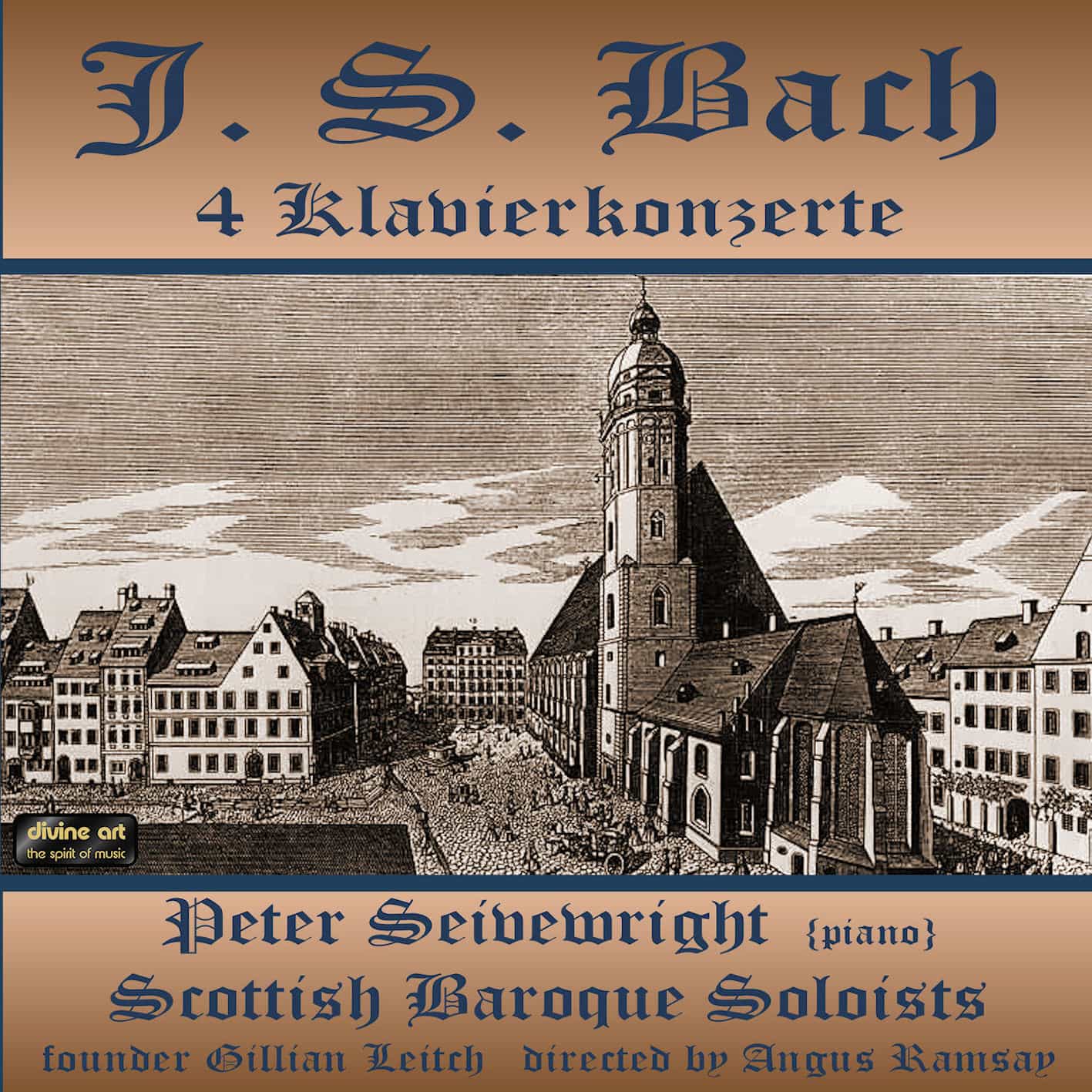
  • J S Bach – 4 Klavierkonzerte

    J S Bach – 4 Klavierkonzerte

    Bach’s Concertos for keyboard and chamber orchestra are rightly acknowledged as masterpieces of the genre, and among the first truly great concertos of the Baroque/Early Classical period. They are performed with a wide variety of instrumentation, and here Peter Seivewright plays a modern Steinway Model D grand piano, accompanied by a baroque size ensemble, also using modern instruments, but in the authentic one-to-a-part style. The continuo here is provided, again authentically, by the Spanish guitar, which gives a warmer sound than the more common harpsichord.