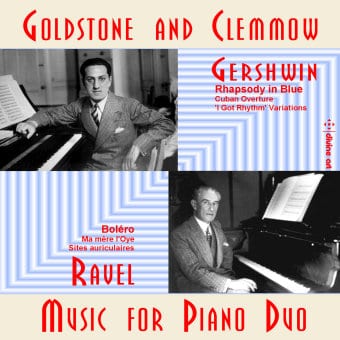
Catalogue Connection: 25055

  • Whole Note review of Gershwin and Ravel

    Oh to have been a fly on the wall in that New York room in 1928 when George Gershwin played his Rhapsody in Blue for Maurice Ravel. The evening encounter is rich with anecdotes but Ravel’s brush with American music and Harlem jazz made a lasting impression that emerged repeatedly in his writing of that period.Gershwin, Ravel [sic] is a tribute to the works of these two composers for piano duet and two pianos. Piano duo Goldstone and Clemmow recorded these tracks over the decade 1997-2007 and their re-release in this repertoire compilation is a reminder of how their performances will be missed since the death of Anthony Goldstone two years ago.

    There is such full engagement and energy in all this playing. The Rhapsody in Blue is the original versions for two pianos and seems in no way diminished from its orchestral scoring. The same is true of I Got Rhythm, also in its original two-piano version. As in all their recordings, Goldstone and Clemmow never falter. They breathe and play as a single mind, whether at one keyboard or two. The disc’s closing track is perhaps both the most novel and amazing. Ravel’s version of Bolero for piano duet (that’s four hands at one very crowded keyboard) is simply impossible to imagine as it unfolds.

  • Gershwin & Ravel Piano Duos review

    Anthony Goldstone died in January 2017 and in a review of one of his more “serious” collections, we lamented on lost talent. This new CD is more a cause for celebrating a life as he plays (with his wife Caroline Clemmow) some tunes that will bring a smile if not some tapping of toes.

    The programme opens and closes with two very famous pieces, Gershwin’s Rhapsody In Blue getting things going and Ravel’s Bolero bringing the programme to an end. Surprisingly (to us, anyway) “modern” George Gershwin was born just before the end of the 19th century but died young in 1937, the same year as “classical” Maurice Ravel, who was two decades older. They did meet: in January 1928, Ravel was on a four-month tour of North America, and asked to meet Gershwin at a party for his (Ravel’s) 53rd birthday. Gershwin played the Rhapsody In Blue, and Ravel was “astonished” at Gershwin’s playing and gift for weaving complicated rhythms. Gershwin later took Ravel to hear jazz played in Harlem.

    Even casual fans of the classical will know both these tracks. Rhapsody combines classical music with jazz; Brian Wilson of The Beach Boys has said it influenced Smile, and songs such as Good Vibrations. It was also used in the 2013 film The Great Gatsby. Boléro is reportedly the most performed piece of classical music — allegedly it is performed somewhere in the world every 15 minutes — and is even more famous thanks to the film 10 and Torville and Dean.

    In between these two tracks are a number of other similar pieces of music, alternating between the two composers, all with a jazz influence. Pour yourself a glass of illegal hooch and pretend you’re in a speakeasy.

  • Gershwin and Ravel: Music for Piano Duo

    Gershwin and Ravel: Music for Piano Duo

    With over forty CDs to their credit and a busy concert schedule stretching back more than thirty years, the British piano duo of Anthony Goldstone and Caroline Clemmow was firmly established as a leading force. Their recordings are not only brilliant performances but usually innovatively programmed, leading to rave reviews for every album. Sadly Goldstone died in January 2017 but their legacy lives on.

    This album was originally released in 2007 (dda 25057) but withdrawn due to complex issues regarding one track. Now available again (without that track!) this is a superb rendition of music inspired by jazz and popular idioms, including the original piano duo versions (not transcriptions) of several of the pieces. The combination of these two great composers and one of the world’s best-ever duos makes for a stunning recital album.

  • Musical Opinion review Gershwin and Ravel piano duos

    [Review of previous release]
    The husband and wife team of Anthony Goldstone and Caroline Clemmow have been recognised as among the most popular and versatile piano duo over many years. Goldstone himself has an impressive reputation as a solo pianist, again with a constant fascination into neglected and rarely heard music of quality. The Divine Art CD of Unheard Mozart on dda25051 is a particularly interesting example.

    Gershwin’s admiration for Ravel is well known and an excellent excuse for bringing these two composers together in both original and arranged music. The Rhapsody in Blue, for example, was first scored for four hands, though the first performance was given with instrumental scoring by Paul Whiteman’s arranger Ferde Grofé. This performance is packed with poetic exuberance and well worth the cost of the CD in its own right. However, the other Gershwin pieces, the Cuban Overture and the Variations on I Got Rhythm, offer new facets of Gershwin enhanced by the variety available for four hands.

    Ravel’s Mother Goose, here in what is the first recording in Roger Nichols’ corrected edition for Peters, is a delight and played with an enormous sense of imagery. Boléro, of course, cries out for Ravel’s superb orchestration. However, if listened to in this version there is much to enjoy in the development of the great climax.

  • The Guardian review of Gershwin and Ravel piano duos

    [review of previous release]
    George Gershwin and Maurice Ravel were something of a mutual admiration society; the story goes that when Gershwin asked Ravel for piano lessons, the Frenchman asked the American how much he earned, then said: ‘Maybe you should be giving me lessons!’ Their influence on each other is evident in this delightful disc from the British husband-and-wife team Anthony Goldstone and Caroline Clemmow, who include the original two-piano version of Gershwin’s Rhapsody in Blue and ‘I Got Rhythm’ alongside Ravel’s ‘Ma mere l’Oye’ from Mother Goose and a rousing 15-minute climax of Ravel’s Bolero.

  • ClassicalNet review of Gershwin and Ravel piano duos

    [review of previous release]
    This disc is a delight from start to finish. With such inspired piano playing throughout, one rarely has the time to reflect on the fact that these works were not strictly composed for piano duet but Goldstone and Clemmow belie that.

    Gershwin’s ‘Rhapsody in Blue’ and his Cuban Overture (actually the original version for piano duet) come across quite magically with the thrill and exhilaration superbly portrayed with both pianists’ nimble fingers. I also greatly enjoyed the ‘I Got Rhythm’ Variations which are very colourful and include some outstanding technical touches.

    Turning to Ravel, the music is perhaps a bit more mellifluous but nonetheless it is no less enjoyable. The delicate nuances of ‘Ma mere l’Oye’ are nimbly played by Goldstone and Clemmow whilst the ‘Sites auriculaires’ also contain some dazzling piano effects. All comes to a close with a barnstorming rendition of ‘Bolero’ which is the ideal show stopper that rounds off the disc in real party fashion. The disc is fabulous as it is but the added bonus of detailed notes by Anthony Goldstone make for a truly indispensable package. Thumbs up to the enterprising label that is Divine Art for providing us with such a barnstormer of a disc. Here’s to more from this fine stable.

  • International Record Review: Gershwin and Ravel

    [review of previous release]
    This formidable piano duo (and husband-and-wife team) has made over 30 CDs already and the latest disc further enhances their considerable reputation. Anthony Goldstone provides the excellent programme notes, explaining how when they met in America in 1928 Gershwin’s request to study with Ravel was greeted with the reply that it might cause him to “lose his great gift of melody and spontaneity”. The notes are generally a mine of information (Ravel’s Boléro is ‘reputed to be performed somewhere in the world very fifteen minutes’). The works of the two composers, both of whom died in 1937, are cleverly alternated, creating some fascinating juxtapositions, with Gershwin’s Cuban Overture being followed by Ravel’s ‘Habanera’ (a dance originating from Havana) from Sites auriculaires. The programme provides a wonderful blend of the familiar and the obscure.

    Rhapsody in Blue receives the full-blown treatment in its original version for two pianos. For many this will be a poor substitute as compared with the rich colour of Ferde Grofé’s orchestration, but it is a surprisingly effective arrangement in its own right, really disappointing only in the broad cantabile melodies (such as that of the E major Andantino moderato), which should hold swell and brim forth, providing such a wonderful contrast to the extrovert and often percussive display of the solo piano. With this lack of contrast, the solo part is inevitably less distinct, and the nimble and fleet-fingered passagework – particularly in the repeated note section towards the close – loses some of its lustre and its exuberance, all the more so for the lack of really flamboyant display; the likes of Previn achieve greater evenness of touch, a quicker tempo and a resulting sense of real exhilaration here.

    Ravel’s Ma mere l’oye – ‘receiving its first recording in Roger Nichols’s corrected edition for Peters’ – is performed with a very suitable delicate simplicity. There’s more subtlety of shape and colouring to be found in this work, as evident in last year’s release by the Labèque sisters, and greater vitality too from Lortie and Mercier (even if it’s at the expense of the composer’s own metronome markings in ‘Laideronette’), but Goldstone’s and Clemmow’s approach is no less valid for being less overtly characterised.

    The smaller works fare equally well, with dance rhythms predominating, clearly articulated in Gershwin’s I Got Rhythm Variations, Cuban Overture and Ravel’s ‘Habanera’, before culminating in a controlled performance of Boléro. This is again undercharacterised and slightly subdued, avoiding the intensity and excitement of Lortie and Mercier, who are more than two-and-a-half minutes quicker.

    A few reservations apart, these are very worthy performances, the programme is an attractive one for its variety and for the inclusion of many rarely heard works, and the sound quality is ideal. The major works here may have received more committed performances than these, nevertheless, devotees of piano duo repertoire will doubtless want to add this to their collections.