When I wrote my six part blog Celebrating British Music I knew that such an undertaking would inevitably leave out some fine composers that deserved a mention. Brian Chapple (b.1945) may not be a household name but he has written some attractive music of real substance. He attended the Royal Academy of Music studying composition with Lennox Berkeley and piano with Harry Isaacs. His orchestral work Green and Pleasant was winner of the BBC Monarchy 1000 Prize in 1972. Its premiere took place in Bath when, conducted by Norman del Mar, it was broadcast and televised. Brian Chapple has received commissions from and premieres by the London Sinfonietta (Venus Fly-Trap), the London Mozart Players (Little Symphony, 1982), BBC Singers (Lamentations of Jeremiah, 1984) and the New London Orchestra (In Memoriam, 1989).
His work with the Highgate Choral Society resulted in two substantial choral, orchestral commissions, (Cantica, 1978) and (Magnificat, 1987) and the choir of St Paul’s Cathedral has premiered his Missa Brevis, Ecce Lignum Crucis and St Paul’s Service, 1996, a tercentenary commission.
The Choir of St Pauls Cathedral has recorded Chapple’s Ecce Lignum Crucis on a Hyperion disc entitled Passiontide at St Pauls. Chapple’s other works include a Piano Concerto premiered by Howard Shelley in 1979, the Choral symphony In Ecclesiis, Songs of Innocence, Five Blake Songs, Five Shakespeare Songs, a Piano Sonata and other piano works.
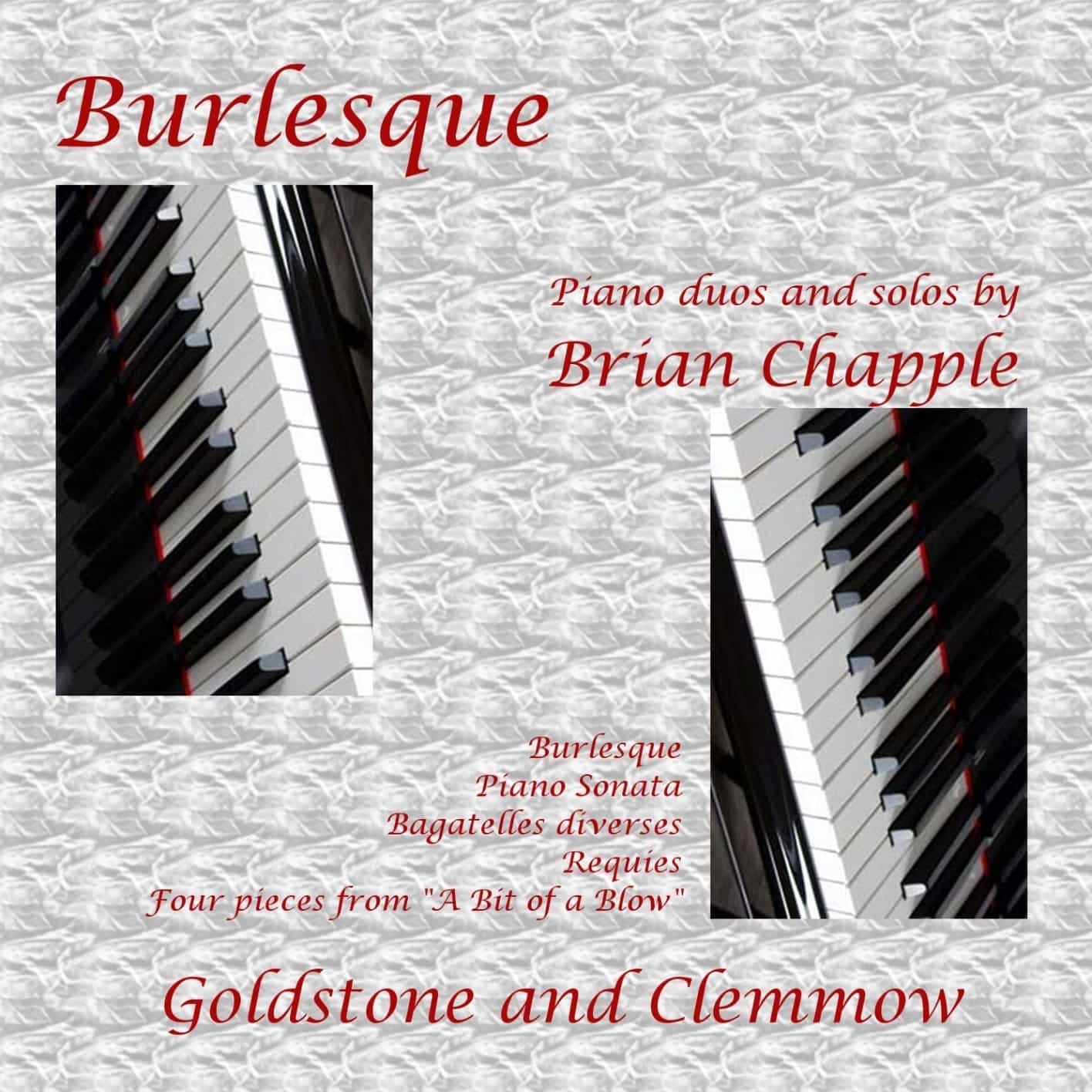
It is a recording of some of his piano music that has been issued by Divine Art Recordings played by one of our finest piano duos, Anthony Goldstone and Caroline Clemmow.
The opening work on this disc, Burlesque, was originally written for two pianos, eight hands and was premiered in 2000. This new version of the work from 2005, is for two pianos four hands. The opening marked Con moto slowly builds with richly sonorous playing from Goldstone and Clemmow whilst the following section, Con brio, has a Spanish flavour showing this duo’s supreme accuracy, playing as though one.
The third section, what the composer in his notes describes as a moto perpetuo, brings lithe rhythmic playing before the finale section which really swings with joyful playing of jazz rhythms and not a little virtuosity.
We enter a somewhat different world with Chapple’s earlier Piano Sonata (1986) commissioned by Julian Jacobson and premiered by him at the 1986 Dartington International Summer School.
The first of the three movements is a short Adagio where the music seems to search around for a theme. The second relatively short Allegro movement again seems to leap around without obviously settling on a theme. The final movement progresses through an Allegro energico, a Largamente and Adagio tranquillo before a final short Allegro. It is in this movement that the themes searched for in the first two movements are seemingly resolved. There is certainly a resolution in the Adagio tranquillo section before the brief Allegro coda.
So engrossed was I by this sonata that I took Anthony Goldstone’s superb pianism for granted. His performance really is magnificent.
Brian Chapple’s Bagatelles diverses for solo piano consist of nine pieces, all seemingly fragmentary, and I was not convinced when reading the composer’s notes that they would ‘coalesce into a twenty three minute work of some weight.’ To my surprise the longer final bagatelles do just that and, by the penultimate bagatelle the work pulled together forming a work of some substance.
Caroline Clemmow’s playing of these pieces is wonderful and contributes much to the works cohesion. The richness of her playing towards the end of the work is superb.
Chapple’s Requies, for piano solo was written around the time of the first Gulf War and it was television images of destroyed armoured cars and the dead strewn across the landscape that led to this piece. Lasting around eleven minutes, this is an expressive and sombre piece that can indeed conjure up the feeling of wandering amongst the debris of war and the thoughts that it provokes. Anthony Goldstone really gets inside this work conjuring up an intense and mesmerising performance.
The disc ends with Four Pieces from ‘A Bit of a Blow’ for piano duet. No wonder a previous version of this music for solo piano was entitled ‘Swing’s the Thing’ as jazz rhythms embrace these pieces in a piano performance of style and panache showing this duo’s astonishing artistry and versatility.