Catalogue Connection: 25061

  • International Record Review – Julian Haylock – 25061

    One of the most richly enjoyable musical experiences of my playing career was performing violin in a small Baroque chamber ensemble with a Baroque flautist, whose original wooden instrument produced a sound of blemishless, mellow purity. While it would be overstating the case to assert that it is impossible to match on a metal flute the amber-toned, oak-aged, ravishing tone that radiates from Celia Redgate’s 1921 Rudall Carte, I can’t think of a single modern player who makes a sound to rival it. Redgate’s mid-range floats by seamlessly as though buoyed aloft on a warm current of air rather than activated by it. Her upper register is completely free of breathy shrillness, and her lower notes are encompassed effortlessly without the slightest sense of ‘reaching down’.

    Some of the most enchanting British chamber music ever composed has been touched by the neo-classical charm of late nineteenth-century France, as witness Edward German’s Flute Suite, which sounds for all the world like an evacuee from Debussy’s Petite Suite . Arnold Cooke’s Sonatina has more than a whiff of Claude Arrieu about it, York Bowen’s Flute Sonata is closer to Poulenc, while Stainer’s whistle-stop Étude suggests Godard as its starting-point. The other pieces on the album are more quintessentially ‘English’, including Sir John Tavener’s Greek Interlude , which despite its Mediterranean derivations possesses a meditative, chant-like quality which sounds engagingly Albionesque.

    Throughout this generous and musically well-balanced recital Redgate and her endlessly supportive and sensitive accompanist Michael Dussek play with supreme naturalness. Her mellifluous tone and impeccable technique combine to create the perfect vehicle for these endlessly delightful miniatures, while her effortless phrasing and enchanting musical presence completely disarm any sensation of there being an ‘interpreter at work’. Glowingly recorded and played with exemplary taste and skill, this is one of the most distinguished flute discs to have come my way in a long time. More please!
  • Pan Magazine – Richard Stagg – 25061

    This CD has three united but distinct strings to its bow: it features works by English composers or by those who are honorary Englishmen despite their cross-border connections; it celebrates the achievements and influence of important Royal Academy of Music teachers; and it celebrates the continuing survival of the wooden flute in the twenty-first century.

    Celia Redgate (née Pitstow) studied with the late Gareth Morris at the RSAM, where she gained many distinctions. Her career has centred on recital work and chamber music. Sir Edward German Jones’s Suite for flute and piano comes across as distinctly Elgarian, Sir John Tavener’s Greek Interlude could almost pass for English, and the Welshman Frederic Griffith’s Danse Nègre sounds as English as tea and toasted crumpets.

    The high points of the CD are, for me, York Bowen’s Sonata and Christopher Redgate’s Three English Folksongs . Christopher, who is married to Celia, is a well-known oboist who doubles on the didgeridoo. He is also, evidently, an accomplished composer, as his inventive and skilfully-wrought folk arrangements demonstrate. Michael Dussek is a first-rate accompanist with a scrupulous ear for balance and ensemble. With all this virtuosity one might expect an embarras de richesses , but not a bit of it! The message of this CD is that simple is beautiful, and that simple can also rustle up a storm to make your hair stand on end. The wooden flute offers good plain country fare, cooked properly, which doesn’t need the whole spice-jar thrown into the stew. Don’t just take my word for it, buy the disc.

  • Gramophone – Andrew Achenbach – 25061

    A pupil of former Philharmonia principal flautist Gareth Morris, Celia Redgate has followed in her teacher’s footsteps as a champion of the wooden flute, whose mellow tone was such a familiar voice in British orchestras throughout the first half of the last century. She has devised the present programme to show off the virtues of her chosen instrument, the works having been selected, to quote her own engaging notes, ”for their rich diversity of style and character, and their relevance to a group of English flute players.”

    Edward German’s charmingly innocuous Suite of 1889 is inscribed to his flautist friend and fellow RAM alumnus Frederic Griffith, whose sprightly Danse n è gre nestles next to a delicious Etude by Charles Stainer. Stainer in turn taught Gareth Morris, whose exquisite artistry inspired both York Bowen’s 1946 Sonata (along with Arnold Cooke’s Sonatina, the most durable offering here) and Michael Head’s idyllic By the River in Spring (1950). Redgate herself gave the 1979 world premi è re of John Tavener’s Greek Interlude , while her brother Christopher chips in with Three Folk Songs (“Barbara Ellen”, Green Rushes” and “The Wraggle Taggle Gypsies, O!”) that he wrote as a birthday gift for her in 2002.

    Suffice to say, Redgate performs all this attractive material with conspicuous flair, grace and discrimination (vibrato is kept within tasteful bounds). I need merely add that Michael Dussek accompanies with the utmost sympathy, and the recorded sound is nicely intimate and beautifully balanced to boot.

  • American Review – 25061

    What’s different about this attractive flute recital is that Ms. Redgate plays a wooden flute which all but vanished in the U.S. in the 1920’s and which lasted into the 50’s in the U.K. A few artists still play this instrument, and Ms. Redgate’s was purchased used in 1921 by her father, and now she plays it. The York Bowen Sonata has been recorded at least a half dozen times before and the lovely Michael Head piece has a single other recording on ASV, but the rest of the program would seem to be premiere recordings.

    The playing is first class. Michael Dussek is familiar from many recordings on a variety of labels, and he partners Celia Redgate beautifully. The Edward German Suite is much like his songs. Redgate’s husband, Christopher, has made a charming set of three folksongs: Barbara Ellen, Green Bushes, and The Wraggle Taggle Gypsies, O! Nifty. Michael Head is best known for his songs and his recitals on which he accompanied himself in them. His flute piece is a song without words – very lovely.

    Arnold Cooke studied with Hindemith, and his Sonatina shows some mild influence of his teacher, but nothing to be afraid of. It’s a thoroughly English piece. York Bowen’s piece is virtuosic as you’d expect, and of course the piano writing reflects the composer’s ability as a brilliant keyboard artist. The Tavener piece is a bore, and is there I suppose because Redgate before her marriage gave the premiere. The short Griffith is a cute encore piece and so is the Charles Stainer. Redgate gives his dates as 1874-1947, but this is one of Sir John Stainer’s sons, and Dibble in his recent Stainer bio give his birth date as 8 June 1871. The 1947 death date is correct. Recommended highly.

  • Albion Magazine – Em Marshall – 25061

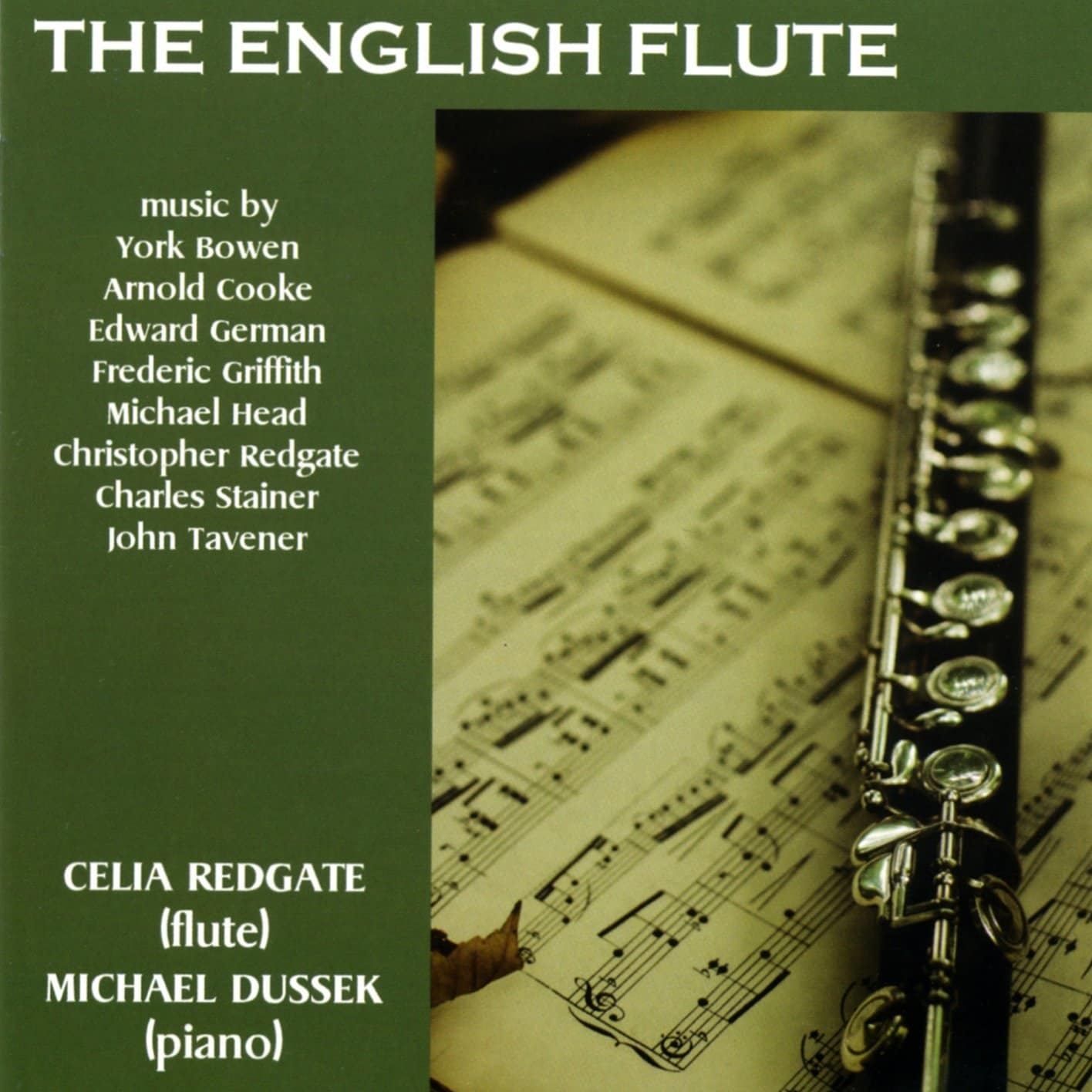
    The term ‘English Flute’ referred, at least for much of the twentieth century, to the wooden flute (as opposed to the metal flute usually played these days), and the works on this disc were all written for this style of instrument. The record opens with the utterly delightful, lively Edward German Suite for flute and piano, in which Redgate and Dussek really make the music dance. This is followed by Redgate’s attractive arrangement of three folk songs; the slightly syncopated Green Bushes is particularly well-composed, with its strong rhythmic drive and contrasts of mood, and the final Gipsy Dance is quite virtuosic. The disc also included Head’s evocative By the River in Spring, Cooke’s Sonatina – an engaging little piece – and the York Bowen Flute Sonata . This latter is the most substantial piece on the disc, both in terms of length and content, and the lush piano accompaniment (excellently played by Dussek) is characteristic of Bowen’s romantic style. In Greek Interludes , Tavener employs old Byzantine modes, combined with folk-song melodies from different parts of Greece, to create an atmospheric, interesting, and engaging piece, while Griffith’s Danse Negre and Stainer’s Etude in D minor finish off the record beautifully. Redgate and Dussek are an excellent partnership on this disc of light, lovely music.

  • Land Of Lost Content – John France – 25061

    Sir Edward German (1862-1936) is often seen as being a second-eleven composer. People who have come across him associate his name with his light opera Merrie England . Of course German did write a deal of ‘light music’ yet he also penned two symphonies, much incidental music and a number of chamber works. I recently received a CD to review called ‘The English Flute’ with Celia Redgate, flautist and Michael Dussek, pianist. Among a variety of good things there is German’s Suite for Flute & Piano. This was composed in 1899 and dedicated to his friend Frederic Griffith.

    The Suite is an attractive piece of ‘quintessentially English “music. It could be argued that much of these three movements nod towards the music of Arthur Sullivan. Yet this ignores the fact that there is a quality about this suite that goes beyond that particular genre. In fact the middle movement, the Souvenir , is a perfect miniature that well balances sentimentality with retrospection. To be fair, the Gypsy Dance does owe much to the ‘theatrical life’ of the late nineteenth century.

    The rest of the disc includes works by York Bowen, Arnold Cooke and Michael Head. The last track is by a chap called Charles Stainer – but he deserves a post in his own right!

  • Midwest Record – Chris Spector – 25061

    A solid collection of flute/piano duos with Michael Dussek along for the piano ride. Focusing on several composers, the works cover a lot of ground and are presented in a proper English fashion that makes the simple seeming date deliver some high toned listening throughout. Certainly the kind of recording you want to play when you want to feel like you have some class, it almost transports you to a drawing room in another time and place.

  • The English Flute

    The English Flute

    A fine recital of 20th century music for flute and piano by English composers including some rare pieces, all melodic and memorable. A special recording as it features the traditional “English” wooden flute rather than the metal flute now more prevalent. Its warm tone embellishes these works even more.