Catalogue Connection: 25072

  • The Consort – Elizabeth Rees – 25072

    This is a very fine performance of an attractive composition which is potentially of great significance, although it has rarely been recorded. The Four Seasons of Giovanni Guido, who was born around 1675 and died some time after 1728, may well have formed a model for Vivaldi’s ever-popular work of the same title. It is here performed with great delicacy and vivaciousness by solo violinist Caroline Balding with the Band of Instruments. This is an Oxford-based group who employ two violins, cello, bass and harpsichord on this recording, which was made at New College , Oxford .

    Guido was probably born in Genoa; he studied violin in Naples, and subsequently worked in Paris as Master of Music to Philippe II of Bourbon (1674-1723), Regent of France. Philippe was a patron of music who favoured the Italian musical style, which Guido was in part responsible for introducing to French audiences, according to Titon du Tillet. Guido’s composition compares very well with Vivaldi’s in quality: it is varied, attractive, graceful and colourful.

    The ‘Musical divertissements on the four seasons of the year’ survive in a set of undated printed parts published at Versailles. An anonymous cycle of poems, entitled ‘Les caractères des Saisons’ is printed at the beginning of the score. Each movement draws on the poems, and phrases from them are printed in the score, where musical ideas illustrate the text. In form, the movements resemble French suites, while their style is Italianate. Since the four concerti were probably composed in 1716-17, they are likely to predate Vivaldi’s Le Quattro Stagioni of 1723 by at least five years, although the evolution of Vivaldi’s four concerti is itself unclear: in his dedicatory preface to op.8, he described them as old works which would ‘appear new’ to his patron because he had added ‘a very clear statement of all the things that unfold in them’.

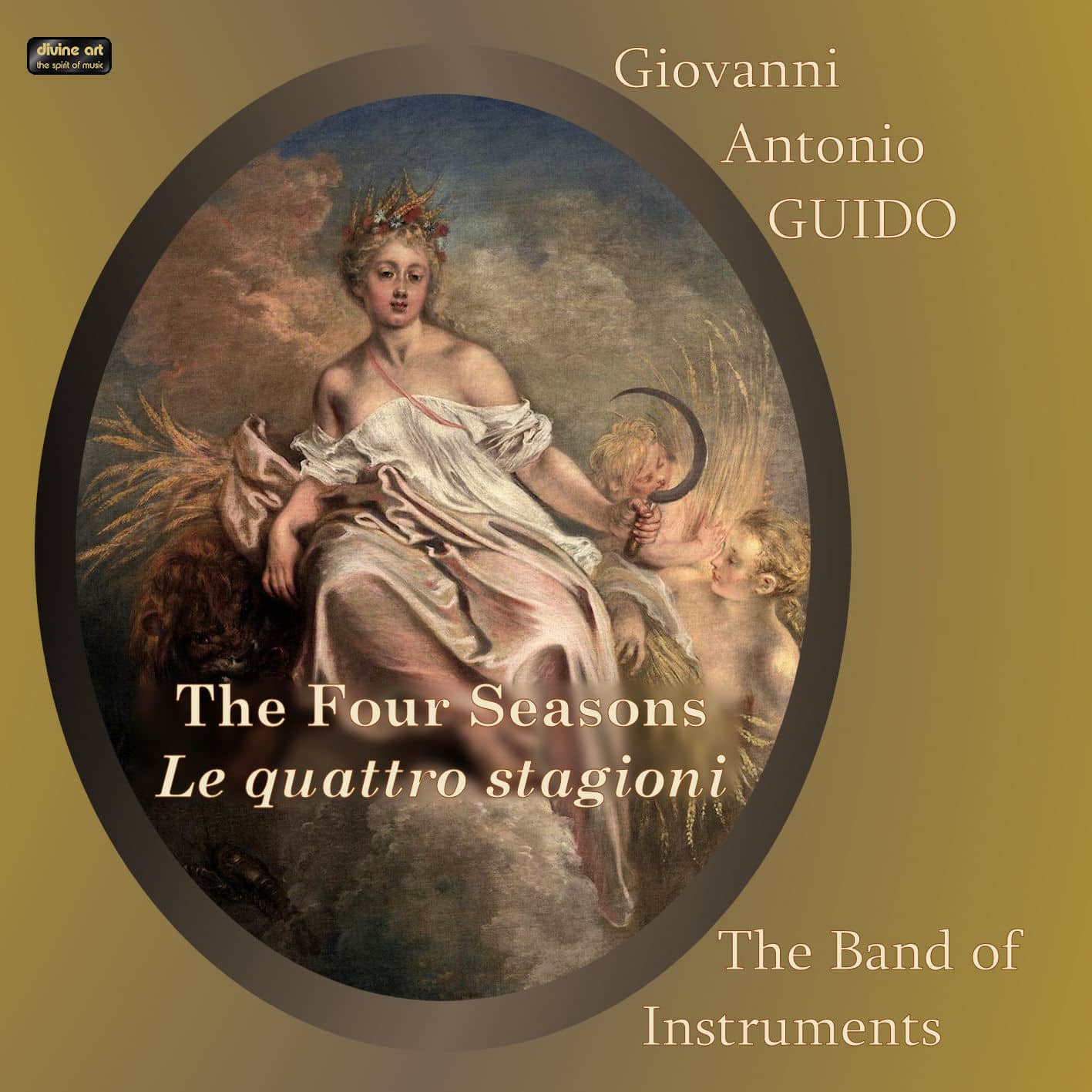
    The inspiration for Guido’s concertos appear to have been four oval panels depicting the four seasons, painted by Watteau between 1713 and 1716 in the dining room of a wealthy Parisian, Jean-Pierre Crozat. It is possible that Crozat commissioned both the anonymous poems and Guido’s music, to mark the completion of, or harmonise with, his dining room. The fascinating background history is outlined by Michael Burden in the informative CD flier, which is also translated into Italian.

    The four oval panels depicting the seasons are also reproduced, together with the four poems (for which an English translation would have been helpful, although the French is not too complex). The only surviving portrait of Guido, a drawing by Watteau, is also reproduced in the flier. Divine Art is to be commended for bringing to us this little-known music, which is both historically important and beautiful.

  • MusicWeb – Brian Reinhart – 25072

    An Italian baroque composer writes four picturesque concertos for string ensemble depicting ‘The Four Seasons’. Each of the four short concertos is accompanied by a descriptive poem outlining the events in the music. The set starts with spring and concludes with winter. The composer’s name is Giovanni Antonio Guido.

    Hah! Surprised? Giovanni Antonio Guido’s ‘Four Seasons’ were probably composed around 1716-1717, at around the time Vivaldi was probably writing his. Very little is known about the composer; in fact, his name, which is a weird combination of three first names, is such because he apparently alternated between calling himself ‘Giovanni Antonio’ and ‘Giovanni Guido’. The result is a trail of archival mystery, although we can be certain that he composed these works in France. His death date is “after 1728”.

    Guido’s concertos are far less melody-driven than Vivaldi’s, and more episodic; they’re more like baroque suites. Each concerto is divided up into 8-12 sections instead of just three. Thus in spring we get a brief nightfall, a depiction of birdcalls, ‘Air de trompette’ and a concluding dance. Like Vivaldi, Guido ends his summer with a “violent storm”, but he also includes a dance of the fauns, an appearance by the goddess Ceres (Demeter), a “minuet of the nymphs” and a minute-long cameo for cuckoos. Structure is rare; once an idea is given, we move on to the next.

    Some of them are very striking, and every so often I lunge for the booklet to see what fun thing just happened. The faux trumpet fanfare in Spring, given by violins, is vivid, much more so than a birdcall episode which is noticeably lacking in anything like birdsong. Immediately after the trumpets, the string ensemble strikes up a shockingly good imitation of bagpipes. It’s amusing to hear the cuckoo-call woven into a very standard baroque tune – and to hear a very cuckoo-like call used when Ceres arrives. Autumn ends with a very striking death scene and one of the few instances of a previous theme returning.

    Not everything stacks up. Guido’s summer storm is a lot cheerier and, well, sunnier than Vivaldi’s, although it’s just as fast and virtuosic. The Winter concerto is so genial that I completely missed the “war march”.

    Still, you shouldn’t necessarily compare this with Vivaldi. These aren’t virtuoso violin concertos, they’re suites for a small ensemble of highly skilled string players who exchange solos and duets. They’re much more specific in program but more abstract in musical content. They almost never stray into minor key. They’re a whole lot of fun, and the extremely talented players who make up The Band of Instruments are a pleasure to hear. I’m now tempted to seek out their other recordings.

    So I say adjust your expectations and dive in. These Four Seasons are not at all like those . They are a set of fun, vivacious, diverting baroque suites, and they are very skilfully played. Why this 2004 recording took so long to arrive on CD beats me.

    The only caveat I have about this very enjoyable enterprise is that if you want to follow along to the musical program or read the poems, you’ll need to know French. The poems aren’t translated and neither are the movement names. The seasons themselves are given peculiar names, perhaps reflective of 18 th -century spelling (“L’este” for “L’été”). On the other hand, maybe Giovanni Antonio Guido’s years in France weren’t enough to make him fluent. They were certainly enough to provide us with some very fun music.

  • International Record Review – Michael Round – 25072

    Divine Art’s policy is to include at least one premiere recording per disc. In the case of Giovanni Antonio Guido’s The Four Seasons this extends to the whole album. Genoa-born Guido (c.1675-died after 1726) is a shadowy figure, confusing would-be biographers by using both Antonio and Guido as surnames during his lifetime: the only known likeness of him is a drawing by Watteau. His Scherzi armonici sopra le Quattro stagioni dell’anno could well pre-date Vivaldi’s: confirmation is hard to come by, though the booklet note exhaustively attempts to clarify the issue. Ideas from poems adorning the first set of printed parts form en-route titles to the music (‘Les ruisseaux’, ‘Menuet des nimfes’, ‘La Chasse’, ‘Les riantes fêtes’ and so on): these sections are not separately tracked but the start time of each episode is sensibly given in the listings.

    And the music? Resemblances to Vivaldi, inescapable with present-day hindsight, are never embarrassingly close: I was reminded more of Rameau. Soloist Caroline Balding is superb, her backing Band of Instruments under director Roger Hamilton wholly admirable, and only one-to-a-part-phobes may have wished for more players in order to heighten the contrast between solo and tutti. I foresee much enjoyment as well as many irritating pub-quiz questions like ‘Italian, Four Seasons, not Vivaldi but who?’

  • Fanfare – Bertil van Boer – 25072

    There is an inherent difficulty if one is known only by three first names, especially if the sources list music under all three. But such is the case of Giovanni Antonio Guido (c.1675-c.1728), a composer-violinist who spent much of his working life at the French court of the Duc D’Orleans. It is presumed that he was from Genoa, and he disappears from history after a Concert spiritual in 1728. What is known is that he was trained at one of the conservatories in Naples, and by 1703 he had moved permanently to Paris, where he served the Regent under Charles-Hubert Gervais. There is, however, a portrait of him by no less a person than Watteau, which shows him to have been a rather serious, contemplative type with prominent spectacles (and the usual long wig); in other words, a 17th-century nerd. He caused no controversy, was a serious collaborator with Gervais and other composers on a super-friendly basis, and performed regularly but without inciting the sort of passion for which the French court musicians and connoisseurs were known at that time.

    His music is all but unknown, and he might well have been a completely forgotten name were it not for a set of four works based upon poems entitled Les quatres saisons . Which of course, brings us to his polar opposite, Antonio Vivaldi, a man with overweening ego, a habit of shameless self-promotion, and whose life was marked by scandal and prominence. In other words, precisely the opposite sort of person than Guido, but one whose Quattro Stagioni has entered the realm of musical icons. Given the disparity between these two, it has often been regarded (when thought of at all) that Guido decided to imitate his more famous contemporary’s popular violin concertos, first published in 1725 but composed several years earlier. Now, however, research has demonstrated that Guido’s works were written as early as 1716, possibly predating Vivaldi by several years, with the implication that the famous master may have cribbed the idea from his reticent colleague, and perhaps some of the musical ideas as well. I don’t intend to enter this possibly tortuous debate, but what is apparent here is that Guido’s four compositions, entitled Scherzi armonici (and not concertos), provide the antipodes to Vivaldi’s often flamboyant concertos.

    The works are based upon four anonymous poems that apparently inspired Watteau to produce four images that were often reproduced in engraved form at the time. The poetry is solid and pictorial, with Spring noting how the birds begin to return, the trumpets sound for war, and the various peasants celebrate the promise of the year; Summer noting the blossoming of a bountiful harvest, the fauns and nymphs dancing about, and thunderstorms brewing; Fall celebrating the harvest (particularly of grapes) and the hunt; and Winter depicting ice, snow, furious winds that ravage the earth, the approach of old age (metaphorically speaking), and the celebration of the returning warriors to festive balls and even more venal pleasures. For Guido, these were just the sort of elements that allowed him to juxtapose both the French and Italian styles in his musical renditions.

    It would be a mistake to call these concertos, for they are more like multi-movement suites, though with the caveat that the typical baroque suite is left far behind. Indeed, as the poetry unfolds, the movements are like miniature tableaux, in which one element blends smoothly with the next. For example, the musette of “Spring” features the emphatic drone of the lower strings, which then moves directly into a less obvious peasant dance. In “Fall,” the strings sound very much like hunting horns, and when the stag attempts to flee, it does so with a series of fast trills that agitate the melodic line before the final plaintive death chords. In “Winter” the poetic stanza about old age has the violins creeping along with halting chords, breaking into a set of dotted rhythms for the march entrance of the warriors. In the thunderstorm in “Summer,” the strings rush about with tremolos and skirling figurations that are wild and untamed musically. One could go on, but this is the anti-Vivaldi, a sort of characteristic work that focuses upon the drama rather than the soloist, upon the pictorial elements of the poetry, and not the obvious sorts of word-painting that one finds in the Venetian composer. This makes the issue of who came up with this idea somewhat moot, for they are two very different works, and this despite what are sometimes striking musical phrases that are, ahem, parallel.

    This is not the first time that these works have been recorded, for in 2004 L’arte dell’Arco released both on a single disc for CPO. The Band of Instruments, an early music group from Oxford University, has chosen to let the Guido stand on its own, thereby separating the works of the two composers to avoid the comparisons that would inevitably arise. As to their performance, director Roger Hamilton runs a very tight ship, with good contrasting tempos, nice phrasing, and an ensemble that is very much in tune. Their performance is well executed and I can find no fault with it. Where I do have a quibble is with the track indexing. Each of the pieces is given its own track, but the clear movement divisions are merely indicated as “the starting point of each section.” In this day and age, it would have been simple to do multiple tracks, instead of making the listener have to hear them all at one go and making them clock-watchers. Also, the poems are given only in the original French in the booklet, which makes them less useful if one doesn’t speak the language. Still, if you can put up with this, you will be treated to a first-rate performance of works that really do deserve to be more popular, even if they have to contend with an icon.

  • Pizzicato – Remy Franck – 25072

    The Italian violinist and composer Giovanni Antonio Guido was born about 1675-1680, probably in Genoa, and died after 17 September 1729, the date on which his name appears for the last time in ‘Mercure de France’ about the performance of his ‘Te Deum’. He lived in Paris from 1702 until 1729 at least, the service of the Duke of Orléans, and his son, Louis d’Orléans.

    He was not a flutist, despite the statement to that effect in the translation of the inscription, written on the back of his portrait drawn by Watteau (original in the Louvre and included in the Divine Art CD booklet. His composition “Scherzi armonici sopra Staggioni dell’anno quattro : four Concertos for 3 violins, flutes, oboe, harpsichord, bass viol and cello” is now his most famous work.

    The German label cpo released a recording with extracts of four concertos and the Divine Art label seems to be the first to publish the full composition – it lasts more than an hour! Without reaching the quality of melodic invention Vivaldi, Guido still realized a beautiful Baroque work in a mixture of French and Italian styles.

    The subtitles are suggestive, with for Spring: Time Flies – The Night – Song of the cuckoo – Streams – Birds – Air for trumpet Musette – Dance of the shepherds.

    Summer : the air ignites – Zephyr disappears – cuckoos sing – Fly to the rescue, sweet Ceres – Descent of Ceres: Dance of reapers – Dance of fauns – Menuet of nymphs – Serenade: The respectful Lover – a violent storm.

    Autumn: Celebrating the return of Autumn – shouting and laughing of the revellers – Sleep – Hunting – Flight of deer – Death of deer.

    Winter: season of frosts – The Cruel Aquillon declared war on us – Take care of your day – March of the Warriors – The happy festivals – banishment of sadness.

    Here is a beautiful work, vigorously played by ‘The Band of Instruments’, a group based in Oxford that accompanies Caroline Balding who shows herself to be a great violin virtuoso.

    Giovanni Antonio Guido’s ‘Four Seasons’ might not show the musical richness of Vivaldi’s work, but this is nevertheless music extremely pleasant to listen to, in a fresh and sharp reading by ‘The Band of Instruments’.

  • American Record Guide – Catherine Moore – 25072

    Giovanni Antonio Guido (c 1675 to after 1728) was a contemporary of Vivaldi; his Four Sea­sons takes the poetic conceit into French court life. The piece survives in an undated set of parts, printed in Versailles and listed as Opus 3. It may or may not pre-date Vivaldi’s famous set of four violin concertos (published in 1725, but available in manuscripts for a number of years before that), but the answer as to who-copied-who doesn’t really matter. Guido’s seasons are French suites with many movements, not Italian violin concertos.

    Among the few details known of Guido’s life is that he was in the service of the Duc d’Orleans, a great patron of music and an enthusiast of the Italian style. Guido adapted that style for the enjoyment of his patron. As with Vivaldi, poems were attached to each piece, either by the composer or an editor, and in the Guido suites short excerpts from the poems are matched to the movements. The complete poems are printed in the booklet (in French only) and the text fragments are included in the track listing. It would be helpful for the listener to have English translations, at least of the fragments.

    The performances by The Band of Instru­ments are completely engaging. They have mastery of all the effects Guido comes up with (chirping birds, marching warriors, laughing Bacchantes, and crashing storms among them) and they play with energy, imagination, character, and poetry. Some movements – such as Muzette and Danse Des Bergers from ‘Spring’ – are characteristically French, and others – such as the opening of ‘Summer’ – lean towards the Italian style before turning to French elements such as a cuckoo’s song with a “knitting” accompaniment that brings Couperin’s harpsichord suites to mind.

    There are some human characters too, and the ensemble brings them vividly to life: for example the respectful lover (L’Amante Respectueux from ‘Summer’) makes a deep reverence when approaching his beloved, and the hunters pursue a deer first with surging force and then with tiptoeing stealth (‘Autumn’). ‘Winter’ starts with hushed tones and chilled pauses, but ends with good cheer, banishing sadness in a prestissimo flourish.

    There is a recording of a Four Seasons Guido piece on a disc by the Arte dell’Arco ensemble, but it can’t be the same piece as here. There the Guido is coupled with the Vivaldi, but the total timing is 56 minutes, and the Guido alone here is 66 minutes. There is no reference in the present booklet to any other Seasons by Guido or to a shorter version. The CPO was reviewed twice in ARC (S/O 2004 & N/D 2012); perhaps it’s just selected passages. Ms Crawford found it a charming and lively imitation, whereas Mr Haller found it a pleasant but pallid trifle compared to Vivaldi. Both praise the addition of a significant contingent of winds and horns in the arrangement of the Vivaldi.

    The present “complete” recording is a real find and a grand evening’s divertissement. The musicians of The Band of Instruments prove themselves extremely fine advocates of this inventive music.

  • The Classical Reviewer – Bruce Reader – 25072

    Little is known about the Italian composer and violinist Giovanni Antonio Guido (c.1675-c.1728). My old set of Groves doesn’t have an entry for Guido or Antonio, the alternative that Guido was thought to sometimes use. He was probably born in Genoa and from 1683 he studied violin at the conservatory in Naples. From 1702 he was in Paris at the service of the Duke of Orleans, where he remained until at least 1728. There is an account of a concert performed at Fontainebleau in front of the English Queen Anne in November 1703, where Guido is referred to as an excellent violinist in the service of the Duke of Orleans, a supporter of Italian music.

    Through his connection with the Duchess du Maine Sceaux, a favourite of Louis XIV, Guido gained the attention of the King. In1707 he was granted a privilège général enabling him to publish his works. That year a collection of six motets was printed in Paris and, a few years later, two sonatas for two violins and basso continuo were published. From 1714 to 1724 he took part in concerts organized in the home of the financier P. Crozat. These evenings were attended by writers, artists, musicians, as well as members of the aristocracy, including the Duke of Orleans. Among these was Jean-Antoine Watteau (1684-1721) who painted some of those present at the concerts including Guido whose portrait dated, Paris Sept. 30. 1720, is now in the Louvre, Paris.

    There is no known information about Guido after 1728 and the place and date of his death is unknown. Guido had greater fame as a violinist than as a composer, but in his compositions he was able to combine the Italian style with the French.

    It is not known when Guido wrote his four concerti Le Quattro Stagioni (The Four Seasons) but they were certainly very popular in France.

    Divine Art Recordings have just released a new disc of Guido’s Le Quattro Stagioni played by the Band of Instruments directed by Roger Hamilton with Caroline Balding (violin). Interestingly, this new release has a reproduction of Watteau’s portrait of Guido in the CD booklet.

    The five movement Concerto No.1 Le printemps (Spring) opens with a movement marked Le temps vole: Presto – La nuit: Adagio e piano – Chant des coucous: presto. It begins very much in the Italian style, with rapid bowing in the opening presto. There are some rich bass textures in the adagio of this movement and with the second allegro we have sunny Italian string sounds.

    Marked Les ruiseaux Andante-Adagio – Les oiseaux: Adagio the second movement is introduced by solo harpsichord in a beautifully decorated passage taken up by the strings that has much of a French feel to it. In the andante, one could imagine dancers at the French court. Air de trompette: Allegro is a lively movement with incisive playing and bowing from Caroline Balding. This is a lovely rhythmic movement with great playing. The fourth movement, Muzette: Tendrement , a little muzette has some lovely timbres and in the final movement, Danse de bergers: allegro there is a lovely bouncing allegro to conclude this concerto.

    The Italian style is certainly here in this work but with subtle French inflections. This band of six players is absolutely top notch.

    Concerto No.2 L’esté (Summer) is in ten movements starting with L’air s’enflame: Spiritoso – Zephire disparoit: Adagio e piano – Chant des coucous: Presto which has a varied and lively spiritoso , a short Adagio e piano and a presto , bright and joyful with lovely playing. The second section marked Vole a notre secour a Ceres adorable: adagio has a wistful adagio somewhat reminiscent of Corelli and the Descente de Ceres: Spiritoso has some terrific interplay of strings in the spiritoso – a lovely movement.

    Danse des moissoneurs Allegro – Allegro has a bass drone below a lively string tune. There is great invention here with even a Scottish feel. The largo has a beautiful working out of a simple little descending motif before the six movement Dance des faunes: Allegro , a crisp allegro with great ensemble throughout.

    Menuet des nimfes is a slow menuet , full of charm and grace, with a lovely tune, full of feeling and sensitivity. A short preludio introduces the ninth movement Serenade: L’amant respectueux: Allegro . Here the Italian influence shows again. There are slow sections that alternate and lovely little figurations on the violin. The final movement marked Un violant orage: Prestissimo has a fiery final prestissimo almost outdoing Vivaldi in its panache.

    The Concerto No.3 L’Automne (Autumn) returns to the five movement format and opens with Celebrons le retour de l’automne: Allegro assai – Les cris et ris des baccantes: Allegro assai. Autumn really comes in with the brisk flowing allegro assai with a lovely little rising counter melody. The second allegro assai is full of invention, beautifully done where strings answer the solo violin.

    A moderately paced, light and varied second movement allegro shows the variety in this music, but never rushed. Sommeil: Adagio e piano – presto – adagio has a finely wrought adagio with some lovely playing and a short presto central section.

    The fifth movement Allegro has some lovely phrasing from the violins as they follow one another in this attractive movement before the final La Chasse: allegro – Fuite ducerf: presto – Mort du cerf: adagio – prestissimo – allegro . La chasse has a slow galloping rhythm which soon gives way to a faster trot in the presto . A chill arrives in the adagio which slowly begins to move forward until the prestissimo banishes the cold and leads back to the opening allegro theme.

    Concerto No.4 L’hiver (Winter), again in five movements, opens with La saison des frimats: Largo – Le Cruel Aquillon nous declare la guerre: Prestissimo where winter creeps in with a tentative largo in short string phrases (and do I detect the tune to twinkle, twinkle little star?), before the prestissimo arrives, full of energy, blowing aside everything. Prenez soin de vos jours: Adagio is a slightly mournful adagio and the third movement Marche des guerriers: Vivace is a sprightly piece with a bounce to the rhythm that seems to give a warmth and a glow.

    Les riantes fêtes: allegro is an expansive, lively allegro full of instrumental weavings followed by the last movement Laissons gronder les vents – Brannissons la tristesse: Prestissimo a joyful prestissimo that concludes this concerto with a richness of sound that belies the size of this little band. There are two lovely, almost Handelian, sections, the last forming the coda.

    Whether Guido has his own voice is difficult to say without hearing more of his music. He certainly knew how to write attractive music, full of invention and lovely sonorities. There are apparent influences of other composers but they are more generalised than specific.

    If anyone is tired of Vivaldi’s Four Seasons, and I suspect many will be, then this new disc provides a refreshing alternative with thrilling playing. The recording made in New College, Oxford, is first rate.
  • Klassik.Com – Marina Brunner – 25072

    This cycle of seasons was written by the Italian composer Giovanni Antonio Guido (born approx. 1675; deceased after 1728), who was serving as ‚maître de la musique‘ for the duke of Orléans. His suites about the four seasons are unmistakably based on Vivaldi’s unreachable standard and jumped on the bandwagon of excitement which was sparked in France by ‘Le quattro stagioni’. ***

    Guido’s concertos place less emphasis on the melodic element as compared to Vivaldi and differ fundamentally in form. Guido’s seasons are divided in 8-12 episodes each, instead of only three in Vivaldi’s.

    The Band of Instruments conducted by Roger Hamilton plays the spring time coming to an end in a cheerful and swinging way and also includes disturbing nuances of the dark night, clearly played out by the contrabass. Spring is characterized as daring. Good spirit, busy streets, a sea of lights, colorful and happy gatherings is the framework for the 10 episodes of summer. The dynamic differentiation is conspicuous in ‘Descente de ceres. Spiritoso’. Each musician succeeds to control their own interpretation in such a way as to benefit the ensemble. But not in the fiery Prestissimo-Finale. Imitations and continuing motives are covered and blurred. It creates the impression that the musician’s drive took over. The violin fragments in ‘Menuet des nimfes’ are full of charm and grace. Caroline Balding, Matthew Truscott and Sarah Moffatt play perfectly synchronized in timbre and expression.

    Fall comes along with at a rapid pace as if remembering remaining energy from summer. Alison McGillivray’s well-sounding cello moans and groans in ‘Sommeil. Adagio’. It convinces the listener with tender consistency to let go and tumble into sounds of fall and let go of the familiar summer sounds. The ensemble plays in a superior way and sounds convincing in ‘Les cris et ris des baccantes. Allegro assai’. The dominating violin solo sounds fascinating and is accompanied by the ensemble with detailed nuances.

    Trembling due to winter’s cold is realized by the six instrumentalists in an outstanding manner. The sophisticated and virtuous figures in ‘Vivace‘ are reproduced very precisely. Overall we experience a balanced interpretation, which does not strive for big sound, but prefers the search for small details.

    *** with respect to the reviewer, it is now thought by many scholars that the Guido ‘stagioni’ were composed before Vivaldi’s and it is in fact this work which inspired Vivaldi to write his grander, more extrovert and Italaniate work.

  • The Strad – Robin Stowell – 25072

    With recordings of Vivaldi’s Four Seasons still dominating the catalogues, it is refreshing to hear another composer’s take on a similar idea, his work likewise inspired by poetry and refaced by poetic phrases that are illustrated in the music. Indeed, Giovanni Guido’s inventive ‘Scherzi armonici sopra le Quattro stagioni dell’anno’, which more closely resemble French suites and Italian concertos, may pre-date his more celebrated compatriot’s op. 8 concerto set.

    This small-scale ensemble’s one-player-per-part policy creates a bright, clearly defined texture in which nobody can hide, and tone is occasionally raw and intonation sometimes suspect. Nevertheless, Caroline Balding and her colleagues bring commendable agility, shape and energy to their performances, incorporating affecting dynamic nuances and demonstrating close empathy with the music’s rhetorical language, as in the musette and the dance of the shepherds (Spring). The reaper’s dance (Summer) is also well characterized, along with a storm that, however, fails to match Vivaldi’s for power or dramatic effect.

    The shouts and laughter of the inebriated and the soporific after-effects are deftly conveyed as are the succeeding hunt and the death of the stag (Autumn) and the frosts and cold winds of Winter. The recording, dating from 2004, seems over-reverberant, giving an impression of false and excessive spaciousness.

  • Guido: The Four Seasons

    Guido: The Four Seasons

    Vivaldi’s Four Seasons is perhaps the “classical” work best known to the general public; until very recently this work by Giovanni Antonio Guido was almost forgotten. It is a splendid work and some scholars now think it was the first to be written and may well have been known by Vivaldi and inspired him to write his own version. In any case, this is a superb baroque work and beautifully performed by The Band of Instruments under their director Roger Hamilton.