Catalogue Connection: 25075

  • American Record Guide – Stephen Estep – 25075

    Tuach and Harboyan stunned the audience with Arutiunian’s Impromptu in a recital a few years ago in Newfoundland, where Tuach is from. They decided to seek out other Armenian pieces and have now graced us with this. You probably know what to expect: well-crafted, folk-influenced music with colorful and sometimes mournful melodies. The Arutiunian is a vigorous yet contrasting piece, only a few minutes long. Babadjanian’s ‘Vocalise’ has a spun-out melody line and a tempo that’s similar to Rachmaninoff’s, but the accompani­ment sounds more Baroque than anything. It doesn’t have the depth of the Rachmaninoff, but it’s still lovely.

    Haro Stepanian’s sonata from 1943 is the centerpiece. It’s lyrical and tonal, and the solid classical writing has moments of folk inflections. It does pay homage to the Shostakovich Cello Sonata, and if it doesn’t achieve the same greatness, it has a charm all its own. The first movement is sober and didactic, lasting about as long as the other two combined. II is a chromatic, shifting Andante Cantabile that reminds me of one of Chopin’s funereal pieces in mood, except the Caucasian lines that act as highlights. The Allegretto Giocoso is a dance movement that seems too weighted-down. Two handfuls of short pieces by Komitas supply the most variety and attractiveness of the entire program – they form a tasteful and glorious suite.

    The duo plays beautifully; the only thing I would ask for is an occasional whispering tone from Tuach – it would be quite effective. That aside, they’ve given us a charming, balanced, well-engineered program, and I’m grateful. Notes in English, Armenian, and French.

  • The Whole Note – Terry Robbins – 25075

    The idea for Music from Armenia for Cello and Piano , a Divine Art CD featuring Newfoundland cellist Heather Tuach and the Armenian-Canadian pianist Patil Harboyan , began with a 2012 recital by the duo in Newfoundland that included Alexander Arutiunian’s Impromptu , the short work that opens this disc. The enthusiastic audience reaction to the piece encouraged the performers to search the Armenian cello and piano repertoire for music that would make for an appealing and informative CD. They certainly succeeded.

    Armenia was under Soviet Russian rule from 1920 to 1991, and the music here is essentially what you would expect from that background (Arno Babajanian’s Vocalise , for example, is very similar to Rachmaninov’s), but the significant aspect of the CD is its recognition of the importance of the docu­mentation and preservation of Armenian folk music.

    The crucial figure in this respect was Gomidas, described in the excellent booklet notes as the founder of Armenian classical music and ethnomusicology, working in much the same manner as his direct contem­porary Béla Bartók in Hungary. Most of his ten short folk songs here are arrangements by cellist Geronty Talalyan of the string quartet versions by Sergei Aslamazian, and they’re highly entertaining.

    The one major work on the CD is the Sonata for Cello and Piano Op.35 by Haro Stepanian, who graduated from the Leningrad Conservatory and also collected Armenian melodies from his homeland; the influences of both his Russian training and his Armenian folk music research are evident in a very attractive and effective work.

    he whole CD is a fascinating portrait of a musical heritage perhaps most widely repre­sented for most people by the music of Aram Khachaturian, who openly acknowledged his – and Armenian music’s – debt to Gomidas. The performances are rich and full of nuance, and the balance and recorded sound are ideal.

  • Gapplegate Classical Modern Music – Grego Edwards – 25075

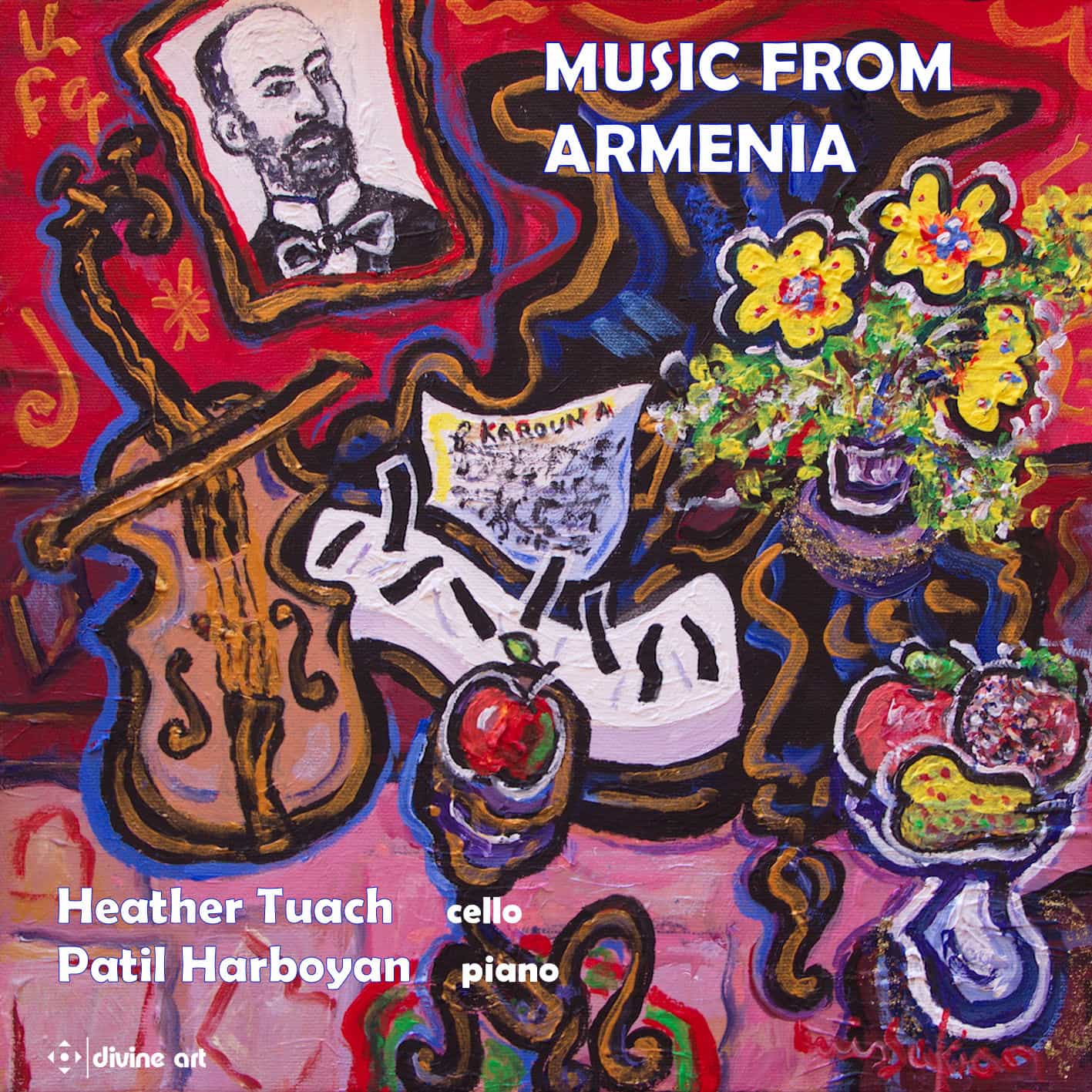
    Like I suspect many adventurous listeners, in my early years I came across the Armenian mode through certain works by Armenian-American composer Alan Hovhaness. I fell quite thoroughly under the spell of the way the music spoke to me. Time went by and an exploration of Armenian folk music followed. Since then I’ve always been interested in Armenian composers, Khachaturian being the most prominent, but others when I happen upon them. So when cellist Heather Tuach and pianist Patil Harboyan came out with the anthology Music from Armenia (Divine Art 25075), I jumped at the chance to listen to and review it. What we have are 13 works by 20th-century Armenian composers, in some cases specifically arranged for cello and piano, in other cases written for the instrumentation.

    This is often music in a neo-romantic vein, but nearly always recognizably in a minor Armenian tonality, with typically Armenian tonal phrasing. And of course that’s what makes it especially interesting. You may or may not be familiar with the composers (I wasn’t) depending on your knowledge of the era and region, but they all come through with a flourish captured well by Tuach and Harboyan.

    The most formally involved work is the “Sonata for Cello and Piano, op. 35” by Haro Stepanian (1897-1996), but the shorter, sometimes folksy works come together as well. We have ten of them by Gomidas (1869-1935), one by Alexander Arutiunian (1920-2012), and one by Arno Babajanian (1921-1983).

    All told this is a musical program to delight those who respond to the magic of Armenian eastern lyricism. A modernist might find more immediacy in some of the Hovhaness works, but this album is a most pleasing refuge of its own. And the playing is very idiomatic and appropriate.

  • Gramophone – Jeremy Nicholas – 25075

    You can hear [four Armenian composers] on Music from Armenia for Cello and Piano , a delightful disc of discoveries played by two Canadians, Heather Tuach and Patil Harboyan. The idea for the recording came after the pair had a huge success with Impromptu by Alexander Arutiunian, surely destined to become a favourite encore. They started investigating other Armenian works for the two instruments: Vocalise by Arno Babajanian which, despite its obvious indebtedness to Rachmaninov, is a real charmer, and Haro Stepanian’s Cello Sonata (1943), another rewarding find which reminds us what an important part folk music plays in Armenian classical works. This is most directly illustrated by the arrangements of nine short folk songs collected by Komitas, the godfather of Armenian music and ethnomusicology. They are played with an unaffected simplicity, Dzirani Dzar (‘Apricot Tree’) and Akh Maral Jan (‘Ah, dear Maral’) among the best of them.

  • MusicWeb – Steve Arloff – 25075

    The concert given by Newfoundland native and cellist Heather Tuach and her Armenian-born pianist colleague Patil Harboyan was a success. The programme included Armenian composer Alexander Arutiunian’s Impromptu which was extremely well received. The duo dreamed up the idea of devoting an entire CD to Armenian music for cello and piano and set about ferreting out whatever such music existed. This CD is the result. As will be explained later not all the music here was written specifically for cello and piano.

    It is easy to see how the Arutiunian piece was such a hit with the audience at that Canadian concert. It is a very beautiful work and a far cry from the work for which he is best known, his trumpet concerto. When I say a ‘far cry’ I only mean it in terms of scale for the haunting folk-like themes and melodies are equally in evidence in both works; indeed, in all the works here.

    Gomidas, as the booklet explains is a key figure in Armenian classical music. Gomidas Vartabed as he is sometimes known is a fascinating figure. Vartabed is Armenian for priest which is what Gomidas trained to be following the death of his parents both of whom he had lost by the age of eleven. Gomidas was the name of a renowned 7 th century musician and poet and he took that as his name on completion of his priestly studies at the age of 24 in 1893. His real name was Soghomon Soghomonyan at birth in Turkey. He was part of the huge Armenian minority that had lived there in harmony for centuries until the terrible events of 1915. This was when the Ottoman Empire carried out the first ‘ethnic cleansing’ genocide of the twentieth century. It virtually totally eliminated the Armenian population and resulted in the deaths of over 1½ million. It was only following the intervention of the US Ambassador to the Ottoman Empire that Gomidas was released from an internment camp. He had been among the first arrested. Prior to his move to Constantinople he had toured the whole of Armenia collecting folk songs and dances in much the same way as did Bartók. Tragically almost all were destroyed following the events of 1915. He finally ended up in Paris where he died in 1935.

    His short piece entitled Groung was originally a song and that is how the other nine of his works on the disc also began their lives. This charming little melody is an arrangement of an arrangement for violin and piano. Although it may be hard to imagine it being played on anything other than cello and piano once you’ve heard it in this version I have no doubt that it would work with almost any combination. I can imagine it working very successfully for flute and piano, for instance.

    Another arrangement is Arno Babajanian’s Vocalise . It’s clearly heavily influenced by Rachmaninov’s Vocalise and was also written to be sung with a solitary vowel. It was transcribed by Geronty Talalyan (1926-2000) – brother to Genrikh (or Henrik) Talalyan. Geronty was a prominent cellist who was also responsible for making transcriptions of several other of Gomidas’ songs played here. There are three notes in his piece that continually remind you of Rachmaninov’s and it is just as beautiful in its own right.

    The only work on the disc, apart from Arutiunian’s, that was specifically written for cello and piano is Haro Stepanian’s Sonata for Cello and Piano composed in 1943. This is an orgy of sumptuous melodies that make it totally irresistible. Right from its opening notes there is an achingly beautiful theme that emerges on the cello that is taken up by the piano. This mirrors its sad and deeply reflective nature. Stepanian was another avid collector of folk melodies amassing over 350. His music highlights their influence as it does his musical training in Russia. His music represents an effective synthesis of the Russian school of romantic writing and folk-inspired Armenian melody – a powerful combination. The most overtly folksy movement in the sonata is the final one. It opens with an obvious Armenian folk song that is highly attractive and that is developed throughout the movement. Each instrument takes it in turns to hold the tune with the cello mimicking the strumming of a folk instrument when the piano is in command.

    Gomidas’s songs have been skilfully arranged, some of them firstly for piano or string quartet then re-arranged for the combination here. Once again they seem to be perfect vehicles for cello and piano. While several are less than joyful – even the second entitled Striding, Beaming in English – they are all so lovely that repeated hearings are the order of the day. Listening to these Armenian melodies it is all the more sad to reflect on the huge number in his collection that were destroyed during the genocide of 1915.

    There is a commonality in the music throughout the disc. One could easily believe that all of it was by the same composer but this is not meant in any way as a disparaging comment. I have thoroughly enjoyed being introduced to the music of this fascinating country and am highly impressed by the wealth of truly gorgeous tunes that have come from there. If I was asked to single one out to give a flavour of what is on the disc then it would be Akh Maral Jan (Ah, dear Maral) which is a heartfelt paean to love.

    The Tuach/Harboyan duo hoped that they could produce a disc that “would be accessible and appealing to a wide range of listeners”. This they have certainly done and their playing mirrors their commitment to the project for it shows in every note.

  • Fanfare – Martin Anderson – 25075

    The disc opens with the Arutiunian Impromptu (1948) and one sees straightaway why it is so successful with audiences: After a brief introduction, a sparkling dance leads into an expressive cen­tral section, which builds to a powerful and dignified climax from which it falls away into further retrospection before the dance swirls back in to round everything off. It’s a perfect encore piece which, placed here at the other end of a recital, also acts as an appetizer for what’s to follow.

    Tuach and Harboyan present one of the Gomidas arrangements ahead of the others (perhaps to so as to vary the textures), and the folk inflections of this first of them, Groung (the title is the only one of the 10 not translated in the track-listing), act as an effective foil for the neo-Baroque character of Arno Babjanian’s Vocalise, the cello singing a Romantic melody over Bachian piano writing.

    The meat of the recital is Haro Stepanian’s Cello Sonata, his op. 35, composed in 1943. Stepanian is an obscure enough figure to deserve some elucidation here (all of it shamelessly stolen from the booklet essay, which is unsigned, but I see phrases there which also occur in the interview above, and so I name Harboyan and Tuach as prime suspects). He was born in Elizavetpol (as it was called during the Russian Empire; previously it was Ganja, as it is again now) in western Azerbaijan (where there was a large Armenian community) in 1897 and studied music first at the Gnessin Academy in Moscow and then at the Leningrad Conservatory, graduating in 1930, by which time he was already an established folksong collector. He was a professor at the Komitas State Conservatory in Yerevan from 1930 to 1934 and chairman of the Armenian Composers’ Union from 1937 to 1948. (Is that year significant? After all, it was when life went belly-up for a number of Soviet composers). His other compositions include five operas, three symphonies, four string quartets, sonatas for violin and cello, piano pieces and songs. The cello sonata is an appeal­ing amalgam of Soviet koine and Armenian folk-style. The notes point out its debt to the Shostakovich Cello Sonata, written nine years previously, although it has none of the intensity of the earlier work. The opening Allegro risoluto starts out in clear Armenian mode, with a charming tinkling figure in the piano and the cello adding offbeat accents, but the second subject unfolds as a long Russian-Romantic melody, and throughout the movement, as throughout the work as a whole, Stepanian makes little attempt to integrate the two styles; he simply juxtaposes them, but so innocently and naturally that it works. I’m not sure that the first movement justifies its 10-plus min­utes’ duration – there are passages where the knife might have been more effective than the pen – but the other movements compensate by lasting only as much again. The central Andante cantabile loses its way, but does so charmingly, and the finale, Allegretto giocoso, is a jolly folk-dance, with the cello generally singing away over an especially busy piano part.

    The remaining nine Gomidas arrangements, most around the two- to three-minute mark, tend to cover the same sort of ground, with an atmospheric, generally understated piano part supporting an equally restrained cello line, but both capable of briefly exploding with passion in their central sections – imagine Bruch’s Kol Nidrei, but with the Jewish melisma replaced by an understated Armenian one. One in particular, Akh Maral Jan (Ah, Dear Maral), is very beautiful indeed, and the last of them, Shoger Jan (Dear Shoger), the closing item on the disc, is a suitably buoyant dance – which I recognize from the music of another Armenian composer, though I haven’t yet put my finger on where yet.

    Tuach and Harboyan’s interview reveals the extent to which they had to choose between mak­ing the music their own and not overburdening the simpler pieces with “meaning” beyond that which they already carry, and to my ears they’ve got the balance just right, allowing each narrative to unfold naturally, but giving it a little lift here and there with an inflection, a change in the dynamics, a gentle touch of rubato – the kind of interpretative decisions that bring any performance alive. This is natural, unemphatic playing, trusting the music to speak for itself, and the recital as a whole is all the more effective for it; flying at the music like a dog at a postman (not you, Eddie!) would do it no service. The recorded sound is equally natural, putting the listener in a front-row-of-the-stalls position, close enough to notice detail but sufficiently far back to give the music perspective. The booklet essay tells you just what you need to know. In short, it’s a release which informs, charms, distracts, and moves you, without ever raising its voice. It should find lots of friends.
  • Fanfare – Henry Fogel – 25075

    This is an attractive and somewhat exotic disc. The music has the “eastern” sound we would expect, much of it folk inspired. The majority of the pieces here are transcriptions of vocal music based on folk songs by Komitas (1869-1935), the father of Armenian classical music. (This disc spells his name Gomidas, and I have also seen Komidas. Previous listings in the Fanfare archives, including a previous review of his music by me, are under Komitas. His original name was Soghomon Soghomonian; he was given the name Komitas upon his ordination to the priesthood of the Armenian Apostolic Church, and later received the title of “Vardapet” (or “Vartabed”), meaning “divine scholar,” upon being made an archimandrite.) His life story is a sad one, as he was utterly dispirited, even devastated, by the Ottomon Empire’s genocide of Armenians, and even though he was released from prison due to pressure from the U. S. ambassador Henry Morgenthau, he was never to recover his faculties, and in 1919 was committed to a sanatorium in Villejuif, a suburb of Paris, where he died.

    Everything on this disc except for Haro Stepanian’s Cello Sonata and Autinunian’s Impromptu is an arrangement. Stepanian lived from 1897 to 1966, studied music in Moscow and Leningrad, and although Armenian folk music is at the core of this Sonata, he manages the arc of the large form well. He seems influenced also by Shostakovich, but not in an unhealthy way.

    All of the miniatures are attractive. At first I feared that the disc was going to be too much of the same kind of sounds, but in fact there is variety here. It may not be challenging music, but it is appealing and at the same time unusual enough to hold our interest.

    The performances seem very committed and sensitive, but the recorded sound of the piano seems rather thin and even clattery. There are helpful notes in English, French, and Armenian. An interesting disc for those with a taste for the exotic.

  • Wrightmusic – David C F Wright – 25075

    Gomidas Vartabed is said to be the founder of Armenian classical music and has kept their musical culture alive and here we have simple arrangements of vocal folk music. He also made a major contribution to the Armenian church and composed a Divine Liturgy for male chorus. His dates are 1869 to 1935.

    The most important work on this CD is the Cello Sonata by Haro Stepanian, born in Elizabethpole in 1897, and died in Yerevan in 1966. He studied at the Gnessin School in Moscow and then at the Leningrad university graduating in 1930. He collected folk songs of Armenia and was taken with the beauty of his country, for which he had a great love which is shown in much of his music. He was professor at the Yerevan Komitas State Conservatory from 1930 to 1934 and chairman of the Armenian Composers Union from 1937 to 1941. He composed opera, three symphonies, four string quartets, cello and violin sonatas and piano music and vocal works based on texts from Armenian poets.

    The Cello Sonata shows some Russian influence but it also reveals his love for his country and its beautiful landscapes.

    The short pieces by Arutiunian and Babajanian are attractive and not slight.

    Both the performers are first class. Heather Tuach is Canadian and a member of the Fitzwilliam String Quartet which has toured throughout the UK, the USA, Canada, Italy, France, Germany Slovenia, Denmark and South Africa. Among the repertoire are the quartets of John Ramsay and a jazz infusion album of works by Uwe Steinmetz. If I may be allowed a personal comment, I think it is a pity when great and ‘serious’ musicians resort to lesser music as some may call it.

    She has a glorious and beautiful tone and, although I have not seen the music, her performances are attractive and appealing. I would love to hear her performance of Shostakovich’s Cello Concerto no 2.

    Patil Harboyan is an accomplished pianist, chamber music player and teacher and has worked with many fine musicians and had the advantage of having Gilbert Kalisch as her teacher on a full scholarship at Stoney Brook University in New York. She is a founder member of the Ararat Trio. She has received awards and, included in her repertoire, is the Second Concerto of Liszt. That she is a fine pianist is clearly evidenced in this recording.

    The sound is exemplary and the booklet notes are excellent.

    This CD is important and will give deep satisfying pleasure to all who hear it. A real breath of fresh air and let us have some of the major works of Stepanian.

    A CD of real joy!

  • Music from Armenia for Cello and Piano

    Music from Armenia for Cello and Piano

    In Europe and the US, familiarity with Armenian music has been largely limited to Khachaturian but there is a surge of interest in the unique distinctive melodic traditions of the country. This collection contains formal works and arrangements of folk tunes from the Talalyan archives which derive from the collecting of Gomidas (Komitas) and is superbly presented by Canadian celist Heather Tuach (also previously cellist with the Fitzwilliam Quartet) and Armenian-Canadian pianist Patil Harboyan. The music in Western terms is very much in the Romantic tradition, the folk arrangements quite sophisticated and worthy of as much attention as well-established collections.

    A highly entertaining and revelatory program – almost all of the works receiving their first recording. Booklet notes in English, Armenian and French.