Just like you never heard of Salieri until Mozart [went] mainstream, again, there are a raft of Russian composers that probably never scored a blip on your radar. Musical archeologists like Goldstone don’t let that stand in their way as he raises another worthy composer from the dust bin of time and gives him his due. You can play a lot of musical chicken/egg games here as some of his works predated masters you know yet seem eerily similar. A great bit of hide and seek for classical enthusiasts that want to dig deeper without hav[ing] to go on a scavenger hunt to do so.
Catalogue Connection: 25081
-
Classical Pointers – Peter Grahame Woolf – 25081
Apart from the horrid overprintng on the covers, this Russian Piano Music Series has much to commend it for musical explorers.
Innovative in his time and an early proponent of the whole-tone scale, the all but forgotten music of Vladimir Rebikov (1866-1920) foreshadowed composers like Debussy, Scriabin, Stravinsky, Copland and Villa-Lobos. His tiny experimental pieces tackle a variety of problems; the Chansons blanches, on white keys only, anticipate Constant Lambert’s 30 years on.
This survey has 42 little pieces in 50 minutes, outdoing in their brevity Webern’s to come, plus one of Rebikov’s few extended Lisztian Tableaux musical-psychologiques, a continuous stream-of-consciousness 20 minutes single movement.
Anthony Goldstone’s comprehensive notes draw you into this unique composer’s world, and he plays all the music with a winning flair, recorded close by his home in the village church at Alkborough, Lincolnshire.
Warmly recommended, and lots of worthwhile pieces to consider for piano teachers (who just might know The Christmas Tree ) [Scores available free on line]
-
New Classics – John Pitt – 25081
Described by The New York Times as ‘a man whose nature was designed with pianos in mind’, Liverpool-born Anthony Goldstone is one of Britain’s most respected pianists. A sixth-generation pupil of Beethoven through his great teacher Maria Curcio, Goldstone was born in Liverpool and studied with Derrick Wyndham at the Royal Manchester College of Music and with Curcio in London. His career has taken him to six continents and the Last Night of the Proms (where he was much praised by Benjamin Britten) as well as many broadcasts and nearly seventy CDs. He is also one half of the brilliant piano duo Goldstone and Clemmow with his wife Caroline.
The second volume of his Russian Piano Music Series features works by Vladimir Rebikov, who was born in Siberia in 1866 and died in 1920. In addition to many piano works Rebikov wrote numerous orchestral, vocal and stage pieces, including ‘musico-psycholographic dramas’ in some of which he experimented by combining spoken and sung text to a musical accompaniment. He wrote in a bewildering array of styles and was admired by other composers, including Janácek, Debussy and Grieg, but despite his considerable achievements – he has been called ‘the father of Russian modernism’ – Rebikov has been driven to the margins of musical history. This is borne out by the fact that, as far as can be determined, out of this recital programme only a piece of two minutes’ duration has previously been recorded. Anthony Goldstone’s formidable playing is technically superb and articulate, revealing all the passion and colour in this little heard music.
-
OzArts Review – Neville Cohn – 25081
This is a most welcome addition to the discography of Russian music for the piano.
Most of the pieces here are short, ranging from durations as brief as 23 seconds to two or three minutes. There’s one larger scale offering: Esclavage et liberte which runs for just under twenty minutes. As a schoolboy growing up many years ago in Cape Town and an enthusiastic competitor in local eisteddfodau, I often played set pieces by Ladoukhin, Maykapar, Karganov, Goedicke, Rebikov – and numbers of so-called Fairy Tales by Medtner. Nearly all of these, as I recall, were published by Chester . Their level of difficulty approximated some of the trickier pieces in Schumann’s Album for the Young. They were handy to play at piano teachers’ end-of-term concerts and at school prize giving ceremonies.
Very few of these miniatures are available on CD which is a shame as these morceaux deserve an occasional airing – and this recording of music of Rebikov is a welcome addition to the recorded repertoire, not least because, according to the liner notes, of the 43 tracks, one – and one only – has previously been recorded. The soloist in this miniature was Shura Cherkassky who would offer it as an encore from time to time: the charming, lilting little Valse from The Christmas Tree suite.
Rebikov, born in Siberia in 1866, died in warmer climes (Yalta in the Crimea) in 1920, leaving a great deal of music, much of it now being recorded by enterprising and adventurous pianists such as Anthony Goldstone.Rebikov wrote in a bewildering variety of styles; many are on offer here. Listen to The Devils Amuse Themselves and The Giant Dance. Both call for emphatic, foot-stamping heaviness. Goldstone presents these noisy little pieces with gusto. Bittersweet melancholy informs almost every moment of the six brief utterances that are collectively called Autumn Leaves. This is hardly great music but certainly worth an occasional airing.
A liner note suggests that the very short items that together make up A Festival anticipate the ultra-brief pieces of Webern. As well, the opening Vivo eerily calls Stravinsky’s Petrouchka to mind in its rhythmic treatment – and there’s a gritty gaiety to the following miniature which Goldstone despatches with nimble, accurate fingers. Of the suite – Pictures for Children – it is The Music Lesson, in particular, that delights with its deliberate pedal blurring depicting a piano pupil very much under par And The Promenade of the Gnomes makes a graceful obeisance to Mussorgsky’s Pictures at an Exhibition.
-
Amazon – David Hollingsworth – 25081
In Anthony Goldstone’s authoritative, scholastic, yet revealing essay, Robert Craft, perhaps the leading current Stravinsky conductor and scholar, asked the great, ingenious Russian “Were you aware in your St. Petersburg years of the work of such Russian experimental composers as Rebikov, with his whole-tone structures, unresolved dissonances, fourths à la Schoenberg’s Kammersymphonie?” Stravinsky replied, “I did not know Rebikov personally, but his innovations were familiar to me in my Rimsky-Korsakov years and I much admired at least one of his works, the ballet ‘Yelka’” (p. 4). And although Rebikov’s works especially for piano have been known by some quarters (the composer himself a phenomenally energetic pedagogue and performer), it is indeed amazing that the Russian school of orchestral pianism (in particular) had essentially steered clear of them. It was only by 2009 when we began to get a generous taste of Rebikov’s musical art thanks to pianist Anatoly Sheludyakov’s comprehensive survey of his piano works in a 3-disc Art Classics album (ART-189, though not available in Amazon as of this date). Goldstone, the other pianist with the excellent essay mentioned above, admirably complements that album with this one reviewed here (incidentally released in 2009 also).
The neglect is not only unfathomable, but also sinful, given that Vladimir Ivanovich Rebikov (1866-1920) is not only dubbed at times the Father of Russian Modernism, but he was also, along with Glazunov and Felix Blumenfeld, a rather salient representative of the link that lied between the generation of Tchaikovsky, Rubinstein, Mussorgsky, et al. and that of the more progressive-minded composers such as, say, Scriabin, Roslavets, Stanchinsky, Stravinsky, and Feinberg to name a few. And although he studied at the St. Petersburg Conservatory of Music with Nikolai Klenovsky, himself a pupil of Tchaikovsky, his styles are arrestingly far-ranging yet far-seeing. Deep down, Rebikov was profoundly a Russian a la Tchaikovsky, Rakhmaninov, and Medtner: the man of floridity, nostalgia in its deep reflectiveness, and worldliness (pinpointing him is a chore in and of itself). And yet unlike in the case of Medtner, the Teutonic love for traditional structuralism, form, and discipline did not fit Rebikov all that much. He was closer to the French (Satie, Faure, Chabrier, Debussy, later Poulenc & Milhaud) in the characteristique aspect in the writing. And my goodness do these temperaments of the works vary widely: they could be as introspected yet worldly and urbane as in Tchaikovsky, Rubinstein, and Arensky, eccentric as in Satie and Poulenc, utterly picturesque and exquisite with some striking subtlety, sense of longing, and profound nostalgia as in Chopin, Bortkiewicz, Faure, Catoire, again Satie and Tchaikovsky, William Baines, and later John Ireland, lucid, poetic, glittery, and heavy-hearted like in Glazunov and Lyapunov, disquietly mystical as in Scriabin’s music (and the music of the progressives by the early 20th Century), stately as in Glazunov and Poulenc (try the hymne au soleil of Trois Idylls-1913). And yet he could be as playful as, for example, Lyadov (as the first piece of this disc “The Devils Amuse Themselves” attest). Remarkably, though, Rebikov’s music is quite unlike anything I have heard before: imaginatively designed yet conspicuously original and searching.
For instances, listen to how urbane and chic Rebikov could be in, say, Feuilles d’ Automne (Autumn Leaves-1902) that evokes Faure, Catoire, and Bortkiewicz (his Lamentations & Consolations). And yet his Esclavage et Liberte (1901) is a ‘darkness to light’ bewilderment, restless of a piece that Scriabin, Rachmaninoff, Feinberg may have known well (Feinberg’s Ninth Sonata – 1939 comes to mind here). Going even further than that, could it be that Myaskovsky, Bax, and even Ireland knew at least some of Rebikov’s music as well? His Chansons Blanches (White Songs) have some wonderful autumnal, otherworldly, yet melancholic writings (like in the mesmerizing lento) that bring to mind the searching qualities of some of Myaskovsky’s earlier music for pianoforte (and of Ireland’s). Stravinsky knew Rebikov’s music pretty well. But is the profound detachment (or primitiveness) in his “Rite of Spring” (1913) possibly a reflection of Stravinsky’s familiarity with, for instance, Rebikov’s 1906 Parmi Eux (berceuse movement)? How about Scenes Bucoliques (tracks 26-30)? Do any Poulenc fans sense something in its flamboyancy and deviance, its beurre sur la sauce fashion that was to become the Frenchman’s hallmark?
I could go on, but I think we got the idea. The diversity of styles in Rebikov’s music is abundantly apparent and forward-looking, yet the core personality and technique remain firmly his own. As with Balakirev, another shockingly neglected as a serious composer for the instrument, Rebikov is a force who must be reckoned with, for what I can tell, his music is consistently of a high, imaginative, unpretentious order: teasing and playful in some instances, but hardly ever facile or shallow. The genuinity and revelatory aspects of his works should not at all be overlooked, and Anthony Goldstone brings out those aforementioned qualities cogently yet with the hypnotizing sensibilities I found in his surveys of the piano works of Lyapunov and Arensky. As scintillating and imaginative Goldstone is though, never do I sense the over-selling or over-indulgence of any kind: the music is given its ample space to speak for itself, and tellingly so. The recording is aptly spacious and the overall presentation (essay included) is splendid.
Enthusiastically recommended, although Anatoly Sheludyakov, whose approach is more subtle than Goldstone though with equal validity, should be in everyone’s consideration. I have a feeling that these recordings will raise Rebikov’s music and reputation from the depths of neglect and ignorance quite immeasurably (providing of course, the amount of notices these albums will be getting).
-
International Piano – Jouni Somero – 25081
“I have to say that in every case [Goldstone’s] performances are more convincing than Somero’s. Goldstone manages to inject rhythmic variety and élan where Somero is turgid and stubbornly earthbound.”
-
Glasgow Herald – Michael Tumelty – 25081
Music by Vladimir Rebikov is really worth listening to.
Here is a revelation. Some insiders have been dubbing Vladimir Rebikov “the Father of Russian Music”. To the world at large, however, he is an unknown. Not even his name, far less any of his music, is going to be familiar. Born in Siberia in 1866, Rebikov died in 1920. He has been said to pre-date in his experimentalism absolutely everything from Stravinsky’s Rite of Spring to Messiaen’s Quartet for the End of Time. That’s extravagant but the music which is on this CD, almost all of it recorded for the first time, should really have music lovers sitting up. It is abundantly original, not least in its tendency to be spiky, angular and aphoristic: it says what it has to say then stops. It will remind you of Prokofiev or Bartok; then you will hear something like Ravel or Satie or Chopin without the perfume. You will hear music which is written with whole-tone scales, orientalisms and pounding dissonances. Pianist Anthony Goldstone’s championship is authoritative and gripping. -
Fanfare – Lynn René Bayley – 25081
Divine Art has truly struck gold with this release of piano music by the little-known Vladimir Rebikov (1866–1920). A pupil of Nikolai Klenovsky, himself one of Tchaikovsky’s pupils, Rebikov wrote music that is seldom if ever Tchaikovskian. As pianist Anthony Goldstone put it in his liner notes, “He wrote in a bewildering array of styles. Some of the composers, most of whom flowered later, whose music is brought to mind by that of Rebikov are: Satie, Poulenc, Milhaud, Bartók, Stravinsky, Copland, Chávez, Ives, Cowell, Debussy, Scriabin, Prokofiev, Messiaen, Mompou, Villa-Lobos, and Vaughan Williams. Lack of key signatures, time signatures, bar lines, ‘hanging,’ unresolved endings and fades, harmonies based on fourths, sevenths and ninths—these were some of his trademarks.”
If the above quote doesn’t intrigue you, your musical curiosity is dead and should be buried in the back yard next to your late, lamented pet dog or cat. If you don’t believe it, then simply buy this disc and hear for yourself. Rebikov was a genius of monumental proportions—one might say the Russian Alkan—who wrote in exactly the opposite dimensions. Whereas Alkan’s music is extremely long (he is sometimes described as the Mahler of the piano), Rebikov wrote in short, terse statements. Of the 42(!) pieces on this CD, none run longer than two and a half minutes with the lone exception of his “musical-psychological tableau,” Esclavage et liberté. Most of them—I kid you not—run a minute and 40 seconds or less (34 of them, to be exact). Rebikov was not a composer who wasted your time, but ironically I think it is because his musical statements are so terse that he was rarely if ever programmed in recitals. Indeed, I’d say there is another connection to Alkan, that this disc by Goldstone is as much a revelation of Rebikov’s genius—and as spectacularly played—as the late Raymond Lewenthal’s 1963 RCA Victor LP was revelatory of Alkan.
The proof is all there in the listening. Rebikov’s strange alchemy of Alkan, Debussy, Scriabin, Satie, Stravinsky, Prokofiev, et al., leaps out at the listener with stunning audacity. Describing these short, compact, almost enigmatic works is virtually impossible. Even Goldstone has trouble doing so in his liner notes, and he’s the performer! And since he appears to be an excellent note writer as well, I shall let he who has actually seen these scores, and doesn’t just analyze by ear, make a few comments:
Les Démons s’amusent: “At 19 seconds into The Devils Amuse Themselves … the central melody strikingly anticipates the sinister ostinato that begins at figure 65 of Stravinsky’s The Rite of Spring.”
Esclavage et liberté: “The opening section, with its idée fixe of a descending chromatic scale—a moan or cry of anguish (later becoming a scream)—ideally requires three hands. Passages of plaintive recitative express self-doubt or inner turmoil, and sudden impulses take the music off in new directions. … There are interesting similarities with Schoenberg’s Verklärte Nacht … which Rebikov could not have known, as, although it had been composed in 1899, it was premiered in 1902 and published only in 1905.”
Trois Idylles: “For the cover [to the sheet music] Jurgenson commissioned an illustration of fantastical creatures: a mermaid, a frog prince, Pan, a witch, and others. The contents are hardly less odd. Bar lines and time signatures are absent from all three pieces. The solemn Hymn to the Sun … features parallel motion and intervals of a fourth and makes extensive use of note clusters, the majority of which include every white note in the span of an octave, to be played ‘with the edge of the palm.’ The American Henry Cowell and the Russian-American Leo Ornstein, later credited as pioneers in this field, had yet to begin their work.”
Scènes bucoliques: “Here there is an attempt to evoke the spirit … of ancient Greece: old modes are used in the first four [pieces]; … the mercurial fifth, Round of the Elves, is built largely by stacking up minor thirds and eventually evaporates into thin air.”
Parmi eux [“Among Them”]: “portrays giant alien creatures that live in a parallel, whole-tone, world. … The first [piece], entitled The Males Dance, is heavy-footed and clumsy. Dance with a Bell features syncopated gong-like bass notes, after which a hypnotic Berceuse sends the baby off to sleep. Dance of the Quadrupeds, perhaps the aliens’ proportionately huge, lumbering equivalent to our pet dog, brings to mind the more sluggish bear in Pétrouchka.”
There’s a lot more in the notes (and music) than this, of course, but I hope this gives you a taste of what you’ll experience in listening. As for the performances, Goldstone is a pianist of formidable technique and astonishing coordination. Not only are both hands always in perfect synch, but (again) like Lewenthal, he makes the difficult sound easy without underplaying the drama in so many of these short works.
Discovering missing links in classical music is always fun as well as instructive. Rebikov is one more missing link, as once were Gossec, Spontini, and Alkan. I cannot recommend this disc highly enough. It should be in the library of any serious student of modern music, and the best part is that these pieces are as enjoyable as they are visionary.
-
Audiophile Audition – Robert Moon – 25081
Amazingly, most of the music on this CD of delightful and stylistically varied piano miniatures has never been recorded before. Vladimir Rebikov (1866-1920), is a Russian composer who was one of the first to use the whole tone scale, as well as an innovator in using advanced harmony (seventh and ninth chords and open fourths and fifths), polytonality, and unresolved cadences. Stravinsky was aware of some of these innovations and used them in many of his works. But despite his experimentations, Rebikov never strayed from tonality.
The selections here vary from twenty-five seconds to nineteen minutes. The first two, The Devils Amuse Themselves and The Giants Dance “bear intriguing similarities to later iconic works by acknowledged composers,” notes pianist Anthony Goldstone. He’s referring to Stravinsky’s Rite of Spring in the first instance and Messiaen’s Quartet for the End of Time in the latter. Autumn Leaves is pregnant with Russian melancholy, probably influenced by Tchaikovsky. A Festival is animated and energetic, filled with ostinato figures. The longest work on this disc, Slavery and Liberty (1901) is one of three ‘tone poems’ that explored the meaning of art in an unstructured, stream of consciousness style. It’s passionate, filled with emotional extremes, and uses repetition creatively. Rebikov’s popular waltz from his music-psychological drama The Christmas Tree was played as an encore by many pianists. In Three Idylls , the composer uses white notes and note clusters long before Henry Cowell and Leo Ornstein. Pictures for Children was composed for his students to use for practice, mirroring Schumann’s Kindersczenen.
Adventurous British pianist Anthony Goldstone has done us a favor by discovering these engrossing miniatures and performing them with verve and understanding.
-
Classics Online – JY89484 – 25081
Vladimir Rebikov, often called ‘the inventor of the whole-tone scale’, is now almost completely forgotten, save his Silhouettes (a set of interesting children’s pieces), and his Valse op.21, a popular encore piece. Due to most of his pieces being miniatures, with definite musical phrases and simple forms (far from Satie), not many people paid attention to him. To the disengaged, Rebikov seems like one of the many salon composers, with nothing of note.
This album does very well to dispel this notion. Rebikov was an innovator with modest ability; he was the one who invented palm clusters (before Cowell), and wrote a piece completely in whole-tone scale (way before Debussy). All of these landmark pieces, including a suite completely in white keys (Chansons Blanches), are included in this album, played with musicality by Goldstone.
Other than being an innovator, he was a master of the simple forms he wielded with ease. Consider the interesting ideas and endings of Promenade of the Gnomes, The Music Lesson, and Rondes des Elfes and you might see why. While they may not have the substance of great masterworks, they are enjoyable to listen to and are very accessible, as they have very clear melodic lines and 2-2-4 music phrases.
Even in his Tchaikovsky-like pieces in the suite Feuilles d’Automne, Rebikov used a few musical devices (such as obsessive repetition) that made them his own, rivaling even some of The Seasons in terms of melody and form. For example, the comforting ending of the fourth movement, Con dolore, in contrast with its sad beginnings, exhibits a very rare poignancy that only Rebikov can provide.
In short, this is a rather valuable premiere of Rebikov’s music. The other one which I have heard, a little known album by Sheludyakov, is too ponderous and vastly inferior to this album, where the tempos are suitable. If you want to explore more unknown composers who are simple yet enjoyable to listen to, this is highly recommended.
-
MusicWeb International – Jonathan Woolf – 25081
Vladimir Rebikov, the self-styled inventor of whole-tone music, was born in Siberia in 1866 and studied composition with Nikolai Klenovsky, a Tchaikovsky pupil. He was an experimenter and wrote ‘musico-psycholographic dramas’ having increasingly turned to novel forms and moved in harmonically advanced directions. His ideas were not always well received and he, apparently, became embittered at the success of Scriabin – a name that springs to mind when listening to Rebikov’s music – and even Debussy, both of whom, he believed, had stolen his ideas. Some contemporary writers did, to some degree, agree that he had anticipated their seismic shifts in harmonic thinking, though it remains moot whether they did. He certainly met Debussy as well as Grieg and Janácek. And Stravinsky certainly did know about Rebikov and admitted as much, and his early influence.
Given his still-ambiguous place in the history of whole-tone adventurism it’s interesting to note that, as far as I’m aware, the first pieces of his to be recorded were songs. Not that he lacked for modernist experimentation in vocal music, either, but the songs sung by Zoia Rosovsky for Vocalion were not especially alarming for contemporary taste in the early 1920s. They can be found in a box set of discs devoted to the obbligato player, the great violist Lionel Tertis.
The piano music recorded in this Divine Art disc is part of the company’s ‘Russian Piano Music’ marque, itself an adventuresome jaunt amongst the highways and byways of the muse. It’s clear that Rebikov managed often to fuse traditional and experimental harmonies convincingly, as he does in Feuilles d’automne where Tchaikovsky-like moments – in the Pregando – vie with the far more advanced Scriabin-evoking Con tristezza movement. The ethos manages also to marry, seemingly paradoxically, remoteness and warmth.
He was also an adherent of selective precision. Une fête for instance has seven movements and lasts in total three and a half minutes. Nothing is wasted. There are Stravinskian anticipations in the rhythmic charge of the music, and this little cycle shows his vitality and striking sense of rhythm. Chansons blanche uses the white keys only and aspires to a reserved plangency – which is achieved with some success. The longest piece is the grandly named Esclavage et liberté of 1901, subtitled Tableau musical-psychologique in accepted French terminology. This is a striking piece, but mainly for its Lisztian melos, a psycho-drama of pregnant anticipation that shares a similar sense of drama and contrast as Liszt’s B minor Sonata. It gradually lightens and brightens its tone into extravagant chordal dynamism. It’s apparent by now that Rebikov looked back as well as forward. As well as anticipating the rhythmic advances of Stravinsky and the glowering expressionism of Scriabin he also stands revealed as an inheritor of mid-nineteenth century tone poetry as well, a synthesiser of ambition unvexed by the problems he thus faced.
These also included the use of clusters, where he certainly was in the vanguard, and which he employs in the 1913 Trois idylls, as well as the lightly burnished orientalism of the second of the two Episodes from Yolka . He sought Arcadian-Greek inspiration in the brief Scènes bucoliques and looked back to Schumann’s inspiration for the charmingly droll Tableaux pour enfants. His putative influence on French impressionism can perhaps best be gauged by the c.1906 settings in Parmi eux – note Elles dansent in particular. And it’s fascinating to consider his influence on the Czech composer Novák, whom Rebikov knew and to whom the third of these pieces is dedicated, and on Novák’s subsequent compositional direction, not least as a composer for the keyboard.
Anthony Goldstone is wholeheartedly to be commended on his playing. He reaches into the heart of the Rebikovian dilemma and produces performances of intensity and suggestive tonality. Maybe the Valse from Yolka could be more capricious – Shura Cherkassky once recorded this and his playing was lither and more treble glinting [Ivory Classics 72003] – but elsewhere he produces performances both sensitive and, in the opening track , Les démons s’amusant, puckish.
And with detailed notes and excellent recorded sound, this stakes a permanent claim on the listener.
-
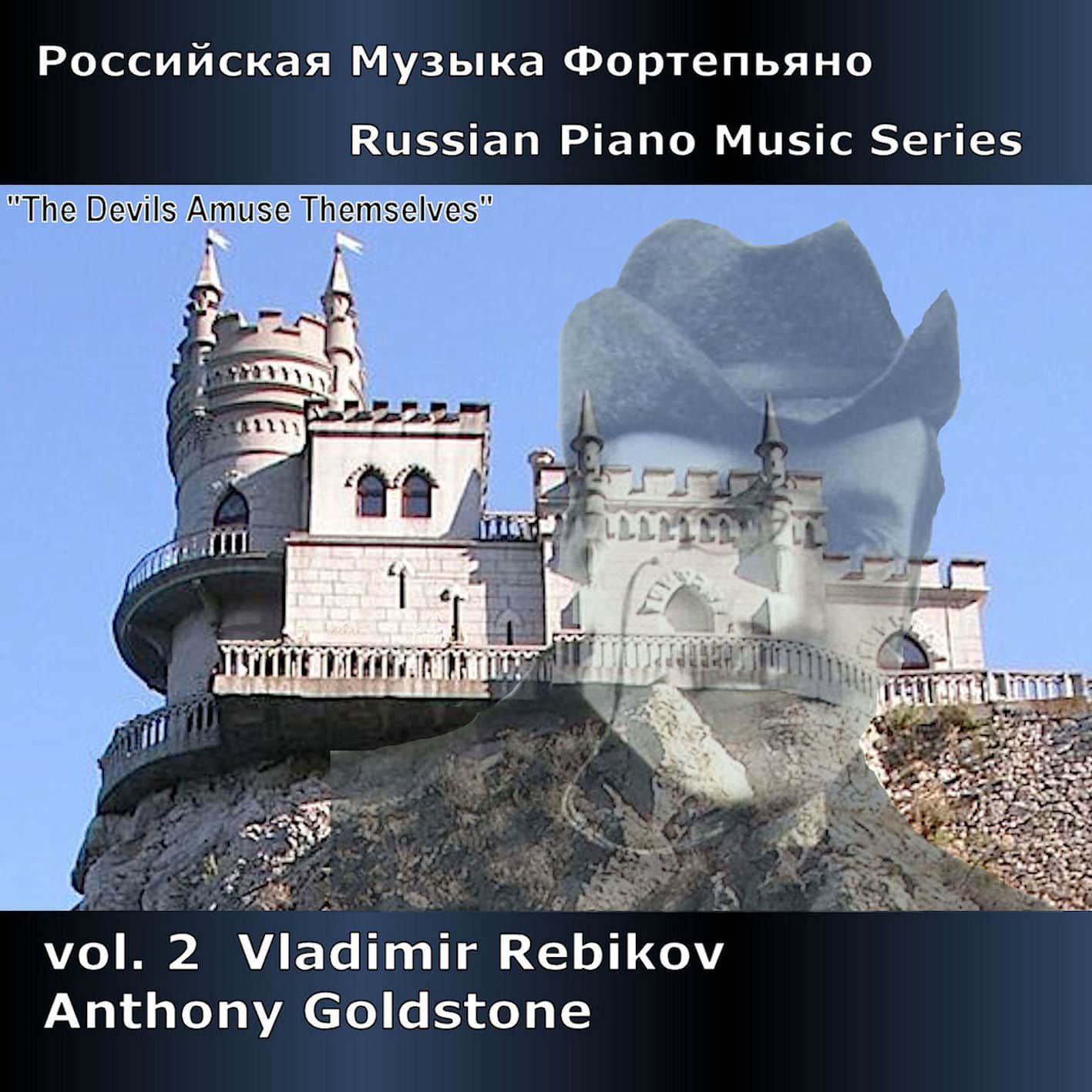
Russian Piano Music Vol. 2 – Rebikov
Apart from the regular use of some his works in examination syllabuses, the music of Rebikov (1866-1920) is shockingly neglected – most items on this CD are receiving their first recording – and this is the composer who was once called ‘the father of Russian modernism’. One of the first proponents of the whole-tone scale, his music is in a bewildering array of styles, foreshadowing composers as diverse as Debussy, Stravinsky, Copland and Villa-Lobos.
The music here, apart from the 20-minute Esclavage et liberté, consists of a number of suites of impressionist music. Modern, but bright, direct and often humorous music makes Rebikov the perfect composer for pianists and piano enthusiasts whatever their preferences in genre.