Catalogue Connection: 25084

  • American Record Guide – Becker – 25084

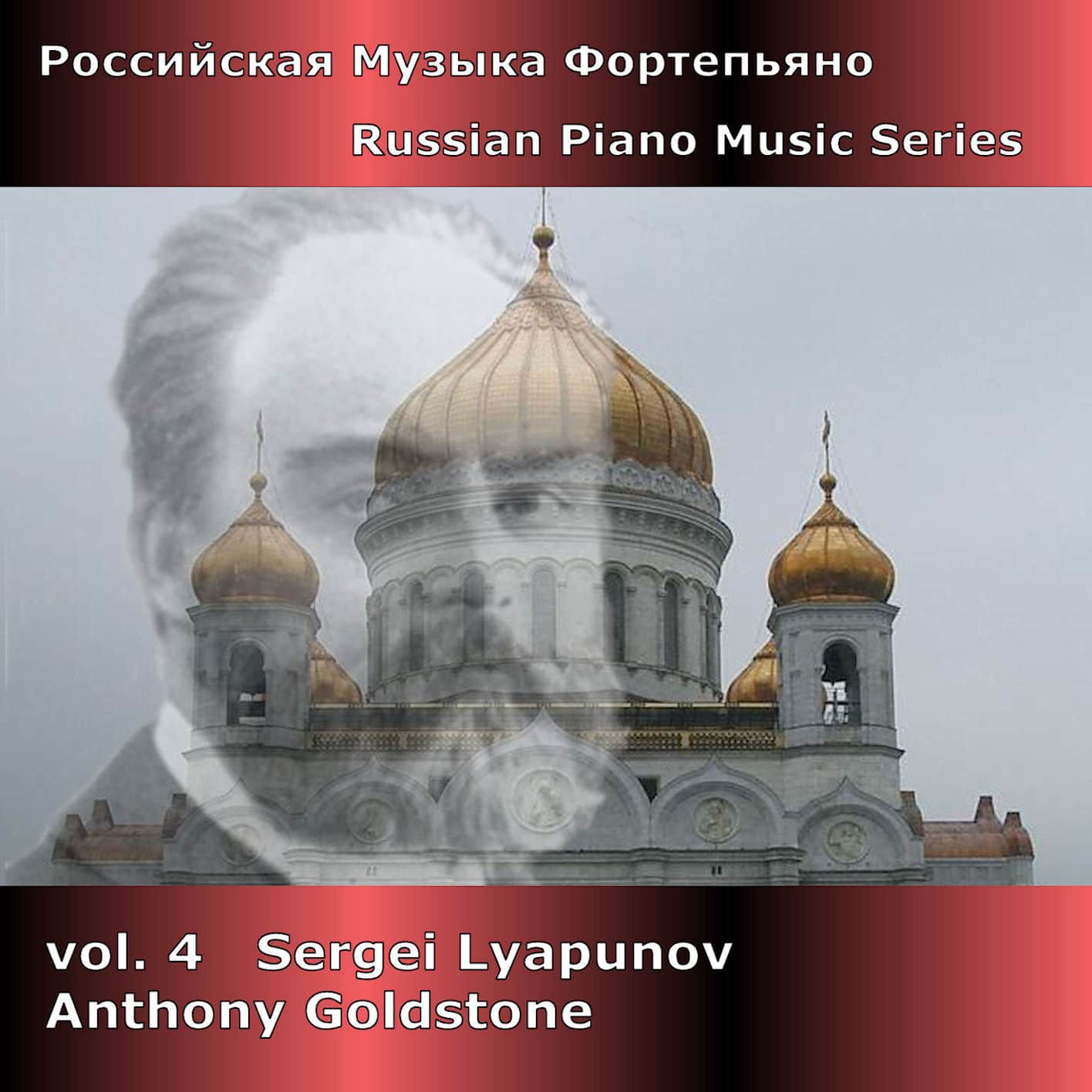
    Volume 4 of the Russian Piano Music Series brings us works of Sergei Liapounov (1859-1924), who is all but forgotten today. Still, in the annals of recorded music his piano works have had a few outings before, and collectors are faced with a conundrum with respect to acquiring this part of his output.

    Anthony Goldstone is no slouch when it comes to performing rare and difficult music. The Lisztian Piano Sonata, with its echoes of Balakirev and Rimsky-Korsakoff, has been recorded a few times before, most notably by Karl-Andreas Kolly on Novalis (July/Aug 2005) and Dorothy Elliot Schechter on Marco Polo (Nov/Dec 1993). Neither is currently available. We can dispense with Schechter, since she makes heavy weight of the piece and manages to stretch it out to a remarkable 32 minutes (others knock at least five minutes off this time), and sounds boxy. She does include several pieces not found on the other recordings. I would be hard pressed to decide between Goldstone and Kolly, the latter including the attractive Six Easy Pieces not found elsewhere. Further complicating matters, Goldstone includes a Barcarolle, Nocturne, and Mazurka that you will have to give up if you do not purchase his recording. Each of these breathes the Russian lyrical soul, and would be a loss for the serious piano collector. The Variations on a Georgian Theme and Fetes de Noel are included on both the Goldstone and Kolly discs and are well worth having.

    If you already have Kolly, be reasonably content. If you have neither, get Goldstone and lament the loss of the all too brief but endear ing Six Easy Pieces. To get all of the pieces you will have to get all three recordings. If you have all three and want to create additional shelf space, you might dispense with the Schechter. Her additional pieces are also less interesting than the others. Excellent notes by Goldstone and sonorous recorded sound.
  • Midwest Record – Chris Spector – 25084

    Goldstone has simply proven himself to be one cool cat. Diving into the well of unsung Russian classical composers yet again, he’s produced another winner as he digs into the ornate works of Lyapunov, a composer who you’ve probably never heard of if you are reading this on this side of Vladivostok. The composer must have pissed off someone in the Kremlin to have his works so criminally ignored unless Goldstone adds so much to the interpretation that he’s playing things that were never heard. If you love classical piano with a flourish, this is right up your alley. With never a dull moment, you’ll fall in love with something you should have heard a long time ago. Well done.

  • Liverpool Daily Post – Peter Spaull – 25084

    Liverpool born Anthony Goldstone plays piano music by the Russian Sergei Lyapunov, who died in 1924 aged 65. This CD from Divine Art has a sonata, a Christmas suite, variations on a Georgian theme and three shorter pieces making an attractive programme. One wonders why we don’t hear more of this romantic composer? It’s a feast for piano buffs.

  • MusicWeb – Nick Barnard – 25084

    Another disc to force a reassessment of a ‘known’ composer. This is one of a superb series titled Russian Piano Music Series from pianist Anthony Goldstone. In fact I would have been happy to include any of the volumes here because they all display the same virtues of massive technique, musicality allied to aptness, excellent engineering and production and insightful and entertaining liner notes from the pianist. Choosing the Lyapunov is based on the quality of the music – a stunningly exciting big Sonata amongst others – which forced me to think again about a composer I had previously thought of as a Russian also-ran.

    Recording of the Year 2010

    Having recently enjoyed one of the other releases in this series performed by Anthony Goldstone I was particularly pleased to receive this disc to review. All of the good opinions of the other CD – Glière’s piano music – are repeated if not reinforced here; this is an excellent disc and one that should not be missed by lovers of Russian romantic solo piano repertoire. This is not its first incarnation – the playright is from 2000 and this exact programme was released on now-defunct Olympia . Much as I enjoy Glière I would have to say that I think the music here by Lyapunov is superior. As a symphonic composer he is one of the late Russian romantics whose music has not inspired me as much as others. On the strength of the current CD I am going to revisit my old Svetlanov/Melodiya recordings and see how they sound now.

    As before Anthony Goldstone proves to be a superb guide to this unfamiliar repertoire. He has the full measure of it musically as well as technically. What I particularly admire is the way he gauges his performance to fit the implicit scale of the work under his fingers. So the heroic romantic Sonata in F minor Op.27 that opens the programme is played with virtuosic grandeur and a rich resonant tone but the delightful Fêtes de Noël are given the light and affectionate touch they deserve. Goldstone provides also an illuminating and enthusiastic liner note – a model of its kind, add an excellent recording and you will understand my enthusiasm.

    Lyapunov is another of those composers whose life straddled the extraordinary events of the Russian Revolution. Musically though his work belongs to the end of the 19 th Century and for all the important teaching posts he held in St. Petersburg he was naturally conservative. What is clear though from this programme is that he forged for himself a distinct personal style which is a subtle amalgam of influences ranging from Chopin to Liszt but also absorbing Russian Orthodox chant and folk music. All of these can be heard in the aforementioned sonata written between 1906-8. Interestingly the dedication is to Karl Klindworth whose extraordinary transcription of Tchaikovsky’s Francesca da Rimini I reviewed on this site last year. Klindworth was one of Lyapunov’s teachers and in turn a pupil of Liszt. So it should not be wholly surprising that the model is the Liszt Sonata in B minor and its revolutionary four-movements-in-one form. But this is no slavish imitation – in some ways Lyapunov is more subtle than Liszt in his melodic transformations that gives the work its structural unity. Goldstone’s analysis of the work in the liner is as lucid and intelligent as his performance of the notes. I’m not sure if it because of the more muscular style of the actual music but the recording here sounds a little richer and fuller than that which was achieved in the same venue two years later for the Glière recital. The sonata opens in stormy and dramatic mood which is balanced by a beautiful long-breathed second subject. Goldstone has exactly the right feel for the natural ebb and flow this music requires. I love the impetuous virtuosic way he allows the music to push on or linger lovingly yet all without sounding arch or self-conscious. His ability to balance the inner voices is exemplary too – this is richly complex music which could descend into chaos all too easily in lesser hands. An interesting comparison can be made with Bax’s Piano Sonata No.1 which was written only some 2 years later and was influenced both by the Liszt and more significantly an extended visit to Russia . Side by side the Lyapunov does sound more reactionary than the Bax – which is not the most modern piano work circa 1910 by a long way itself! – but does that really matter more than 100 years after the event?, not a jot in my book. Try dipping into the Lyapunov sonata just as the “2 nd” movement/section starts [track 2] for a marvelous example of the composer’s gently passionate lyrical gift and how well this is molded by Goldstone. The way this theme transforms into something more liturgical is beautifully handled by both composer and pianist – it does achieve the aural sleight-of-hand equivalent of happening before you, the listener, was aware what was going on. Goldstone paces the numerous climaxes in the work superbly too. It would be all too easy to allow this style of music to ‘gush’ but again Goldstone’s balance between fluency and flamboyance is perfectly achieved. Again the dissolve into the richly figured return of earlier lyrical material is brilliantly managed by one and all. The final peroration is glorious – positively cinematic in its heroic grandeur, to be suddenly replaced by a gentler chorale-like prayer which rises up through the keyboard as it fades away with a final gruff paragraph ending the work in quiet reflection. This is an instantly appealing work which would be enjoyed by anyone with a penchant for big-boned piano repertoire. I was having a quick browse to see if there was much competition in the catalogue for the music recorded here. I see there was (is?) a Marco Polo disc which includes the Sonata and the Variations on a Georgian Theme Op.60 . Not having heard it I cannot make a comparison BUT I do see the timing of the sonata on that disc is a good 7:00 minutes longer than the version here which is a staggering difference in a 25 minute work. I can’t imagine for a second Goldstone has cut a bar and certainly does not sound at all rushed which leaves ones speculating about the other performance. The only other competition is from a disc on Dynamic which includes the Fêtes de Noël. This is performed by Marco Rapetti whose recital of Borodin’s piano music I reviewed recently which I found suffered from gross distortions to the pulse and shape of the music. Exactly the kind of disfigurement Goldstone avoids here.

    Although the sonata is the stand-out work here it represents just under 1/3 of the disc and all of the other music here is of considerable worth as well. The Barcarolle in G sharp minor Op.46 is the composer’s only attempt in this form. It is by turns languorous and sensual – Goldstone points out that Lyapunov’s use of a flattened 2 nd note in the scale adds some distinctly oriental spice to proceedings but ultimately this is elegant rather than erotic. The Variations on a Georgian Theme Op.60 date from 1914-15 and resolutely ignores the passing years and evolving musical trends let alone the political turmoil at home and abroad. Putting that to one side this is another instantly appealing work. The theme is oriental in the way that gives more than a nod to Borodin in Polovtsian mode. Again, Goldstone’s control and ability to bring together the widely divergent variations into a coherent whole is superb as is the clarity of his articulation and subtle pedaling [track 7 shows this to great effect]. These are very pictorial short variations – you can imagine them being given descriptive titles, this is hugely enjoyable vibrant unpretentious music – by the end it sounds as though the piano has just started slipping out of tune!

    Aside from the Sonata the piece I enjoyed most on the disc were the four Fêtes de Noël . Although far from simple to play I am sure they capture an innocent wonder through an amalgam of Orthodox melodies, folk melodies and an evocation of the first Christmas. So in Nuit de Noël the shepherd’s pipes call from near and far (beautifully evoked by Goldstone’s sensitive touch), a pastoral interludes leads to an Orthodox hymn announcing the Christmas message and an exultant return of the pipe melody. The Cortège des mages is a brisk no -nonsense affair, the tempo dictated by the need to allow the choral-like counter melody to speak at a reasonable speed. The Russian influence is again clear with the appearance of pealing festive bells. The final two movements were written bringing the Christmas story to the 1910 present. In Chanteurs des Noëls Lyapunov skillfully creates the effect of singers approaching from the distance building to another powerful climax. As Goldstone puts it so neatly in the liner the last movement, Chant de Noël is in “skittish holiday mood” with a neatly understated throwaway ending. I find this work utterly charming. The disc is completed with a beautifully lyrical Nocturne – Lyapunov’s only composition given that title – and his 8 th and last Mazurka . These simply underline and reiterate the quality of what has gone before and provide a very fitting close to a deeply satisfying programme.

    This is a disc in which all those involved can take great pride. Revelatory repertoire superbly performed, recorded and beautifully presented.

  • Thomas’s Record Stores – Chris Dench – 25084

    After many years of neglect, there seems to be something of a Renaissance of late-ninteenth century Russian piano music under way. After admirable CDs of Shostakovich (DDA25080), Rebikov (DDA25081), Gliere (DDA25083), and Arensky (DDA25085), Anthony Goldstone has turned his attention to the large-scale romantic solo piano works of Lyapunov. It is certainly unarguable that these works borrow their soundworld largely from of the music of Balakirev, his mentor, but given the quality of the model that is surely no bad thing; besides, many composers inherit large parts of their musical idiolect and we think no less of them for it. Both composers are overdue for a reappraisal, and it is pleasing to see new recordings of Balakirev’s own solo piano works (CDA67806 with Danny Driver, and BRILL94086 with Alexander Paley) appearing this month.

    Despite the resemblances, there are quite palpable differences between the two composers. Lyapunov’s works have a breadth and grandness beyond that achieved by Balakirev, and in contrast with Balakirev’s focussed and melancholy Sonata, Lyapunov’s feels expansive and rhapsodic. This is attributable to a strong flavour of Liszt in the latter’s soundworld, which works both for and against the music, making it gesturally coherent but also less quirkily distinctive than Balakirev’s, imbuing it with an urbane and slightly aloof quality. That it delivers its riches less readily does not make Lyapunov’s music less worthwhile; music that requires repeated hearing to be fully appreciated frequently proves to be of deeper and more enduring worth than the immediately assimilable.

    There is another recording of these works (Marco Polo 8223468), but Anthony Goldstone’s is in every way preferable for insight, virtuosity—at a high level, these works require serious pianism—and recording quality. Less melancholy than Rachmaninov, more characterful than Medtner, this is music of poise, elegance and dignity that will provide much listening satisfaction. Naxos have also just released recordings of his Piano and Violin Concertos (8570783 & 8570462); now is surely a perfect time to make his music’s acquaintance.

  • Music And Vision – Bill Newman – 25084

    Conductor , pianist and a collector of folk songs (with the help of Balakirev and Lyadov), Sergei Mikhailovich Lyapunov ‘s piano music — with the exception of his Twelve Transcendental Studies — is still relatively unknown outside his native Russia , despite his conscious modeling on better known contemporaries. One can rightly nominate him as a Romantic outsider, although acknowledged masters like Chopin , Liszt and even the colourful Rimsky Korsakov, continue to reap the benefits of stardom.

    Perhaps, his own performances , notably at The Henry Wood Proms (where Beethoven ‘s Piano Concerto No 4 in G major and Britten ‘s Diversions for the left hand were each described as notable events ) took the attention away from Lyapunov ‘s own music , which is modeled on established scores by more famous composers . He suffered the fate of our own York Bowen , yet time and a considerable flurry of interest has righted our revised recognition in that direction . Lyapunov’s own music has been compared to other Russian nationals and other European International giants, which has partially hidden his name and reputation in dusty musical almanacs, halfway through the alphabet. But he is beginning to be included in programmes of younger keyboard players , eager to research into ‘something new and original ‘, to whet audience ‘s appetites. Hamish Milne and Anthony Goldstone, both experts in this period of Russian composition , following the late Louis Kentner, should present a series of recitals entitled ‘Those other Gifted Russians’.

    You can clearly hear his teacher , Tchaikovsky , in the Piano Sonata ( 1905 ), along with Rimsky-Korsakov and an amalgam of other composing influences. Liszt’s B minor Sonata is certainly the catalyst behind the bold gestures and the grandiloquence of ideas. Overstatement of the latter sometimes hides genuineness of intention, but there is no denying the Brahmsian depths of utterance. Barcarolle in G sharp minor has a similar kind of obsession to Tchaikovsky’s Dumka — it even suggests remembrances of some other remote village scene . There are some lovely counter ideas with a taste for roaming key sequences, including a Chopinesque cascade of colourful invention . Shorten the subject matter, and the contrasting ideas become better balanced : I can imagine John Ireland delving into the harmonies for positive material gain.

    Variations on a Georgian Theme , Op 60, is all about bells , swirling Russian maidens with nostalgic regrets and pastimes. Rimsky’s Scheherazade makes her entry mixed in with Ippolitov’s Caucasian Sketches . It clamours with drastic affronts and incessant repetition . There is no let up, with a presto galop carrying us to a swift conclusion .

    Fêtes de Noël are series of repeating chants of endearing charm . Chopin himself would relish the conscious attempts to escape the tonality through Lisztian embellishments.

    Even more intriguing is the Mazurka (G minor, and the rest!) constantly slipping in and out of focus , the coda leaving us questioning its true intentions. What a tease! Delights galore, with performances matching the recording.

  • Classiqueinfo-Disque – Fred Audin – 25084

    It is a praiseworthy enterprise to try to interest the western world in Russian piano music, the generic title of the series produced by Divine Art: one admires the perseverance and the devotion to this repertoire of the English pianist Anthony Goldstone, responsible for four of the five volumes that have appeared… The fourth volume [is] dedicated to some rare works by Sergei Lyapunov… Fortunately for lovers of romantic Russian music, Anthony Goldstone delivers unrivalled versions of all the pieces that he records…

    The influence of Liszt is evident in [Lyapunov’s] technically very demanding piano music… [The sonata contains] a succession of tumultuous episodes, complicated by chains of five-note chords in both hands – writing that sometimes makes direct reference to the orchestra… Anthony Goldstone succeeds, with an exemplary fidelity to the text, in respecting the minutest indications of nuances, delineating the constant variations in atmosphere, unlocking the strands, with an intelligence and a love reflected in his booklet notes. He never stops at technical flamboyance, giving priority to the lyricism and the melody… Happily he also knows how to give all the necessary projection to imagery when the music becomes pictorial and one can see caravans snaking through the desert in The Procession of the Magi, when singers can be heard approaching from the distance intoning a religious chorale, for the music of Lyapunov is as strongly marked by exotic images as by liturgical tradition: with what seems to us today a certain nostalgic tenderness, mixed with salon-upholstered delicacy, it evokes a world about to disappear, which celebrates, with a naive joy, age-old traditions that from one moment to the next might vanish in a puff of smoke…

    This superb disc … of Russian music … magnificently interpreted by an English pianist … obviously deserves to be available anew.

  • Russian Piano Music, Vol. 4 – Lyapunov

    Russian Piano Music, Vol. 4 – Lyapunov

    Our series continues with one of the lesser known figures of 20th century Russian music – and some wonderful music which is brilliantly constructed. This is high Romantic music at its very best; a sumptuous Sonata, and several more pieces which can be considered equal to the established repertoire and is truly among the most virtuosic and rich music ever written.

    (previously very briefly available on Olympia)