Catalogue Connection: 25085

  • Gramophone – Bryce Morrison – 25085

    Heard in quantity, Arensky’s piano works can seem limited and occasionally facile. But heard separately, many of the 38 pieces on this fine CD acquire the status of gems. Salon music in the best sense, such writing is raised by Anthony Goldstone to a still higher level. And, as he points out in his admirable accompanying essay, if Rimsky-Korsakov was dismissive (“he will soon be forgotten”), such disparagement was countered by enthusiasm from both Tchaikovsky and Taneyev.

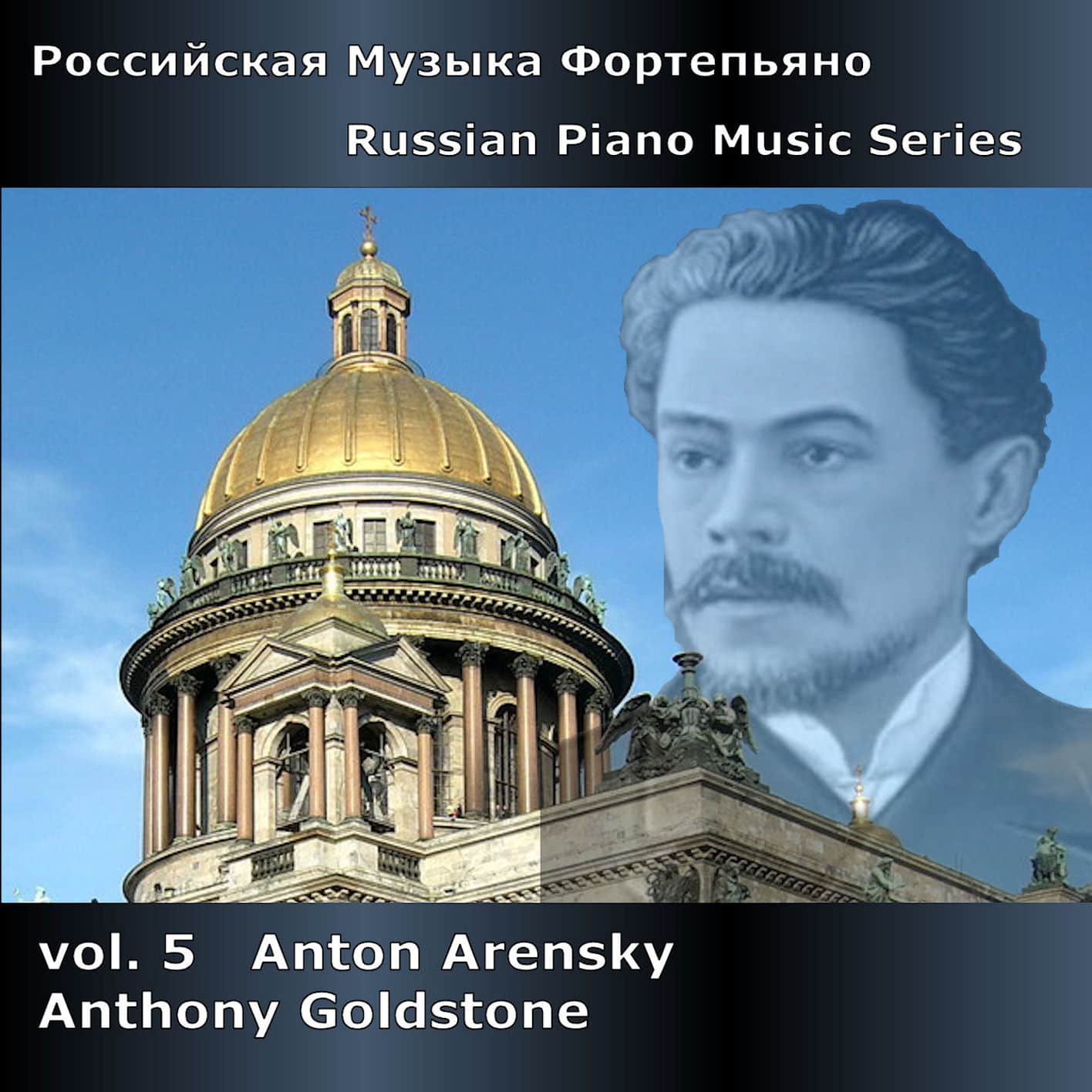
    Here, then, is a stream of encores to surprise and delight an audience. The first of the Op. 63 Preludes is indelibly Russian and so is the peal of bells commencing No. 2. No. 6 looks ahead to Medtner’s exquisite Fairy Tale, Op. 9 No. 3, also in G (Arensky’s work must surely have lingered in Medtner’s prodigiously well stocked mind), while the Forgotten Rhythms are more exploratory, though with memories of Brahms in No. 5. Chopin, too, is remembered in the fourth of the Op. 74 Etudes (his Op. 25 No .12 study), yet, more generally, Arensky runs the gamut of an essentially Russian Romantic pianism. Short in length but often sizeable in virtuoso demands, all this music is played by Goldstone with unflagging musical energy and brio. Volume 5 in Divine Art’s Russian Piano Music series is admirably recorded and presented with fine photographs of both the composer and pianist.
  • Fanfare – Barry Brenesal – 25085

    This album of Arensky’s shorter piano works was previously issued in 2001, on Olympia 692. It’s varied in inspiration: The 12 Etudes of 1905 frequently pay tribute to France—No. 1 in C Major seems especially beholden to Fauré—yet No. 7 in E ? -Major displays the same interest in Wagner as the introduction to the slow movement from Arensky’s Symphony No. 2. If the 12 Preludes, Trois Morceaux , and Arabesques owe a great deal to Chopin and Schumann, the six Essais sur des rythmes oubliés display the composer’s fascination with metrical and rhythmic experiments. These appealed to his contrarian personality; as Tchaikovsky noted with frustration, whenever he criticized the younger man’s obsession with 5/4 time, Arensky would simply use it more often. It may be that Arensky was spurred to his best by such challenges.

    Certainly the Borodin-like “Sari” movement finds him in excellent lyrical form, with a game of inversions in its central section, while the 5/4 rhythm and weak-accented primary theme of “Péons” might almost pass for a dance transcribed in the Balkans. Not everything is equally inspired on this album, but there’s more than enough in the 12 Etudes and the Essais sur des rythmes oubliés to make up for the longueurs that occasionally appear elsewhere.

    Anthony Goldstone performs all of this music in fine fashion, with a connoisseur’s appreciation for its elaborate traceries, and shifting expressive patterns. This works especially well in the more intimate selections, such as the Morceaux , although the pianist isn’t slow to respond to the expansive vigor required in the “Strophe alcéenne” from the Essais , or the Chabrier-like charms of the Vivace movement from the Arabesques . Technically, he has everything well in hand. The runs and figurations of the Etude No. 6 in D Minor are performed with coruscating finish, and the rubato of the Arabesques ‘ Tempo di Valse is handled with admirable naturalness. There’s plenty of color here, and expressiveness that never sounds forced.

    Sound quality is good. Divine Art deserves a nod of thanks for bringing this release, and Goldstone’s entire series devoted to piano works by the Russian Romantics, back into print.

  • MusicWeb – Nick Barnard – 25085

    One of the most pleasurable voyages of discovery this year has been the ‘Russian Piano Music Series’ and in particular the four volumes entrusted to the superbly capable and musically astute care of Anthony Goldstone. This is the third volume I have had the pleasure of reviewing … and I bought the fourth volume for reasons of simple pleasure. The common thread through all of the discs has been the rediscovery of virtuoso piano repertoire from the first half of the last century. Each disc has been hugely satisfying in itself but I would argue that the four together become even more stimulating allowing the listener to compare and contrast the differing musical approaches of four composers from essentially the same Russian Romantic stock.

    Anthony Goldstone has proved to be the ideal guide. It is more than just a case of a rock solid technique; in each case he has shown himself not only to be totally attuned to both the core style of the repertoire but crucially, equally at ease with one minute bon-bons or large-scale sonatas. This empathy extends beyond the performances to include some of the most interesting and best written performer liner-notes that I have read; an ideal blend of insight and information. As with the Glière disc previously reviewed this recital of Arensky’s music seems to be a straight reissue of an Olympia disc originally released in 2001. All credit to Divine Art for restoring this to the catalogue. This is a programme of miniatures with only two of the 39 tracks running beyond 3 minutes. Even the collections of 12 Preludes Op.63 or 12 Etudes Op.74 have less cumulative impact as a group than the magnificent 25 Preludes Op.30 by Glière which dominate volume 3. Yet it would be quite wrong to assume miniature means slight. Yes, as Goldstone points out, many of these pieces smack more of the Salon than the Steppe yet craft and care and idiomatic piano writing ooze from them at every turn. Goldstone quotes a wonderfully dismissive and sniffy passage from Rimsky-Korsakov’s autobiography where the senior composer points to Arensky’s penchant for cards and drink that led to his early death at the age of 44 and states rather bleakly; “he will soon be forgotten”. Frustratingly, the dissolute life did mean that both the Preludes and Etudes exist as incomplete half-sets but the pleasures to be had from the music that we do have is considerable. Again as Goldstone points out – well if you will write an astute liner it’s going to be quoted! – the influences here are much more Chopin and Schumann rather than fellow Russian nationalists. Given that the two Arensky symphonies are very much in the nationalist tradition it is a little disappointing that his 100+ piano works do not ever grapple with something on a larger more dramatic scale. Instead every movement evokes a beautiful miniature world. I enjoyed in particular the flowing harmonies of Prelude No.6 in G major [track 6] and the lyrical ‘question and answer’ of Prelude No.10 in D minor – the smooth ease with which Goldstone navigates this kind of deceptively hard writing indicative of his playing throughout. As in the Glière recital the engineers and producer have created a relatively intimate salon acoustic which I feel suits the music ideally – likewise the chosen piano is perfectly scaled to the repertoire.

    If I was forced to choose I would have to say that I found the Lyapunov disc the most revelatory with the Glière not far behind. Both those composers cover a wider musical and dramatic range in the programmes as recorded but then conversely this Arensky is disarmingly charming and gently moving. There is something desperately poignant about a man creating such simple beauty by day and living a nihilistic existence by night. More wide-ranging – in relative terms – are the six Essais sur des rythmes oubliés Op.28 . These are studies in flexible rhythm which Arensky exploits to try and lose predictable bar lines. Hence he uses a 5/4 time signature some years before Tchaikovsky did in his final symphony. Curiously, for all their attempts to be more radical at 120 years distance they sound more harmonically conservative with the rhythmic ‘novelty’ barely registering. But they are all adorned with some ravishing filigree writing that again Goldstone plays with artless ease and the subtlest rubato – this really is a master-class in the playing of this style of music. As befits their title the 12 Études are more overtly technical and as such less immediately charming; that being said the harp-like cascades of No.5 in D major [track 23] are instantly beguiling. The disc is completed with two shorter compilations of pieces with the six Arabesques Op.67 being the music of least consequence on the disc. But all credit to Goldstone for not trying to impose a ‘meaning’ where one does not try to exist; this is graceful elegant music. The disc is completed with one final nonchalant – but brutally hard – Etude – which you could imagine as the encore to a superb recital, all easy wit and technical display couched in winningly charming terms. And that is just how it sounds here – a superb conclusion * to a triumphant series of discs in which Mr Goldstone can take enormous pride. Proof if proof were needed that music does not need to always storm the heavens to be life-enhancing. Bravo!

  • ClassicalNet – Gerald Fenech – 25085

    This disc, the fifth instalment in Divine Art’s mini-cycle dedicated to Russian Piano Music, features the keyboard music of Anton Arensky. Born in 1861, Arensky’s career ran parallel with some of Russia’s most famous composers like Rimsky-Korsakov and Tchaikovsky to mention but two, so his life’s work tends to be somewhat overshadowed by the achievements of his contemporaries. Still his music, that includes symphonies, concertos, chamber and instrumental pieces is extremely well crafted, and a strong melodic vein is a constant feature. Unfortunately, just like Mussorgsky, he was a compulsive gambler and drinker not to mention other vices, and as a result his health started deteriorating at an early age. He died in 1906 from sepsis due to an infected insect bite, not yet age 45.

    The piano works that make up this issue reveal a master miniaturist. Many of the pieces last just over a minute, but their idiomatic timbre and graceful subtlety make them highly attractive creations. Indeed, the one real remarkable feature is their understatement and lack of bombast, but overall there is much that one can admire and enjoy.

    As in the previous recordings, Anthony Goldstone’s love for this music is all too apparent, and his advocacy for these Arensky gems is splendidly accurate and spontaneous. That emotional touch is not amiss either. This is an exciting and wonderful conclusion to an innovative series full of fascinating, if not wholly memorable, surprises

  • American Record Guide – Becker – 25085

    Anton Stepanovich Arensky (1861-1906) is remembered today for a bare handful of his compositions and as the teacher of Scriabin, Rachmaninoff, and Gretchaninoff. His short life, addicted to gambling and alcohol, ended at a sanatorium in Finland where he died of tuberculosis. His music shows the influence, if not the genius, of Tchaikovsky; and it is enjoyable, well crafted, melodic, and not without charm. In these two recordings of his piano music the only duplication is the set of 12 Etudes, Op. 74.

    The Etudes show a real difference between these two performers. Neiman, the American pianist, is sweepingly lyrical. Everything flows smoothly, with rippling motion—lots of arpeggios.

    Goldstone, from England, is more dramatic and modern in sound. His recording was originally on the Olympia label—and favorably reviewed at the time (Nov/Dec 2001). He sometimes finds the angularity and odd inflection in the music. But both recordings are excellent.

    [In] Goldstone’s selection, the 12 Preludes Op. 63 are virtuosic and well contrasted. They resemble Chopin only in their fecundity, and each one seems to beget another as they flow forth in a natural manner. The Essays on Forgotten Rhythms are said to take their rhythms from the poetry of ancient Greece and Rome. While the first employs left hand arpeggios, the second is characterized by catchy rhythms. The remaining four convince us that Arensky has a first-rate melodic gift; there is much that is very beautiful, and nothing falls short of elegant.

    A Suite of Arabesques, Op. 67, and the three pieces of Op. 42 complete Goldstone’s selection. If not revelatory or particularly innovative, they are interesting and increase one’s admiration for the composer. While all these pieces are short, they rarely reek of the salon, and usually manage to bring smiles to the face of the listener. Goldstone is a wonderful interpreter, and people enamored of the piano will be considerably poorer if they do not invest in this.

    While Goldstone offers his own informative notes, Naxos does a reasonably good job in that department as well. Further confusing matters is the outstanding recital on Hyperion from Stephen Coombs. While there is much duplication, his gentle playing exudes charm and forces me to have all three on my shelves.

  • Russian Piano Music Vol. 5 – Anton Arensky

    Russian Piano Music Vol. 5 – Anton Arensky

    Arensky was a fine pianist who actually made several recordings in the 1890s; his pianism is evident in his compositions for the instrument and he could easily be thought of as the Russian Chopin – brilliantly conceived works in the high Romantic tradition which deserve to be highly popular.

    This recording was previously released briefly on Olympia.