Catalogue Connection: 25086

  • International Piano – Julian Haylock – 25086

    Maria Curcio was one of the most remarkable, passionate and musically intuitive piano mentors of the last century. Her death on 30 March last year inspired a series of heartfelt testimonials from many of those who benefited from her years of accumulated wisdom (she was born in 1919). Now Anthony Goldstone has gone one stage further with a recital of pieces chosen either to enshrine her spirit and infections personality, or – specifically Mozart’s Rondo in A minor K511 , Beethoven’s Fantasy op.77 and Chopin’s F sharp minor Polonaise – because he studied them with her.

    One of Curcio’s maxims was that music should be lived through as a vivid emotional experience. As if in response, Goldstone infused each piece in this wide-ranging recital with an almost choreographic sense of its expressive (as well as structural) potentialities and continuity. His limpid-toned phrasal sensitivity reaches its apex in the Mozart Rondo, which is voiced with the same deeply felt refinement that characterises the whole programme.

    Typically Goldstone uncovers some rarities along the way, including Casella’s op.3 Variations on a Chaconne, which in places anticipates Rachmaninoff’s Corelli Variations, and four of Schnabel’s op.15 Waltzes. The recital culminates in a moving, live 1957 performance of Mozart’s concert aria Ch’io mi scordi di te? , with Elizabeth Schwarzkopf, the Concertgebouw Orchestra conducted by Otto Klemperer and Curcio playing the enchanting piano part like an angel.

    Highly recommended.

  • Fanfare – Boyd Pomeroy – 25086

    Here is a curious concept album—devoted to the memory of a pianist, but mostly played by someone else, and with an eclectic choice of repertoire not even particularly closely associated with the honoree.

    Maria Curcio (1919–2009) was an Italian-born pianist of exceptional promise, whose studies with Schnabel were interrupted by the war, and whose playing career never really recovered from wartime upheavals and an associated legacy of health problems in later life, despite the support of Britten, Giulini, and Klemperer, among others. But she ended up building an incredibly successful teaching career in London from the 1960s. Not only was she an inspirational force for a generation of British pianists (including Anthony Goldstone, I need hardly add); the list of those who sought her advice at one time or another includes Argerich, Fleisher, Lupu, and Uchida.

    Goldstone’s chosen program reflects her national ancestry (Italian/Brazilian), teachers she studied with (Schnabel, Casella), canonic 18th- and 19th-century repertoire she (or any other piano pedagogue) would have taught, and even pieces that happened to have been inspired by the name Maria in various contexts (Schubert/Liszt, Reger). But it all works surprisingly well, with some interesting rarities as well as provocatively thoughtful approaches to the standard fare. It is a nice touch to end with Schumann’s Widmung , with its subtle parting quotation of the opening piece, Schubert’s Ave Maria.

    Goldstone is an artist of real substance, and his Mozart and Beethoven are strongly assertive and characterful, valuable additions to these pieces’ substantial discography. The Chopin polonaise is tangy and idiomatic, if less effortlessly virtuoso than some. The Liszt arrangements are technically accomplished and well characterized, if slightly monochromatic ( Ave Maria ) and a little too serious ( La Danza ). Casella’s variations (the chaconne is “La Folia”) are a nice discovery, as are Schnabel’s waltzes—an engaging brew of Johann Strauss, Schumann, and Reger—though they could use a lighter touch than Goldstone gives them. The only real disappointment is the Villa-Lobos, rather heavy and unidiomatic. The recording is close and resonant.

    As a substantial bonus we get a rare glimpse of Curcio herself, in a memorable collaboration with Schwarzkopf (fiery, intense, and virtuoso). On this evidence, she was indeed a pianist of rare artistic sensibility—fluid and refined playing, with a delicately supple animation. She does not elaborate Mozart’s skeletal (shorthand) left-hand basses, but this was par for the course for the time. Klemperer’s direction is characterful, with a strong rhythmic profile. The performance is also available, in identical (very good) sound on the RCO Live label, in the orchestra’s own anthology of live performances from the 1950s. It certainly qualifies for classic status.

    I was not convinced by the idea of this collection to begin with, but ended up being won over by the combination of Goldstone’s artistry, imaginative programming, and the rare distinction of Curcio’s own playing. Recommended.
  • MusicWeb – Jonathan Woolf – 25086

    Maria Curcio was born in Naples in 1919 and died in March 2009. She was best known as an eminent teacher, after health crises ended an active performing career around the time of the end of the Second World War, and she had a fine list of pupils to her name. One of them was Barry Douglas, who contributes an interesting two paragraphs concerning his studies with her. And another was Anthony Goldstone whose ‘International Piano’ journal article about her, and his studies with her, is reproduced in the booklet, and who performs on this tribute disc.

    The works are all connected to Curcio; two contain her first name in the title, and of the others, these were works with which she had affinities, and composers with whom she had a strong connection. Casella and Schnabel were among her mentors, and so Goldstone duly performs music by them. The programming is effective, in any case, irrespective of its source of inspiration.

    Goldstone starts with two Lisztian concoctions, the first, an obvious starting point – expressively and indeed linguistically – being Ave Maria, and the second La Danza. The first is affectionately spun, heartfelt, limpid and appealing, whilst the second is played with reassuring élan. Goldstone measures and calibrates the B section of Villa-Lobos’s Choro No.5 with precision, ensuring that the outer writing retains intensity; the dance and the melancholy are adeptly held in balance. Casella’s early Variations on a Chaconne is a gripping if somewhat conventional piece, echoing Handel and La Folia, and reminding us of one of the Bach-Busonis in miniature. Nevertheless the characterisation is strong, faster and slower variations are well handled, and the music is stirring. As the variations proceed things are progressively more interesting harmonically.

    Three years after Casella’s Variations, Schnabel wrote his Waltzes, delightfully unserious, of which the last of the four is both the most extensive and the most quirky. Its extreme halts gently guy the genre. The three most extensive pieces then follow; a highly expressive Mozart A minor Rondo majoring in exceptional layers of melancholy; then Beethoven Op.77 Fantasie, with its elegant nobility; and finally a mature reading of Chopin’s Polonaise in F sharp minor. These allow a gentle winding down via Reger’s Mariä Wiegenlied and Schumann’s Widmung.

    To finish there is a bonus track, which features Curcio herself, playing marvellously, with Schwarzkopf and Klemperer live in Amsterdam in 1957, essaying Mozart’s concert aria Ch’io mi scordi di te? The soprano was later, in 1968, to record it with Alfred Brendel, the London Symphony Orchestra and George Szell. It ends the recital disc on a poignant yet uplifting note.

  • Amazon – Scott Morrison – 25086

    This CD of solo piano music played by the distinguished British pianist Anthony Goldstone is dedicated to his teacher, Maria Curcio, who died at age 89 in 2009. Curcio had been a student of Artur Schnabel and was a brilliant pianist who, because of ill health, principally malnutrition during a time when she and her Jewish husband were in hiding from the Nazis in Holland and then tuberculosis, was unable to pursue a career as a virtuoso. She gave her life over to becoming one of the most revered teachers of the twentieth-century. Among her students have been such pianistic luminaries as Martha Argerich, Stephen Kovacevich, Leon Fleisher, Mitsuko Uchida, Claude Frank and Radu Lupu. The works performed here were in one way or another associated with Curcio and they make a lovely tribute to Goldstone’s beloved teacher.

    Along with such familiar works as Liszt’s arrangement of Schubert’s ‘Ave Maria’, Schumann’s ‘Widmung’ and Rossini’s ‘La danza’, as well as Chopin’s Polonaise in F sharp minor, Mozart’s A Minor Rondo, KWV511, and Beethoven’s Fantasie, Op. 77, we also get rarer but wonderful pieces like Alfredo Casella’s ‘Variations on a Chaconne’, and Reger’s ‘Maria Wiegenlied’. And perhaps best of all, because this is a world première recording, we get Schnabel’s Four Waltzes, Op. 15, No. 3. Most people who even know that Schnabel composed music think that it was all rather gnarly and atonal, but these waltzes are early works and are entirely lovely Viennese bonbons.

    The disc concludes with a bit of Curcio herself playing, along with soprano Elisabeth Schwarzkopf singing, in Mozart’s concert aria ‘Ch’io mi scordi di te? … Non temer, amato bene’, recorded with the Amsterdam Concertgebouw under Otto Klemperer, recorded in 1957. Gorgeous.

    Goldstone’s playing is all one could ask for — sensitive, well-shaped, feelingful and effortlessly virtuosic. He is playing a marvelous piano — my hat is off to the piano technician — that has warm middle and low tones and a brilliant upper treble, all recorded magnificently in clear lifelike sound in a warm aural environment. Strongly recommended. (5 stars)

  • Inspiration – Homage to Maria Curcio

    Inspiration – Homage to Maria Curcio

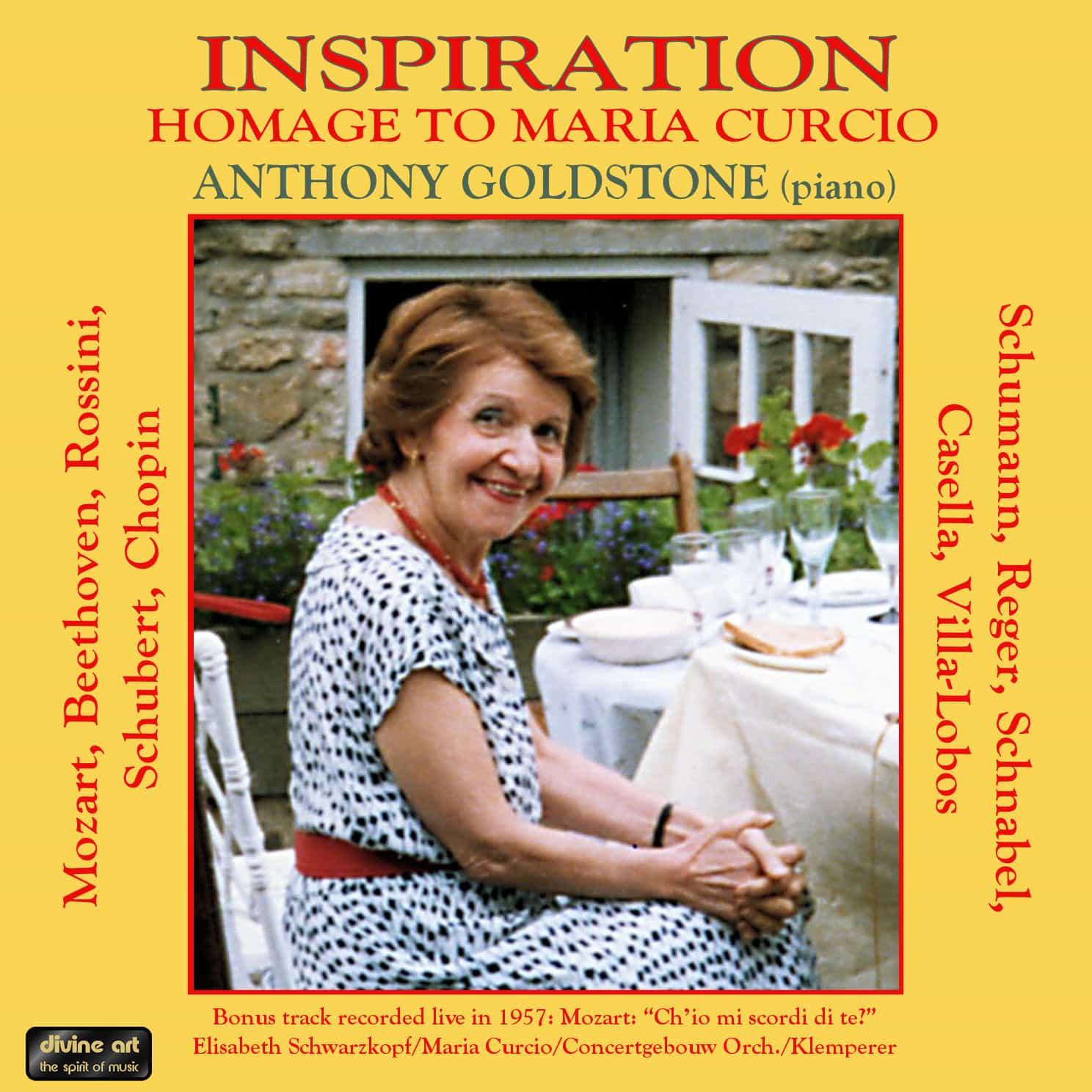
    Maria Curcio was one of the most influential and sought after piano teachers of the latter part of the 20th century including among her students such luminaries as Martha Argerich, Peter Frankl, Radu Lupu, and Mitsuko Uchida – and Anthony Goldstone. Following Curcio’s death in 2009 at the age of 89, this is Goldstone’s tribute to his mentor – a fine recital in its own right, and works all of which have a connection to her, in some way or other. This is the first ever recording of the lovely Waltzes composed by Artur Schnabel. As a bonus we include one of the very few surviving recordings made by Maria Curcio, where she accompanies Elisabeth Schwarzkopf in a Mozart aria – a performance first broadcast in 1957.