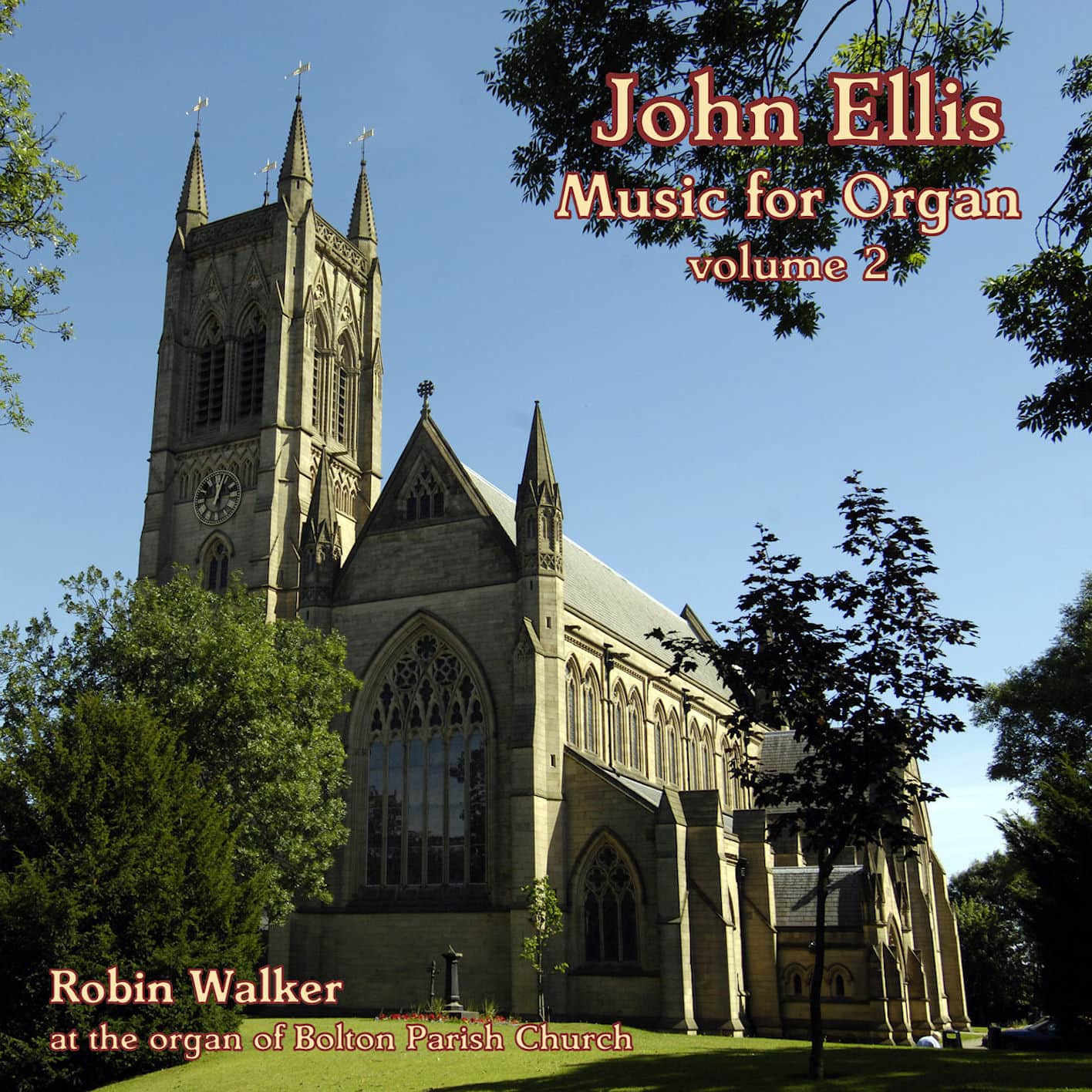
I should begin by repeating immediately the same declaration I made in my review of the first volume of John Ellis’s Organ music, recorded at St.Anne’s Church Manchester (Divine Art DDV 24141): he was a friend of mine and a erstwhile colleague in the ‘Lakeland Composer’s Group’ for several years. We knew each other’s music and his style is very familiar to me. This is the third commercially available disc of his works. Very sadly John died in April this year (2010) and we have lost a wonderful musician. As an organist based in the Manchester area he concentrated on organ music but there are also several choral pieces. He was a man of a quiet and unassuming nature. One of his last works saw him moving in new directions. It was an elegant Flute Sonata which was premiered in Kendal in May 2009.
Volume 1 was re-released last year on the Divine Arts label and this present volume was devised with the Organ Sonata as its climax and focal point. The first work is typical of Ellis: it is a set of Variations on Picardy , otherwise known as the early medieval hymn ‘Let all mortal flesh keep silence’. Each variant explores differing tonal qualities of the rich and beautiful organ in Bolton Parish Church . The composer knew the instrument so well. Each imaginative delving into the tune ends with something strong and decisive.
I remember hearing John play his lively Scherzo-Fantasy . Brief and reminiscent of Langlais, it is in a flowing compound time. To quote the booklet notes, it was inspired by Bach’s Fugue No 4 from Book 2 of the Well Tempered Clavier.
The Festive Voluntary does what is says on the tin and has a bright almost out-of-doors feel which reaches a strong and exuberant climax.
The Two Hymn-Tune Preludes may, especially at the beginning of the first, remind some people of Howells. The first – Passion Chorale – is suitably sombre and even improvisatory being based on ‘O sacred head’. It is slightly lacking in character. The next – Veni Creator – is a reminder that there is a fine set of variations on this famous plainchant on volume 1; this playfully weaves the chant around a rhythmic counterpoint.
A happy and flowing Toccata follows. This is a canon and is in continuous quavers building to a fine climax. The ensuing Minuet i s paired with it and is quite up-beat and perhaps not as “dream-like” as the booklet writer (who may be the performer himself) would have us believe.
Tonality is key to Ellis’s music but in the first of the Three Pieces for Organ the opening Interlude is ambiguous and achieves a thoughtful, questioning atmosphere. It has long melodic lines which are passed between the hands. The second, ‘Recessional’, is described, rather enthusiastically in the booklet as “explosive”. In its use of fanfaring fourths it has a Mathias-feel although is, in its middle section, much more lyrical and searching. The longest of the three is the closing and rather amiable, ‘Meditation’. It is quite similar both in speed and tonality to the first piece.
In case you thought that Ellis could only compose miniatures, and then only pieces based on already conceived ideas, the Organ Sonata should dispel your concerns instantly. In the weeks before he died he sent this CD to our Lakeland Composer’s March meeting and we listened intently. It is a work he had, in his extraordinary modesty kept very quiet about. The first movement which carries the most weight is a dramatic Fantasia and seems to be immediately on a different plane from much of Ellis’s other music. Its opening discords create a searching and passionate atmosphere. It would be a difficult to analyse so I won’t attempt it as it’s so free in form. The all too brief second movement is marked Scherzo and is Toccata-like. It ends in a final rushed flourish of exultation after searching around for direction. The Adagio is in a sort of ternary form with a mysterious first section which has a sinuous and delicate melody often projected over oscillating, tonally ambiguous triads. The B section has a little more movement and determination which reaches a choral climax linking back to the opening. The finale is a Passacaglia. This chromatic and slithery line, stated first in treble, grows through ten repetitions into a fine climax having been taken on a journey into various surprising and sometimes disturbing areas. Without a doubt this is John Ellis’s masterwork and the more I have heard it the more it surprises and amazes me. Any organist interesting in something new and challenging should track it down. Robin Walker is a marvellous advocate.
The accompanying booklet is a model of its kind. It possesses succinct but useful comments on the music as well as biographies of both the composer and performer. They also feature in the good quality coloured photographs in the centre-fold. There is photograph and history of the organ along with its detailed and vast specification. Robin Walker handles the instrument superbly. When he is not making CDs he is Director of Music at St.Mark’s Florence!