Catalogue Connection: 25088

  • The Consort – John Collins – 25088

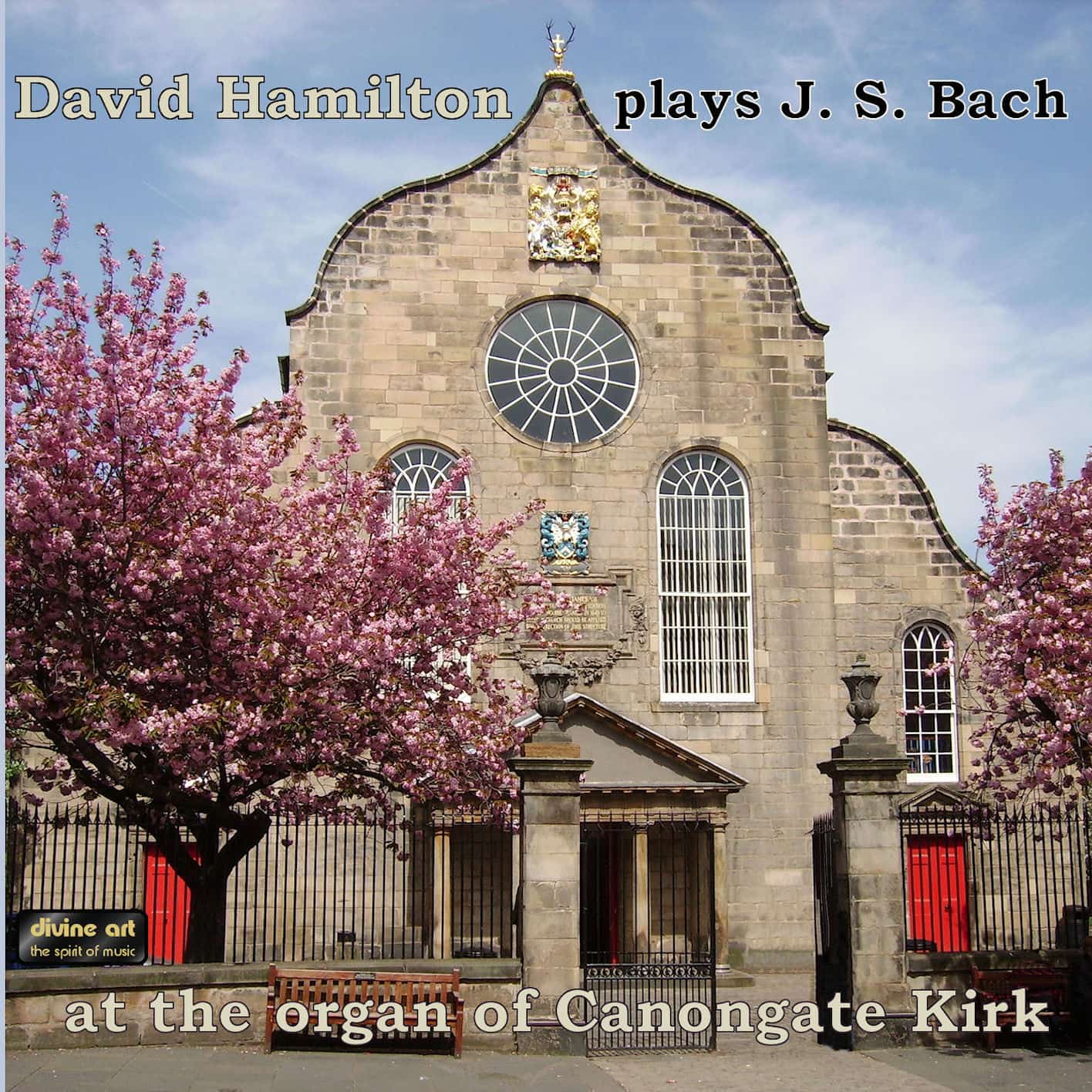
    The Frobenius organ at Canongate Kirk was dedicated in 1998, and its modestly dimensioned 2-manual plus pedal offers well-balanced tonal potential for the early repertoire, as is demonstrated here by David Hamilton, organist at Strathclyde University and lecturer at the Royal Scottish Academy of Music and Drama.

    This selection of eight of Bach’s organ works includes four very well known large-scale works and four chorale preludes of which two are not frequently heard. The disc opens with Wachet auf (BWV645), the tenor solo being given out on the Great trumpet, which is clear without being strident, and which does not overshadow the accompanying right hand ritornello and pedal bass. A lively pace is adopted, but clarity of phrasing is maintained throughout.

    This is followed by the Passacaglia (BWV582), in which Hamilton offers varied registrations throughout, which suits the character of the unfolding sequence of variations on the ostinato; the fugue receives an effective steady treatment. The highly chromatic Erbarme dich (BWV721), played here in a manualiter setting, is taken at a leisurely pace, without the repeated left hand chordal writing sounding labored, and the choice of quiet string registers addes to the penitential mood.

    In the Pièce d’Orgue (BWV572), it is the gravement , the lengthy middle section, which stands out, and David Hamilton captures the appropriate French style through his ornamentation, with the occasional subtle application of notes inégales . After the opening movement’s transparently bright registration for the continuous single-note line, the use of the manual principal plenum over the pedal with its basun 16ft. arrests the attention, before the final movement of another single-note line over a descending pedal bass reverts to a quieter registration. O Mensch, bewein ein Sünde gross (BWV622) is played spaciously, but without losing the feel for the regular pulse, and the highly florid and frequently chromatic solo line is well phrased, the trills in particular being well integrated into the melodic line.

    In the Toccata, Adagio and Fugue (BWV564), after a quiet introduction, we hear David’s virtuosity in the pedal solo, in which the reed is again utilized; the reappearance of manuals leads to a reduction in registers. The Adagio , with its solo floating above the accompaniment leads into a short Grave section; its highly dissonant suspensions are emphasized through the increased registration. The fugue is played quietly throughout, but David chooses to repeat some of the Toccata to form a da capo , which does not work for this reviewer.

    From the Clavierübung, Hamilton has chosen the longer setting of Dies sind die heil’gen zehn Gebot (BWV678), The solo line of two voices in canon is played on the oboe against two voices in the right hand and a steady pedal line; the balance between the parts is effective. The CD concludes with a sterling interpretation of the Prelude and Fugue in E flat (BWV552) which, through well –balanced registrations and articulation, captures both the profundity and the playfulness of this popular work.

    The CD booklet contains a brief description of the pieces, the organ and the performer, whose attention to detail and nuance, especially in the ornamentation, makes listening most enjoyable. The tempi are frequently brisk, and the registration is in several pieces rather quieter than in other interpretations, but the acoustic allows this approach to succeed. The disc offers excellent value, and is one to which I shall return.
  • Classic FM Magazine – Andrew Mellor – 25088

    The music: In this recital you get some gems of JS Bach’s organ output, including the exquisite choral preludes Erbarm ditch. O Mensch bewein dein and Wachet auf (the latter from the Lloyds Bank ad) and a few larger works including the Passacaglia and Fugue in C minor. It’s music that’s eminently listenable-to and yet recognisably crafted with extraordinary and humble genius.

    The performance: This is a fine meeting of instrument and performer. The organ in Edinburgh’s Canongate Kirk was built in 1998 using materials Bach would have recognised. It’s not the most powerful instrument, so immediately surprising is that the imposing Passacaglia works so well – played with a delicate beauty that actually finds great cumulative power. His repertoire is perfectly matched to the instrument’s clear sonorities and played with light dexterity but weighty intellect. That, and Hamilton has a habit of reaching for the perfect stop to illuminate particular lines.

    The verdict: I’ve had hours of pleasure from this CD already and there are many more to come.

    Why You’ll Love This
    Clear Lines
    In this famous chorale prelude Wachet auf, ruft uns die Stimme Hamilton chooses just the right stops to create the sense of three different-yet integrated musical lines. The piece has rarely sounded more deliciously clear-cut and translucent.
    Expressive Fingers
    You can’t play ‘harder’ or ‘lighter’ on an organ, but you can play expressively in other ways – take the wonderful space Hamilton suggests in the opening bar of O Mensch bewein and the anguish of his poised trills.
    With a Flourish
    After the pedal – workout introduction to Bach’s Toccata in C major, the sprightly major – key cadences resound with a truly joyous feel and Hamilton’s fingers appear to dance quicksilver-like through the ensuing passages.

  • MusicWeb – Gavin Dixon – 25088

    David Hamilton is clearly a fine organist, but there’s no doubt that the instrument is the real star of this disc. It was built by Th. Frobenius of Copenhagen in 1998 and is in tip-top condition. Like the kirk itself, the organ isn’t big, just two manuals and a registration that fits comfortably on half a page of the liner notes, but this is definitely a case of small is beautiful.

    It is much more common to meet discs of popular Bach selections played on huge cathedral organs, but what this organ lacks in power it makes up for in the precision of the sound and the subtle combinations of the tone colours. Hamilton avoids the temptation to concentrate solely on the small-scale works and includes two of the behemoths: the Passacaglia in C minor BWV582 and the Prelude and Fugue in E flat major BWV 552. The Passacaglia in particular sounds great at this chamber music scale, and all sorts of contrapuntal devices and inner lines become apparent that larger organs usually obscure.

    Clarity and evenness of tone are the main virtues of this instrument, and of Hamilton’s registration choices – just because there are less stops to pull, that doesn’t make the decisions any easier. In the Adagio second movement of the Toccata in C minor BWV564 the voicing of the individual notes of the melody is immaculate. The opening movement also benefits from the clean, well defined sound, and the grace notes in the main theme are actually heard as pitches, another detail that is often lost on larger organs. There isn’t much in the way of mutation or colouristic devices in the registration. The only piece to use a more constrained, nasal stop is O Mensch BWV678, and even that has a relatively open tone.

    Hamilton is quite conservative in his use of ornaments and his rubato is either non-existent or so subtle as to be imperceptible. The result is a series of very clean interpretations, an approach ideally matched to the tone and scale of the instrument.

    The sound quality is good, and it seems that the organ and the acoustic are ideally matched. There is very little resonance – for a church I mean – but enough to give the organ sound a satisfying warmth. The bass in the recording is excellent, clear and focused and not artificially amplified, or at least not obviously so. The bottom end of the organ is actually quite meagre, the pedals have two 8′ stops and two 16′, but that’s plenty, even for the Passacaglia.

    An enjoyable disc then, and not your usual Bach greatest hits. This may be the absolute core of the organ repertoire, but it does have a tendency to bring out the worst excesses of megalomania in professional organists. David Hamilton demonstrates how a little humility can go a long way.

  • UK Regional Press – Kevin Bryan – 25088

    This splendid keyboard recital was recorded in February this year using the organ in Edinburgh’s 17 th century Canongate Kirk.

    Hamilton feels a natural affinity for the music of Baroque composers such as Bach and this crisply crafted offering serves up a varied and representative selection of the great man’s organ works, taking advantage of the naturally warm acoustic that this Danish designed instrument offers to the skilled practitioner.

  • Midwest Record – Chris Spector – 25088

    Start with Bach and organ, add a cat that knows and loves both and let the fun begin. Unless you’re talking about a game changer like Wendy Carlos, there’s only so much you can do with the basics here but if you bring some vision and passion to the proceedings, the work is a nice addition to the canon. Using all ten fingers and all ten toes, Hamilton comes in with a great gift idea, for yourself or any other Bach lover. Well done and tasty.

  • Choir & Organ – Graeme Kay – 25088

    This is, unequivocally, one of the most enjoyable Bach recordings to come my way recently. Strathclyde University organist and Baroque scholar David Hamilton, who studied with Harald Vogel and Jos van der Kooy, has chosen Canongate Kirk’s III/20 Frobenius Op.1000 of 1998 to offer a representative selection of free works and chorale-based music including, inter alia, the Passacaglia & Fugue in C minor, the Pièce d’orgue, the ‘St Anne’ Prelude & Fugue, the Toccata, Adagio & Fugue in C, Wachet auf, and O Mensch, bewein.

    Hamilton and the Frobenius – not a stop larger or smaller than it needs to be – are perfectly attuned to the repertoire: recorded close in, music and performer lead the listener on a Bachian journey of pure, almost chamber intimacy.

  • Fanfare – Scott Noriega – 25088

    What Chopin was to the piano, Bach was to the organ. The many sides of the composer can be seen in the many genres that his organ works inhabit, from the more modest, but no less impressive, chorale preludes to the grandiose preludes and figures and the mighty C-Minor Passacaglia. David Hamilton, playing on the organ at Canongate Kirk in Edinburgh, Scotland, has chosen a very fine cross section of the organ works to display not only the many sides of the composer, but also the many capabilities of the chosen instrument as well. He is a very fine advocate for this music. The smaller works are played simply, but not without emotion.

    Hamilton’s tempos are spot-on, and the tender way he shapes the lines- sometimes ornamenting them slightly- gives one the impression of hearing the pieces for the first time. The Passacaglia, in particular, is well paced. The constant flowing of its theme is never compromised, nor compromising in its relentlessness, but rather gains in grandeur as the piece unfolds. The Pièce d’Orgue is perhaps the best performance on the entire chordal section, where the dissonances are somewhat startling. Hamilton gives just enough weight and time for the dissonances to be made palpable before moving on effectively to the concluding section, which is reminiscent of the opening in spirit and figuration. The ending is once again simple and unadorned, but heartfelt. The Toccata’s prelude is given the effect of real improvisation, so unfettered and free is it in its movement. It is at times playful, at times serious. This leads to the more dramatic and potent Adagio. It is never so slow as to lose its momentum, yet never so quick as to make it sound frivolous. The fugue that ends the work begins it in a slightly introverted manner-something that works particularly well here, as it allows the organist to build up to the immense climax at the end.

    The so-called “St Anne” Prelude and Fugue ends the recital. It is given a grand reading, with enough lift and breath to characterize its many facets. All in all, Hamilton proves to be a very fine guide, one who highlights the intricacies of these works, often illuminating them in new ways. For a truly enjoyable experience of some great Bach organ works, this recording is as wonderful for novices as for experts.

  • Classical Net – Gerald Fenech – 25088

    This beautifully-recorded CD shows David Hamilton in his element playing the works of the master on one of the most exquisite sounding organs I have heard of late. The richness yet at the same time simplicity of sound is particularly noticeable in the imposing Passacaglia in C minor, BWV 582 which I could not stop playing over and over again.

    The short pieces are also highly evocative especially the opening “Wachet auf” and BWV 678 which although brief are informed with much zest and rarefied beauty. Hamilton uses the Kirk organ’s tonal palette quite magically and Divine Art’s recording is admirable in its clarity and homespun acoustic.

    You may perhaps find bolder-sounding versions of these works with Peter Hurford (Decca) or Helmut Walcha (DG) not to mention Christopher Herrick’s admirable series on Hyperion but Hamilton is the real deal if you want to listen to a truly original Bach recital. His notes are also detailed but easy to read and this is all part of a package which is most strongly recommended to the organ and Bach enthusiast.

  • MusicWeb Download Roundup – Brian Wilson – 25088

    This gets into the Christmas supplement by virtue of its overall excellence – if you’re looking for a single-disc introduction to JSB’s organ music, this could well be it – and also because it opens with the Advent chorale Wachet auf . The download from theclassicalshop comes complete with the booklet of notes, which includes the specification of the Canongate organ. David Hamilton’s performances are fully the equal of those on his earlier Divine Art recording of Buxtehude and the lossless sound is excellent.

  • Classical Music Sentinel – Jean-Yves Duperron – 25088

    What an impressive little instrument this Th. Frobenius (Opus 1000) pipe organ is. The Danish firm of Frobenius built this 19 stop organ in 1998 for the 320 year old Kirk of the Canongate church in Edinburgh. They build organs with characteristic modern casework, but the instruments themselves are built in the classical tradition, with mechanical actions. From the very first notes of the opening Wachet auf, ruft uns die Stimme, BWV 645 , you can tell that this organ is extremely well balanced in its voicing, and that every stop, from the 16′ pedal stops to the 2′ Flute, are designed and built in perfect proportion to each other. And don’t be misled by its size. When power is called for, as in the end of the Passacaglia in C minor, BWV 582 , it’s there. It might not be the bone rattling sound you get from a 100 stop organ with 32′ pedal stops, but rather a bright, clean, direct and focused power where each and every note of a chord comes through nice and clear. Balance, proportion and output scaling are definitely this organ’s strong points. And all these qualities are very well captured and reproduced by the Divine Art recording, in which you can clearly hear the speech of each individual pipe.

    The works chosen for this recording fit this organ’s personality very well, and help display its versatility and sunny character. They are as follows:

    Wachet auf, ruft uns die Stimme, BWV 645
    Passacaglia in C minor, BWV 582
    Erbarm dich mein, o Herre Gott, BWV 721
    Pièce d’Orgue, BWV 582
    Toccata, Adagio and Fugue in C major, BWV 564
    Dies sind die heil’gen zehn Gebot’, BWV 678
    Prelude and Fugue in E flat major, BWV 552

    Organist David Hamilton , a Royal College of Organists exams prizewinner and teacher, uses this organ’s attributes and Canongate’s acoustics to his advantage, and delivers a crisp, focused and finely registered account of all these pieces, and really brings out the instrument’s charm in the BWV 645 and the Fugue of the BWV 564. His previous Divine Art CD of organ works by Buxtehude, was very well received and reviewed by many music critics around the world. There are many fine recordings on the market today of Bach’s organ works, each one valid for different reasons. This new recording, based on all the aforementioned points, should rest nicely at the top of the heap.

  • Johann Sebastian Bach Organ Works

    Johann Sebastian Bach Organ Works

    This splendid recital of works by Johann Sebastian Bach has been produced in collaboration with Canongate Kirk, Edinburgh, to display the fine and distinctive sounds of the instrument. The booklet contains a history of the organ and its full specification. David Hamilton’s second CD, as with his recent Buxtehude album, shows a performer with skill and musicianship and also a deep empathy with the works of the baroque masters.