Catalogue Connection: 25089

  • Fanfare – Lynn René Bayley – 25089

    I hesitated more than a few minutes before asking to review this CD, as I was not necessarily dying to hear duo-piano performances of such noted orchestral scores as An American in Paris and La Création du monde, but what tipped the scale for me was that one of the pianists is Anthony Goldstone, whose recording of Vladimir Rebikov’s piano music (Divine Art 25081) impressed me so favorably. I’m glad I chose it because the performances by Goldstone and his wife, Caroline Clemmow, are absolutely “right” in terms of rhythmic feeling and musical nuance. Yet more importantly, this recording says a lot—but not all—about the early cross-pollination of classical music and jazz, a crossbreed that flourished sporadically, almost spastically, one might say, over the next century.

    We are so far removed from the Jazz Age that nearly everything we hear from it, the good and the bad, sounds rhythmically stiff and harmonically staid. Even by the late 1930s, the music had grown and evolved so much and so rapidly that a musician suddenly transported from 1922 to 1938—a span of only 16 years—would have difficulty understanding how it changed so much, so quickly. Yet also, by that time, only the famous Gershwin works ( Rhapsody in Blue/American in Paris/ Concerto in F) still survived as repertoire items, the remainder of Jazz Age hybrids being either forgotten or relegated to Europe until their resuscitation many years later.

    The rhythm certainly has a lot to do with this. Early jazz, like Baroque music, was formulated as spirited and freewheeling inventions by the top-line instruments (or, in the case of a keyboard instrument, the right hand) while the ground bass (or left hand on a keyboard) generally, but not always, played a stiffly metronomic 4/4. In the case of the greatest pianists of the time, such as Jelly Roll Morton, Earl Hines, and (a little later) Art Tatum, the left hand played independent figures, often in cross rhythms, but with the basic pulse coming from ragtime and cakewalk music (think of Debussy’s Golliwog’s Cakewalk or Stravinsky’s Ragtime ), the primary function of the jazz musician was to weave around the stiff bass. It was not considered, at that time, either archaic or a detriment.

    Yet because so many of these works were built around this sort of rhythm, it was only normal that they should sound dated. And it was, in part, because of this anachronistic rhythmic feel that the entire concept of jazz-classical fusion was scrapped, thrown aside, or considered to be in the category of the cutesy and precious—at least, until such innovators as Charles Mingus, Stan Kenton, and George Russell emerged in the late 1940s and took jazz and its classical connections to entirely new and different levels.

    Goldstone and Clemmow give us a very good, if incomplete, view of this heady era and its musical products. Stravinsky’s experiments are mentioned, Milhaud is placed right alongside Gershwin, and, to my surprise and edification, they have unearthed some very interesting if lighter works by Edward Burlingame Hill (1872–1960), Alexander Moyzes (1906–84), and Mátyás Seiber (1905–60), each of whom embraced the jazz aesthetic from different perspectives. Hill was a pupil of composer-organist Charles-Marie Widor, Moyzes a pupil of his father, Mikuláš, and Dvorák pupil Vitezslav Novák, and Seiber, both a student of Kodály and (in his mid-20s) director of the world’s first department of jazz studies at a major university, Frankfurt-am-Main. All of this activity goes to show how very seriously our “stepchild of the musical arts” was taken, even then, outside of America. Yet since they chose not to include any of their music, Goldstone and Clemmow left out a discussion of Ravel, whose string quartet and later piano concerto incorporated jazz; George Antheil, the expatriate American who composed an all-percussion, jazz-influenced score for the experimental film Ballet Mécanique; and John Alden Carpenter, who in 1922 wrote a wonderful little ballet based on the popular comic strip Krazy Kat, and who, in 1924—the same year Rhapsody in Blue premiered—wrote the greatest jazz-classical orchestral score of the 20s, Skyscrapers. Nor is it mentioned that, in one instance at least, the young, enthusiastic Milhaud was accidentally misled when collecting records of “genuine black jazz music” to base La Création du monde on. The late jazz clarinetist and archive collector Frank Powers proved this when he unearthed for Dave Brubeck—the famed jazz pianist who was also a pupil of Milhaud—a copy of one of the principal records Milhaud used as a basis for Création, “Aunt Hagar’s Children’s Blues” by “Ladd’s Black Aces.” Seeing the name, Milhaud was convinced they were a genuine African-American band, but in fact it was one of Sam Lanin’s many studio pseudonyms, a white band featuring reedman Doc Behrendsen and pianist Jimmy Durante! (I can just imagine Jimmy saying, the first time he heard this piece, “Whaddaya know! Everyone wants to get into the act!”)

    As to the origin of the most famous pieces, this is Milhaud’s own arrangement of Création for piano four-hands and, with modifications, Gershwin’s own duo-piano arrangement of American in Paris. The modifications are these: Additional music deleted from the orchestral version is left out here, music from the final version is put in, and there’s a return to the original texture. The last two items, popular songs of the era by Gershwin ( Embraceable You ) and Hoagy Carmichael ( Stardust ), may indeed seem like light dessert, but these particular arrangements are highly inventive and sparkling. Overall, a highly recommended disc.
  • MusicWeb – Jonathan Woolf – 25089

    What an excellent idea; and what fine execution. And not only these two qualities, but a third one too – real listening pleasure. All these elements mean that this latest Goldstone-Clemmow release proves just as attractive as the preceding ones. It’s also very much worth noting that we apparently have a raft of first recordings of these particular piano duet performances; the Burlingame Hill, Milhaud, Seiber, and Carmichael.

    Gershwin’s own two-piano score of An American in Paris was not published at the time – after his death a different version was published – and only appeared in the 1980s. It included some short sections that he cut from the orchestral score, and this version was recorded at the time by the Labèque sisters. For this recording G and C have used Gershwin’s final thoughts on the matter, which therefore correspond with the published full score, as it were. Sometimes the effect of listening to a piece in this way is rather like trying to recognise an old friend by his skeleton, but so practised are the duo, and so enjoyable is the arrangement, and so jam-packed with colour and incident, that one listens to its teeming narrative with unvarnished pleasure. From Gershwin to Hill is something of a leap. Hill, a fascinating figure and composer – teacher no less – came to jazz, or its like, at the age of 48 with the politesse of a Harvard grandee. The opening movement of the four Jazz Studies is polite Ragtime , whilst there’s a nicely sprung near-relative of The Black Bottom and – the most interesting harmonically – a tight, fast vivace to finish.

    La création du monde is heard in the composer’s familiar piano-duet version. One says ‘familiar’ but it appears actually never to have been recorded before. What an oversight! If your marker for this is the composer’s own recording (one of them, anyway) or, say, Bernstein’s then there’s still no reason why you shouldn’t want to hear Milhaud’s own piano-duet reduction, given that it lays bare motivic strands in a way that you might miss in the glistening animal passion of the clothed orchestrated version. It’s a work of which I never tire, and not for nothing did I queue in the rain to get Lenny to autograph his LP of it for me.

    A decade after the Milhaud, Alexander Moyzes wrote his Jazz Sonata for two pianos. For most Czechoslovakians – Moyzes was a Slovak – ‘jazz’ still meant hot dance bands, extrapolated ragtime, or something of that kind. It certainly didn’t mean King Oliver. Moyzes studied with Novák and is a crucial figure in modern Slovak music. His suite is delightful, unpretentious and not out to make points. There’s a charmer of a waltz and an endearing foxtrot: great fun. Seiber’s Easy Dances for piano duet, of which we hear a selection, were written when the composer was living in Frankfurt . These dance aperçus almost all last less than a minute. One, the Rumba , sounds like Stan Kenton’s Peanut Vendor in basic miniature, whilst the Slow-Fox makes me wonder how deeply his knowledge of jazz went; it sounds deeper by far than Moyzes or Hill for example. (Seiber co-wrote with Johnny Dankworth the Jazz-Improvisation for orchestra and jazz band and this was recorded in 1962 with the Dankworth’s band and the LPO conducted by Hugo Rignold: British Saga LP XIP700) Had he heard James P. Johnson’s records? To finish we have two little encores; Hoagy Carmichael’s Stardust and Gershwin’s Embraceable You arranged successively by Maurice Whitney and Percy Grainger. They make for a fitting envoi.

    This is a sparkling and vivacious disc, marvellously played, and not just for jazzers only.

  • Fanfare – Michael Ullman – 25089

    George Gershwin wrote at least two masterpieces, Rhapsody in Blue and An American in Paris , out of his misunderstanding of jazz, which he thought characterized by stiff, jumpy rhythms and staccato phrasing. But then, he meant in Rhapsody in Blue to break the boundaries that others had placed on jazz. He described the idea for Rhapsody as occurring to him in an instant: “Jazz, they said, had to be in strict time. It had to cling to dance rhythms. I resolved, if possible, to kill that misconception with one sturdy blow.” Louis Armstrong did more to kill misconceptions about jazz than did the wonderfully successful Rhapsody in Blue, which nonetheless inspired composers to work with jazz sounds and lively rhythms. In 1928 Gershwin showed what could be done with both in An American in Paris , which he wrote in a two-piano version that he subsequently orchestrated. He gave the two – piano score to his publisher, but that original version wasn’t published until 1980. It since has been recorded several times, including by the well- known duo Katia and Marielle Labeque.

    Now the popular British duo Goldstone and Clemmow have recorded it in the company of some more obscure Jazz Age works and with a previously unrecorded two-piano version of Milhaud’s La Creation du monde by the composer himself. I previously reviewed a recording of romantic works by this piano duo; unkindly, but I believe truthfully, I said that the recording was for people who liked to hear their Chopin sound like Gilbert and Sullivan. The good news here is that Goldstone and Clemmow ‘s jaunty style is more at home here in the Jazz Age , and that they have presented an unhackneyed repertoire, including the recordings of not only of the Milhaud but of Seiber and Edward Burlingame Hill, as well as the arrangement of Hoagy Carmichael’s Star Dust by Louis Merkur.

    Nonetheless, I don’t think this is the perfect recording of An American in Paris. Perhaps such a recording on two pianos would be impossible. Where the orchestration adds weight, our pianists compensate by slowing down, or sometimes by fooling with, the tempo or phrasing. This is slightly disconcerting elsewhere and truly disturbing in one place: the blues theme that is usually played with something approaching nonchalance and that here is tugged and pushed for no reason that I can see. They are much less mannered in the Milhaud, which I know primarily from the recordings by the composer and by Charles Munch. On two pianos, the opening is much less mysterious, but also less sentimentally played, than in the recording the composer conducted. In fact, the piece works remarkably well for two pianos, and the zest and clarity of this performance should interest many listeners. About the Hill, composed between 1922 and 1924, and the Moyzes he lived between 1906 and 1982 and published his Jazz Sonata in 1932), one can say that a jazz influence is muted I hear nothing jazzy about the movement Tempo giusto in the Hill, for instance, yet it is a pleasing piece, with a delightful melody over an obsessive rhythmic figure. Moyzes, a Slovak composer who graduated from the Prague Conservatory, has written a much more dramatic work in his sonata and one that has even less to do with jazz, except if one considers every dance movement jazzy. That does not make his sonata, especially its waltz movement, any less charming. Matyas Seiber (1905-60), who was born in Budapest and thanks to the Nazis ended up in England, wrote a series of short, easy studies in dance rhythms, some of which are found here, and all which are appealing.

    Finally, Hoagy Carmichael’s Star Dust is made rather grand by arranger Louis Merker. The Embraceable You is Percy Grainger’s expansion of an arrangement by an American composer Maurice Whitney. The renditions of these two popular songs start great jazz versions – Louis Armstrong’s Star Dust , Pee Wee Russell’s and Charlie Parker’s Embraceable You – dancing in my head. Still, it is easy to recommend this unique disc that shows the widespread, though greatly dissipated, influence of jazz on world music, and that contains several world premiere recordings. For many the Milhaud would alone make it worth acquiring.

  • New England Regional Press – Frank Behrens – 25089

    I am such an admirer of the duo piano recordings of Anthony Goldstone and Caroline Clemmow that I find myself playing their CD renditions of Tchaikovsky’s “Symphony No. 4” or Grieg’s “Piano Concerto” more often than CDs with the fully orchestrated versions. I find I can appreciate the inner workings of the pieces much more when they are heard in piano redactions.

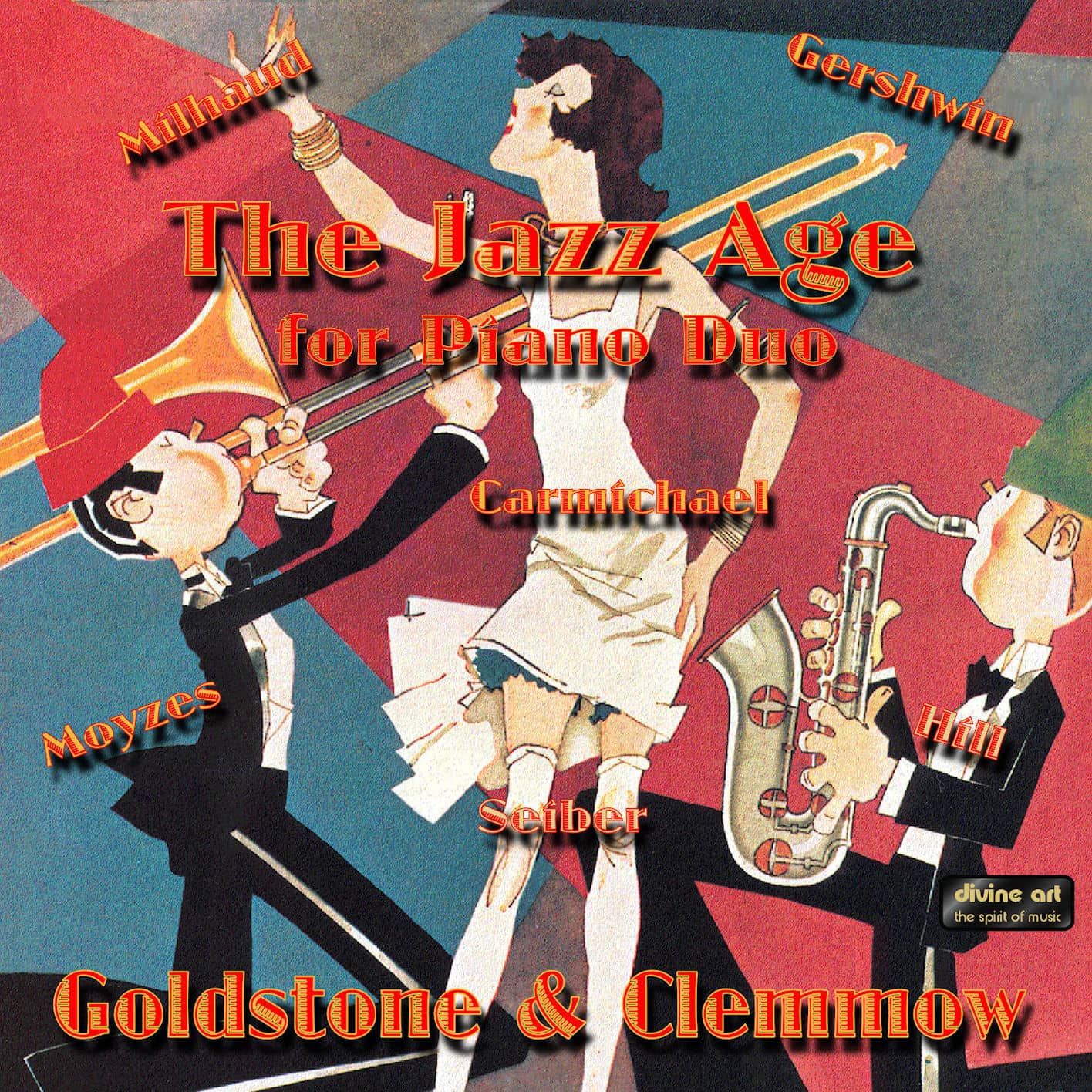
    Their latest release on the Divine Art label is “The Jazz Age for piano duo.” The program includes Gershwin’s two-piano version of “An American in Paris” and Milhaud’s piano-duet version of “Le creation du monde.” Some of the other pieces needed no arrangements: Edward Burlingame Hill’s “Jazz Studies for two pianos,” Alexander Moyzes’ “Jazz Sonata for two pianos,” and selections from Mayas Seiber’s “Easy Dances for piano duet.”

    The program ends with two gems: One is an arrangement by Louis Merkur of Hoagy Carmichael’s “Star Dust for two pianos.” This is a world premiere recording of this version. The second is Percy Grainger’s rearrangement of George Gershwin’s “Embraceable You.” What a treat!

    The booklet has more information than most companies provide, and it is all in sensible and therefore legible black print on white pages.

    Yes, I did find the title of the CD misleading but was delighted to see the actual works contained thereon. Much recommended to one and all.

  • Audiophile Audition – John Sunier – 25089

    Married couple Anthony Goldstone and Caroline Clemmow formed their duo in 1984 and have performed worldwide – frequently creating entertaining programs from works they have dug up themselves. They have recorded a seven-CD set of all the works written by Schubert for piano four hands.

    There have been several orchestral albums centered around works showing jazz influences, but theirs may be the first two-piano album devoted to jazzy-sounding works. Of course Gershwin’s Rhapsody in Blue has been a starting point for this sort of thing ever since its creation, so Goldstone & Clemmow have selected his own two-piano version of An American in Paris – which he actually composed first and then orchestrated later. Edward Hill was educated at Harvard and studied with Widor in Paris at one point. His two-piano Jazz Studies of 1922-24 lack the blues influence heard in Gershwin, and instead make use of popular dances of the era, such as ragtime, the Turkey Trot , Black Bottom and even a rumba. One of the studies sounds much like Kurt Weill.

    Darius Milhaud became nuts about American jazz when he visited Harlem in 1922. The next year he created his jazzy ballet The Creation of the World – which really presaged Gershwin’s Rhapsody in Blue as the first major classical work with a strong jazz influence. Dave Brubeck calls it “The best jazz piece from a classical European composer.” Milhaud wrote his own piano duet version of the score, and that is the one played by Goldstone and Clemmow. Alexander Moyzes is regarded as the founder of the Slovakian school of composition. He wrote his Jazz Sonata for Two Pianos in 1932 for another two-piano duo, also showing more dance-hall influence than that of Harlem.

    The other shorter works are of great interest, and the special arrangements of Star Dust and Embraceable You that close out the program are a total delight. Several of the works on this CD here receive their first recording – including the piano duet version of The Creation of the World.

  • New Classics – 25089

    The internationally renowned Anthony Goldstone and Caroline Clemmow formed their piano duo in 1984 and have given many two-piano and piano-duet recitals as well as double concertos, taking in major festivals in Europe and the USA. Their concert repertoire mixes well-known masterpieces and rarities, often including first hearings of unjustly neglected works, and their recordings (approaching forty in number) include many world premières.

    On this hugely enjoyable CD, the acclaimed British duo play American (and American influenced) piano music from the Jazz Age, which in turn was inspired by a collection of short stories published in 1922 by F. Scott Fitzgerald under the title Tales of the Jazz Age. The Great War was over and, despite political turmoil, brutal racial repression and Prohibition, Americans managed to throw caution to the winds and enjoy themselves until the Great Depression struck in 1929. ‘The jazz age’ is now taken to refer to this ‘anything goes’ period, during which jazz flourished and many new popular dance crazes popped up and were frequently displaced equally suddenly. The Charleston and the Fox Trot have endured, but others included such animal inspirations as the Kangaroo Hop, Grizzly Bear, Bunny Hug and Horse Trot.

    The music here includes Gershwin’s own two-piano version of An American in Paris and Embraceable You (arranged by Percy Grainger for piano duet) and Darius Milhaud’s La Création du Monde, as well as works by Edward Burlingame Hill, Hungarian-born Alexander Moyzes and Mátyás Seiber (who wrote jazz works for John Dankworth), and Hoagy Carmichael’s classic Stardust.

  • Jazz UK – Roger Thomas – 25089

    The Jazz Age’ from long-established duo pianists Anthony Goldstone and Caroline Clemmow is confident, gathering tunes by Gershwin and Hoagy Carmichael together with less obvious material by the likes of Milhaud and Seiber and allowing then all to illuminate each other. It’s rewarding listening if this is your kind of thing, though you may have to fish it out from the classical racks.

  • Midwest Record – Chris Spector – 25089

    Goldstone picks some super pleaser material but goes out on a limb for a varied program that takes you back a century or so for some fun, atavistic listening that sounds right in the moment but sounds modern as well. With his duet partner bringing the other two hands to the fore, this is a snazzy classical/crossover date that’s expertly played and a gasser to listen to. Too heady to be simply cocktail music, it’s best enjoyed in your fave easy chair away from the maddening crowd. Well done.

  • The Guardian – Stephen Pritchard – 25089

    You’re no doubt familiar with George Gershwin, but Edward Burlingame Hill? Alexander Moyzes? No, me neither, but their jaunty, jazzy studies and sonatas get a new lease of life in this engaging selection from the husband-and-wife duo Anthony Goldstone and Caroline Clemmow. Mátyás Seiber’s hilarious tangos and foxtrots will put a spring in your step, while you can melt over Percy Grainger’s (yes!) arrangement of Gershwin’s “Embraceable You”. All great fun but recorded in the echoey, sepulchral acoustic of a church, which pours some pretty cold water over some very hot music.

  • The Jazz Age for Piano Duo

    The Jazz Age for Piano Duo

    Above all other periods, the ‘roaring’ 1920s were possibly the years of greatest carefree feeling in British society; America too, to an extent despite the Prohibition and limitations on personal freedom. The new dance crazes, from the foxtrot to the Charleston, Black Bottom and tango, together with the ever increasing popularity of jazz and blues idioms which created the ‘hot dance’ number, created a golden era in light music, which was eagerly taken up by ‘serious’ composers; here we have a parade of gems – major works from Gershwin and Milhaud, to miniatures full of fun. Exquisitely performed as ever by Britain’s top duo.