Catalogue Connection: 25091

  • Music Notes review – Venice in Mexico

    Stephen Sutton’s ever eclectic divine art label provided us with both the catchy title for this blog post and the pleasurable music contained in a new release of Baroque music by Vivaldi and Facco.

    Facco, did I say?

    Yes, I too had never heard of this most unfairly neglected of composers. Giacomo Facco was born in 1676 in the Most Serene Republic of Venice, the warmongering in-spite-of-its-title City State where composers like Vivaldi, this CD’s other and better known featured composer made their careers count for something.

    But Facco chose to cast his lot farther to the South and west of the City on the Lagoon and off to Madrid he went at age 24, where he fell in the good graces of the Royal Family and became Music Master to the household of the Infante and eventually a member of the King’s household.
    By a cruel twist of fate, all but a handful of the dozens of compositions penned by Facco were lost in a fire in the Royal Palace. Then, by another twist of fate – a beneficial one this time around – a set of twelve of his concerti, entitled Pensieri Adriarmonici ended up in – of all places – a nunnery in Mexico DC.

    By a series of fortuitous events, Facco’s work came into the care of Mexican musicologist and maestro Miguel Lawrence, who brought together a group of the country’s finest Early Music players to record two of Facco’s and six of Vivaldi’s concerti – two of them with the exotic Mexican psaltery deputizing for the Baroque guitar for which it would have been written, and another for sopranino recorder.

    The fine dozen players of the Mexican Baroque Orchestra, conducted by Miguel Lawrence, do lovely work on all eight of the concerti, featuring throughout the excellent violinist Manuel Zoghi, Daniel Armas playing with brilliance the intriguing Mexican psaltery, and Maestro Lawrence playing the sopranino recorder with panache and elegance. The obligatory Baroque continuo is strongly provided by Juan J. Puente on the guitarrón mexicano. Marieta Lazarova, Jared Ahedo, Rodrigo Martinez, Caleb Ahedo, Stanislav Ouchinsky, Connie Ruiz, and Marco Estrada are the marvelously musical members of the string section.

    The CD is elegantly packaged and impeccably engineered by Pedro Wood.

  • American Record Guide – C MOORE – 25091

    Both Giacomo Facco (1676-1753) and Antonio Vivaldi (1678-1741) were violinists and composers based in Venice. Facco’s music had been lost in a fire in the Madrid Royal Palace, but a copy of the 12 concertos in his Opus 1 Pensieri Adriarmonici , published in Amsterdam in 1716 and 1718 and likely taken to Mexico in 1723, was discovered in a library in Mexico City in 1961. The Mexican Baroque Orchestra was formed in 2009 by director and recorder player Miguel Lawrence in order to play this music.

    Although playing on modern instruments, the ensemble uses the same forces that were likely used in Mexico in the 17th and 18th Centuries as well as baroque style and articulation.

    Starting in the 17th Century, basso continuo in Mexico was played on instruments that today we are most likely to know from mariachi bands, specifically the guitar-shaped vihuela and guittaron. The two instruments are always played together, and the large guittaron (played in the same position as a guitar but with a body wider than a cello) offers the bass notes. The resulting basso continuo group—including cello—works very well with these compositions and doesn’t sound “out of place” at all. The guitar timbre is most evident in the slower movements, and the ensemble blends and balances very well, playing with a nice style and spirit.

    The violins sound rather thin sometimes, both in the solo and ensemble concertos. As for the other solo instruments in the Vivaldi concertos, it is interesting to hear psaltery used for the mandolin concerto (R 425). Although it does match the thin string sound here, I don’t like its metallic timbre (I tend to feel the same way about the mandolin), but it is a valid approach that certainly pays homage to the composer’s fondness for writing concertos for unusual instruments. Like their use of vihuela and guittaron, the Mexican Baroque Orchestra’s inclusion of psaltery is not anachronistic, since that instrument has been in Mexico for centuries.

    The finest playing here is in the two concertos for sopranino recorder (R 443 and R 445). Miguel Lawrence plays with a most natural birdlike quality that is very attractive and musical. Often these pieces, with their extremely high tessitura, are piercing and onedimensional as the player concentrates on hitting the notes and staying in tune. Here the color is varied and rich, and the virtuoso playing delightful to hear.

  • The Consort – Elizabeth Rees – 25091

    This CD of baroque concertos by two Venetians, Antonio Vivaldi (1678-1741) and Giacomo Facco (1676-1753), is interesting for a number of reasons. Firstly, Facco is a little-known baroque figure, most of whose compositions were destroyed by a disastrous fire in the royal palace, Madrid, where he worked. All that survives are some short pieces for two cellos and a set of concerti entitled Pensieri Adriarmonici , perhaps to be translated ‘Thoughts of the harmonious Adriatic’. These were rediscovered only ion 1961, by the Italian conductor Uberto Zanolli, in the library of Colegio de las Vizcainas in Mexico City; they were probably brought to Mexico in about 1723 to be performed as entertainment for Spanish noblemen.

    The two concerti by Facco on this CD, for violin, strings and continuo (op. 1 no. 1 in E minor and no. 5 in A major), are as attractive as many by Vivaldi and Corelli; indeed, the Mexican Baroque Orchestra was established in order to perform Facco’s music. Like Vivaldi, Facco was a composer and violinist. He wrote a series of successful operas, such as Las Amazonas de España , first performed in Madrid in 1720; it was the first opera to be set to a Spanish libretto. While at the Spanish court in Madrid, Facco taught the harpsichord to the future kings Louis I and Fernando VI. He eventually became Music Master to the Infante Dan Carlos, who later became King Charles III. Yet, like Vivaldi, Facco died in obscurity, as a mere violinist in the orchestra of the Royal Chapel, Madrid.

    The second interesting feature of this CD is that the Mexican Baroque Orchestra, here a group of eight musicians, choose to play the basso continuo on today’s mariachi vihuela and guitarrón. These instruments were created in 17 th century Mexico, and were derived from various European continuo instruments, the archlute, theorbo, European vihuela and baroque guitar. The two mariachi instruments resemble each other in shape and sound, and are always played together. The guitarrón is much bigger than the vihuela: with its lower register, it plays the bass notes in octaves, always plucking two strings at a time.

    The mariachi continuo is most prominent in the solo concerti by Vivaldi: two for sopranino recorder (in C major RV443 and in A minor RV445) and in the concerto in C major RV425, originally for mandolin, performed here on the psaltery. The mariachi continuo is softer than its European counterpart, lacking the harpsichord’s familiar twang. It also sounds a little four-square: perhaps this is a feature of the instruments.

    The third interesting feature is the use of the psaltery as a solo instrument. Vivaldi indicated the use of this instrument to accompany the aria Ho nel petto fort cor in his opera Il Giustino , RV717. Here, the traditional Mexican psaltery is an entirely satisfactory ‘local’ replacement for the mandolin, played with delicacy and fluency by Mexico’s leading virtuoso on the instrument, Daniel Armas. Daniel was taught to play the psaltery by his mother, who was taught be her father.

    The other soloists are also excellent: the sopranino recorder is played with delightful virtuosity by the orchestra’s conductor, Miguel Lawrence, and the solo violin in the Facco concerti is sensitively played by Manuel Zogbi. I found the orchestra somewhat lacking in variety of tempi and dynamics within each movement, but this aside, there is plenty to enjoy on this CD. These Mexican performers give a hint of how European music might have been interpreted in the New World in the 18 th century.

  • Fanfare – Jerry Dubins – 25091

    At first glance, the title of this disc, Venice in Mexico , led me to think this might be a collection of Italian Baroque composers who emigrated to Mexico or, failing that, of late 17th-and early 18th-century native-born Mexican composers. It turns out to be neither. The Mexican connection, however, is Miguel Lawrence and his Mexican Baroque Orchestra, and Italian-born composer Giacomo Facco (1676–1753), if not for whom the Mexican Baroque Orchestra wouldn’t exist.

    Long story short, Facco, like many a dutiful Italian composer of his day, first gained attention as a violinist, procured a court position (in this case at the court of Carlo Antonio Spinola, Marquis of los Balbases, Viceroy of Sicily), and soon found himself in demand as a composer of sacred vocal works and operas. Fought over for his services by the competing Spanish and Portuguese courts, Facco chose Spain, where, through a series of posts, he eventually acceded in 1731 to the post of clavichord master to Don Carlos, the future King Carlos III. By Baroque standards, Facco didn’t write a great deal of music, and much of what he did was destroyed in a 1734 fire at the Royal Chapel in Madrid. From there, Facco’s fortunes took a nosedive. Backstabbing colleagues conspired against him, until in his last years he’d been stripped of title, position, and possessions.

    Here comes the Mexican connection. In 1961, music scholar Uberto Zanoli discovered a dust-covered set of 12 concertos, titled Pensieri Adriarmonici (Adriatic Harmony Thoughts) by Facco, languishing in Mexico City’s Library of Colegio de las Vizcainas. Exactly how or when they got there is uncertain—the booklet note speculates around 1723—but they had been published in Amsterdam between 1716 and 1718.

    The Mexican Baroque Orchestra was formed by Miguel Lawrence in 2009 under private sponsorship specifically for the purpose of performing these concertos. Thus, I find myself at a loss to understand why, of the eight concertos on this CD, only two are from the Facco collection of 12, while the other six by Vivaldi have all had more than their fair share of representation on disc. If you don’t recognize the concerto for psaltery, it’s because RV 425 is actually the well-known concerto for mandolin. We don’t really need more Vivaldi, do we? I can’t help but wonder why Miguel Lawrence, especially given his explicit charter to perform Facco’s concertos, would not have recorded the entire set, or at least as many of them as would fit on the disc. This strikes me as a really squandered opportunity.

    Lawrence, if he reads this, would no doubt argue that his program affords the listener the opportunity to hear not just two unfamiliar works but several familiar ones given in unusual, perhaps unique, performances. For you see, the standard Baroque complement of instruments one would expect to hear employed for the continuo parts—harpsichord and cello, or in some cases low, plucked string instruments, such as theorbo and archlute—are replaced in Lawrence’s Mexican Baroque Orchestra with what the booklet note calls “Mexican colonial instruments like the vihuela and the guitarrón, according to 18th-century practice in Mexico.” Otherwise, despite the orchestra’s name, these are not period-instrument performances, though they are played one to a part.

    I’m strongly tempted to say that if Facco had written more than he did, and ill fate had not befallen him and his music, our CD collections today would be bulging with Facco instead of Vivaldi. Based on just these two concertos, Facco makes Vivaldi sound almost stale, all the more reason that I’m just furious with Lawrence for not having given us more of them.

    But guess what? Lawrence and his Mexican Baroque Orchestra have been scooped. Hiding in my collection between Joseph Eybler and Manuel de Falla, I found a Pavane CD I’d forgotten I had, proclaiming to be the world premiere recording of Book 2 (the concertos seven through 12) of Facco’s Pensieri Adriarmonici publication. It was recorded in 1999 by the Ensemble Albalonga on period instruments. Moreover, there’s a recording on Deutsche Harmonia Mundi with L’Arte dell’Arco, containing what I believe to be the six concertos of Book 1 (Nos. 1–6), though I can’t be sure because I don’t have that particular CD. Anyway, I realized that Facco was not quite the unknown I thought he was when I first began this review.

    This in no way, however, changes my reaction to or enthusiasm for his music. These concertos really do sound like the best things Vivaldi never wrote. So, if you love Vivaldi, and you can’t get enough of him, I would submit to you that Facco is the perfect fix for your habit. His music is so vigorous, so high-spirited, and so infectious you will tap your feet, clap your hands, bob your head, and swing your whole body in rhythm to its allegros and hum along to the sweet strains of its adagios.

    The plucked continuo instruments lend these performances a bright, almost bell-like quality that rather resembles something approximating a cross between a cittern and a celesta. The sound can be quite delightful, though I do have doubts as to their historical authenticity in music of this origin and time period. All the more reason for skepticism is Vivaldi’s popular mandolin concerto adapted for psaltery. Hernán Plama y Meza’s note rationalizes that Vivaldi, being a fan of unusual instruments of his time, “would not have been slow to add a new ring to his repertoire of sounds.” The problem is that by Vivaldi’s day, the psaltery, a medieval plucked instrument of the harp or zither family, had pretty much had its moment in the sun, and though a few 18th-century composers kept it alive, “the fact that Vivaldi, who wrote for almost every instrument of his time, didn’t compose anything for it,” as Johan van Veen of MusicWeb International notes, “makes it rather implausible to suggest that he would have approved of such a performance.” He concludes that “these performances are relics of a bygone era.” What the psaltery sounds like, at least in this recording, is a set of tuned finger cymbals or a Lilliputian lyre.

    Questions about the instruments aside, I will say that the Mexican players and their performances on this disc are outstanding. Manuel Zogbi is highly accomplished. His insertion of sizzling embellishments into the already rapid passagework of Vivaldi’s popular A-Minor Concerto from L’Estro Armonico is amazing, as are his dazzling virtuosity, spontaneity, perfect pitch, and beautiful tone. Miguel Lawrence, in addition to conducting, plays the two sopranino recorder concertos by Vivaldi with sufficient timbral resonance and sustaining power to summon the neighborhood’s dogs. As for psalterist Daniel Armas, I doubt that he finds his phone ringing off the hook with offers to record classical music, but I understand he enjoys a professional career both in the Mexican film industry and in accompanying famous Mexican singers.

    Despite my reservations, I thoroughly enjoyed this disc and recommend it, but I plead with you to seek out more complete offerings of Facco’s concertos on Pavane, Deutsche Harmonia Mundi, and possibly other labels. You’ll be glad you did.
  • Rutland Herald – Ed Barna – 25091

    If anyone had doubts that Brandon had indeed become a center for the arts, they should have been resolved when Brandon Music made Warren Kimble’s former home and barn studio their North American headquarters. Divine Art (“the spirit of music”), a significant producer of well-received classical recordings had chosen Brandon, when they could have gone just about anywhere, with the result that the town’s name is now being attached to first-class performances by the kinds of musicians that avid collectors seek out.

    They have been kind enough to send some of their recent CDs to me, for my listening pleasure and reviewer’s opinion. From time to time I will be relaying to you my responses, there being precious little room in any newspaper for coverage of anything but concerts. To start with, I’d like to recommend “Venice in Mexico,” Miguel Lawrence conducting the Mexican Baroque Orchestra.

    Before spinning the CD, I was imagining all kinds of possibilities for Mexican flavored 18th century music. Would native instruments be substituted for the more familiar ones? Would the performances have a particular rhythmic verve, like the Latin jazz that is such a comfort to hear on a chilly Vermont evening? Was there some kind of crossover?

    Nothing of the sort. This was Baroque pure and simple, with no unusual twist other than featuring two concerti by Giacomo Facco (1676-1753) as well as six by better-known Antonio Vivaldi (1678-1741).

    But the Mexican Baroque Orchestra doesn’t need gimmicks. Manuel Zogbi (violin), Daniel Armas (psaltery) and Miguel Lawrence (sopranino recorder as well as conducting), plus five associates, carry the day with the verve and accuracy of their playing. “Venice in Mexico” would be a good Christmas gift for someone who “has everything,” music being something one does not “have,” but which happens, in a way that carries a listener along with it.

    Baroque music, played in a dutiful fashion, can seem repetitious beyond endurance. But the MBO approaches each measure as if it were fresh from the composer’s pen, a series of discoveries and lovely surprises. In any case, the MBO’s enthusiasm for the pieces on this CD translates into a combination of melodic interest and rhythmic drive that makes the CD enjoyable throughout.

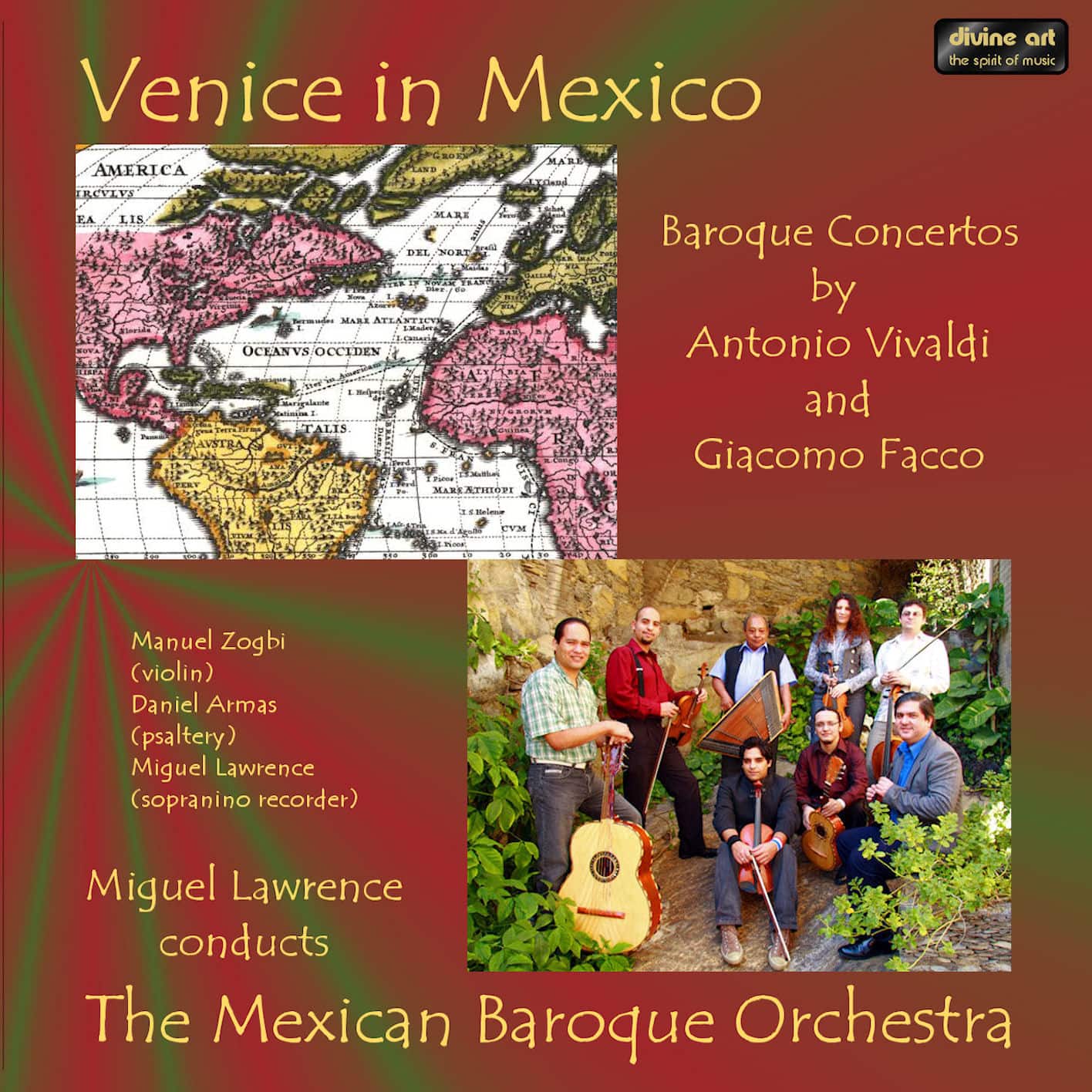
    The instrumentation isn’t part of an effort to reproduce an 18th century style. The psaltery is a Mexican psaltery; in a picture on the CD insert, it looks a bit like an autoharp, to name another instrument in the same group, all of which use plucked strings with fixed tones. Here it fits right into the style.

    The program notes say, “Daniel Armas, born in Mexico, is considered to be the most important and virtuoso player of the traditional Mexican psaltery.” But the star of this CD is Lawrence playing recorder. Many people are familiar with this as a beginner sort of instrument, the kind a whole class will attempt because at one level it’s easy to play. Forget all that. Lawrence turns the recorder into something magical, a unique voice that it would be shameful to replace with a flute or piccolo. Which he could have done—his distinguished career started with studying baroque flute and recorder at the Guildhall School of Music and Drama in London.

    In short, dda25091 is a release of which Divine Art should be proud—and Brandon as well.

  • Venice in Mexico

    Venice in Mexico

    Mexico after the Spanish arrived saw a great deal of European art and culture being imported, including music from the great centres such as Venice. Not having harpsichords to hand, it became usual to use local instruments, vihuela and guitarron, for continuo. This policy is used here, and the sharp clear sound of the strings with the rhythmic base gives these works a new impetus and vitality. The Vivaldi pieces are fairly well known but the fine concertos by Facco were only discovered relatively recently.

    Soloists: Miguel Lawrence (sopranino recorder); Manuel Zogbi (violin); Daniel Armas (psaltery)