Catalogue Connection: 25098

  • Musical Opinion – Robert Matthew-Walker – 25098

    The work of the long-lived and multi-gifted musician Hans Gál has recently been receiving welcome attention from various record companies and concert-giving organisations, and it is with particular pleasure that I welcome this outstanding new recording of his music for two pianos and piano duet.

    This is not the place to go into great detail about this immensely-gifted composer, just one of many who suffered under the Nazis and found welcome refuge in Britain. As a boy in Vienna, Gál’s family lived above a patisserie, presided over by a very elderly lady who sat in a big chair by the shop’s entrance, half on the pavement.

    She would often hear Hans practicing the piano as a boy and one day told him that the ‘old gentleman’ would have loved to hear him play—the ‘old gentleman’ being Beethoven, who lived above her parents’ bakery, and whom she knew—and was a little afraid of—as a child. She had been born in 1820, and was seven when Beethoven died; she was in her 80s when she told Hans this story. Hans Gál’s music for piano duet is very varied, from the early Serbian Dances Opus 3, through the Concertino for two pianos to the delightful, relatively late Three Marionettes, and other finely-wrought pieces. The performances are uniformly admirable, and this important issue is a most welcome addition to the catalogue. ***** (five stars awarded)

  • Fanfare – Lynn Rene Bayley – 25098

    I am generally so fond of Anthony Goldstone’s playing, whether as soloist or as here, in duet with his wife, Caroline Clemmow, that I enjoy reviewing every disc I can get my hands on. He (they) does (do) not disappoint here, giving us the warm, lyrical, and ever-so-slightly modern but mostly tonal works of Hans Gal.

    As pointed out in the liner notes, Gal’s piano duets were a small portion of his oeuvre but not an insignificant one. When he published the Three Marionettes in 1958 he wrote, “When I was young, piano duet playing was a favorite pastime of music lovers. I am afraid this habit has very much diminished but I have always maintained my love for it.” In a sense, Gal’s love of piano duets shows itself in every piece on this album. In this specific trio of pieces, Gal shows himself a deft cre­ator of moods as well as characters. The music has its share of quick harmonic changes and chro­matics, yet remains melodic and accessible while he paints brief but telling portraits of “Pantalone,” “Columbine,” and “Arlecchino.”

    The Serbian Dances, composed in 1916, are very much in the tradition of Brahms and Dvorak, their lively folk rhythms and allusions to various peoples of the region (Slav Serbs, Croats, Muslims, and Jews) charming as well as infectious. Indeed, Gal orchestrated some of them to avoid piracy, but the full set of six pieces—not terribly long at 21 minutes—makes a fine concert work in its own right. The falling flatted thirds, sixths, and other “ethnic” modes (including crushed note clusters) continually add interest to the pieces, as do the fluctuating tempos, somewhat different from the rhythmic layout of the Brahms pieces. No. 5 in B is the most interesting of the six in form, vacillat­ing as it does between slow and fast passages almost continually and without warning. No. 6 in A Minor, though having some medium-tempo passages, generally tends toward speed and energy, bringing the set to an exciting climax.

    Gal wrote his Concertino for piano and orchestra in 1934, but then made an arrangement for two pianos. As Goldstone and Clemmow point out in their notes, this version sacrifices the juxta­position of the string orchestra with the piano but creates an interesting antiphony between the two pianos. Here the melodic language as well as the layout, but not the harmonies, hark back to 18th-century models. In a way, it reminded me of Strauss’s Dance Suite after Couperin, though the con­struction is more Classical and less Baroque. (Goldstone’s allusion to Hindemith is also quite apro­pos, as that composer also enjoyed writing modern works based on earlier models.) Indeed, of all the pieces so far on this disc, this sounds the most modern harmonically without borrowing unusual modes from ethnic folk music.

    The Three Impromptus , though written in 1940, were not published and only received their first public performance in 1993 by these two artists. The music is somewhat interesting but not quite as fine as the earlier works on this CD. The concluding Pastoral Tune, originally written for six hands at one piano in 1954, was adapted for this recording by Goldstone for piano four-hands. It is a charm­ing piece, albeit brief and somewhat lightweight.

    Goldstone and Clemmow, as usual, are thoroughly into the spirit of the music they perform. It’s difficult for me to think of any other regularly performing piano duo of today who so selflessly give of themselves to the composers whose work they serve. There is nothing the least bit pretentious, overdone, or underdone in their performances; indeed, one is scarcely aware of personalities in their playing whatsoever. They simply give one the music, in the style of the composer, and do so with joy as well as humility. Would that the classical world had more artists of this caliber.
  • American Record Guide – Harrington – 25098

    Hans Gal (1890-1987) was born near Vienna and appears to have had an early life that got him well on his way to a major career as a composer and teacher. Supported by notable musicians like Furtwangler and Richard Strauss, he became the director of the Mainz Conservatory in 1929. His many compositions were regularly performed, including operas, symphonic works, and chamber music. In 1933 Gal, with the rise of the Nazis, suffered the fate so many Jewish musicians did: he was dismissed from his position and his music was banned. He fled Germany and eventually settled in Edinburgh, where he taught at the conservatory for many years. He died there at the age of 97.

    This music was composed over a 42-year period from 1916 to 1958. Gal was an excellent pianist, and his editions of the complete piano music of Brahms are among his most lasting legacies. There is no doubt that Gal’s Serbian Dances from 1916 owe something to the very popular Brahms Hungarian Dances , also for piano duet. The Concertino dates from 1934 and was composed for piano and string orchestra. Gal arranged the string parts for a second piano, and Goldstone and Clemmow shows how effective that version can be. The Impromptus were written for two amateur pianists for their Saturday Entertainments. These were not published until 1991, and the first documented public performance was by the present artists (in Edinburgh). The Marionettes (1958) are three movements based on characters from the Commedia dell’arte and conjure up some marvelous images.

    As with everything to come from Goldstone and Clemmow over the past several years, this is a marvelous release. It is full of new music, performed and recorded to the highest standards. Add the artists’ excellent notes and you have a perfect way to introduce rarely heard works of the piano duo repertoire.

  • Musical Pointers – Peter Grahame Woolf – 25098

    Recorded in 2001, this passed me by and indeed I have nothing of “Olympia”. Handsomely re-released by Divine Arts a decade on in the full flood of the Gal revival, it is sheer joy, now that we’re no longer afraid of music that isn’t completely “up to date”.

    Goldstone & Clemmow supply ideal programme notes, quoting Gal’s reminder of the joys of piano duet playing, a habit “sadly diminished”.

    Delightful music whose time has come; put it high on your piano recordings to buy list.

  • Wrightmusic – David C F Wright – 25098

    No one needs to be reminded of what a very fine duo Goldstone and Clemmow are… they are in the best in the UK and probably the best internationally.

    As a duo, and in Mr Goldstone’s solo recitals, they have brought to us some rare and neglected music and enriched our lives. I have always been thankful to Mr. Goldstone for his Rebikov !

    This CD is no exception as to quality, although I would be the first to admit that, while the music is attractive and worth having, it may not be the greatest music.

    My friend, the late Robert Crawford, always spoke well of Hans Gál who was his teacher for a while . Gál’s music was never really in fashion but regarded as anachronistic .

    He was born near Vienna on 5 August 1890 and was a Hungarian Jew. He studied with Mandyczewski and with him edited the works of Brahms, a composer near to his heart and to the heart of everyone who values great music.

    In 1915, Gál won a State prize for music in Austria but World War l ruined Austria in many ways including musically. His poor eyesight prevented him being called up for military service.

    Gál went to to Germany in the 1920s. His early operas were a success there an d he became the director of the Mainz Conservatory. But when the evil Hitler and the Nazis came to power, Gál’s music was banned. He moved back to Vienna but had to emigrate to England in 1938. He had a meeting with the stuffy Tovey in Edinburgh and became a lecturer at the University there.

    Robert Crawford told me that Gál was sincere and never pompous but self- effacing and utterly likable .

    But he did have a flaw, if one could call it that. He would not move with the times not even by a centimetre. He was in bondage to the Austrian tradition. Egon Wellesz was the same. And, in Italy, Pizzetti’s mind was also closed.

    Gál married Hanna Schicke and they were married for 65 years until his death on 3 October 1987. His operas had some measure of success, his chamber music is refined and the Serenade for string orchestra is lovely. There was a Violin Concerto and a Violin Concertino as well as a Triptych for orchestra which were recorded. He wrote a Piano Concerto in 1948 and a Concertino for piano and string orchestra earlier in 1934.

    The influence of Brahms is never far away and, apparently, Brahms had the idea that piano duets were ‘fun’ and more intimate than string quartets. There are flashes of humour in Gál’s duos and, as he was a good pianist himself, he understood the piano. That he was an academic is shown in the finale of his Concertino for two pianos which is a fugue. Nonetheless, the Concertino is the best work on this CD.

    Listen to ‘Brahms’ in the Second Impromptu and then play Brahms Op 117.

    What I like about this duo, is that their playing is never excessive . Unlike many of our young pianists of today, they are not out to show off and conduct demolition jobs on the piano. Their performances are so convincing, highly polished and show a maturity not hampered by fussiness. They make the music speak and often sing. Their touch and tone is impeccable and the sound is choice. There is admirable subtlety in their playing … and the clarity of the playing is quite superb!

    I hope young pianists will take note of the excellent and indispensable example that these two fine musicians give.

    This is a real find. Thank you Mr and Mrs Goldstone!

  • MusicWeb – Jonathan Woolf – 25098

    The recent recordings devoted to the music of Hans Gál have been heartening. They’ve ranged from the symphonic to single movement solo piano works, and staging posts in between. That said, it was not wholly a discographic desert a decade or so ago. Back in 2001, the team of Caroline Clemmow and Anthony Goldstone recorded the music for piano duo for Olympia (OCD709). Don’t be confused by its reappearance under licence here. It’s the same thing. It’s very welcome for all that and if you missed it first time around, now is your chance to take advantage of the portfolio of discs by the composer now available.

    The Three Marionettes Op.74 date from 1958 and offer commedia dell’arte pleasures, whether brimming over with contrapuntal drollery (the first) or mining post-Schumannesque charm in the second. The six Serbian Dances for piano duet are much earlier, having been composed in 1916, shortly before the Dual Monarchy, which bound together the Serbs and all the other denizens of Austro-Hungary, imploded. These dances are well couched in the vernacular, and are certainly versed in the language of those two august predecessor sets of dances by Brahms and Dvorák. They’re eager and melodically generous pieces with especially interesting, often meditative, B sections that offer plenty of internal contrast. They’re played with delicious attention to detail and also a fine sense of flow – not least when conveying wry rubato: try No.3 in F sharp minor, which is delightful. Gál’s harmonic feints, even so early in his compositional life (this set is his Op.3), are also notable.

    The Concertino for two pianos (1934) is in three baroque-sounding movements. The first is a genial French overture, once again freighted with harmonic interest. The second is a beautifully sustained Siciliano which anticipates a pert fugal finale. The work was originally written for solo piano and string orchestra, but it works well in this guise. In 1940, now in exile, Gál wrote the Three Impromptus for two pianos and they mix engaging, rather roast beef Englishry with playful light-heartedness. The recital ends with the charming 1954 Pastoral Tune , originally written for six hands at one piano – always a fun genre – but here transcribed for the more squeeze-free four hands at two pianos.

    For the most part this is Gál in unbuttoned mood, and a source of great entertainment and vitality.

  • Daily Classical Music – Robert Anderson – 25098

    Hans Gál has long been on my music shelves, not as composer but rather as editor in connection with the Brahms Complete Edition. Adolf Hitler chased him out of Mainz in Germany , and then from Vienna . It was the farsighted Donald Tovey who lured him to Edinburgh . A prolific composer of operas , symphonies , many choral works, and much chamber music , he scored more than a century of opus numbers. The ‘Newest Grove’ has not caught up with all this duo music, though admittedly the Op 43 Concertino from 1934 is a slight cheat.

    The CD has been divided equally between music for piano duet and two pianos , played with their customary skill by Anthony Goldstone and Caroline Clemmow. The Three Marionettes of 1958 deal with the most important characters of the Commedia dell’ Arte. If Gál leaves out Pulcinella, who developed into our naughty Punch, that may be because Stravinsky got in first. ‘Arlecchino’ (Harlequin) is a madcap and pensive tearabout never quite achieving his much-desired Columbine.

    Gál had every reason for gratitude to Serbia , as it got him out of fighting in the First World War . He had nevertheless to deal with military matters while there, as did I more recently, while gazing gloomily at Belgrade buildings knocked about by allied bombing and also admiring the remains of Trajan’s bridge over the Danube towards Dacia. Gál turned his residence into music, an enchanting suite of six duet pieces based mainly on folk music that had caught his fancy, while not forgetting the Vienna where he had recently completed his studies .

    The three-movement Concertino, first performed with great success at an Austrian Radio Festival , was originally written for piano and strings but later arranged by the composer for two keyboards. This works particularly well in the final fugue . Mozart had managed a similarly acrid movement for the same combination . Gál is here in full contrapuntal flight , laying claim to the great musical heritage in which he had been brought up. By contrast , his arrival in Britain was heralded, very properly, with A Pickwickian Overture.

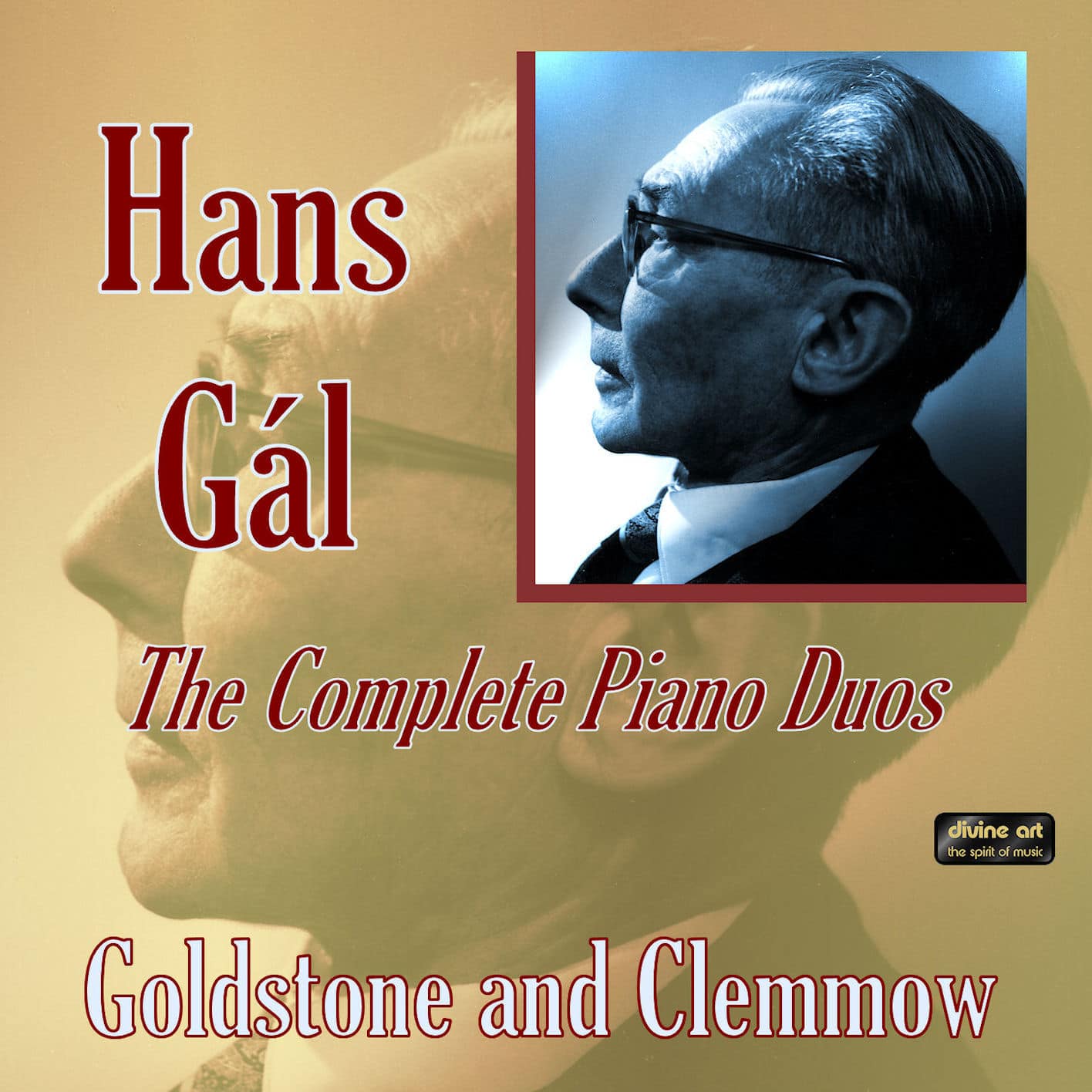
  • Hans Gál – The Complete Piano Duos

    Hans Gál – The Complete Piano Duos

    The music of Austrian composer Hans Gál is being rediscovered and appreciated more and more for its infectious tunefulness and verve, and bears close comparison with the music of Dvorak and the other mid European late Romantics. Here is the first and only recording of his works for piano duo : the album was previously released on Olympia but only weeks before that label’s demise, so it will be new to almost everyone.