Catalogue Connection: 25099

  • Fanfare – Maria Nockin – 25099

    The Debussy Ensemble is made up of flutist Susan Milan, violist Matthew Jones, and harpist Leuan Jones. Milan is a former principal flute of the Royal Philharmonic Orchestra; all of these artists teach at the Royal College of Music in London.

    Composer Arnold Bax was born in England, but after reading a good bit of Irish literature he became fascinated with the Emerald Isle and its wild, windswept coast. Making frequent visits, he drew inspiration from its landscape and from the culture of its hardy people. He wrote the Elegiac Trio in memory of friends who died in Ireland’s 1916 Easter Uprising, mounted by Irish republicans who had hoped to end British rule in Ireland while the Empire was fighting World War I. The hauntingly sad themes of this work combine his memories of Ireland with lush French Impressionistic har­monies. The members of the Debussy Ensemble balance the timbres of their instruments beautiful­ly in their intense rendition of this colorful piece.

    Claude Debussy wrote his Sonata for Flute, Viola, and Harp in 1915, when France was totally embroiled in World War I. Although he was already ill with a fatal cancer, he wrote to Igor Stravinsky, “New beauty should fill the air when the cannons fall silent.” He tried to make it so with this highly evocative sonata, the pastoral first movement of which exudes a calm, bucolic atmos­phere. The ensemble that named itself after this composer has done very well by him in this instance. The catchy second movement and the propulsive third surround us with shimmering combinations of tone and timbre.

    Ravel’s Sonatine as heard here is a transcription by harpist Carlos Salzedo, with Ravel’s approval, of his well-known piano Sonatine. Although it is a rather difficult piece to play, the Debussy Ensemble handles it with great delicacy. They play its wild arpeggios and tempi changes with deceptive ease.

    William Mathias wrote his Zodiac Trio in 1976. A very individualistic composer, he dedicated the piece to the musicians who premiered it by titling the movements with their respective zodiac signs. The scintillating first movement is “Pisces,” the second a resplendent “Taurus,” and the last is a sonorous “Aries.” Here, the ensemble plays with something of a bite, for at this point in the pro­gram a change of pace is in order. Impressionist pieces tend to blend into each other if some varia­tions are not made.

    Theodore Dubois won the Prix de Rome in 1861 and some years later he succeeded Camille Saint-Saens as organist at the Church of the Madeleine. He also taught at the Paris Conservatory,

    where one of his pupils was Paul Dukas. He wrote a great deal of music that should be heard more often. In 1904, he composed this disc’s title work, the Terzettino. An enthralling, romantic work, it provides a luminous finale for this exquisite compact disc.

    The Debussy Ensemble plays each piece with voluptuous dynamics and expressive phrasing. The players converse with each other on an equal basis, the viola providing opulent low tones and the flute exquisite highs. The sound is warm and well balanced. I would choose this disc for back­ground music at a sophisticated gathering.
  • Daily Classical Music – Bill Newman – 25099

    I have known Susan Milan for about fifteen years, from the time I interviewed her at the Royal College of Music where she teaches and runs a course of masterclasses. In her earlier years she was principal flautist for the Royal Philharmonic Orchestra under the late Rudolf Kempe, where she excelled. Since then she has been responsible for forming various chamber groups where she performs at different venues, and I always enjoy these events, most often at St Johns’ Church, Smiths Square. She comes from a distinguished line of performers of which I well remember Gareth Morris, Geoffrey Gilbert and William Bennett.

    The music on this CD is finely contrasted: Arnold Bax’s Elegiac Trio possesses a typically Irish tonal setting — although he was London born — and in its musical makeup has the strains o f Donegal, where Bax settled, using the pseudonym of Dermot O’Byrne in his published writings and poetry. His mentor was William Butler Yeats. Like his brother Clifford, Arnold was a born painter of images that reflect the land of his adoption, and the music is ideally coloured by the mysterious undercurrents that stimulated the imagination.

    Debussy’s Sonate en Trio is divided into three movements — Pastorale, Interlude-mouvement de Menuetto and Anime — and is not dissimilar. Indeed, one could easily mistake its derivation as the last of three final sonatas he wrote at the end of his life. Here the oboe part is replaced by Matthew Jones’ viola to give warmth to the irridescent colourings.

    Ravel’s Sonatine en Trio is an arrangement by that doyen of harpists, Carlos Salzedo. The original was a test piece set for students to play at The Paris Conservatoire. The flow of pieces so far is natural and spontaneous, and seizes on the imagination.

    I believe I was the last journalist to interview the late Welsh composer William Mathias (1934-1992). He had been suffering from cancer for some time. At the invitation of his daughter Rhiannan, I journeyed to the Menai Straits in North Wales and did a very successful interview just a week before his demise, afterwards writing an obituary for The Daily Telegraph . Three contrasting sections make up The Zodiac Trio, Op 70: Pisces ( Allegro vivo ), Aries ( Andante ) and Taurus ( Allegro alla danza ), and they are typical of this late, lamented genius of a composer.

    Lastly, Theodore Dubois’ Terzettino — a single Moderato lasting just five and a half minutes provides a fitting conclusion to this beautifully balanced CD.

  • Wrightmusic – David C F Wright – 25099

    A lovely CD.

    The performers are all well-known and deservedly admired. They bring to this music commitment and style. And in the Bax a glowing beauty.

    His Elegiac Trio dates from 1917 when like most other people he was troubled by the war. His love for Ireland and its political upheavals also distressed him. There was the Easter Uprising in Dublin in 1916 and , to my mind the composer captures a peaceful countryside scene with reference to Irish folk music . There is the sound of running streams and evokes a warm day of delight and peace.

    I would not call this work impressionistic music because this is not just mood music. It is not just atmosphere. It contains themes and logic.

    The Debussy is rather more earthy and a good piece in parts although it does not have the same obvious coherence.. It consists of a pastoral, interlude and finale. The performers do very well in this episodic piece. But the music is rather like a patchwork quilt. It is like that famous remark about Jane Austens novels in that nothing ever happens in them. The soloists all produce gorgeous sounds and impeccable intonation. I do love the tone of the violist and he proves again that this instrument is the Cinderella of the orchestra. But do not misunderstand me … Susan Milan and Ieuan Jones are also exceptional. Having seen them in concert produced evenings of rare pleasure.

    I am not sure why anyone would want to arrange Ravel’s Sonatine for piano into a trio. In its original form it is a very satisfying work , But Ravel liked to write piano music and then orchestrate it but not always successfully. The arranger Carlos Salzedo was both a composer and a harpist and perhaps wanted to extend the repertoire for the harp and Ravel apparently gave his approval to this arrangement. For what it is, it does bring out elements in the music and you have hear different and new aspects.

    This Sonatine is a very fine work and , again , it is not just mood or atmosphere but contains memorable material.

    William Mathias is an uneven composer. Some of his works are truly magnificent and others are disappointing. (see separate article on this site about Mathias).

    His works for organ and his piano concertos are first rate but his late works do not reach those heights. The harp is the national instrument of Wales and so one expected Mathias t o write for the harp. He wrote a Concerto for flute, harp and strings, a Harp Concerto, a Sonata for harp, Improvisations for harp and the curious Santa Fe Suite for harp.

    The Zodiac variations are three pieces to the astrological signs of Pisces, Aries and Taurus. [ The reviewer believes that Mathias ‘borrowed’ the idea and title from Searle’s work of 1970 some five years earlier].

    Mathias’s work is challenging for the performers but he uses techniques such as flutter-tonguings ,tremolos, harmonics and sliding a metal object on the fingerboard and various tappings , but this does seem to blend with the conventional use in the piece. If you are going to use such effects then it must result in a totally contemporary piece. If you are to write a conventional piece then these non conventional effects are not at home.

    Theodore Dubois lived from 1837 to 1924 and was a successful academic and composer. His organ music is in the libraries of every discerning organist. Terzettino was apparently written for Phillipe Gaubert, Van Waefelgham and Henrietta Renie and is a sumptuous piece. It is unashamedly romantic an d has a logic in its structure.

    Much to commend this CD.

  • Midwest Record – Chris Spector – 25099

    The title means a collection trios for harp, flute and viola and you get what they play for in taking on the works of five fairly contemporary composers, including namesake Debussy, and giving those works a fine ride. Sounding more like a soundtrack studio orchestra than only three pieces giving their best and their all, this is a classical record like the kind they used to make, when they put the music first no matter how important the money was in the bean counter room. The group plays like a dream, making this a top notch audio getaway just perfect for when you need to check out from the noise the world has to offer. A winner throughout.

  • MusicWeb – John France – 25099

    Most folk would regard the combination of flute, viola and harp as rather unusual and unlikely to have brought forth many works. However, a brief look on the Internet reveals dozens of pieces for the medium, with many of them having been written in the past thirty years. The earliest would appear to be the present Sonate by Debussy; however, Bax could be the contender for that honour.

    Even the most cursory hearing of the works on this CD reveals a great potential for richness of musical colour and tone. It is an instrumental combination that must be a gift to any composer who wishes to write a piece of evocative music that nods towards impressionism, the mysterious or the exotic.

    Arnold Bax balanced impressionism with romanticism in many of his works. Added to this was the influence of the ‘Celtic Twilight’. In the present Elegiac Trio all three stylistic elements are present. This is a lyrical work that alludes to the 1916 Easter Rising in Ireland and what Bax perceived as the loss of his ideal (and maybe imaginary) world.

    The work is written in one continuous movement and references Irish melodies, ‘colourful pastoral scenes [and] … rippling waves.’ I think that what impresses me most about this work is the successful balance between the various instrumental timbres. It is possible that Bax was inspired by Debussy’s Sonate for the same combination of instruments which was written some six months previously. However, some scholars feel that Bax would not have had an opportunity to hear this work as it was not heard in London until just six weeks before the Bax premiere. So maybe he invented this particular chamber grouping.

    Debussy’s Sonate en Trio was, as stated above, written during the Great War in 1916. It is one of three important sonatas written in the last years of his life: the other two are for cello and violin. In many ways, the present work sounds like an improvisation, where the soloists experiment with various instrumental colourings. They are often used in a pointillistic manner which may remind the listener of the orchestral work La Mer . The Sonate is in three movements.

    I am not quite sure about Ravel’s Sonatine en trio . This is simply a transcription of the well-known Sonatina for piano. It is attractive enough, but I would much rather hear it in the original version. It was arranged sometime after 1915 by the harpist Carlos Salzedo with, ‘by all accounts’, the composer’s blessing. Perhaps it would have been better for the Debussy Ensemble to champion a work by a lesser-known composer that was especially written for their instrumental combination.

    After reading the liner-notes about the William Mathias’s Zodiac I was a little concerned. My eye caught a sentence about ‘cosmic’ effects, such as ‘string sliding using a metal object’ on the viola and ‘soundboard tapping’ on the harp. As my late father would have said, it sounded a little ‘long haired’. Yet I need not have worried. Mathias’s good sense and musicality saved the day. The work is conceived as a journey between the star signs of Pisces, Aries and Taurus. The three constellations are separated by ‘travelling’ music. This is an attractive, musically interesting piece that is often haunting and always interesting. There is another recording of this piece listed in the catalogues on the ‘Harp and Company’ label, however I have not heard this.

    Theodore Dubois is best remembered in the organ loft. I wonder what aspiring organist has not attempted the superb Toccata . However, there is a deal of instrumental, chamber, vocal and stage works in his catalogue. The Terzettino , which gives its title to the CD, was composed in 1904: the composer was 67 years old. It is a delicious work that is both romantic and reflective. The only downside is that it is far too short.

    The Debussy Ensemble consists of three well-respected and competent soloists. Susan Milan was a former principal of the Royal Philharmonic Orchestra who now has a largely solo career performing with three chamber ensembles including the present one. She is also Professor and Fellow of the Royal College of Music and is a director of the British Isles Music Festival. Matthew Jones is a teacher, performer on the violin and viola and a composer. He regularly gives recitals with the pianist Michael Hampton. Finally Ieuan Jones began playing the harp at the age of six. He continued his studies at the Royal College of Music. He has given concerts in many countries and has made a number of recordings.

    Much of this music is impressionistic and numinous in mood and I felt that this was not reflected in the sound quality of this CD: they are just a little let down by the hard edge in the recording. However, the playing is excellent and all three soloists respond to each other sympathetically.

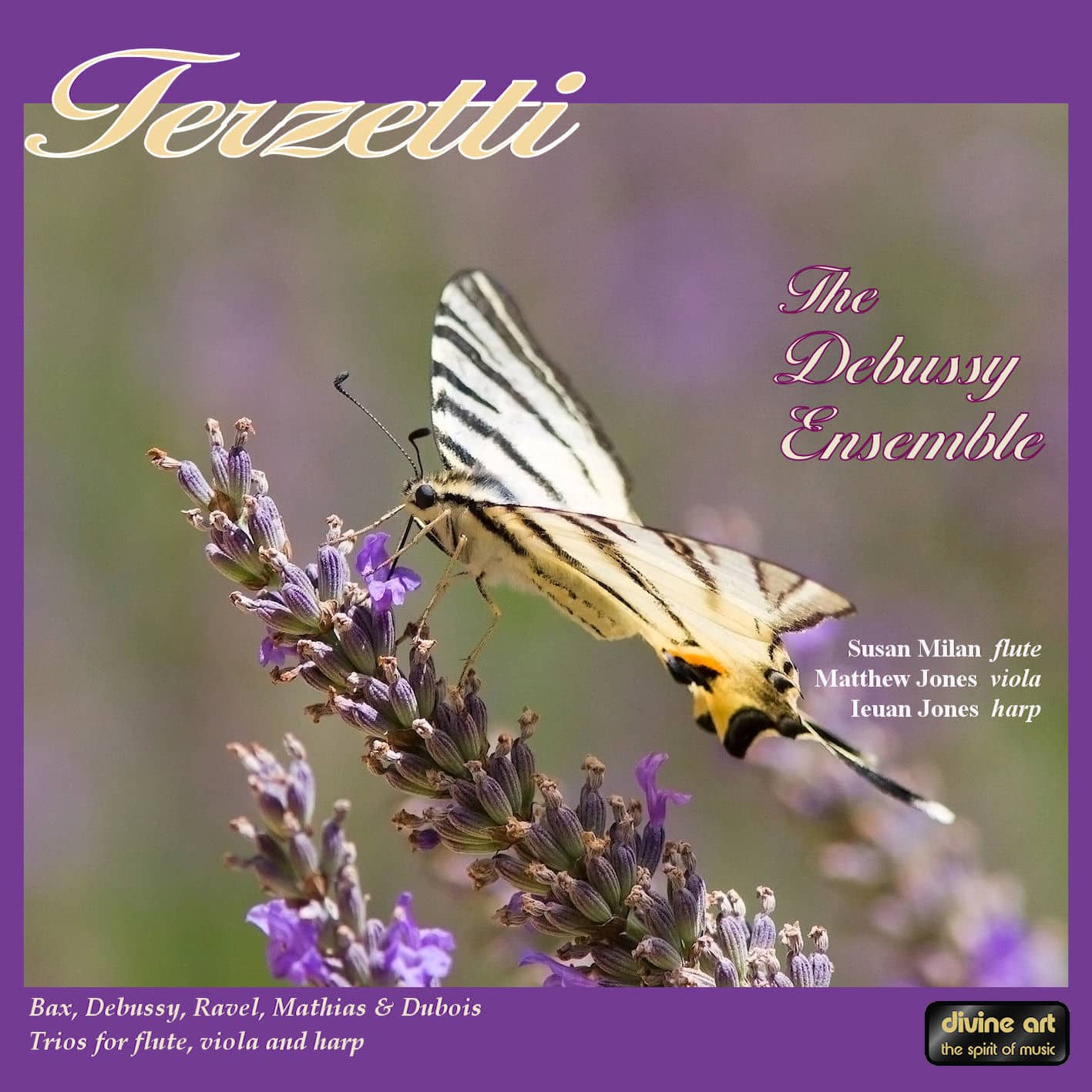
    Bearing in mind that these works are not well known, the liner-notes could have been more extensive. For example, there is virtually no description or analysis of the Ravel, the Bax or the Dubois. Finally, I felt that the cover was just a little bit ‘naff’.

    Nevertheless, this is a great CD with a wide-ranging selection of music: it displays an instrumental combination that is relatively rarely heard.

  • Music Web – Brian Wilson – 25099

    The combination of flute and harp can be very evocative – I’m thinking especially of Mozart’s concerto for the pair where he somehow overcame his supposed dislike of the two instruments, especially the flute, and Ravel’s Introduction et allegro for harp, string quartet, flute and clarinet. The Ravel Sonatine on this Divine Art recording was not originally composed for those two instruments plus viola but is often played in this arrangement and sounds little short of the power of its better known sister piece. All the other music is well worth hearing, too.

    I found this album to be attractive late-night listening. Over speakers at a moderate volume I thought the performances sensitive without being over-sugary and that the lossless recording serves the players well.

  • International Record Review – Mark Pullinger – 25099

    ebussy’s Sonata for flute, viola and harp of 1915 was the second of a proposed series of six sonatas, including some for diverse combinations of instruments, of which he completed only three. Although it was originally conceived for flute, oboe and harp, Debussy decided the viola’s darker timbre would work better than the oboe, the stringed instrument contrasting well against the flute. Ironically, across the Channel at roughly the same time, Arnold Bax composed his Elegiac Trio for the same usual combination of instruments. It was first performed at London’s Aeolian Hall on March 26 th , 1917 by the same group which had given the British premiere of Debussy’s Sonata just seven weeks earlier. The Debussy Ensemble pairs these two contemporaneous works, adding a Terzettino by Théodore Dubois from 1905 (the first example of this instrument configuration?), William Mathias’s Zodiac Trio from 1975 and an arrangement by Carlos Salzédo, claimed to be supported by the composer, of Ravel’s Sonatine.

    Unfortunately, a thoughtfully constructed programme is marred by two major factors which inhibit enjoyment of this disc. The claustrophobic recording finds us dangerously close to the players—capturing every creak and clatter—while the acoustic is quite reverberant. The playing of flautist Susan Milan is most disappointing. I’ve long admired her artistry, her Gaubert survey for Chandos being particularly fine, but her tone here is laden with heavy vibrato from the first bar of the Debussy, where the long C judders queasily; less mélancoliquement, more mal de mer. Her sound production (and close recording) brings out other undesirable harmonics and whistles.

    Matthew Jones’s viola sounds appropriately glassy in the sul ponticello passages in the Pastorale first movement, but his contributions to the opening of the finale sound overly aggressive. Milan and Jones seem mismatched in tone quality. There are several examples in Debussy’s Sonate of Klangfarbenmelodie, where the melodic line is split between two instruments, but the joins are anything but seamless here when flute tone is so wobbly. It is also disconcerting in passages, such as the closing bars of the Pastorale , where flute and viola play in unison; placed either side of the stereo picture, the disparity is particularly alarming if listening via headphones. ‘Expressive and delicate’ are Debussy’s markings at several points in his Sonata; sadly there’s little that’s expressive or delicate here. The classic Melos Ensemble Decca recording remains unsurpassed, although Philippe Bernold, Gérard Caussé and Isabelle Moretti for Harmonia Mundi offer a beautifully expansive account, treating the opening movement as a languorous cousin of the ubiquitous Faune.

    Bax’s Elegiac Trio fares a little better. Ieuan Jones’s harp seems more distantly placed, the rippling bardic solos in the single movement work played sensitively, varying dynamics. Milan shows agility and imagination in her solo passages, though the vibrato remains disconcerting. The Nash Ensemble (for Hyperion) or Mobius (Naxos) are both stronger recommendations for this atmospheric work.

    The arrangement of Ravel’s Sonatine doesn’t strike one as particularly successful, however attractively played; the harp seems redundant for much of the time, apart from the final Animé movement where a more glittering accompaniment is permitted. The central Mouvement de Menuet is pretty enough.

    The Zodiac Trio , an astrological suite composed by Mathias for the Robles Trio, is attractive. Its three movements (‘Pisces’, ‘Aries’, and ‘Taurus’) were selected as the birth signs of the Trio’s three members, said to reflect their characters, the Taurean finale particularly quirky. The imaginative programme concludes with Dubois’s charming Terzettino , in many ways the most persuasive performance on this disc, flute lines admirably clean and a berceuse-like lilting harp accompaniment as flute and viola arch ever skyward: a silver lining on an otherwise unmemorable disc.

  • Musical Pointers – Peter Grahame Woolf – 25099

    A lovely disc which may prove revelatory to some? The programme is carefully chosen, with the Debussy trio the best known yet most elusive music; I found it very rewarding to hear it again twice in succession. The Ravel, familiar on the piano, and one that I worked hard on years ago, comes up well in Salzedo’s transcription, a worth-while addition to a slender repertoire. The meatiest (and longest by a short head) is the short-lived Welsh composer William Mathias’ quite complex trio (1975); he eschewed serialism quite early, but that proves our gain.

    Recommended.

  • Terzetti: Trios for Flute, Viola and Harp

    Terzetti: Trios for Flute, Viola and Harp

    This disc contains beautifully atmospheric 20th century works for flute, viola and harp, from the well known Zodiac Trio of Mathias, to the lesser-known gem by Dubois. Three of Britain’s foremost soloists join to provide a memorable program.