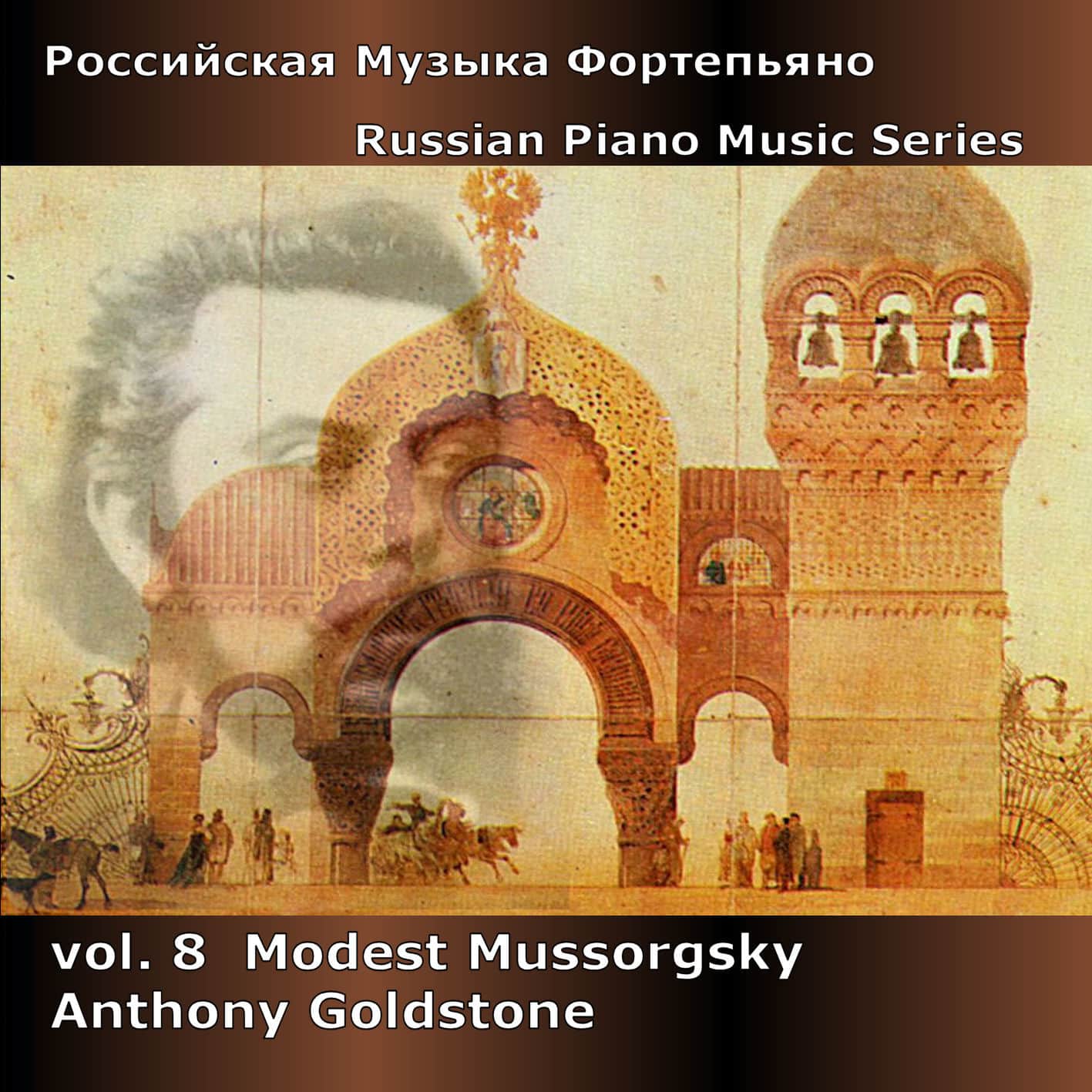
Given that Volume 4 in this series – featuring the magnificent Lyapunov Sonata – was one of my discs of the year for 2010, I was looking forward to listening to this disc hugely. I am pleased to report that in every respect it is up to the high standard of the earlier releases and matches them in the quality of the engineering, production, programming and above all the performance of pianist Anthony Goldstone. Goldstone has been the cornerstone of this – to date – eight volume series; this is his fifth disc. A cursory check on Goldstone’s discography reveals a remarkably diverse repertoire all of which he performs with remarkable sympathy and aplomb either as a solo performer or in tandem with his regular duet partner and wife Caroline Clemmow. The consistent quality of his music making is both a wonder and a delight but if pushed I would have to say that it is this series of Russian piano rarities that has given me the greatest personal pleasure.
You get the feeling that the production team here have the formula– in the best sense of the word – for these discs off to a tee. The recording location is the same as the earlier discs and if anything the sound here is even finer than those excellent recordings; a piano in superb condition evenly voiced across the entire keyboard, richly recorded with plenty of detail but set in a pleasing acoustic. I notice that there seems to be no producer or engineer credited and that the playing rights for the disc resides with Goldstone himself so I wonder if he supervised the technical as well as musical aspect of the performance? He certainly does provide – again as before – the superb liner note. He has a natural communicator’s ability to write in a manner that is fascinatingly informative and packed with interesting facts yet at the same time wears its academic credentials lightly. A case in point here is that the performing edition of the Pictures from an Exhibition is nothing less than the composer’s manuscript and the liner points out numerous deviations and alterations between this text and the standard published version.
With previous volumes nearly all the repertoire was unfamiliar. Here we get the very familiar Pictures which will have collectors contemplating the need for repertoire duplication. Given the quality of the performance, the fact that it uses the manuscript and includes rare variant movements and that this work represents less than half of the music on this very well-filled disc I would have to conclude it is well worth the outlay and risk of duplication. I cannot claim any huge knowledge of Mussorgsky’s piano works away from the big central piece so this has proved to be a fascinating voyage of discovery. A fact that stares one in the face but I had not really considered before is that Mussorgsky is in scale if not emotional content a miniaturist as far as this repertoire is concerned. Strip away the umbrella title of ‘Pictures’ and in essence you have a series of concentrated tone-poems for piano of which only the final Great Gate lasts for more than five minutes. In fact only one other work recorded here is longer – the nine minute Intermezzo in modo classico – all of which reinforces the impression that in his piano music at least Mussorgsky was a composer who preferred to distil his utterances into concentrated and detailed writing. This in turn makes it vital for the performer to get straight to the heart of the music without time for generalised or discursive gestures. Of the first three works recorded the opening Gopak is the most familiar although Goldstone has chosen an early version of the work which is thereby given its ‘possible first recording’. It sets the tone for the quality to come with dancing rhythms, articulate inner part playing and dynamics carefully controlled. With much of Mussorgsky’s music the extra-musical associations are significant. The next two pieces show different yet important influences. The first is On the Southern Shores of the Crimea . This was written as a response to a concert tour the composer did of that area of Russia and reflects his delight in the folk music he heard there. As Goldstone points out, these are not intended as ‘folk-transcriptions’ but instead are musical postcards or impressions of the country. Hence this piece fuses a melancholy opening and closing evocation of the landscape framing a folk-dance central panel. If musically and emotionally Mussorgsky felt he identified more with the common man than the Russian aristocracy he also found emotional refuge in memories of childhood. This is particularly evident in the pair of pieces From Memories of Childhood [tracks 4 & 5]. Both last barely a minute and a half but they are perfect examples of Mussorgsky’s extraordinary ability to create memorable music on the shortest timescale. The second piece here – Nurse shuts me in a Dark Room – receives its [nominal] first recording, requiring as it did to be completed by Goldstone (the same piece turns up on the ‘complete’ piano works on the Skarbo label played by Sylvie Carbonel but it is unclear if she plays the published incomplete piece or another editor’s version). Both of these nursery pieces have echoes of Chopin’s Etudes but the latter foreshadows elements of Pictures – still a decade in the future. This is a bravura toccata-like work that displays Goldstone’s superb technique and ability to combine power with articulacy and sheer dexterity.
Goldstone’s approach to the main work is narrative rather than episodically virtuosic. The ever-illuminating note links the composer’s careful annotations to the score – as so often amended or ignored by well-meaning editors – to an emotional journey through the gallery of his great friend’s work. The benefit of this is that there is a coherent sweep to the work in toto that is often missing. Goldstone sees the linking Promenade movements in particular as charting the viewer’s journey from nervous indecisiveness to confidently striding. The same emotional arc brings a logic to the placement of the ‘big’ Great Gate as the closing indeed crowning movement not just because of its scale and visceral impact but because the picture itself [a design for a ceremonial gate in Kiev to be built to celebrate Tsar Nicholas II’s escape from assassination] was one of the artist Hartmann’s proudest achievements. Conversely, certain movements are quite deliberately not given the grandstanding virtuoso treatment to which one has grown accustomed. Gnomus [track 8] – although played with all the care and precision one could hope for – does not make the sheer impact here as other versions have. This is one of the Hartmann illustrations that have been lost so it is not possible to be certain just how grotesque Mussorgsky’s Gnome should be. But from here on I have nothing but admiration for this interpretation. Highlights include Il vecchio castello with the lilting lute accompaniment ebbing and flowing to perfection. Goldstone’s phrasing is wonderfully free without being in the slightest mannered – his real skill is the freely phrased song in the right hand over an insistently thrumming left hand. The ox cart Bydlo lumbers splendidly without being simply loud and is in brilliant contrast to skittish Tuileries or Ballet of the unhatched chicks. The latter in particular I do not think I have ever heard so effectively characterised. Goldstone provides the text that Mussorgsky wrote (but subsequently crossed out) elaborating on the gossiping that is the main element of the Limoges – le marché. Curiously, given the lightness of touch elsewhere Goldstone opts for style that echoes the earlier Nursery toccata one imagines more arguing in the market-place rather than gossiping. Catacombs comes across as strikingly modern with a starkness and rhythmic freedom quite beyond most contemporaneous piano music. Likewise the following Cum mortis in lingua mortua which Goldstone sees as a communion between the living composer and his dead friend. Bab-Yaga is another showpiece. Here we do have the Hartmann drawing and it is clear that Mussorgsky has chosen to encapsulate the nightmare character of Russian myth rather than the slightly twee clock of Hartmann’s design. This movement leads without a break into the famous Great Gate . Goldstone is especially good at recreating the effect of the overlapping pealing of bells. This has never been my favourite part of the work – it strikes me that Mussorgsky has to work too hard at creating the overwhelming impact he strove for. Which is no doubt why the piece has been subjected to so many orchestral and other arrangements. Even Goldstone cannot prevent the piece sagging but in its own terms this is a performance the equal of any other. For the rest of the disc we have some more appealing miniature tone-poems for piano and the three alternative versions of movements from Pictures. The long Intermezzo in modo classico does rather outstay its welcome making my comments earlier about Mussorgsky being happiest when creating concentrated pictures in sound seem all the more accurate. The three early versions of the Pictures are again less concentrated than they finally became – the differences are not huge and they are well worth hearing but again the conclusion that concision and quality go hand in hand with Mussorgsky in unavoidable.
So, another fine and valuable addition to this excellent series. If I won’t return to it as often as some of Goldstone’s other contributions to the cycle that is simply because I respond to the musical content of the other discs more. The quality of the performance and presentation here is ideal and for those curious about Mussorgsky the piano composer away from the main cycle this is self-recommending. There are other multiple disc collections that claim varying degrees of completeness. I have not heard any of those sets – variously available on Brilliant Classics and Danacord. For a single disc survey I find it hard to believe the disc under consideration here will be easily beaten.