Catalogue Connection: 25101

  • International Record Review – Raymond S. Tuttle – 25101

    This is an aptly named CD. The programme that Anthony Goldstone and Caroline Clemmow have assembled is obviously intended to instil, above all, a sense of delight in the listener. They, like Pierre Luboshutz and Genia Nemenoff before them, and Vitya Vronsky and Victor Babin, and many other piano duos, are a married couple. If their marriage is characterized by as much zest and harmony as their playing here, then their relationship must be felicitous indeed.

    Goldstone and Clemmow have recorded nearly 40 CDs, many for Divine Art. Sooner or later, a Spanish-themed album is practically de rigueur for classical recording artists, and Goldstone and Clemmow have assembled theirs from versions prepared by the composers themselves (Chabrier, Rodrigo, Rimsky-Korsakov, Saint-Saëns) or by other hands. Thus, it appears that Cécile Chaminade’s La Sévillane is the only work here specifically intended for two pianos. This programme is a mixture of music for piano duo one piano, four hands, in other words ­ and two pianos. This is made apparent by the recording engineers, who widen the sound-stage when two pianos are involved. This recalls the early days of stereophonic sound (remember Juan García Esquivel?) when music endearingly ping-ponged from one speaker to another in every self-respecting bachelor¹s pad. Divine Art¹s engineers have also contrived to present the pianists in an acoustic that is warm and resonant, albeit with no loss of detail.

    Much as I like Esquivel, ‘Delicias’ is a more refined treat ­ more savoury than sweet. In other words, this is more than a gimmick, and more than a collection of picture postcards, even if the music is rather on the light side. The success of the recital, and of the performances, is driven home in the two-piano arrangements of Nights in the Gardens of the Spain and of the second movement from Rodrigo’s Concierto de Aranjuez . Both of these are concertos, of course. One ‘A. Bertram’, of whom nothing seems to be known, arranged the second piano part of the former, and Rodrigo himself arranged the second piano part of the latter. In concertos, advanced piano students are used to being accompanied by a second piano, in lieu of an orchestra, but what is acceptable in the practice rooms of a conservatory is not always agreeable in one¹s listening room at home. It is to the credit of ‘A. Bertram’, as well as Goldstone and Clemmow, that Falla’s work is not reduced to a monochrome and that the piano parts are of equal interest. (The original piano part seems to have been left alone.)

    As for the Concierto de Aranjuez , interpreting guitar music for the piano is another challenge altogether. Rodrigo anticipated this in a solo piano arrangement of this movement (Aranjuez, ma pensée), but that doesn’t take away from the success of what Goldstone and Clemmow present here. It would be a cliché to say that I hardly missed the guitar. Nevertheless, when one has a melody as good as this one, it is almost impossible to go wrong with it. (Some readers might remember Isao Tomita¹s synthesizer arrangement of this movement in the 1970s. It was, and still is, a guilty pleasure for me.)

    Rhythmic slackness would be particularly damaging in a programme of Spanish or Spanish-inspired delights. Fortunately, Goldstone and Clemmow don’t miss a trick, and their playing here is precise without becoming pedantic. There is abundant colour in their pianism too; try the shimmering timbres one minute into the first movement of Nights in the Gardens of Spain and ask yourself if the piano is truly a black-and-white instrument, both inside and out.

    Goldstone, in addition to his outstanding pianism, and his arrangement for piano duet of Francisco Tárrega’s Gran Vals , originally for guitar, also wrote the booklet notes for this release. No raiding of Wikipedia here: Goldstone put considerable research into these notes, and they are informative as well as friendly.

    I played this CD multiple times over the course of two days and at no point did my enjoyment and admiration diminish. As February is a disagreeable month throughout much of the northern hemisphere, might I suggest 29 hibernation days, accompanied by a bottomless pitcher of sangria and a copy of ‘Delicias’?
  • Gramophone – Bryce Morrison – 25101

    Latest in a series of duo-piano transcriptions of Spanish works ‘Delicias’, the title for Anthony Goldstone and Caroline Clemmow’s “Spanish delights for piano duo” is the 15th issue in their endlessly enterprising series for Divine Art. And here, whether in authentic Spain or clever pastiche, they make you wonder why the Spanish repertoire and its offshoots aren’t more eagerly embraced by virtually every musician. True, its personal and volatile idiom remains alien to several great pianists (‘I’m a Russian, not a Spanish gypsy’ – Horowitz), but at its greatest, as in Falla’s Nights in the Garden of Spain , it remains a haunting evocation, the very essence of a once exotic land.

    Goldstone and Clemmow launch their recital with Chabrier’s España , a riotous tribute to the composer’s lifelong love of Spain and its women, who entranced him with their ‘sparkling smiles and that marvellous Sevillian behind that goes on turning and turning while the rest of the body seems not to turn at all.’ They’re also at their brilliant best in Rimsky-Korsakov’s Capriccio espagnol , in Saint-Saëns’s elegant take on the Spanish idiom and in their Tarrega finale, where they send you gently waltzing across the ballroom floor, for Goldstone, writing in his informative notes, ‘a whimsical encore’. Elsewhere, in Granados, Lecuona, Rodrigo and Falla, I could have wished for a higher degree of engagement. The Falla in particular cries out for a finer memory of its orchestral colour, its magic weighed down by this none the less fascinating arrangement. But all these performances are never less than richly experienced and musicianly, and Divine Art’s sound is admirably clear, leaving you to wonder what this admirable duo still have up their sleeves and their fingers.

  • MusicWeb – Jonathan Woolf – 25101

    Surely there is no more entertaining or exploratory a piano duo in the world today than Goldstone and Clemmow. Their names are beginning to take on the ring of Vronsky & Babin, or Smith and Sellick, or Bartlett and Robinson or other of their elite predecessors. Except, I think, that G & C have undertaken a recording programme that is throwing up many more first performances, arrangements, and novelties, than ever before. And this disc is no exception.

    We have a ‘Spanish Delights’ programme. Not all the composers are Spanish, but all have plugged into the national grid of the continent and produced music of vivid immediacy. Chabrier leads with España . The composer played the piece to his wife-to-be and it was probably conceived for piano. It remains deliciously colourful, and is rendered here with sufficient rhythmic brio to ensure that its vitality is richly conveyed. I mentioned earlier Bartlett and Robinson and it’s their arrangement of Granados’s Quejas ó la maja y el ruisenor – from Goyescas – that we hear in its first digital recording. No complaints at all about the rich melancholia conveyed in either arrangement or performance. Lecuona’s Malagueña is heard in the arrangement for two pianos by Grace Helen Nash, and full marks to the duo for their rich chording and rhythmic vitality.

    It’s something of a surprise to hear Rodrigo’s Adagio from the Concierto de Aranjuez. I’ve certainly never heard this version, which is not surprising as it is apparently the first ever recording of the composer’s own arrangement. As ever, whilst one’s ear misses the known version it’s rewarding to hear a ‘bare bones’ performance that clarifies the music. Chaminade and Saint-Saëns bring their own French high spirits to the party: the former has a salon-carnival approach in La Sévillane whilst Saint-Saëns unveils his dance with crisp panache, and the two performers do so likewise. The reduction of Falla’s Nights in the Gardens of Spain is by one A. Bertram, and it’s a highly competent piece of work heard, once again, in a claimed first ever recording. I like the way the flamenco guitar is evoked in this piano duet performance of Rimsky-Korsakov’s old pot boiler, the Capriccio espagnol. If ever you get tired of the orchestral flourish, you might turn your ear to this less gilded version with advantage. Unlike the rest of the programme this is a much older recording, taped back in 1990. And as an envoi you can listen to Tárrega’s delicious charmer, Gran Vals . It’s a first recording too, it seems. One word of warning: if you play it and notice a little theme that makes you narrow your eyes and squint and say to yourself; ‘But I know that tune, what the Hell is it?’ then let me tell you. It’s the Nokia ring tone. Who knew? How did Nokia get hold of it? Thanks to Anthony Goldstone for pointing that out in his highly readable notes. It saved me some minutes of agony.

    As I hope you can tell, I’ve enjoyed this disc immensely. Piano duets or reductions or originals that are better known in orchestrations aren’t everyone’s cup of tea, but when the playing and recording are as good as this, I don’t think you could possibly complain.

  • Audiophile Audition – Lee Passarella – 25101

    Delicias, indeed. When I started to listen to this disc, I thought two pianos couldn’t possibly capture the essence of this music, especially the dazzling coloristic effects that Chabrier and Rimsky-Korsakov achieved in their orchestration. But surprise! The arrangements —some lovingly done by the composers themselves—and playing are both so spirited and accomplished that I’m entirely won over. Plus there are some gems here that are virtually unknown in any format, such as Saint-Saëns’ Jota and Chaminade’s La Sevillane. The latter is pretty and appealing as is all the music I’ve heard by this composer, but there’s more of Paris salon than of Seville dance hall about it. On the other hand, Saint-Saens’ work is a short fantasy rather than a straight-up presentation of the famous dance melody and represents a splashy, quirky, thoroughly virtuosic take on it.

    Some of the arrangements augment rather than diminish the original forces. Cuban composer Lecuona’s Malaguena is a duo-piano arrangement of an original solo piano work, as is Granados’ Quejas ó la maja y el ruisenor (“Laments, or the Maiden and the Nightingale”) from his Goyescas, this piece based on a folksong of Valencia, portraying a maiden pining for her lost love to the accompaniment of a nightingale’s song.

    While some listeners might gripe that there’s enough duo-piano music around that one doesn’t need to arrange concerted works like the Falla (which, I guess, doesn’t extend to the Rodrigo since in this case the composer did the arranging himself), I find Falla’s orchestration so subdued (not to say drab) that this the arrangement of Nights in the Gardens of Spain doesn’t compromise the local color of the original. It certainly preserves the delicately scented nocturnal atmosphere of the orchestral version.

    Then we have Tarrega’s sweetly sentimental Gran Vals, which includes a “musical phrase that has surely been heard the most often in history.” Really? Yes! You see, the phrase in question was chosen by Nokia to be the ringtone on its mobile telephones; when you hear that da-da-da-da da-da-da-da da-da-da-da-da-da, you’ll have a serious case of deja-vu that might find you thinking “Turn that damn thing off!” But stick with Tarrega’s charming little ditty —and with the whole program—for a most enjoyable musical tour of Spain, very attractively, and very stereophonically recorded as well.

  • Fanfare – Radu A. Lelutiu – 25101

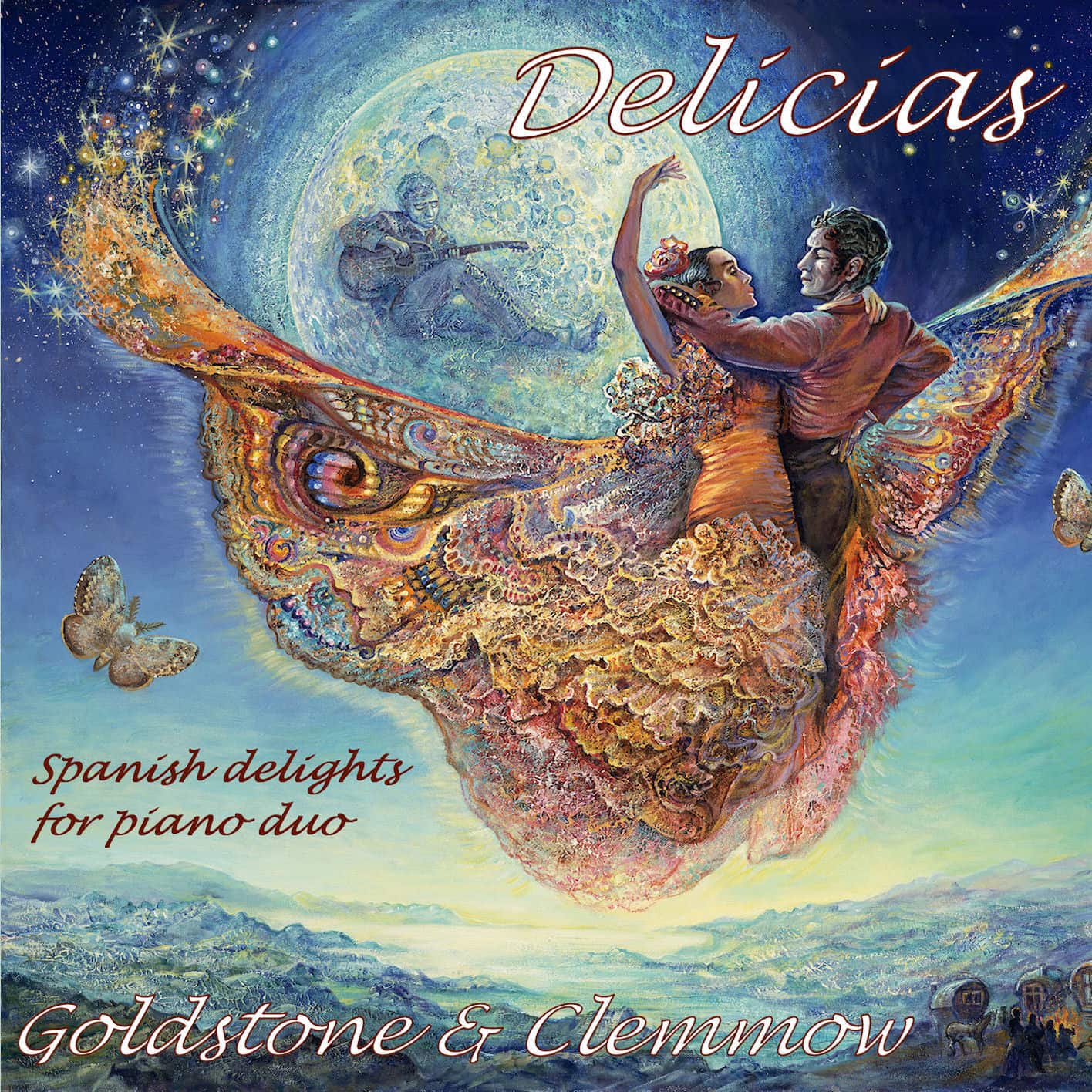
    How do you put together a recording that is guaranteed to be a hit with both Music 101 students and more seasoned listeners? Here is one brilliant idea: Collect approximately 75 minutes of highly accessible music by composers born under or inspired by Spain’s beautiful, carefree sun and have one of today’s best piano duos record it. That pretty much sums up Delicias, the latest disc issued by the British duo of Anthony Goldstone and Caroline Clemmow. I have to confess that upon receiv­ing this recording and being greeted by its rather over-the-top, colorful cover design created by fan­tasy artist Josephine Wall, I wondered what had gotten into these respected artists and prepared myself for the worst. (In case you are curious, the cover illustration depicts two Gypsy dancers float­ing in midair under a brightly lit moon that holds a pale boyish figure playing the guitar.) A minute into Chabrier’s delightful España all was forgotten, and I accepted this recording for what it is — plain old fun that does not pretend to be anything else.

    Yes, it is true that most of this recording consists of guilty pleasures. The aforementioned Chabrier piece, the transcriptions of Lecuona’s hit Malagueña and Rodrigo’s famous Adagio from the Concerto de Aranjuez, the spunky piece by the little-known composer Cecile Chaminade, Saint-Saëns’s infectious Jota aragonese, and Tárrega’s charming Gran Vals certainly fit in that category. But these light treats are served alongside slightly more consistent dishes —Granados’s haunting The Maiden and the Nightingale (the fourth piece from Goyescas), Falla’s ever-lovely Nights in the Gardens of Spain, and Rimski-Korsakov’s vital Capriccio espagnol. In the end, therefore, I doubt that anyone will walk away from this recording feeling hungry.

    The performances are superb. I am not entirely certain how this husband-and-wife team splits primo and secondo responsibilities, but their playing has a unity of purpose that makes that detail large­ly irrelevant. It is particularly impressive how the pianists treat all of the scores with respect and man­age to avoid ever sounding cheesy. The engineering is excellent, as are Goldstone’s informative notes.

    Some parting words. Listeners who enjoy playing the “where have I heard that before?” game will probably notice that the jota featured in the Saint-Saens piece also shows up in Franz Liszt’s famous Rhapsodic Espagnole. I doubt, however, that anyone who has not heard the Tárrega piece is ready for this piece of trivia: In 1993, approximately four seconds from this piece were chosen by Nokia to be the ring tone of its mobile telephone, and that bizarre historical accident likely makes the Tárrega piece —or at least a few seconds of it—the most instantly recognizable and most often-heard work in the history of music. How about that? Enthusiastically recommended.

  • American Record Guide – Harrington – 25101

    I must label this delightful in every way. Clemmow and Goldstone have consistently supplied me with listening pleasure over the years. I still listen to their wonderful discs of Grieg (Divine Art 25042, Jan/Feb 2008), Mozart (25046, Jan/Feb 2008) and Gershwin-Ravel (25057, Sept/Oct 2008). When I saw the colorful booklet cover, I expected an enjoyable collections of bon-bons (or the Spanish equivalent) and maybe Ravel’s Rhapsody Espagnole .

    The reality, as you see above, is a few bonbons and a number of much more substantial little-known works, very possibly getting their first commercial recording with this release. The two-piano version of Falla’s Nights in the Gardens of Spain and Rimsky-Korsakoff’s own piano duet version of his Capriccio Espagnol are major additions to the recorded repertory. As a collector with a penchant for the obscure, I welcome the completion of my piano duet collection of the three large Russian orchestral capriccios composed in the late 19th Century. The other two are Tchaikovsky’s Italian (Labeques) and Rachmaninoff’s Bohemian (Pleshakov & Winther).

    The other substantial works here include Chabrier’s own two-piano arrangement of his best-known work, the orchestral rhapsody España . It is a brilliant program opener, fabulously performed. There are first-hand accounts of Chabrier performing this piece on the piano “as if a hurricane had been let loose”. The familiar Rodrigo Concierto de Aranjuez is a cornerstone of the classical guitar repertoire, and the central Adagio movement is possibly the composer’s best known work. While my guitarist colleague and friend would undoubtedly disapprove, playing both the guitar part and an orchestral reduction on pianos works quite well. There are moments such as the climax of the guitar cadenza, just before the full orchestra comes in, where this performance makes you forget that you are listening to two pianists. Lecuona’s ‘Malagueña’ took me back to my teens when I also played it. The Saint-Saens and Chaminade are delivered with just the right panache. Granados and Tarrega complete this most entertaining release.

  • Music & Vision – Robert Anderson – 25101

    It so happens I have been immersing myself recently in the less satisfactory aspects of Spanish history . Soon after her greatest sixteenth- century composer , Tomás Luis de Victoria , returned from Italy to his native land, Philip II launched his armada against Elizabeth ‘s England , suffering far more than a singed beard. And the Inquisition had already been supervising its bonfires for more than a century, an entertainment that continued till 1834, only a few years before the birth of certain composers on this CD.

    Ravel may indeed have considered Boléro his masterpiece , and that ‘Unfortunately, there’s no music in it.’ Its music, so far as its endless crescendo takes it, was inspired by the Arab legacy of El-Andalus, before Catholic Spain reasserted itself with such a vengeance. And thus it has been with other French composers, from Bizet ‘s Carmen on, inspired by local gipsy music. Chabrier was there in autumn 1882: ‘What an eyeful we’re getting of Andalusian behinds wiggling like frolicsome snakes!’

    He jotted down much music, and the result was España .

    The Spanish are not very fond of the French at the moment, because so many Basque refugees have slipped over the border to safety. But French music has paid continuous musical tribute to the neighbour across the Pyrenees, as Goldstone and Clemmow so admirably demonstrate in pieces of coruscating brilliance . Chaminade used to be a household name, and at the age of twenty-four she wrote a comic opera for private performance with the same La Sévillane title as this brilliant two- piano piece .

    Saint-Saëns had a multitude of musical gifts, as Wagner recognized in 1860, when in Paris for ill-fated Tannhäuser performances : ‘I thus learned to appreciate the skill and talent of this young musician , which was simply incredible.’ He had both superb accuracy and memory . He became later an inveterate globe-trotter; hence his infectious La jota aragonese .

    This joyous recital includes also music from as far afield as Russia , a country no more able to resist the lure of Spain than the rest of us.

  • Concertonet – Suzanne Torrey – 25101

    I don’t know what I expected when I began to listen to this CD but I admit that, as each track went by, I was more and more impressed. “Two pianos, four hands” – the phrase brings back memories of recitals, agonizing thoughts of “Will I be the one to mess up?” Put those ideas away, because this is the fusion of two excellent individual pianists who work so well together that they truly do play as one. In the first cut, the balance was off ever so slightly so that one piano overshadowed the other, but that one tiny flaw aside, this is a CD that you actually want to listen to over and over again.

    It’s easy to see how even the four of the nine featured composers who had no Spanish roots were seduced by the powerful lure of the exotic music. Does all of the music of the country have its origins in the southern province of Andalusia? Of course not, but this disc satisfies the cravings we have for Gypsy dances where castanets and clicking heels drive the beat until it ends abruptly, leaving all breathless. Ms.Clemmow and Mr.Goldstone play with delicacy, subtlety in phrasing and crispness where needed, their accelerations smooth with no urgency. Even old standards such as Malagueña and the Scena e canto gitano from the Capriccio espagnol sound fresh and new.

    The engineering gives the impression of smaller instruments in a more intimate setting, which only enhances the lush feeling of this CD. While you could play it as background music for a cocktail or dinner party, you’ll want to sit down with your headphones on and experience how really wonderful this disc is.

  • Delicias – Spanish Delights for Piano Duo

    Delicias – Spanish Delights for Piano Duo

    Spain, with its location at the southern tip of western Europe, and its exotic history, has developed a unique music tradition, more aligned, through the influence of the Islamic Moorish period, with the middle east than with the more northern parts of Europe. This cultural uniqueness has attracted hosts of non-Spanish composers to write ‘Spanish’ pieces many of which have become staples of the repertoire. This programme includes some favourites – but in unfamiliar guise – and some wonderful and little known gems too. Full of zest, fire and ‘soul’. Several premiere recordings.