Catalogue Connection: 25103

  • The Consort review Galuppi Piano Sonatas vol. 4

    I was glad to receive this disc as, coincidentally, it arrived prior to my giving a harpsichord course in northern Italy, for which Galuppi was one of the set composers. Best known as a pioneer of opera buffa (of which he wrote some 109), Baldassare Galuppi (1706-85) visited London in 1741-3 where he was lauded at the King’s Theatre, Haymarket. Galuppi was choirmaster at St Mark’s in Venice from 1762 and eventually died there, but took an extended break between 1764 and 1768 in St Petersburg, at the behest of Catherine the Great. Galuppi was the last great composer of the independent Venetian Republic. This hugely prolific composer also produced about 130 harpsichord sonatas, toccatas, divertimentos, lessons and other fragments. They are varied and very diverse; most are in binary or early sonata form, and he favours keys of up to four sharps or flats.

    Galuppi’s first two opus numbers, consisting of six sonatas each, were published in London in 1756 and 1759 respectively. His unpublished Passatempo al cembalo of 1781, consisting of a further set of six sonatas, was composed ‘in omaggio alia granduchessa di Russia Maria Feodorovna’. There is still no definitive catalogue of Galuppi’s works, despite attempts by Fausto Torrefranca (1909), Charles van den Borren (1923) and Hedda Illy (1969), who listed 103 works consisting of between one and four movements each. No chronology of his keyboard works has been attempted, so research into them still leaves much to be desired. The rest of his works (as pointed out by Keith Anderson in the liner notes of another recording), are ‘subject to misattributions, with movements sometimes duplicated, transposed or misplaced’.

    Additionally, sources are widely scattered (they are found in nearly twenty different libraries), so the task of recording the complete works, which Seivewright and Divine Art instigated in 1998, was a complex project: it has taken twenty years to arrive at volume 4, with many more still to be completed. The music is well worth the performing, although the sonatas are perhaps better enjoyed singly than en masse. It is also frustrating to be unable to follow the scores, and the programme notes that accompany this CD give no sources or information on the texts.

    Peter Seivewright studied at Oxford and then at the Royal Northern College of Music, he has performed extensively as a recitalist and concerto soloist. He was among the first musicians to research Galuppi’s keyboard sonatas, a task which he began in 1994: many had to be reconstructed from single-movement manuscripts. Seivewright believes that the works were written for the pianoforte rather than the harpsichord, due to their frequent use of sostenuto, among other factors. He has now recorded 33 sonatas; they have been performed on diverse instruments and they work well on the early piano.

    It is clear from the liner notes that Seivewright is happy to play Galuppi on a modern grand piano; in fact when he started this fourth recording in 2012, he used a Bosendorfer Imperial Concert Grand which he considered to be ‘the perfect instrument for realising these textures’. The concerto in G major added at the end of the CD (about which, Seivewright informs us, there is no documentary evidence for its attribution), was recorded using a Steinway Model D, accompanied by the Scottish Baroque Soloists.

    Seivewright is an extremely assured pianist, with a light, confident and colourful touch; he explores the virtuosity of the music and the tonality of the instrument with a generous use of the sustaining pedal, though I feel that he compensates for the difference in scale between this and the early keyboard by an over-use of staccato. Perhaps unwilling to add a cadential ritardando or rubato, he sometimes pushes the tempo, finishing movements rather suddenly. His playing is clean, neat and well-toned. Although the use of a concert grand can lead to a lack of the elusive expression of fragility, questioning, and charm, Seivewright’s fleetness of touch is excellent.
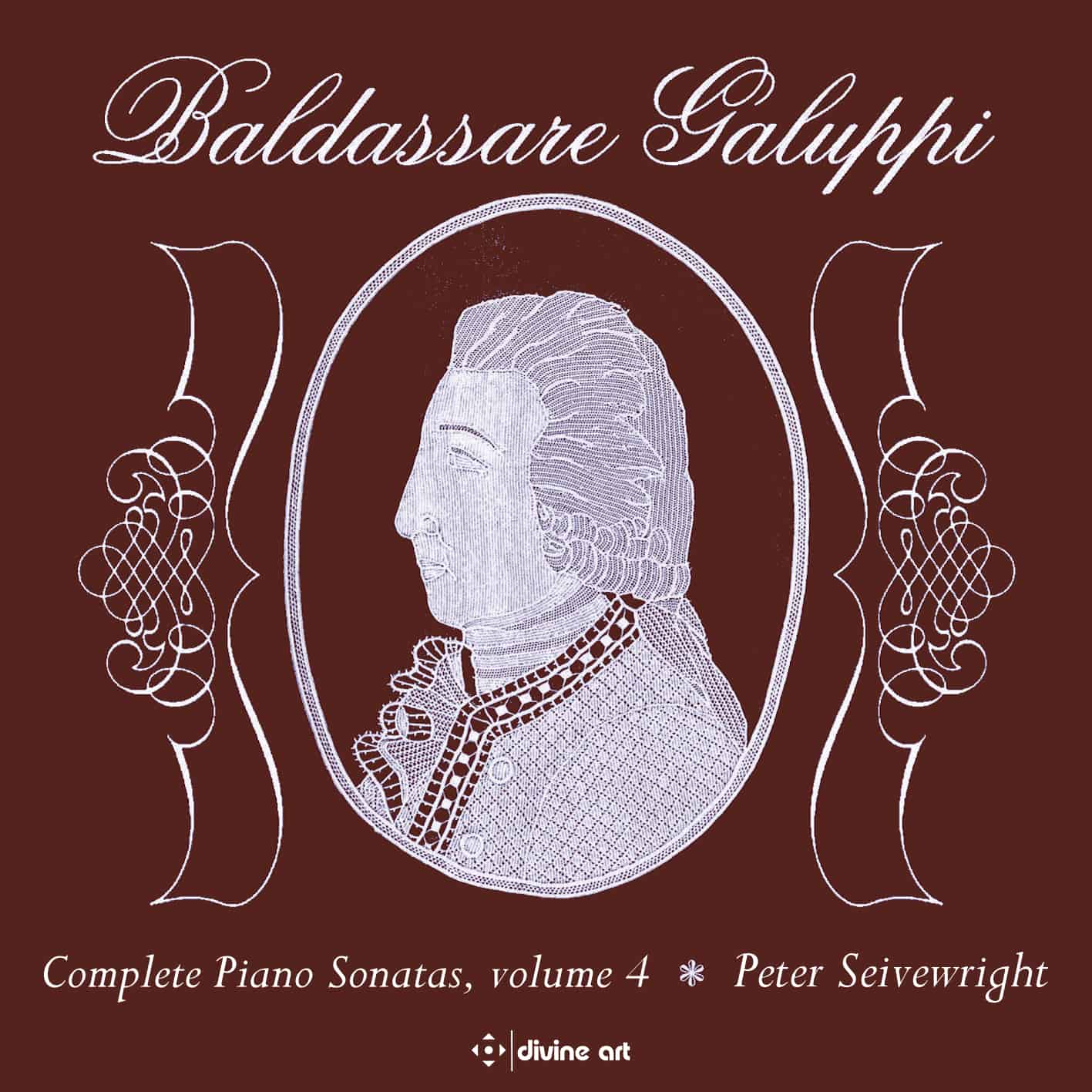
  • Fanfare review: Galuppi Piano Sonatas vol. 4

    When discussion of the early Italian keyboard sonata arises, one usually focuses on the obviously prolific compositions of Domenico Scarlatti, not to mention his Spanish-Catalan compatriot Padre Antonio Soler. These works, almost all in a single movement, seem to epitomize the genre as they represent not only a compositional skill, but a depth and variety of forms, rhythms, and originality as well. One tends to weigh them against the pedagogical works of Johann Sebastian Bach of a contemporary (but yet stylistically earlier) age, or the innovations of C. P. E. Bach, who expanded the styles and structures of music for the keyboard into new realms. This, however, is an apples and oranges comparison, for both the former did their work in Spain while the latter were confined to northern or central Germany, despite the wide circulation of their music. To call their works “Italian” is appropriate to some extent, and yet the concept of the keyboard sonata was not unknown in Italy itself. Recent attention to a rather substantial repertory of keyboard sonatas from this region has resulted in a more comprehensive view. We have now the works of Domenico Cimarosa, and now this is the fourth volume of a substantial repertory by his colleague Baldassare Galuppi.

    Galuppi’s major focus, like that of Cimarosa, was opera, but as a musical director at St. Mark’s and the Ospedale della Pieta in Venice he also composed a huge amount of sacred music. His excursions into instrumental music have been sporadic at best. A few symphonies and some odd concertos do exist, but his main genre was the keyboard sonata, of which he wrote about 90. This disc is, as noted, the fourth volume of the complete sonatas, but as a bonus it also includes one of his concertos, this one in G Major. This is a lively piece that seems quite operatic, at least in the first movement. The opening ritornello is short and quite lyrical, while the solo part has a few virtuoso passages inserted, as one might expect. It is not a difficult work, but the moderate challenges are secondary to the cheerful musicality. The second movement is soft and reflective, almost a variation of the stately violins, while the finale is also lively and bright. This is not a work to compare with the larger pieces of the genre composed by, say, Mozart, but while it is not especially innovative, it does possess a particular charm that makes it worthwhile. It too is short, but the work is compact and has everything that a casual soloist would require.

    As for the piano sonatas themselves, there is a broader set of goals stylistically. They run the gamut from single movement a la Scarlatti to more modern three-movement format, with two being the most frequent. There seem to have been several attempts to record the complete sonatas, and I note that I myself reviewed the disc on Naxos by Matteo Napoli in 2012, but the Seivewright series appears to have been in a bit of a hiatus since the third volume was released in 2004. The late Michael Carter noted regarding the second volume that these works were of “exquisite beauty,” and therefore it is surprising that the several parallel threads of recordings have been so slow in appearing. Here, finally, is Seivewright’s fourth volume in 2019, and while one wonders why the delay; perhaps it was his appointment at the University of Trinidad and Tobago or his concertizing from Phnom Penh to Afghanistan, that led him to far-flung peripheries, or that this took time to jell. No matter, since here is the sequel with eight sonatas (and the concerto as a bonus).

    Space prohibits a thorough discussion of each work, but there are a few samples which can give an insight into the works. First, in the single-movement G-Major Sonata (“Lento, con felicita”) the feeling is of an exercise that is hopping or mincing, with a slight nod to the Baroque in the sequencing. It would be appropriate for an amateur player. In the D-Minor Sonata, the opening Lento is quite operatic, with a lyrical line that is punctuated by trills and the sequencing of the line above a steady ostinato bass line. The second movement is also operatic, with a rushing melody that twists and turns like a windmill. The second F-Major Sonata (in three movements) begins with a tranquil aria that in the central section turns to the minor in a melancholic manner. Each section is finished with a sort of humoresque dotted pattern. The second movement seems to invoke Don Quixote tilting at windmills in the perpetual motion lines that turn about each other. The finale is even more frenetic, with dexterous finger-work sequenced about. The most “Mozartean” of the selections is the second G- Major, which has the rhythmic forward motion of continual Alberti bass figurations, while the upper voice (with lots of parallel thirds) weaves a nicely lyrical melody.

    Seivewright performs these works with consummate skill, even if on a modem piano. He has, as noted in earlier reviews, a knack for good phrasing that brings life to the often busywork of the sonatas, and in the slower movements he is careful to allow both technique and lyricism to emerge.

    It is a shame that we have had to wait so long for this volume, which is every bit as fine as the previous three (two of which have been reviewed in Fanfare). On the other hand, given the rather substantial number of works, it is the much-needed stepping stone to further explorations of Galuppi as a keyboard composer. Recommended.

  • Galuppi Piano Sonatas volume 4 – American Record Guide

    Baldasarre Galuppi (1706-85) is a name you rarely encounter these days—at least not in concerts. He was a Venetian who wrote in a variety of forms, including opera, and is rough¬ly contemporary with CPE Bach, Gluck, and Domenico Scarlatti. This series has now reached its fourth volume, but ARG has apparently only reviewed Volume 2, and that was some 17 years ago. Alexander Morin found the sonatas monotonous and uninspired, but admired the playing of Seivewright (S/O 2001). My take on them is somewhat different.

    As the exceptional notes by the pianist point out, the three-movement Sonata in D that opens this program was something quite distinguished and forward-thinking in the era it was composed. It may not sound so now, but at the time the movements would have shown considerable imagination and pointed toward the romantic era. The other seven sonatas are quite delightful and, considering the chug along of many baroque pieces of the era, manages to hold one’s interest and attention. That D-major Sonata, by the way, concludes with a theme and variations.

    These sonatas sound nothing like Scarlatti’s. Yes, they are galant in style, but quite refreshing, and manage to keep things less complex. Perhaps that earlier volume contained music of a decidedly lesser quality?

    Listed as a bonus is the Piano Concerto in G. In three movements, but taking a brief 8 minutes, the concerto makes no effort at profundity. It charms as a sort of concerto in miniature, but listeners will not be pleased with the short time of the disc. Still, this can be recommended for the skill of the performer and the delightful creativity within the confines of the historical period. Two pianos are used: a Bosendorfer Imperial and a Steinway D.

  • Galuppi Sonatas 4 – Music Notes review

    Baldassare Galuppi, “Il Buranello” (1706 -1784) wrote operas, sacred works, chamber music, and keyboard pieces for the harpsichord and for the then newfangled fortepiano.

    A contemporary of Mozart and Gluck he was unfairly overshadowed by composers of the German and Austrian bent, so much so that after his death many of his both published and unpublished works disappeared, some never to be found again. But those compositions of Galuppi that have managed to survive the passing of time on dusty library shelves or in the hands of care-giving curators have in recent times come to the attention of scholarly performers.

    One such artist is the indispensable musical sleuth and powerhouse pianist Peter Seivewright, who has just added a fourth volume of Galuppi works for the keyboard, appending a lovely concerto a cinque for string quartet and keyboard as the album’s closing number, with the undying support of divine art records.

    Aside from the sheer delight that Seivewright’s playing brings to the soul of this listener, we are stunned by the rich variety and charm of Galuppi’s music.

    No longer stile gallant nor quite severely Classical nor, Heavens knows, Early Romantic in conception or harmonic structure, Galuppi’s sui generis oeuvre spans a transitional moment in music, taking something from here and something else from there, all along not sounding like Gluck or Mozart or anyone else other than Galuppi and that’s a very good thing. The eight sonatas included in this invaluable CD are delightfully quirky one, two and three movement conceptions, surprisingly as brief as a couple of minutes, or as fully drawn as ten minutes in length. Galuppi preferred the happiness of major keys and out of the 19 tracks only 2 are in no doom, no gloom minor keys.

    Overall Italianate in style, unfussy in harmony, uncomplicated in contrapuntal structure, relying instead on a sunny sound culled from the few days of sunshine and the ongoing openhearted disposition of the denizens of the northern city of Venice, along with quintessentially Italian melodies that make them hold our attention from start to finish, Galuppi’s creations for the keyboard are, along with Peter Seivenwright’s labor of love, as endearing as, we hope, enduring.

    The CD is handsome in design, brilliantly annotated by Seivewright, who himself helmed the project as producer. With the help of Andrew Graeme as recording engineer, the album delivers an uncomplicated, faithfully-recorded sound devoid of the claustrophobic over-immediacy of many CD’s these days.

    Under fifty minutes in running time, Peter Seivewright’s fourth volume will undergo a severe test in my home study by being subjected to repeated replays, so much do I enjoy it.
    Steve Sutton, the visionary friend of so many artists and divine art should be saluted for keeping Seivewright busy with past and future projects.
    Rafael de Acha (Rafael Music Notes)

  • MusicWeb review – Galuppi Piano Sonatas volume 4

    Peter Seivewright has spent much time researching Baldassare Galuppi’s piano sonatas. Visits to Venice and other European libraries have yielded several unpublished scores, from which performing editions have been prepared. As I understand it, Seivewright began this project back in 1998, so it has been running for nearly 21 years. The present CD features eight sonatas as well as a bonus piano concerto. It follows on fourteen years after the previous volume. So far, Seivewright has laid down some 33 sonatas. The present CD is number four in a series originally intended to include all 100-plus sonatas that were currently in the catalogue. This number has now risen to about 130 sonatas as more have been discovered. I understand that this project is now back on target.

    A few words about Baldassare Galuppi. He was born on the beautiful island of Burano in the Venetian Lagoon on 18 October 1706. He is best recalled as a composer of opera, of which he wrote some 109. Historians will be fascinated to learn that he visited London in 1741-3 and gained a considerable reputation at the King’s Theatre, Haymarket. He held the post of assistant choirmaster at St Mark’s in Venice, subsequently becoming choirmaster in 1762. Galuppi visited St Petersburg for an extended stay between 1764 and 1768 at the behest of Catharine the Great. Returning to Venice, he resumed his post at St Mark’s. His other musical compositions include oratorios, church music and the above-mentioned corpus of keyboard sonatas. Baldassare Galuppi died in Venice on 3 January 1785 and was buried in the Church of St Vitale in that city. It is a lovely church that I have walked past many times on my way to the Gallerie dell’Accademia – but have never been inside.

    I own to being confused about Galuppi’s sonatas. I cannot work out whether there are separate sonatas for harpsichord, clavichord and piano, or whether these are the same pieces realised on different instruments. The Sonatas have been awarded an Illy number, which, unfortunately are not included in the track-listing. This numbering was generated by Hedda Illy who is/was bringing out a complete edition of the sonatas published by De Santis. Another catalogue of Galuppi’s keyboard sonatas was prepared by David E Pullmann (published 1972). I do not have access to this information. So, it is difficult to pin down exactly what I am listening to.

    The form and style of these piano sonatas runs the gamut from baroque to classical and even pushes towards early romanticism. Galuppi has been regarded as a precursor of Schumann, Weber and Felix Mendelssohn. Some of these sonatas are conceived as single movements echoing the practice of Scarlatti, and others have two, three and sometimes even four movements, looking forward to Haydn and Beethoven. They are all quite pleasant to listen to, without in any way being revelatory.

    As a bonus, the Piano Concerto in D major has been included. There are eight works of this genre in the catalogue. The form of this present example is the conventional fast-slow-fast pattern which was established as the norm by J.S. Bach and others. It is an enjoyable piece that is structurally balanced and always extremely lyrical. The liner notes appear to digress and discuss the Piano Concerto in D major rather than the present example. Furthermore, these notes do not seem to give an overview of Galuppi’s keyboard music. This may, perhaps, have been included in earlier releases (21 years ago).

    Peter Seivewright, born 1954, studied at Oxford University and then at the Royal Northern College of Music. He has had a successful career as a concert soloist and recitalist. Seivewright is also highly regarded as a teacher, working world-wide in musical institutions from Scotland to Trinidad and from Afghanistan to Phnom Penh, Cambodia.

    The playing by Peter Seivewright and the Scottish Baroque Soloists (in the concerto) is excellent. There is always clarity of line and fluidity of invention. I do wonder if everyone will be happy that these performances are played on a ‘modern’ Bösendorfer Imperial Concert Grand rather than a contemporary forte-piano. For my part, I prefer my baroque played on the piano. I was concerned that the piano was a little clattering at times and possibly a touch boxy. I did feel that a mere 50 minutes of music was mean. Surely there was more that could have been included.

    In 2011 Naxos began issuing an edition of Baldassare Galuppi keyboard sonatas played by pianist Matteo Napoli. It appears to have become stuck at Volume 3 which was released in the following year. I have not heard these discs.
    John France

  • Galuppi Piano Sonatas 4 – Congleton Chronicle review

    You could review this CD in two words: “nice piano”, maybe. Or “piano brainwash” if you wanted to be more new age-y about it. It’s a CD that’s impossible to dislike; it’s here to entertain and not be heavy or deep, and its purity does wonders for an over-busy brain. Seivewright plays with simplicity and grace, and it all bobbles along nicely. (Bobbles along, musical term, honest). The music has got real charm and Seivewright sounds like he enjoys playing it. The sleeve notes talk about the “easy and mellifluous expansiveness” of the first piece, (“foreshadowing Romantic as well as Classical styles”, too). The second piece provokes extensive sleeve notes about the key of D minor but towards the end a comment on a “spirit of great joyousness”, which is all you need to know, unless you’re big fan of the “ancient” key, the tonic note of the Dorian mode, as we all know. And so on. For the non-academic piano lover, it’s a charming CD of lovely music that equally suits quiet, late night listening, an early morning wake-up or for contemplation during the day. Academics can still enjoy it, and get the learned sleeve notes as a bonus.

  • Galuppi Piano Sonatas vol 4 Gappleagte review

    Four volumes to date on the Complete Piano Sonatas of Baldassare Galuppi (1706-1785). This Volume 4 (Divine Art 25103) is a good place to start because it includes his “Second Piano Concerto,” a wisp of the breeze through our ears that comes and goes as quickly as a sunset in winter where I am now.

    Galuppi’s sonatas are a model of simplicity, lyricality and buoyancy. Peter Seivewright plays it all with the charm and enthusiasm it demands. It is disarming music that makes a point not to be profound and that is refreshing.

  • Galuppi Piano Sonatas, volume 4

    Galuppi Piano Sonatas, volume 4

    Peter Seivewright was amongst the first musicians to seriously research (in 1994) the 100 keyboard sonatas by Venetian composer Galuppi, also famed as a pioneer of opera buffa. While others have since come to appreciate and record the fine variety and novelty of these works, for many personal and career reasons, Seivewright’s series was held up after volume 3 was released in 2004 but is now back on track with this intermediate album which includes also the G major Piano Concerto. Many of the sonatas have had to be reconstructed from single movement manuscripts. They show amazing diversity, from single-movement works to two- and three-movement pieces, and from traditional baroque style to a Romanticism prescient of Schumann. Seivewright strongly believes that the works were specifically written for the pianoforte rather than harpsichord due to their frequent need for sostenuto and other factors.

    Peter Seivewright studied at Oxford then at the Royal Northern College of Music. He has performed extensively as recitalist and concerto soloist and has taught in colleges around the world, from Scotland to Trinidad to Afghanistan and most recently in Phnom Penh, Cambodia.
    Find Volume 1 | Volume 2 | Volume 3