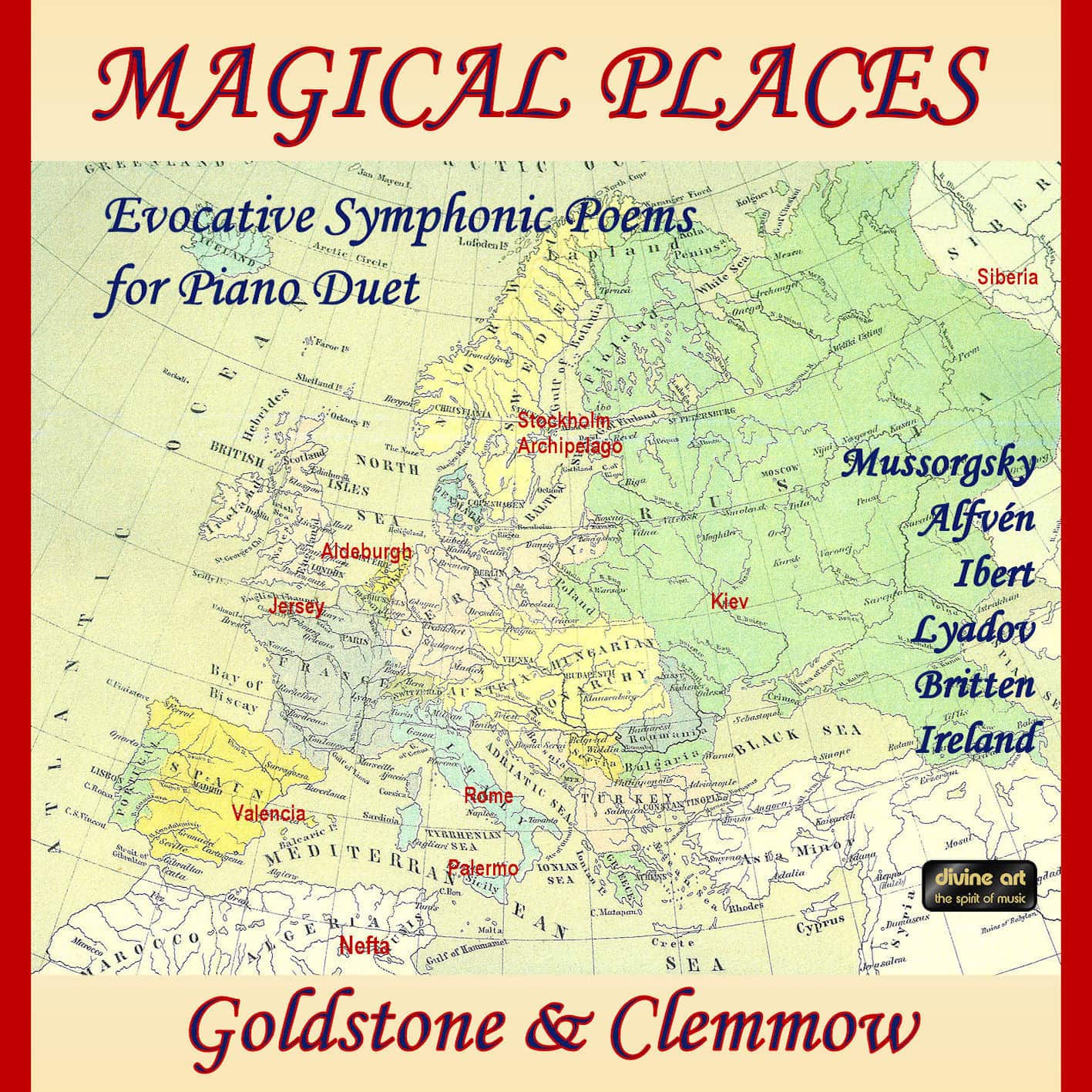
Playing of astonishing brilliance from Anthony Goldstone and Caroline Clemmow in works by Mussorgsky, Alfven, Ibert, Lyadov, Britten and Ireland. There have been a number of recent releases that have included orchestrations of piano works such as Dutton Vocalion’s recording of John Ireland’s Sarnia. However, it is always interesting when the opposite is done and an orchestral work is transcribed for piano. So when I saw that Britain’s premier piano duo, Anthony Goldstone and Caroline Clemmow, had recorded a piano duo version of Ireland’s orchestral work The Forgotten Rite I was extremely keen to hear it, especially as the same release includes Erwin Stein’s transcription of Britten’s Four Sea Interludes from Peter Grimes for piano duo.
But that is not all there is to tempt collectors to this new release from Divine Art Records www.divine-art.co.uk as it contains no fewer than four world premiere recordings. There are also transcriptions of works by Ibert, Lyadov, Alfven and Mussorgsky, all for piano duo.
Entitled ‘Magical Places’ this disc opens with the rare opportunity to hear a transcription for piano duet of Mussorgksy’s Night on Bald Mountain arranged by Nikolai Artsybushev (1858-1937), a pupil of Rimsky-Korsakov who also worked as administrative head of the Belaieff’s music publishing firm and also arranged several works by Rimsky-Korsakov. Whilst commonly known as A Night on the Bare Mountain, due to its roots in Russian legend, it is more correctly called Night on Bald Mountain. Bald Mountain is the legendary setting for the yearly witches’ Sabbath held on St. John’s Night, the night before the feast of St. John the Baptist.
Played with wonderful panache there are some striking dissonances that stand out more obviously in this piano duet version. Thanks to this duo’s playing, this transcription works brilliantly as a piece in its own right.
Hugo Alfven’s Midsummer Vigil (First Swedish Rhapsody) is played here in the composers own transcription. Everyone will know the tune that opens this piece. There is an attractive, languid second subject and some wonderful interplay between the two players in this performance that is full of rhythmic fluency.
The three movement work Escales (Ports of Call) by Jacques Ibert was written as an orchestral piece in 1922. This is again the composers own transcription. The first movement ‘Rome – Palermo’ is, at turns, atmospheric and lively and, if you haven’t heard the orchestral version, you’d think the music was made for the piano.
The second movement, ‘Tunis – Nefta’, an oddly attractive piece, is full of mysterious spiky rhythms and has a perfumed atmosphere, full of Eastern flavour, whilst the final ‘Valencia’ is full of Iberian rhythms. Goldstone and Clemmow catch the mood of these pieces perfectly.
Anatoly Lyadov’s most famous orchestral work The Enchanted Lake (Volshebnoye ozero) for orchestra, Op. 62 (1909) was first published by that same Belaieff for whom Nikolai Artsybushev worked. It is performed here in an arrangement by Vasily Kalafati (1869-1942). Kalafati was also a pupil of Nikolai Rimsky-Korsakov, going on to become a professor at the Saint Petersburg Conservatory. His own students included Alexander Scriabin and Igor Stravinsky.
Vasily Kalafati’s transcription seems to bring out all the orchestral lines of the original work in this sensitive performance of Lyadov’s little gem.
The performance here of Benjamin Britten’s Four Sea Interludes from Peter Grimes was arranged by Erwin Stein, an Austrian musician and writer, prominent as a pupil and friend of Schoenberg. His daughter, the pianist Marion Stein, married successively George Lascelles, 7th Earl of Harewood and the Liberal politician Jeremy Thorpe. In the opening, ‘Dawn’ has some remarkable sounds played with great understanding. ‘Sunday Morning’ sounds more modern than with an orchestra and, as played here, is very evocative of the opera itself. What also comes across is how the use of the lower register of the piano seems to underpin the music.
‘Moonlight’ brings out the impressionistic nature of Britten’s writing as never before whilst the ‘Storm’ shows clearly the formidable talents of this duo in playing of astonishing brilliance.
John Ireland’s The Forgotten Rite arranged for piano duet by the composer is played here with further additions by Anthony Goldstone. As the Forgotten Rite opens we are immediately pulled into Ireland’s strange sound world in playing that is captivating from beginning to end. I will be returning to this wonderful performance frequently.
It is because of the sensitivity and brilliance of Anthony Goldstone and Caroline Clemmow’s playing that these transcriptions work so well in their new guise. This is a beautifully produced disc with excellent notes by Anthony Goldstone which I thoroughly recommend.