Catalogue Connection: 25106

  • MusicWeb – Nick Barnard – 25106

    Another excellent disc from the consistently superb Anthony Goldstone. This is the second and last volume in his survey of transcriptions and paraphrases of Tchaikovsky’s music – this time focusing on his ballet scores (see review of Volume 1). I am a great admirer of Goldstone’s art. Aside from the technical skill to perform these hugely demanding scores he displays real musical sympathy with the inherent style of this music and more importantly still an ability to communicate that sympathy both in the playing of the notes and the insight and interest of the programme notes he supplies.

    As I have mentioned before, I have a great affection for the whole genre of the keyboard transcription – the more improbable and outrageously demanding the better. The two paraphrases offered here are excellent examples of this; familiar melodies adorned in pianistic writing of staggering complexity and virtuosic demand. Others I am sure will feel that this can strain a ‘simple’ melody to its breaking point but I hear a sheer delight and joy in the creation of such works – a kind of ornate baroque splendour – that dazzles as it delights. Certainly this is the case in both Paul Pabst’s Concert Paraphrase on The Sleeping Beauty and even more so in Percy Grainger’s (relatively well-known) Paraphrase on Waltz of the Flowers from The Nutcracker . Both works have the great good sense not to outstay their welcome – more than seven minutes does tend to induce jaw-drop-syndrome in even the most enthusiastic of listeners. These were conceived by their composers as vehicles in the concert hall to display their own mighty talents. Suffice to say Goldstone merits being in the company of such technically renowned player/composers. Pabst was yet another pupil of Liszt and an important professor at the Moscow Conservatory laying the foundations of the Russian Piano School that continued on into the 20 th century. His work as a composer is now all but forgotten. His paraphrase which opens the disc exhibits a real skill at compressing many of the motifs and melodies of the full ballet into a seven minute firework display. Aside from the obvious notes-per-minute virtuosity I admire Goldstone’s ability to lead the listener’s ear with careful inner voicing so that the main melodies do not drown in the sheer weight of the accompaniment. Likewise, and I mentioned this before in another review, Goldstone has the precious knack of choosing wholly appropriate tempi – throughout this disc the music feels ‘right’ – full of life for sure but not gabbled or hasty.

    This quality is especially apparent in the complete Act III of Sleeping Beauty (the so-called Aurora’s Wedding ) presented in the transcription – rather than arrangement – by Alexander Siloti. Siloti was a close and respected collaborator of Tchaikovsky. Goldstone in his ever-illuminating and informative liner quotes the composer; “apart from Taneyev and you I have no one I can trust.” Yet posterity has been less kind to Siloti; if he is remembered at all it is as the editor of the now discredited butchered version of Tchaikovsky’s Second Piano Concerto. However, with this edition of the complete Sleeping Beauty he did a very skilled job indeed. Important though to note that this – and the selection from Swan Lake that closes the disc – is a transcription rather than an arrangement let alone a virtuoso paraphrase. Although the liner does not say as much, the function of this edition is purely practical – a way of allowing Tchaikovsky’s music to be heard away from the theatre pit. One assumes that in the case of scores such as this, this is the version which ballet répétiteurs use in the rehearsal room to this day. That being the case it is no surprise that Siloti presents the score “as is” with little or no adornment or elaboration. The skill is the sense of how little of one of Tchaikovsky’s largest and most instrumentally complex scores is missing. Again Goldstone is superbly adept at subtly highlighting musical lines with a wonderfully varied tonal palette and carefully graduated voicings. He is able to find the expressive range from the grandly ceremonial passages of the closing Sarabande and Apotheosis through to the miniature delights of the Fairy-tale character dances. I have to say I vastly prefer Goldstone’s pacing in comparison to the recent complete score offered by Neeme Järvi on Chandos who is all bluster and bombast. The only problem is that it is hard not to crave the full orchestral sonority. Admirers of Goldstone or collectors of unusual piano repertoire can purchase with confidence; anyone seeking the music of the ballet really ought to hear the full score as originally conceived.

    As mentioned previously, Percy Grainger’s paraphrase is another delight – the musical equivalent of eating a box of chocolates at a single sitting – a guilty pleasure. The thundering opening seems to encapsulate exactly the kind of musical gesture one expects of a keyboard titan. This work appeared on one of the very first CD’s I ever bought played by Geoffrey Saba titled “Great Piano transcriptions”. No surprise Michael Ponti – doyen of the virtuoso transcription – recorded it on a pair of discs “Operatic Piano” although in current company Ponti sounds laboured and disjointed. Saba is the wildest, most overtly dramatic of the three and I must admit to having a tremendous fondness for his heart-on-sleeve approach. Goldstone feels a touch staid in comparison but the trade-off is a greater sense of control and clarity of line. I suspect that Grainger might prefer the former while admiring the skill of the latter.

    The Nikolai Kashkin transcription of Swan Lake fulfils exactly the same function as Siloti’s of Sleeping Beauty . Here we are given a twelve minute excerpt of the Act I Pas de trois . As before the skill of transcriber and performer are never in doubt – shorn of its orchestral garb one can but marvel all over again at the sheer richness of Tchaikovsky’s melodic inspiration. An excellent conclusion to this compellingly enjoyable disc.

    The rest of the “package” – liner-notes, recording and general presentation are first class. The piano sound as recorded is bright and full, detailed but not oppressively so. The Lincolnshire Church is Goldstone’s preferred solo recording venue and as before in this series he retains the playright of the disc and no producer is named so one imagines this is very much a self-managed project.

    A disc of real quality and one bound to give great pleasure to all – guilty or otherwise.
  • Fanfare – Raymond Tuttle – 25106

    This is the second volume in a series of “Rare transcriptions and paraphrases” for piano of Tchaikovsky’s orchestral works—the first (Divine Art DDA 25093, not reviewed in Fanfare), includes the Marche slave, the Serenade for Strings, and music from The Voyevoda and the Third Orchestral Suite. A related release (Divine Art DDA 25020) has been reviewed here, however, and that one features Anthony Goldstone with his wife Caroline Clemmow in transcriptions for four hands of the Fourth Symphony and Romeo and Juliet. Several of Tchaikovsky’s own transcriptions of Russian folk songs are included as well. That release was positively received a decade ago by Christopher Williams.

    I’ve found Anthony Goldstone’s recordings to be consistently delightful. He’s one of those modest virtuosos who can play anything, but who doesn’t perform and present himself as if he were on a perpetual ego trip. His discography contains a long list of unusual music, with an emphasis on nearly forgotten transcriptions and paraphrases, and on underplayed composers. (Vladimir Rebikov, anyone?)

    The 49-minute centerpiece of this new release is the more or less entire third act of The Sleeping Beauty in Alexander Siloti’s transcription, which was prepared at the composer’s request. Why Tchaikovsky asked Siloti to do this is not discussed. If it was to enable amateurs to perform this music at home, then I think Siloti miscalculated: this is not easy stuff. Even your average rehearsal pianist—if that was Tchaikovsky’s intended performer—would be taxed. That need not concern us, though, because Goldstone, without ever sounding glib or insensitive to the limitations of actual dancers, glides through this wonderful, glittering music triumphantly. Of course it doesn’t compete with the orchestral original, but hearing a pianist of Goldstone’s caliber conquer such technical difficulties so genially can’t fail to bring pleasure. The purpose behind Nikolai Kashkin’s transcription of the first act Pas de trois from Swan Lake is similarly unclear (at least to me), but again it was prepared at the composer’s request, as he clearly had other ways to spend his time. Balletomanes will recall that this Pas de trois contains several sections in various tempos and styles; here, it comes out to a bit more than 12 minutes of music.

    The two paraphrases are more difficult, as they were composed for pianists, not for dancers. Paul (or Pavel) Pabst was Tchaikovsky’s contemporary, and he composed a number of paraphrases based on that era’s operas and ballets. Pabst’s blue-ribbon Sleeping Beauty paraphrase is the best-known of these, probably because he doesn’t stray far from Tchaikovsky’s essential tunefulness—he just decorates it with muscles and sequins. Virtuoso pianists specializing in romantic repertory program it now and then. Goldstone’s version is just as good as Earl Wild’s, and that’s saying something. Percy Grainger, as the cliché goes, needs no introduction. His ebullient paraphrase, unlike Pabst’s, is centered on a single number from the ballet, that being the “Waltz of the Flowers.” (Characteristically, Grainger altered the title to “Flower-Waltz.”) Grainger also adheres to Tchaikovsky’s original, in the sense that he uses it as a framework on which to add virtuosic arabesques and fantastic harmonic departures. It’s not in the best of taste, but who cares? In the privacy of the recording studio, I wonder if Goldstone dressed up like Liberace and confided, “I wish my brother George was here.” He plays the heck out of it, and takes it seriously enough, although one senses a twinkle in his eye.

    Although not “important,” this is a fun release—how could it be otherwise, given Tchaikovsky’s melodies and Goldstone’s impressing playing? Have an eggroll, Mr. Goldstone—have a dozen!

  • The Classical Reviewer – Bruce Reader – 25106

    It is easy to overlook some of the fine British artists that have given us pleasure for many years. One such artist is Anthony Goldstone,one of Britain’s most respected pianists.

    Born in Liverpool, he studied at the Royal Manchester College of Music, where his piano professor was Derrick Wyndham and, later, in London with Maria Curcio, one of Schnabel’s greatest pupils, making him a sixth-generation pupil of Beethoven. International prizes in Munich and Vienna and a Gulbenkian Fellowship launched him on a busy schedule of recitals and concertos. His travels have taken in concert appearances in Europe, North and South America, Asia, Africa and Australasia, with prestigious festival invitations and very many broadcasts. Numerous London appearances have included important solo recitals and Promenade Concerts, notably the Last Night, after which Benjamin Britten wrote to him, ‘Thank you most sincerely for that brilliant performance of my Diversions. I wish I could have been at the Royal Albert Hall to join in the cheers.’

    Goldstone has always regarded the classics and romantics as being at the heart of his repertoire, a view that is illustrated by two past recording projects, firstly a series on the Divine Art label of rare Russian Romantics including Rebikov, Lyapunov, Arensky, Glière and Mussorgsky; and secondly a series of six CDs on the Divine Art label devoted to the major solo works of Schubert.

    Complementary to the mainstream repertoire is his interest in exploring intriguing musical byways, leading to première recordings and performances such as Elgar’s Enigma Variations played on Elgar’s own piano, Parry on Parry’s own piano, Sibelius, Bruch, Franck, Mendelssohn and Holst as well as unjustly neglected nineteenth-century composers such as Goetz, Herzogenberg, Alkan and Moscheles.

    In addition, Anthony Goldstone and his wife Caroline Clemmow comprise an acclaimed piano duo whose recordings, broadcasts and concert appearances receive wide praise from public and critics alike. Their acclaimed seven-CD cycle of the complete original four-hand music of Schubert, including works not found in the collected edition, is probably a world first. Goldstone’s completions and realisations of several works by Schubert and Mozart have been greeted with enthusiasm by musicologists and listeners alike.

    Royal Manchester College of Music have honoured Anthony Goldstone with a Fellowship and, following a recital containing Schubert’s Wanderer-Fantasie and Beethoven’s Diabelli-Variations, Die Presse of Vienna wrote of him, ‘…a musician with a sense of the grand manner, long lines unfolding without interruption, strongly hewn rhythms, warmth, a touch displaying the qualities of colour and cantabile, in addition to possessing a sure technique and real strength. An even greater impression was created by his astonishingly profound spiritual penetration.’

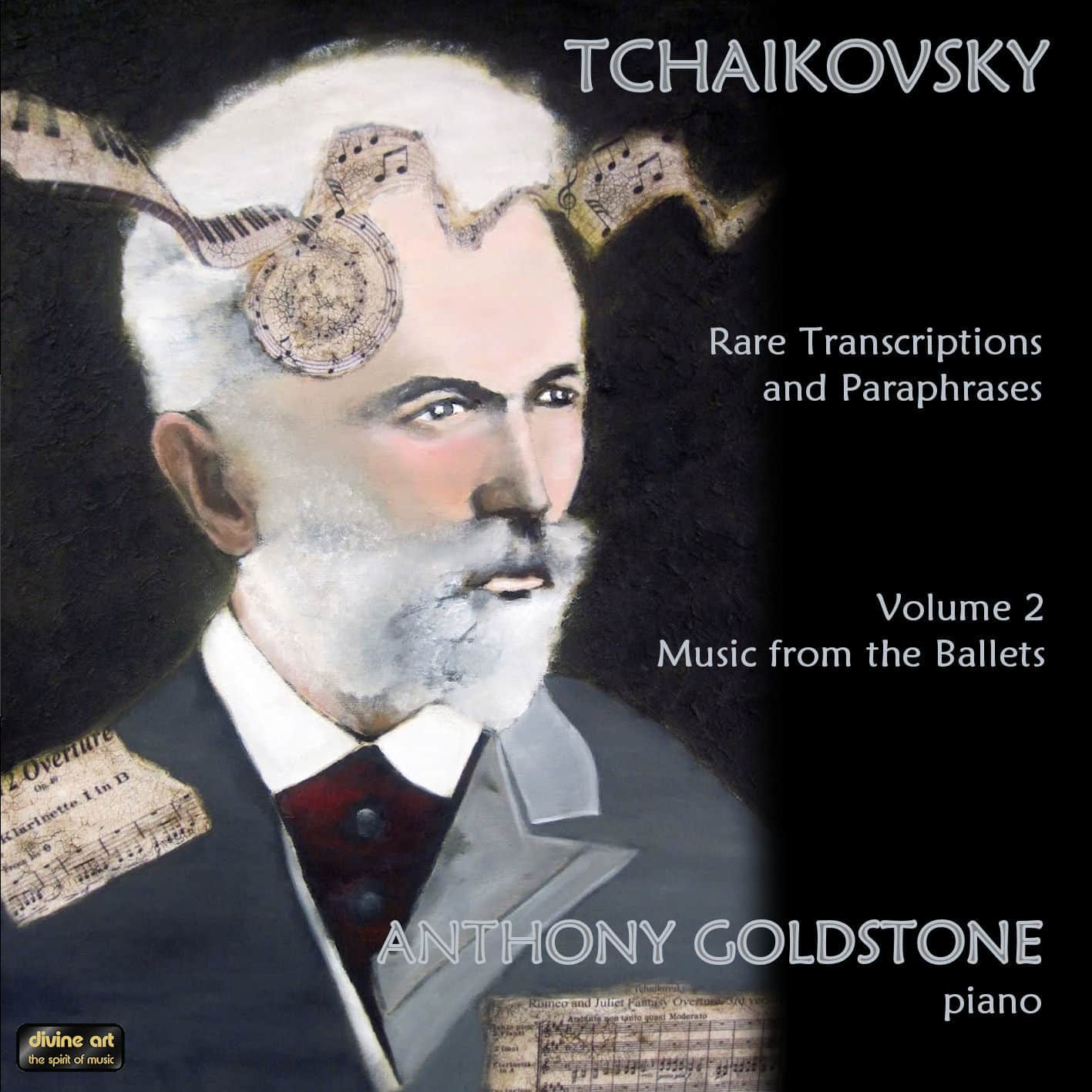
    Somehow I managed to miss a 2013 release from Divine Art Records that reveals many of these attributes, entitled Tchaikovsky Rare Transcriptions and Paraphrases Volume Two , a disc that contains a number of premiere recordings.

    The Concert Paraphrase on The Sleeping Beauty by Paul Pabst (1854-1897) a pianist, composer, and Professor of Piano at Moscow Conservatory, commences with Lisztian chords, played brilliantly by Goldstone before the waltz from Act One arrives bringing a crystalline beauty. It is wonderful how Goldstone holds the structure together so well. The Lilac Fairy’s music again has a pinpoint clarity before the return of an elaborate version the waltz, fiendishly difficult and with muscular precision by this pianist.

    Pianist, conductor and composer Alexander Siloti (1863-1945) was a fine pianist, having studied with Liszt. He was also a first cousin and teacher of Sergei Rachmaninov. With his transcription of Act III of The Sleeping Beauty there is a clarifying of all of Tchaikovsky’s lines especially as played here. In the March Goldstone reveals this clarity with wonderful articulation. Polacca draws much feeling from this pianist, shining a new light on this music and exposing many subtleties of harmony. The Pas de quatre: Allegro, Variations I – IV and Coda has a nicely shaped Allegro and some beautifully crisp playing in the variations before the lovely little coda played to perfection.

    Pas de caractère: Le Chat botté et la Chatte blanche receives a beautifully characterised performance with lovely phrasing and subtly building in intensity as it progresses. Goldstone draws out so much personality from the music. Pas de quatre: Adagio – Variations I and II – Coda opens with lovely little rhythms as the right hand figuration dances over the repeated left hand chords; the central, more flowing theme so affectingly played. It is Goldstone’s phrasing and sense of form that gives such clarity. The two variations bring a lovely dance theme for Cinderella and Prince Charming, followed by the skittish little second variation. The charming Coda has a slight dissonance that one wouldn’t notice in the orchestral setting – almost Satie like. Goldstone has the ability to characterise these pieces so well.

    Another Pas de caractère follows, Chaperon rouge et le Loup where, again, those dissonances are brought out with fine control of dynamics in the concluding passages. A buoyant Pas de berrichon with a terrific ending is followed by the languorous Pas de deux: Entrée . Then follows the Pas de deux: Adagio and two variations and Coda . The beautiful Adagio is given an exquisite performance here with its halting phrases holding back the emotions. Goldstone builds the music to its central climax to perfection. The galloping Variation I is followed by delicate crisp playing of the second variation and the cross rhythms of the Coda , with spectacularly fine playing form Goldstone. Before the Finale and Apothéoso there is a reserved and stately Sarabande . The Finale is full of joyful exuberant dance rhythms before a dashing coda that nevertheless has many subtle shadings. The Apothéoso has at times a Mussorgskian flavour which again shows, in the right hands, how revelatory this transcription can be.

    These are extremely difficult transcriptions to bring off without the cover of orchestral clothing and that Goldstone does so in such brilliant fashion is a testament to his musicianship.

    Paraphrase on Waltz of the Flowers from The Nutcracker – Percy Grainger (1882-1961)

    Grainger gives this the romantic concerto treatment in the opening, yet for all his flamboyance he does create subtleties that are brought out here. For Goldstone, Grainger’s massive chords present no problem and, when the famous waltz eventually appears in its pretty conventional treatment by Grainger, there are still huge chords to manage. This is impressive playing with Goldstone creating some rich sounds in the huge chords and some lovely Lisztian little flights of fancy.

    This performance is an absolute triumph.

    Finally we come to Nikolai Kashkin’s (1839-1920) transcription of Swan Lake: Pas de trois (Act I) another professor at the Moscow Conservatory. Goldstone creates a gorgeous pianistic flow in the Intrada , such a surge in the opening. The gently withdrawn Andante Sostenuto has so many subtleties and lovely gentle rhythms, lovingly played. There is a crisp dancing Allegro semplice – Presto full of charm and a bell like Moderato , so very Russian. The Allegro is light and vivacious and leads to lively rhythmic Coda that hides some pretty dexterous notes played brilliantly to end this disc.

    With an excellent recording and informative booklet notes by Anthony Goldstone lovers of Tchaikovsky and Russian music in general will want this disc.

  • BBC Music Magazine – 25106

    Although sacrificing some of the brilliant colours of his orchestration, these resourceful piano transcriptions from Tchaikovsky’s three ballets by Pabst, Kashkin, Grainger and Siloti nonetheless sound very attractive. Goldstone performs them with great fluency and charm.

  • Sunday Times – Paul Driver – 25106

    This second of Goldstone’s two volumes of Tchaikovsky recensions is devoted to the ballets, and opens swishingly with a Concert Paraphrase on The Sleeping Beauty by the virtuoso Paul Pabst, whom Tchaikovsky admired. Odd that this showpiece — with its treble filigree like a tinkling icicle — hasn’t been previously recorded **. Two other items are disc premieres, too: Sleeping Beauty’s Act III, in Alexander Siloti’s authorised reduction, and the pas de trois from Act I of Swan Lake , in the transcription Nikolai Kashkin made at the composer’s request. Percy Grainger’s Paraphrase on the Waltz of the Flowers from The Nutcracker is a tremendous evergreen.

  • Audiophile Audition – Gary Lemco – 25106

    British piano virtuoso Anthony Goldstone seems to have embarked upon a one-man crusade to revive the legitimacy of the transcription as its own art form, having already given us his renditions of Tchaikovsky’s operas and orchestral concert pieces, and now turns to the world of Tchaikovsky’s three exquisite ballet scores. Tchaikovsky himself sought acolytes whom he trusted to extend his legacy through piano reductions – “symphonic” though they may be – and among such individuals stand out Paul Pabst (1854-1897), Alexandre Siloti (1863-1945), and Nikolai Kashkin (1839-1920). The great iconoclast Percy Grainger (1882-1961) came to Tchaikovsky via Louis Pabst, but Grainger’s own flamboyant, even excessive, personality colors his individualistic treatment of the Waltz of the Flowers (1904). The Pabst paraphrase may have first come to the attention of piano connoisseurs via Shura Cherkassky.

    Goldstone certainly urges its bravura runs and cascades as it preserves motifs belonging to the evil fairy Carabosse and her malignant abuse of Catalabutte, master of ceremonies at Princess Aurora’s christening. The famous Act I Waltz then proceeds in ornamental fashion, a combination of flying fingers and unforgettable melody. The Lilac Fairy appears after a cadenza, and the waltz proper concludes this impressive showpiece.

    That the Ukrainian virtuoso transcribed the entire Act III of Sleeping Beauty itself testifies to a labor of love, as well as to a keyboard wizard of the first order. Tchaikovsky once claimed that among his adherents, only Taneyev and Siloti were worthy of his confidence. The Act III of Sleeping Beauty has had its own “identity” in the form of Aurora’s Wedding , which conductor Leopold Stokowski used to tout as a vehicle for his especial color gifts. Reality and fantasy mix freely in Tchaikovsky’s treatment of the Perrault fairy tale, since characters from childhood fancy arrive to celebrate in dance an otherwise standard royal wedding, considering that the bride has had a preparatory rest of twenty years!

    Twenty-three numbers comprise Act III, and the demands on the solo keyboard can be daunting, beginning with the brilliant Polonaise , which must ring with polyphonic and syncopated colors, all under a light pair of hands. Wonderful non-legato from Goldstone over a pulsating bass line marks the Pas de quatre , followed four splendid variations and a coda. Needless to say, Tchaikovsky melodic gifts could barely exert themselves more brilliantly throughout, considering that each step and harmonic shift had to be coordinated to a balletic gesture. The sparkling variants, belonging to the Sapphire and Diamond Fairy, respectively, provide a shimmer and bravura we could mistake for Gottschalk. Sometimes the active treble part must substitute for the flighty effects of flute and piccolo. The mewing potential of the piano for the Puss in Boots duet with the White Cat suggests Mussorgsky as much as it does Tchaikovsky. Among the most exotic of the characteristic dances is the Pas berrichon , a percussive affair in an antique French style of a (toccata-like) bourree.

    The last eight numbers cast first a duet, then solos, only to re-unite Aurora and her beloved Desire in a series of plaintive gestures, including the extended, scalar Adagio , which for all of Goldstone’s conscientious block-chord ministrations, requires an orchestra for its full effect. Aurora herself realizes a stately Gavotte ( Pas de deux: Var. II ); a confident Russian Cossack Dance follows, and one more antique dance, a Sarabande (often omitted), leads to the mazurka-rhythm Finale and aristocratic Apotheosis , a grand and heraldic paean to the power of love.

    If we have not already been convinced of Goldstone’s prowess, we next encounter the thunderous throes of Percy Grainger’s monumental account of Waltz of the Flowers , which contains more cascading avalanches than flora. We can virtually hear the horns in the orchestration, and the swirls and throbbing runs and trills resonate with a will, effectively rendered by Stephen Sutton’s remastering of the 2011 inscription. Finally, a set of six dances from Tchaikovsky universally successful (though not at its premier) Swan Lake , here transcribed by Dmitrievich Kashkin, who served on the same faculty as Tchaikovsky at the Moscow Conservatory. The Pas de trois from Act I recalls Prince Siegfried’s birthday party, prior to the appearance of the flock of fateful swans. The longest selection, the Andante sostenuto , enjoys an exotic and antique sonority in minor, almost as though Goldstone were performing Rameau. The Allegro semplice enjoys a rustic, ingenuous melody that bursts forth Presto . Big block chords form the alternately lumbering a agile Moderato , suited to a power dancer. After a skittish Allegro , the Coda brings to a swirling conclusion a decisive tribute to the world’s foremost master of the ballet medium.

  • MusicWeb – Byzantion – 25106

    For last year’s Volume 1 (DDA25093), Anthony Goldstone’s programme consisted of others’ renditions of some of Tchaikovsky’s orchestral and operatic music. Now he is back with a diverting look at the ballets, featuring transcriptions and paraphrases from musicians all connected to Tchaikovsky or to each other.

    Goldstone is an old hand at this kind of thing: a decade ago he and his wife Caroline Clemmow recorded some Tchaikovsky duets for Divine Art, including the premiere of Sergei Taneyev’s unforgettable transcription of the whole of the Fourth Symphony and an extraordinary piano version of the Marche Slave (DDA25020). Elsewhere his huge discography is peppered with bravura works of this Romantic-period ilk.

    For this recording Goldstone is Clemmowless, although it sometimes appears otherwise, given the virtuosic nature of what is after all music for pianists with a streak of exhibitionism – certainly the case as far as the two Paraphrases are concerned. As melodist extraordinaire Tchaikovsky’s writing lends itself particularly well to these entertainment-transcriptions, with the next memorable tune arriving before the music even has time to think about lulling.

    That is nowhere more true than in the marvellous transcription of Sleeping Beauty by Tchaikovsky’s pupil and friend Alexander Ziloti, recorded rather amazingly for the first time. Normally, a forty-nine minute work for solo piano is asking a lot of listeners, but not here: whether enjoyed as an endless sequence of captivating melodies and foot-tapping rhythms, or as a spectacle of breathtaking pianism and exquisite detail from Goldstone and Ziloti alike, time simply whizzes by.

    The same can be said of the disc as a whole. Goldstone’s modesty is disarming, whilst his technique and ear for the poetic phrase and dramatic flourish are almost second to none. He may be in his late sixties, but if the years are ever going to catch up with him, they will have to move faster!

    Goldstone’s own booklet notes are in English only, but are detailed, well written and interesting. The back inlay claims Pabst’s highly impressive Concert Paraphrase as a first recording, but this is presumably a misprint – there are at least two others, by Earl Wild and Oleg Marshev, the latter dating back to the 1990s.

    Sound quality is excellent. In fact, the only bad thing about this disc is that it is officially the last one in the series

  • Amazon – Scott Morrison – 25106

    First, let me say that I have a perhaps overly enthusiastic response to piano transcriptions of orchestral music; blame it on my past as a pianist who loved playing orchestral arrangements at my own piano. Tchaikovsky asked for friends and colleagues of his to make these transcriptions and without exception they are wonderful.

    The musicians who made these transcriptions were Paul Pabst, Alexander Siloti, Percy Grainger and Nikolai Kashkin. All four of had close connections with each other and with Tchaikovsky. Pabst (1854-1897) was a favorite of Tchaikovsky, who described him as a ‘divinely blessed pianist’. Pabst’s brother Louis, also a pianist and composer, emigrated to Australia where he was an early mentor of the brilliant Aussie pianist/composer Percy Grainger (1882-1961). Alexander Siloti (1963-1945) was a first cousin of Rachmaninov (and his teacher) and had studied harmony at the Moscow Conservatory under Tchaikovsky. The least-known of the transcribers is Nikolai Kashkin (1839-1920); he was on the faculty of the Moscow Conservatory alongside Tchaikovsky.

    The four transcriptions or arrangements:

    1. Concert Paraphrase on ‘The Sleeping Beauty’, by Paul Pabst. This seven-minute piece collects various of the themes from the evening-long ‘Sleeping Beauty’ ballet. Unlike the following transcription which limits itself to the ballet’s Third Act, Pabst’s work uses themes from the whole thing. It is a work of surpassing virtuosity and is played as if child’s play by Anthony Goldstone, one of England’s finest pianists. It is of note that Pabst also made paraphrases of the operas ‘Eugene Onegin’, ‘Mazeppa’ and ‘The Queen of Spades’. It seems likely that Goldstone, who has already recorded other transcriptions of Tchaikovsky’s orchestral music [divine art dda25093], will get around to these one day. One hopes so.

    2. ‘The Sleeping Beauty’ – Act III, by Alexander Siloti. This is the whole act — 23 sections — arranged for piano. It is hard to imagine that this arrangement, though, is the one that ballet companies would use for rehearsals as it, too, is virtuosic and would take an exceptional rehearsal pianist. Again, Goldstone stars. I particularly liked the third variation of the Pas de quatre, the one in 5/8 time followed by the delicious fourth variation. Of course anyone who has ever heard or seen ‘The Sleeping Beauty’ will know many of these sections.

    3. Paraphrase on the Waltz of the Flowers from ‘The Nutcracker’, by Percy Grainger. Grainger really goes to town here, adding all sorts of harmonic twists and filigree. One can admire Grainger’s creativity , and yet one comes away with even more admiration for Tchaikovsky’s own creation. This is undoubtedly the most difficult of the pieces recorded here. Goldstone does it proud.

    4. Act I Pas de trois from ‘Swan Lake’, by Nikolai Kashkin. This scene occurs early in the ballet and has one man and two woman dancing together and separately at a birthday party (just before the appearance of the swans). It is in six sections; my favorite is section two which has a haunting melody imitated one bar later one octave lower. The Pas de trois has a lively finish that makes a wonderful finish for this wonderful disc.

    Many of you know the orchestral originals but if you have any curiosity about these transcriptions or paraphrases you couldn’t do better than getting this disc by Anthony Goldstone. He is not as well known in the US as he should be but he has made a number of terrific recordings which are available here at Amazon.com, e.g. Inspiration: Homage to Maria Curcio (Maria Curcio was Goldstone’s teacher), Russian Piano Music Volume 5. He has also recorded extensively with his duo-piano partner and wife Caroline Clemmow, e.g. Schubert: The Unauthorised Piano Duets.

    Recommended.

  • Glasgow Herald – Michael Tumelty – 25106

    The great secret of the tireless missionary work of pianist Anthony Goldstone, in frequent duet partnership alongside his wife Caroline Clemmow, is not that these visionaries have given us an alternative view of Tchaikovsky through myriad transcriptions they have championed and recorded, but, magically, they draw us into the detail of the music, even stripped of its orchestral livery. Goldstone, in an earlier volume, demonstrated the approach with the operas.

    Now, with great pianism and insight, he does the same with a range of transcriptions and paraphrases from the ballets. It’s a glorious disc, featuring Act 3 of The Sleeping Beauty, a paraphrase on the ballet, along with other paraphrases and various by other composers. Is this for purists and specialists? I don’t think so. For all? Could be, if people could get over this “transcription is a lesser thing” prejudice.

  • International Record Review – Michael Round – 25106

    The enterprising Divine Art label (and its subsidiary Métier) is indefatigable in bringing out neglected repertoire. Among its 300 plus albums already issued, IRR readers will have undoubtedly spotted the ten-volume Russian Piano Music series, featuring Lyapunov, Gliére, Arensky, Rebikov and Weinberg alongside the likes of Prokofiev and Rachmaninov, and played by artists of the calibre of Anthony Goldstone and Murray McLachlan.

    Goldstone brings to a close his two-volume survey of Tchaikovsky transcriptions (Volume 1 was reviewed in September 2012) with a disc of ballet music. The relentless virtuosity of Paul Pabst’s Concert Paraphrase on the Sleeping Beauty almost smothers the famous waltz theme and leaves the pianist no climax-building opportunities: the result approaches the dogged even with Goldstone in charge. Then follows the whole of Sleeping Beauty’s Act 3, transcribed by Alexander Siloti: solidly but brilliantly played, this sounds like a (48- minute) dance rehearsal run-through and I imagine balletomanes will get more out of it than the rest of us. Grainger’s Paraphrase on Waltz of the flowers from ‘The Nutcracker’ is better known and piano fanciers will enjoy comparing Goldstone’s version with others. The disc closes with ‘Pas de Trois’ from Swan Lake, transcribed by Nikolai Kashkin.

    Goldstone’s comprehensive and highly articulate booklet note is a model of its kind: this generously filled disc is – unavoidably given the ‘stun the punters in every bar’ nature of it all – best listened to in small doses.

  • Epoch Times – Gerry Miller – 25106

    This is quite a find – a CD containing 4 arrangements of ballet music, 3 not previously recorded. If you love Tchaikovsky do not hesitate. Above all Goldstone is a master pianist, not only technically, but also catching the true spirit of such wonderful music. Ballet dancers will find it almost impossible to resist dancing even if they retired years ago.

    Normally we listen to this music played by an orchestra but this is a splendid alternative. Well recorded with a lovely tone. The major offering is music from Sleeping Beauty (all of Act 3) plus excerpts from the Nutcracker and Swan Lake. Finally, the notes written by Goldstone are excellent.

  • Tchaikovsky Rare Transcriptions and Paraphrases, vol. 2

    Tchaikovsky Rare Transcriptions and Paraphrases, vol. 2

    In this superb album Anthony Goldstone performs exquisite versions of music from Tchaikovsky’s three major ballets, The Sleeping Beauty, Nutcracker, and Swan Lake. Apart from the piece by Percy Grainger, these are, incredibly, the first ever recordings of these superb transcriptions.

    See vol. 1 (transcriptions of opera and orchestral pieces) here