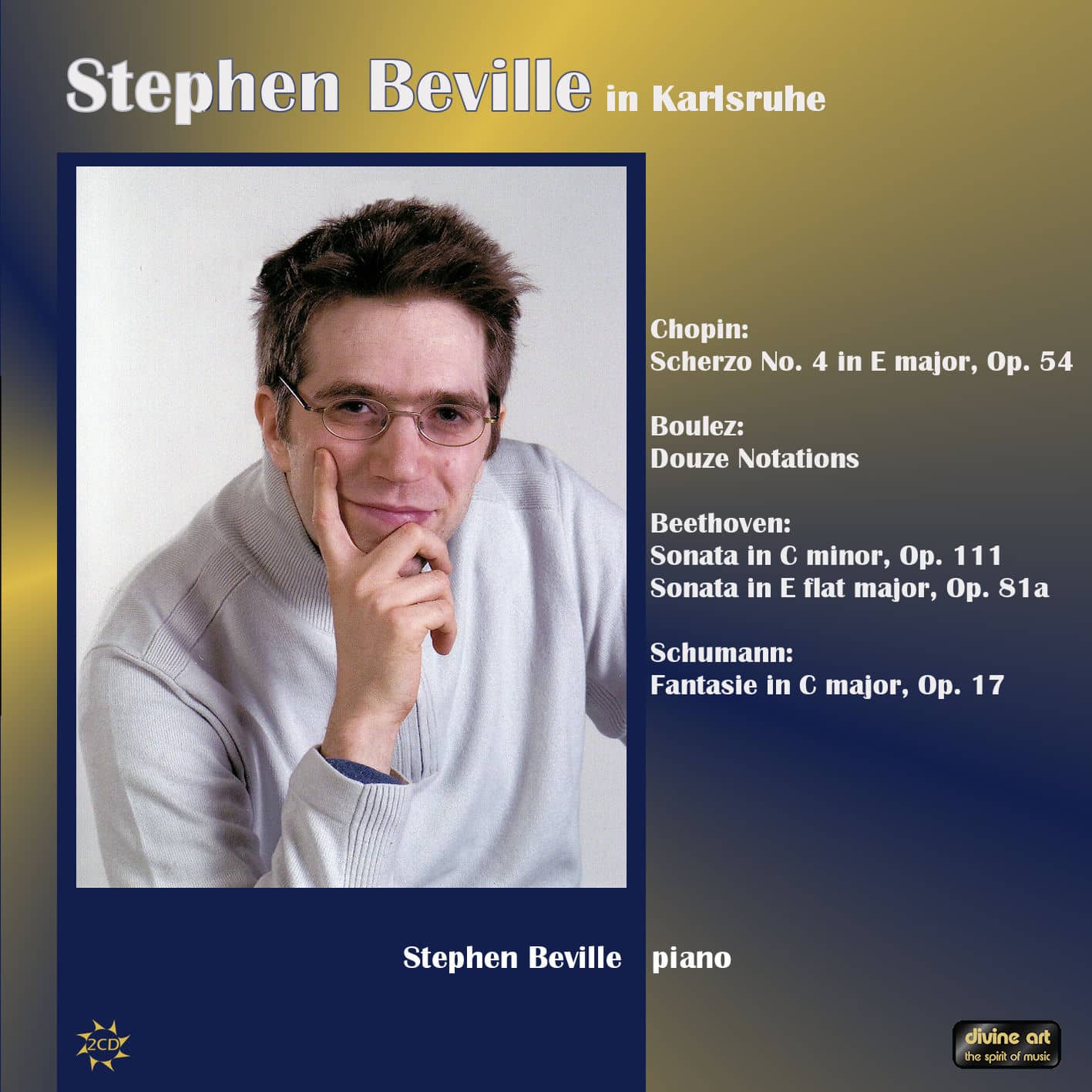
Recorded at the Velte-Saal, Karlsruhe 2003-04, this ambitious recital by a young British virtuoso, a pupil of Peter Katin, captures him in both studio and concert performances. From the outset of the Chopin 1842 E Major Scherzo , we feel the presence of an intelligent, controlled, and searching pair of hands quite capable of imparting power as well as finesse. The skittish figurations alternate with Chopin’s poetic flights of nocturnal fancy in seamless continuity, a moment of girth and nuance.
The Notations of Pierre Boulez (1948) represent his Op. 1 , as it were. They admit freely their miniaturized allegiance to the Schoenberg 12-tone school, fused with sonic shock waves or bird calls endemic to Varese and Messaien. Moody, impulsive, pointillistic, and often austere and dry in wit, they borrow from Debussy as well, at least in his gamelan fascination from the Paris Exposition. The longest of the twelve lasts barely over 90 seconds. The sense of malaise or uneasiness they generate translates well into Beville’s palette, and he seems to harbor an affection for the discrete notions of time.
Whatever startling originality Boulez projects pales in the presence of Beethoven’s 1822 Op. 111 Sonata in C Minor, here recorded in live performance. Beville provides some tender applications in the opening Maestoso , until the double notes begin to shimmer with the earthquake unleashed in the Allegro con brio ed appassionato . A true etude de bravura, the contrapuntal and dynamic hurdles in this movement, rife with “fateful” purport, pass through Breville’s fingers with the confidence of disarming, long familiarity. Beville assigns a grand leisure to the Arietta and its subsequent, intricate, Byzantine evolution through a host of affective gestures. When Beville builds up his momentum, the surge becomes persuasively emphatic, the intimate moments eerily serene. Well in advance of Scriabin, Beethoven’s trill liberates the spirit into some primal aether.
The Beethoven “Les Adieux” Sonata of 1810 evokes a thoughtful, introspective reading from Beville, though his first movement Allegro rings with bright optimism. Beville wants the music to resonate with the anguish and eventual liberation we experience in Beethoven’s opera Fidelio . I might suggest that Egmont , too, factors into the mix of affecting silences and sudden leaps of faith. Beville’s pearly upper register warrants our notice. The Andante espessivo middle movement emanates a singular, lonely pathos, in which silences and perfunctorily animated passages alternate in nervous tension. Pomp and joyful ceremony mark the return, Das Wiedersehn , ostensibly, Beethoven’s gladness at his patron, Archduke Rudolf’s buoyant presence in the composer’s social and creative life.
Beville concludes with a truly Romantic piece, a concert performance of Schumann’s 1836 Fantasie , conceived as part of a Beethoven memorial planned in Bonn. More often, the music laments and celebrates the composer’s tormented courtship of Clara Wieck in contrapuntal conceits partial to their “mythical” personae in Schumann’s imagination. Strong, sweeping syncopes contribute to the heroic effect of the martial second movement by Beville, and he maintains the anti-Philistine ethos without sacrificing the galloping poetry the music contains. The last movement, with its reminiscences of the “Moonlight Sonata” and its adumbrations of Tristan, plays directly into Beville’s ardent hands, an apt gesture from one young poet to another on behalf of “the distant beloved.”
**** (Four stars awarded)