Catalogue Connection: 25109

  • Fanfare – Colin Clarke – 25109

    The songs and anthems of Peter Lea-Cox (b. 1945), presented here in a disc entitled Of Times and Seasons, are eminently appealing. This is most distinctly the English pastoral school, with the very first of the Songs of Gerard Manley Hopkins invoking (in me) memories of Vaughan Williams’s gestures. There are echoes of Finzi here, too. The cleanliness and purity of Lesley-Jane Rogers’s soprano is perfectly suited to the music she sings (she also provides the excellent booklet notes), while Jennie-Helen Moston accompanies with superb sensitivity. Lea-Cox’s final gesture of the brief third song, “Pied Beauty”, is a properly climactic setting of the words “Praise him,” wonderfully devotional and effective. The chordal, hymnic “Thee, God, I come from, to thee go” affords full contrast. Rogers and Moston embrace its warm faith magnificently, impressive in their childlike simplicity.

    I confess I made the mistake of thinking this was a mixed solo/choral disc when I saw the use of the word “Anthems.” These are solo anthems, however (how modern!). Still, it is clear that the Church (and God —the two not always as closely linked as religion would have us believe) are vital­ly important to Lea-Cox, who has held a variety of positions, including at St. Jude-on-the-Hill in North London. The Eight Seasonal Anthems (2005) is intended as a single set, its texts from the Lutheran Book of Worship. Lea-Cox also utilizes chorale melodies within the piano accompani­ments (although sometimes in some disguise). These anthems are generally longer than the Hopkins songs, and although only by a minute or two, the difference is telling. The quiet piano introduction to the second song, “Behold, the herald’s voice is calling”, is most atmospheric and the entire song gives the impression of owning a space far beyond its four-and-a-half-minute duration. The restrained “alleluia” of “Crown Him, Lord of Lords” leads to a resolute statement of the title line as a well-earned climax. Most telling of these songs, perhaps, is the rapt reverence of “Baptised into your Name most holy” (the fifth song); the next song, “Saviour, when in dust to you”, expands the palette somewhat. Some of the harmonies perhaps threaten to move into a more popular genre before settling down into a more dramatic script. Moston is at her most communicative in the more open, celebratory sonorities of the final “rejoice, rejoice this happy morn.”

    The solo item, Cathedral at Night (1971), is a mere three minutes long. Wonderfully atmos­pheric, it seems to be influenced by Ravel (no surprise then that the booklet notes link it to the Rouen Cathedral paintings by Monet).

    Twenty years separate the earliest and most recent of the Collected Songs. Here the composer has selected eight diverse items. The mode of expression, predominantly tonal with Lea-Cox’s own brand of spice, is by now familiar. Lesley-Jane Rogers is excellently responsive to the various texts (there is a variety of poets on offer), whether in story-telling (“The Clod and the Pebble”,( text by William Blake) or dealing with the anguished dissonance of “Prelude-1” (Blake). She sustains the exposed, poignant lines of “Afterwards” (Hardy) stunningly.

    The recording is excellent, particularly when it comes to preserving the warmth of the piano. The venue was the Jacqueline du Pré building, St. Hilda’s College, Oxford. A most enjoyable disc.
  • Musical Opinion – Robert Matthew-Walker – 25109

    Peter Lea-Cox is an accomplished composer, much connected with the English choral tradition, and this new record of no fewer than 23 solo settings demonstrates his gifts and artistry in excellent fashion. Of the wide-ranging songs here, my personal favourite is his setting of Yeats’s ‘Sailing to Byzantium’, with its sly quotation from the Londonderry Air, but each one of these carefully crafted songs has its own individual charm and character. The composer is fortunate indeed to have had Lesley-Jane Rogers and Jennie-Helen Moston to perform these works, for their performances are admirable and do much to ensure this deeply attractive body of music is brought to wider attention – which it clearly deserves. The recording quality is also very good, the singer being well balanced with the piano.
    *****

  • The Classical Reviewer – Bruce Reader – 25109

    The English organist and composer Peter Lea-Cox studied at the Royal Academy of Music in London before becoming, from 1967 to 1972, Assistant Music Master at Oundle School, Northamptonshire. From 1973 to 1986 he was on the staff of the Royal Academy of Music where he taught choral conducting, sight singing and harmony. From 1973 to 1986, he was Director of Music at St. Jude-on-the-Hill Church in Hampstead Garden Suburb in London and has served as organist at St. Mary-at-Hill Church in the City of London. From 1987 to 2004 Lea-Cox served as Director of Music at the Lutheran Church of St. Anne & St. Agnes in the City of London.

    Lea-Cox is an accomplished recitalist who has given organ concerts in Britain, Germany, Denmark, Sweden and the United States. He made his twenty fourth organ recital tour of Denmark in 2011. In 2011 he made his eighteenth musical tour to the United States and, earlier that year, was guest director of the De Swaen Barokensemble performing Bach Cantatas and other works at the Oude Lutherse Kerk in Amsterdam. He has given organ recitals at Westminster Abbey and St. Paul’s Cathedral in London as well as Washington’s National Cathedral.

    He has also performed with the Lecosaldi Ensemble at Westminster Abbey and Canterbury Cathedral. In October 2004, he gave the twenty seventh annual recital in the distinguished Paul D. Wickre Memorial Concert Series at St. Luke Lutheran Church in Silver Spring, Maryland. He has broadcast on Britain’s Radio Three as well as making recordings of organ and instrumental music. Lea-Cox conducts the Camden Chamber Choir and other choral societies as well as serving as a tutor at the annual Oxford Baroque Week.

    He has composed many vocal and instrumental works as well as compositions for organ. He uses the pseudonym “Lecosaldi” when composing in the baroque style of Handel and Telemann and uses “Lea-Cox” when composing in a contemporary idiom.

    Divine Art Recordings have just released a new recording of songs and anthems by Peter Lea-Cox performed by the soprano Lesley-Jane Rogers and pianist Jennie-Helen Moston.

    Peter Lea-Cox’s Six Songs of Gerald Manley Hopkins opens with Hurrahing in Harvest , with a lovely flourish on the piano and a very spring like feel, very much in the English tradition of song writing, with an attractive slow central section. Spring is a very attractive setting, whilst Pied Beauty is an extremely striking setting of verses that must have been a challenge to set. Thee, God, I come from, to thee go is a hymn like setting that has an Elizabethan and even a Vaughan Williams feel. As Kingfishers catch fire is an evocative setting and the final song in this set The Windhover returns to a faster tempo with a lovely piano part from Jennie-Helen Moston. Lesley-Jane Rogers has a lovely pure voice but does seem rather strained in the upper register.

    This is a quintessentially English song cycle which gains so much from the thoughtful and effective piano writing. These songs deserve to be included in English song recitals.

    Noël Nouvelet is the first in this collection of Eight Seasonal Anthems, a terrific Easter anthem that deserves to be in constant use. Again the piano part is so effective. Lesley-Jane Rogers is particularly beautiful in the quieter second verse. Behold, the Herald’s voice is calling opens with repeated, gentle chords sensitively played. Here Rogers is most effective in this lovely Advent piece. Crown Him, Lord of Lords is a rousing Ascension anthem and God’s Word is our great heritage is for Reformationtide, a timelessly English piece. A beautifully peaceful Baptised into your Name, most Holy is so fine in its simplicity. Saviour, when in dust to you is a Lenten anthem, somewhat melancholy, in another fine setting that rises up in the middle. Come before the Saviour’s table has a lovely simplicity, more a song than anthem in feel, but lovely nevertheless and again with some lovely piano phrases. Rejoice, rejoice this happy morn is an uplifting Christmas anthem to end this collection of anthems.

    Jennie-Helen Moston plays a short piano work by Peter Lea-Cox entitled Cathedral at night which is a quiet, effective, atmospheric piece.

    Finally on this disc are eight Collected Songs commencing with Let the Season lift your spirit , a setting of verses by Katherine Foyle, a song that highlights Lea-Cox’s ability to vary the music to create the exact feeling for the words. The Clod and the Pebble is a setting of Blake, beautifully done, again with such an effective piano part. The same applies to Lea-Cox’s setting of T S Eliot, Winter Prelude that completely conjures up the feel of winter. Afterwards is an accomplished Hardy setting with such feeling and sensitivity for the words, whilst Sailing to Byzantium , a setting of W B Yeats, has a jaunty, even jazzy opening before moving to a more thoughtful tempo. Interestingly, in verse four, Lea-Cox almost hints at the Londonderry Air, no doubt touching on Yeats’ Irishness. Like the touch of rain, a setting of Edward Thomas, is exquisite with a lovely piano part. Garlic and Sapphires is another setting of T S Eliot, again showing such sensitivity to the text. Baby Sleeping ends this attractive collection and is a lullaby on the Christmas story, a really charming song.

    This is a very attractive collection of songs and anthems that deserve to be included in the repertoire. As usual from Divine Art, the booklet is beautifully produced with notes by Lesley-Jane Rogers and Peter Lea-Cox together with full texts. The recording is excellent. Though I have certain reservations about certain aspects of Lesley-Jane Rogers’ voice on this recording, her singing is often really lovely in the quieter and more gentle passages. I do urge all those interested in English song and church anthems to hear this disc.

  • MusicWeb – John France – 25109

    This new CD of songs by the composer, musical director and organist Peter Lea-Cox presents a wide-ranging exploration of English verse, songs and religious texts in what is a largely, but not entirely, traditional musical language. The songs extend in mood from the soft dissonance of Winter Prelude (T.S. Eliot) to a catchy setting of Katherine Foyle’s Let the Season lift your Spirit . These numbers will appeal to listeners who enjoy the vocal music of composers such as Gerald Finzi and John Ireland, the emphasis being on a sensitive fusion of words and music.

    I enjoyed the six Gerard Manley Hopkins settings, which were conceived as a song-cycle. The date of composition is not given. I recognise that these extremely familiar words must be exceedingly difficult to set in a convincing and novel manner. Peter Lea-Cox has adopted a Finzi-like setting of most of these texts, which will remind the listener of that composer’s Dies Natalis . There is a good contrast between the lyrical and the declamatory. Typically, the songs reveal themselves slowly: they tend to avoid strophic repetition. The largely syllabic settings of these words are particularly effective. I did not like the hymn-like setting of Thee, God I come from, to thee go – it is in danger of sounding like RVW’s Linden Lea . Unfortunately, the liner-notes give no analysis of these songs. It is as if they have been forgotten.

    I am old-fashioned. I do not agree with the premise that ‘solo songs’ can be substituted for the choral anthem at Matins or Evensong. It is but a short step from this to choruses accompanied by guitars and synthesisers. It probably has its place – but not in any formal liturgy. The present Eight Seasonal Anthems were written in 2005 for use in the Lutheran Church in London: the texts were culled from that denomination’s Book of Worship . In themselves these are delightful songs that slip between an almost Andrew Lloyd Webber-y ‘pop’ feel to RVW/Holst folksong and back to something a little more profound. The effect is typically thoughtful. I would suggest that this set of eight songs actually makes a good ‘song-cycle’ that could be presented in a church-based recital.

    There is a short ruminative piano prelude that has crept into the batting list. It is a fine example of a gently atonal piece that nods to Debussy’s La cathédrale engloutie . I certainly hope that there is more where this came from.

    I enjoyed the ‘collected songs’ best of all. Usually, when a poet issues his or her ‘complete poems,’ it will include scraps, juvenilia and ‘uncollected’ fragments. When it is a volume of ‘collected’ poems it refers to a carefully edited selection of their major achievements. In the case of Peter Lea-Cox’s ‘Collected Songs’ I understand that they have been judiciously chosen from a huge pile of manuscripts. The introduction suggests that the date of composition of these eight songs covers a period of two decades. I do not believe that they are meant to be heard as a cycle as they are too diverse and lack a musical or literary theme. These cover a wide range of poetical and musical emotion. They are settings of poems by a broad selection of writers including T.S. Eliot, William Butler Yeats and Edward Thomas as well as those who were members of the composer’s church.

    I had not heard any music by Peter Lea-Cox before reviewing this disc. I was aware of his exploits as an organ recitalist and as the founder of the Lecosaldi Ensemble and his directorship of the Camden Chamber Choir. When he was director of music at St. Jude-on-the-Hill Church (1973-1986), he composed a number of anthems and canticle settings. During his time at St Anne’s & St Agnes City Church he produced a ‘huge corpus’ of short choir pieces and ‘offertories’ for solo voice and continuo. These were used at Sunday morning worship. One of his larger achievements is four ‘Passions’. These balance modern and baroque idioms. I understand that he has also written a number of Chorale Preludes for the organ in a variety of contrasting styles.

    Lesley-Jane Rogers gives an outstanding account of these songs. Her voice is well-suited to the variety of moods and styles required. Her strength lies in holding an effective balance between the more forceful and extrovert numbers and those that are intimate and reflective. The accompanist Jennie-Helen Moston – does everyone associated with this CD have a hyphenated name? – makes a valuable and sympathetic contribution to the proceedings. The liner-notes are good with the above mentioned exception. The sound quality is ideal.

    I suggest that these three groups of songs be taken as distinct entities. This is not a CD to listen to from end to end. In case anyone thinks I am being unkind, I would take the same view of a disc of songs by Schubert, Britten or Ireland. Explore slowly and enjoy the diversity on offer here.

  • American Record Guide – Mary Southwell – 25109

    This album’s performance puzzles me. I spent some time finding performances of Lesley-Jane Rogers. She is a better singer than you would think from this recording. These typically English songs are solid anthems and well suited for church services.

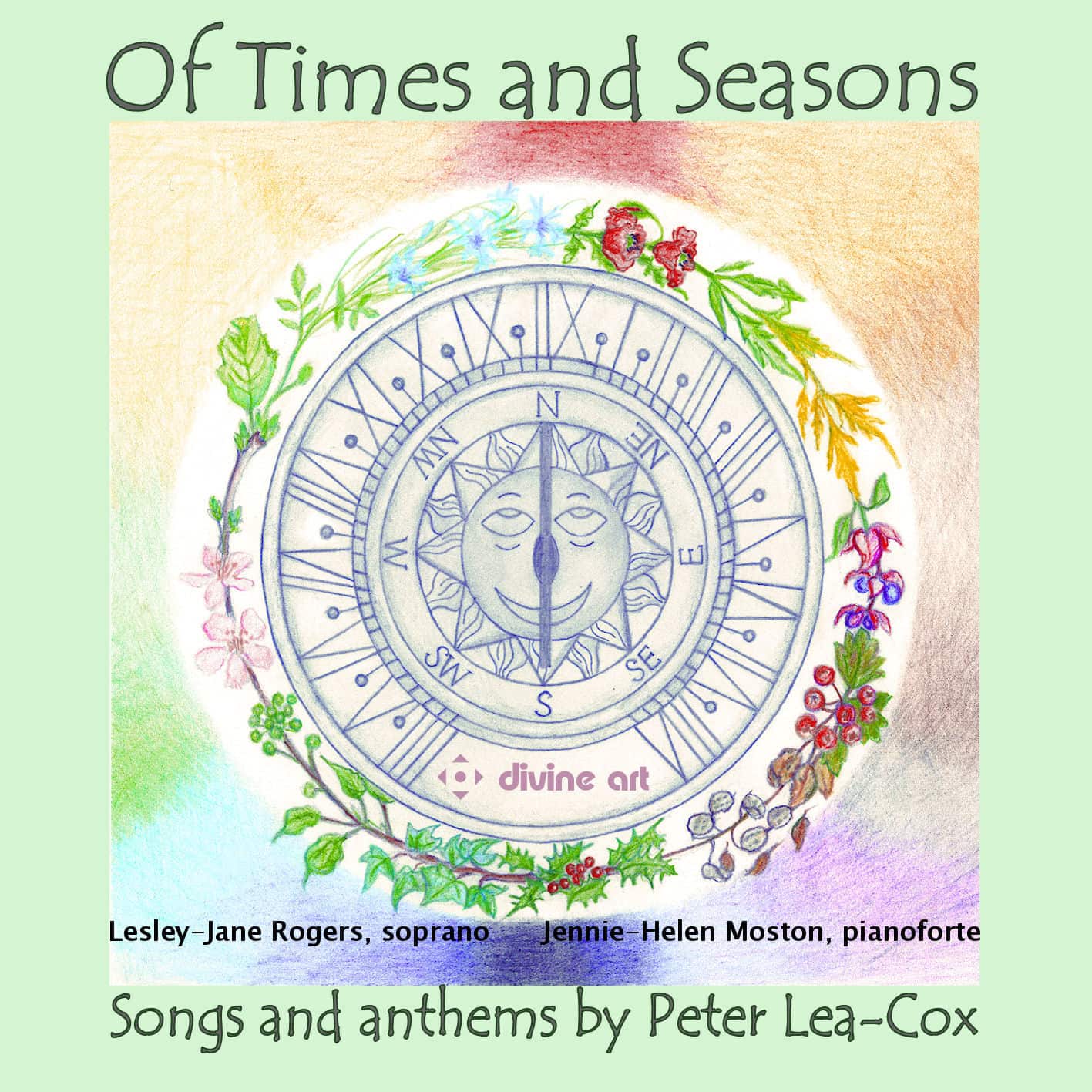
  • Of Times and Seasons – Songs and Anthems by Peter Lea-Cox

    Of Times and Seasons – Songs and Anthems by Peter Lea-Cox

    Peter Lea-Cox is an English composer who while concentrating on vocal (usually sacred) music, employs a huge range of styles in order to best express the words being set – from the dissonance of Winter Prelude to the simple folk-like melody of ‘Let the Season Lift your Spirit’. Above all is Peter’s tremendous sensitivity to the texts and the word-painting and coloration he employs. This album presents a set of six songs on texts by Gerard Manley Hopkins, a set of Anthems for solo voice – for several of the ecclesiastical seasons – and a collection of other songs.