Catalogue Connection: 25110

  • MusicWeb – Gary Higginson – 25110

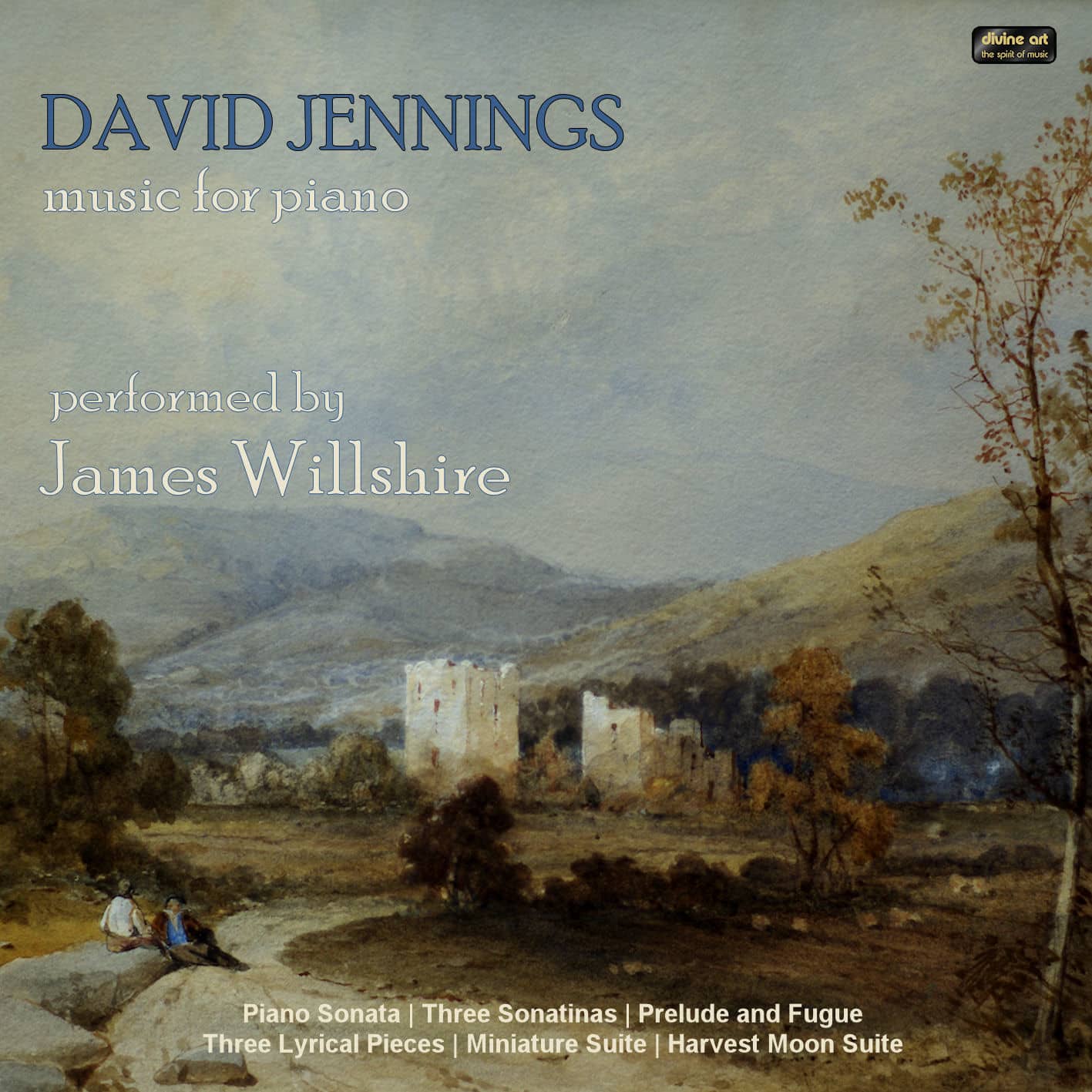
    The lovely cover picture to this beautifully produced CD rather gives the game away. It is a reproduction of a portion of a painting by the little-known north country artist Edward Richardson, ‘A Castle in Yorkshire, 1848′. David Jennings loves British eighteenth and nineteenth century paintings; quite rightly too. There is a certain element in the music recorded here which is stimulated by those very landscapes.

    One of my favourites on this very well filled disc is the Three Lyrical Pieces . It is headed up with the lovely musical ‘watercolour’, ‘Evening Twilight’, an Andante Tranquillo . This piece was inspired by a real watercolour by George Barret Junior a London-based landscapist who died in 1842. The other movements are a Cavatina and a delicious Waltz .

    The disc opens with the longest piece and the one which is the most intriguingly original. It is Jennings’ Op. 1 Piano Sonata which took over twenty years to write before it pleased the composer. The sonata-form first movement has several gestures which would appear quite ordinarily romantic, but their development is full of surprises as Jennings obsessively beavers away at them. In his exemplary notes he describes the movement as “combative”. I would add that with the increasing dissonances the movement is quite disturbing. The jazzy scherzo second movement just adds to the ambiguous atmosphere. There were times in the third, which the composer describes as the work’s “emotional kernel”, when I thought of E.J. Moeran. Its wild middle section is actually quite disconcerting within a ‘Romance’ framework. The way it dies back to the opening and quite complex melody is fascinating. The finale is a truly virtuoso movement only mitigated by a reflective and rather lonely quieter section before the final onslaught. This is proper piano music and a truly extraordinary Op. 1 which deserves regular hearings and public airings.

    For a composer who emerged from the 1980s mêlée of Durham University and the teaching of John Casken, David Jennings has quite remarkably eschewed modernism. He has ploughed his own furrow divorcing himself quietly away in the Lake District. This can be heard in the last work on the disc which is also the most recent. It too was stimulated directly by the Romantic 19th Century water-colourists. It’s the Harvest Moon Suite and it falls into six contrasted movements. These are contrasted not only in length but also in drama and tempo. Surprisingly one of the fastest is the third entitled Haunted Abbey . Most people would expect something shadowy and mysterious but Jennings wittily gives us what he describes as “Gothic gloom famously lampooned in Jane Austin’s Northanger Abbey”. The longest and the central focus of the piece is Harvest Moon itself, inspired by what the composer tells us is a “large and impressive water colour by George Barret Junior”. It’s unfortunate that for most of us these superb pictures are quite unknown. Jennings does us a double favour: he presents his evocative and beautifully crafted piano miniatures and makes us want to search out these overlooked Victorian masters.

    The eclecticism of this disc is exemplified in the next work. I’m especially thrilled to have the Prelude and Fugue , dedicated to me. It’s the most harmonically daring work on the disc and a challenging piece of piano music not to be taken on lightly by its potential players. I’ve decided that it’s beyond my pianistic abilities, but James Willshire surmounts its challenges with consummate ease and poise. The whole piece is searching and dramatic. What we have here is a twelve-tone composition with the row clearly stated in the first bar and the last of the Prelude. The interval of the minor third predominates in both the Fugue and the Prelude but is variously transposed and transmogrified. Begun in the early 1990s it was brought to its final form within the last couple of years.

    Many composers go back over old work as Britten did for his Simple Symphony . The experience and confidence gained over a period of twenty years of writing music enables one quite often to find in some forgotten fragments that once seemed to have reached a dead-end a way to flower and develop. The Sonatinas fall into this category.

    Roughly contemporaneous with the large-scale Piano Sonata come the Three Sonatinas allotted opus number 2 and therefore composed when Jennings was a precocious young teenager. He dug them out of his cupboard in recent years and apparently found little to revise. They are each diatonic and strongly melodious. The lines tend sometimes towards modality and sometimes have a slightly French touch. Melodies are exchanged between the hands in a romantic, wistful, nostalgic, uplifting and often gentle manner that I find quite captivating. The composer mentions in his notes that he sees the piece as “being in the tradition of Schumann’s Kindersczenen ”. I felt this especially strongly in the finale of the second Sonatina and in parts of the third where, for me Finzi was also evoked in the middle movement.

    Beware composers who write miniatures. Very often more can be said in two minutes than in ten. Although this is a disc containing thirty tracks there are just eight separate works. In the case of the Miniature Suite there are five movements. Each of these is a finely polished gem which wastes no notes and says only exactly what it wants. Indeed the way Jennings throws off the third movement Invention when it reaches its natural end is not only entirely suitable but also witty. In fact this whole piece is charmingly humorous, with its snoozing cat in the second movement Air and its later dreamy canal walk steamily entitled Romance . All make a gentle bow towards the great JS with a final jolly fugue and first movement Prelude. As with much else here, one often feels with Jennings that more lies behind the music than he allows us to know.

    James Willshire’s performances are faultless both musically and emotionally. He does not unnecessarily interpose himself between composer and listener as so many young players tend to want to do. I can only strongly advise that you buy this disc and enjoy for yourself a new and individual voice in British piano music.
  • Records International – 25110

    Jennings’ music is refreshingly straightforward and communicative, sometimes plainly neo-Romantic (the Harvest Moon Suite which is inspired by six 19th-century English watercolors; parts of the four-movement, 21-minute sonata, which also has some jazz influences in its second movement) while the short Sonatinas and the Miniature Suite are attractively neo-baroque in intent. As if to prove that he’s capable of it, Jennings even offers a twelve-tone Prelude and Fugue, but prospective purchasers need not shrink back in horror since it’s only five minutes long. Any lover of tonal modern piano music will find much to enjoy in these 78 minutes.

  • MusicWeb – John France – 25110

    When I first received this CD I dreaded that is might be another example of music inspired – if that is the word – by the Italian composer Ludovico Einaudi. In spite of his popularity, he is a composer that leaves me utterly cold. To parody Stravinsky’s comment on Vivaldi, he appears to have written the same piano piece at least three score times. The New-Age blend or fusion of minimalism and pop is something that I cannot come to terms with. I was wrong. David Jennings is a composer who is beholden to no-one in spite of a number of trajectories in his musical language. His is serious, well-structured music that I can do business with. More to the point, many of these pieces are not only impressive, but are interesting, satisfying and often moving. No listener or composer could wish for more.

    This present CD represents David Jennings’ complete ‘musical offering’ for piano – so far. The earliest work is the impressive Piano Sonata, Op.1 which was written back in the 1980s. The most recent pieces are virtually ‘hot off the press’ having been composed in 2009/10.

    The composer’s website gives a brief biography, however three things can be said that will help the potential listener approach this music. Firstly, David Jennings is a Yorkshireman, having been born in Sheffield in 1972. Nevertheless, he has crossed the Pennines on a number of occasions including study at Manchester University with John Casken and his membership of the Lakeland Composer’s group.

    Secondly, Jennings has had a wide range of musical and non-musical influences. He has a great interest in art, especially the 19 th century English water-colourists – which he feels are ‘an inspiring marriage of technique and expression’. It is a quality that he exhibits in his music. The composer is stimulated by the North Country landscape, particularly Yorkshire and Northumberland. From a musical perspective, I mentioned ‘trajectories.’ These include Frederick Delius, Kenneth Leighton, Gershwin and Frank Bridge. In the Sonata I felt that the ghost of Sorabji was haunting some of the music.

    The first piece I listened to came as a wee bit of a revelation. I noted above that I feared music by an Einaudi groupie. Nothing could be further from this with the Prelude and Fugue, Op.6. The Prelude uses twelve-tone procedures throughout. This section of the work was composed in 1992 ‘as a response to newer musical influences encountered at university’. The Fugue had to wait a number of years before being written, with the complete work being issued in 2010. The Prelude is written in a lyrical form of serialism that also hints at jazz. Whereas the Fugue is a tightly knit piece that is austere and musically sarcastic. To my ear the fugue subject metaphorically ‘sticks out its tongue’.

    Next, I decided to listen to the Three Sonatinas, Op.2. These miniatures were composed in the late nineteen-eighties, when the composer was still in his teens, although they have been subjected to a little ‘mature’ revision. David Jennings suggests that they belong to the tradition of Robert Schumann’s Kinderszenen . However, like the German master they are a considered balance of innocence and subtlety. Nowhere is there any suggestion that they are children’s pieces. These are urbane and nostalgic pieces and never become mawkish. Technically, they appear to be demanding and are always musically satisfying. Finally, David Jennings has wisely chosen to cast this set as ‘sonatinas’ rather than ‘character pieces’: they deserve to be listened to as a ‘cycle’ and in the order presented on this disc. For the record, my favourite ‘piece’ is the beautifully written Nocturne from Sonatina No.2.

    The longest work on this CD is the Piano Sonata, Op.1 which was composed around 1988 when the composer was ‘nobbut a lad’! However, it is a magnificently impressive work for an Opus 1, in spite of a little tinkering in 1995. This is a big work in all senses of the word – lasting over twenty minutes, the music fills out a grand canvas with its musical invention. I was reminded of Sorabji in this work. Not so much in the sound of the piece but in the ethos. The Sonata exhibits a certain waywardness in the working out of themes – they seem to me to be derived by a sort of continuous development rather than straightforward eight bar themes. Much of musical background is complex: impressionistic colouring is used. There is considerable ornamentation featured in these pages. The music sounds difficult to play. The harmonies, although largely post-romantic in their effect are wilful. Finally there is a mystical quality to much of this music that could be derived from a sense of landscape. Some of these attributes often feature in Sorabji’s massive musical canvases.

    The opening Ballade is deceptively serene but soon becomes somewhat more aggressive in its tone. The jazz-coloured Scherzo is as dry as a bone – but infinitely varied and intricate as it explores a variety of time signatures. The third movement, a ‘romance’ is deeply felt. This is introspective music that explores considerable depths. Jennings well describes this as consolatory music and he is correct. There is a little relief in the ‘trio’ section; however the dominant mood is restored towards the conclusion. Finally, the ‘Finale’ is cast as a rondo. This is a noisy, splashy piece, which explores a number of moods including jazz. There are a couple of episodes that present a mood of calm, but the prevailing exuberance wins the day.

    I loved this Sonata. It is surely one of the best examples to have come from the pen of a British composer for many years.

    The Miniature Suite, Op.18 is a wonderful piece of Bach parody. The composer’s aim has been to recreate ‘aspects of Baroque style in an updated form.’ The opening ‘Prelude’ is a little ‘toccata’, which nods to a well-known J.S.B. war-horse. Amusingly, the liner-notes suggest that the composer was inspired to write the ‘Air’ after watching a ‘remarkably lazy cat going in and out of slumber.’ The third movement is a little ‘Invention’ that has some un-Bachian twists and turns. This is followed by a gorgeous ‘Romance’ which was inspired by a walk along the equally lovely Lancaster Canal: it is the most substantial movement. The Suite concludes with a well-contrived fugue, which brings this ‘modern’ piece to a rollicking conclusion. Jennings does seem to be rather good at writing fugues – which is a breath of fresh air in the post-modernist age in which we live.

    The final entry is the important and impressive Harvest Moon Suite, Op.19. This six movement work was inspired by six nineteenth century watercolours. However, it is not a North Country Pictures at an Exhibition : Mussorgsky’s music was largely dramatic, whereas Jennings has opted for a romantic, lyrical and often reflective mood. It is here that I am reminded of York Bowen, although the composer assures me that he had only heard a handful of pieces by this composer before he set to work on the score. I believe that it is the subtle balance between bitter and sweet and romantic that suggests this similarity. The musical pictures include Aira Force , The Haunted Abbey and Harlech Castle . It is a very lovely sequence.

    This is a beautifully produced CD in every manner. The sound quality is outstanding, with each nuance of the music being clear. The programme is considerable in both scale and concept: the ‘complete piano works’ lasting over 78 minutes. The interpretation of these pieces by James Willshire is everything that could be wished. I loved the painting by Edward Richardson of ‘A Castle in Yorkshire’ – although it is not too close to the composer’s native heath. In fact, it is Barden Tower in Wharfedale. This was a place beloved of Frederick Delius and has latterly become one of Jennings haunts too. The liner-notes by David Jennings are well judged and helpful.

    This is a CD of piano music that is inspiring and challenging. I have noted one or two musical signposts in the course of this review. However, I do want to point out that David Jennings has discovered his own voice. It is, as Jomar de Vrind has noted, a successful balance between not being ‘ridiculously reactionary and horrendously modern’. One can but hope that there are many more inspired piano works to emerge over the coming years. In addition, I would love to hear some of works in other genres, such as the Lincoln Imp for Orchestra, the Oboe Sonata and the String Quartet.

    (chosen as one of John France’s 5 Recordings of the Year 2013 with this extra text):
    David Jennings is a composer who is beholden to no-one (in spite of a number of trajectories in his musical language). It is serious, well-structured music that I can do business with. And, more to the point, many of these pieces are not only impressive, but are interesting, satisfying and often moving. No listener (or composer) could wish for more.

  • American Record Guide – Jack Sullivan – 25110

    This is all the piano music of English composer David Jennings from 1988 to 2010. Opus 1, a piano sonata, opens with a ballade that has a lyrical main theme and a serene tone that gradually becomes more agitated. There are two lively jazz-influenced movements and a glowing slow one that offers the work’s most eloquent music.

    From the late 80s come three charming sonatinas, innocent and flowing pieces in the manner of Schumann’s Kinderszenen. An angular contrast is the Prelude and Fugue from 1992 and 1999, a 12-tone piece that was, in Jennings’s words, “a response to newer musical influences encountered at university”. For tonal composers like Jennings, the tempta­tion to at least fiddle with a tone row often proved irresistible.

    By the new millennium Jennings had apparently recovered (“Get thee behind me, Satan”): the Three Lyrical Pieces are some of his most songful works, the Miniature Suite an homage to Bach that sounds like a cross between Elgar and the Baroque. Harvest Moon Suite closes the album on a pastoral note. The young pianist James Wiltshire plays all these pieces with warmth and an emphasis on the melodic line. David Jennings’s music is not flashy or ostentatious, but it is melodic, open hearted, and well made.

  • MusicWeb – Jonathan Woolf – 25110

    David Jennings was born in 1972, and studied with John Casken. Strongly immersed in music of the British Musical Renaissance he has also been influenced by poetry and the visual arts. He has composed in a variety of forms but this disc concentrates on music for piano. The earliest of these works are rooted in his childhood.

    The Piano Sonata No.1 was started in 1988 and completed in 1995, though revisions meant that it didn’t reach its present form until 2009. A long gestation, certainly. It covers a pleasing amount of stylistic ground: calm initially but soon subject to tauter, twistier material, then a snazzy, jazzy Scherzo with some good rolling left hand. Then there are more calm, almost Debussian harmonies in the Romance third movement with a contrasting section full of velocity. Written in the mid to late 1980s, the three Sonatinas are succinct and highly communicative, revealing baroque hints as well as other kinds of influence. One such is the ‘Satie Barcarolle’ effect of the central Elegy of the first Sonatina or the Bachian elements of the second. One might think that the Prelude and Fugue Op.6 would build upon certain neo-classical elements that are present in the composer’s music. However this is a much thornier work altogether and one that enshrines quite a rigorous use of twelve-tone throughout its five-minute length.

    The Three Lyrical Pieces were written in 2010 and they’re very charming ‘Old School’ pieces which nod to early twentieth-century British piano writing. His next opus was Miniature Suite , which certainly lives up to its name: the five movements last eight minutes in total. This sees Bach gently modified, updated and generally dabbled with, not least via unexpected modulations. The Invention , the third of the movements, sounds like a thoroughly subverted piece from A Bach Book for Harriet Cohen . By contrast the disc ends with Harvest Moon Suite, a series of six charming watercolours, whether gentle of more lurid. The Haunted Abbey, for instance, its title derived from a William Payne painting, is decidedly Hammer Horror, though Harlech Castle is gaunt, and Innisfallen Lake sonorous and evocative.

    The composer reveals himself to be admirably equipped in writing for the piano and James Willshire seems an ideal interpreter.

  • Albion Magazine – Em Marshall-Luck – 25110

    This disc features the complete music composed for piano by contemporary composer David Jennings, all works written between 1985 and 2010.

    The music is tonal and attractive, with an occasional very slight hint of jazz, but otherwise generally in a lyrical and romantic vein. The works – which comprise a Piano Sonata , three Sonatinas , a Prelude and Fugue , Three Lyrical Pieces , a Miniature Suite and the Harvest Moon Suite – are all well-played by James Willshire.

    Sound quality, presentation and notes are all to be commended, resulting in a very good disc of enjoyable music and sound interpretation.

  • Fanfare – Maria Nockin – 25110

    British composer David Jennings was born in Sheffield in 1972. He studied at Manchester University with John Casken and is currently a member of the Lakeland Composer’s Group. He is busy building his list of compositions, which already range from piano miniatures to large orches­tral works. Jennings strives to achieve a balance between traditional and 21st-century approaches to composition. His work shows the influences of Elgar, Vaughan Williams, Bridge, Gershwin, and medieval music as well as the works of his contemporaries. He writes serious, well-structured music and the interesting pieces on this disc are moving and emotionally satisfying. He knows how to use dissonance and he sometimes puts the piano in a percussive, rhythmic mode, but he can also bring us the lyrical picture of young love in a spring garden. Jennings mentions that the influences on his music are both musical and non-musical. He has a great interest in graphic art and a love of the land­scape of Northern England. Both of them influence his compositions.

    His Piano Sonata begins with a delightful percussive melody riding on a fairly traditional structure. He tries to make his music timeless and, to a great extent, it is. The second movement has a quasi-impressionistic feel but you still know that this entire piece was written in our time. It’s orig­inal and invites the listener to sample it more than once. James Wiltshire is a fabulous pianist whose runs are as smooth as creamery butter. He has a wide dynamic range and a full palette of tonal and emotional color, too. Jennings has found an excellent interpreter for his piano works. While his sonatinas mix traditional melody with the modern infrastructure, they also combine musical maturi­ty with a natural exuberance. The melodies in the Second Sonatina might make good art songs because they are long and memorable. The Third Sonatina shows the influence of Gershwin.

    The mood of the music on the disc changes with the opening drama of the Prelude and Fugue. This piece proves that Jennings can be as ancient as Bach and as modern as tomorrow.

    The Three Lyrical Pieces entitled “Evening Twilight,” “Cavatina,” and “Waltz” provide a bit of respite after the mathematical structure of the fugue. The first is pastoral; the second might be sung by a tenor in praise of the lady with whom he will dance the final Waltz. The Miniature Suite begins with a fast and furious piece that shows off the virtuosity of Wiltshire, the pianist. The Largo Tranquillo is an amusing descrip­tion of the motions of a sleepy cat. In the Invention and the Fugue, Jennings re-creates some aspects of baroque style in updated form. The Romance tells of a pleasant walk along Lancaster Canal. All the sections of the Honest Moon Suite refer to 19th-century English watercolor paintings. Like the soft and subtle colorations of the art works, these lyrical compositions also describe the gothic mood of The Haunted Castle and the stark appearance ofHarlech Castle. In the latter piece Jennings uses fragments that remind us of the style of 13th-century music. The finale is a lyrical interpretation of Fennel Robson’s picture of Innisfallen Lake, a scene noted for its tranquility. The sound on this disc is excellent and it contains music that most certainly deserves a wider hearing.

  • David Jennings – Music for Piano

    David Jennings – Music for Piano

    This is the first album devoted to the wonderfully expressive piano music of David Jennings, all written between 1985 and 2010. This English composer, born in 1972, has a voice which is not afraid to challenge but always within a very traditional soundscape producing modern music ideally representing the growing English new romantic and lyrical tradition. Pianist James Willshire performs in his fine recording debut for Divine Art.