Saxophonist and composer Uwe Steinmetz (b.1975) was born in Bremervörde, Germany. He started to play flute in a local brass band at the age of seven, and soon after began composing German folk tunes and theatre music for his school. He later changed to the saxophone, participating in numerous master classes and workshops, and composing for school ensembles. He was a member of the regional and national youth jazz orchestras and toured throughout Europe and the United States.
Steinmetz continued his musical education in Berlin and Bern with Gebhard Ullman and Frank Sikora, followed by studies at The New England Conservatory of Music in Boston where he worked with Ben Schwendener, George Russell and Jerry Bergonzi. He holds degrees in jazz composition, and saxophone performance as well as a certificate from George Russell for advanced studies in his Lydian Chromatic Concept, authorizing him to teach all aspects of Russell’s unique music theory, which shaped modern jazz in the 1960’s and 1970’s.
Steinmetz lives and works as a freelance musician in Berlin and has performed his own music on four continents and in more than thirty countries as well as recording around a dozen CDs. His Kantata„ God is Now für Jazz nonett, Choir and 3000 singers in 4 Groups took place at the closing ceremony of the International Choir Festival in Greifswald, GER on August 26th 2012.
Steinmetz has been a recipient of numerous grants and prizes, including the 2000 Theodor Fontane Award from the Stifterverbandder Deutschen Wissenschaft, first prize at the 2001 European Jazz Competition in Getxo, Spain, the ‘Jazz In’ prize awarded by Lower Saxony in 2005/2006, and grants for his compositions and other artistic work from the ministries of culture in Hanover and Berlin.
In addition to his teaching, Steinmetz has given saxophone master classes and music theory workshops in high schools and conservatories in both Germany and the US. He has served as a juror for youth jazz competitions in Germany and has served as an assistant music teacher at the Kodaikanal International School in Tamil Nadu, South India, where he also studied fundamentals of South Indian (carnatic) music. He has been on the faculty at the Conservatory of Music in Rostock, Germany, since 2008.
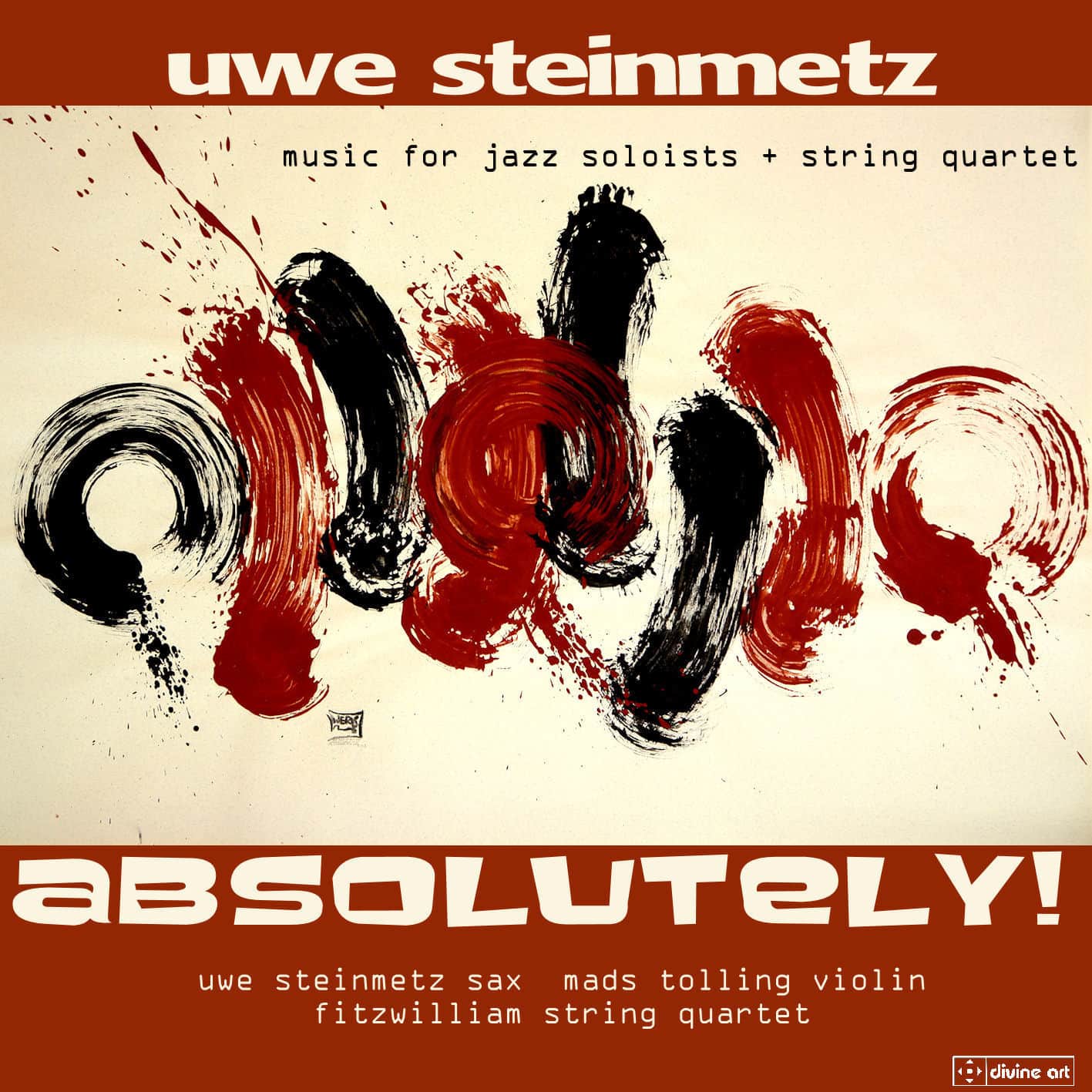
Steinmetz’s compositions include works for choir, string quartet and jazz ensemble, organ, guitar, saxophone and jazz orchestra. Since 2002 he has worked with the London based Fitzwilliam String Quartet who appear with him on a new release of his works from Divine Art Recordings also featuring violinist Mads Tolling.
The title of this new CD Absolutely! is from the first work on the disc Absolutely! – Suite for String Quartet, Saxophone and Violin Solo (2008) a musical meditation on purity, unselfishness, honesty and love. Written in five movements it opens with Prelude where the quartet and solo violin are soon joined by the saxophone in a strikingly unusual sound. The music has the feel of being at least partly improvised, particularly in the saxophone flourishes, yet there is a firm structure here. There is a passage where the solo violin really swings in a terrific, jazz inspired section accompanied by the quartet complete with pizzicato cello acting in the form of a jazz double bass. The saxophone re-joins before a spiky rhythm ensues allowing some terrific playing from saxophone and violin.
Purity opens with some unusual dissonances from the whole ensemble before falling to a more thoughtful mode taken up by the solo violin and quartet. There is some fine playing here, as well as strange cries from the solo violin. The saxophone weaves above the other players in some spectacularly difficult displays of virtuosity before calming a little as the sax and violin form a kind of duet playing above the quartet. The movement ends a long note that fades.
The saxophone opens with jazz flourishes above the string quartet, who set a rhythmic pace in Honesty . The sax and violin eventually join in a short duet, the violin taking over with quartet accompaniment. This particularly bluesy movement has great freedom and breath giving all the musicians the opportunity to really take off.
Unselfishness brings some unusual sounds provided by the orkon-flute. Soon the quartet presents a slow, plodding theme before the orkon-flute and solo violin join in. This soon develops into the drone of a Raga on which it is based. Eventually a jazzy duet between flute and solo violin arrives before the quartet re-joins with rich, chordal playing. The violin then plays a jazzy theme around the quartet before the drone like sounds return.
A slightly syncopated slow theme for strings opens Love , around which the solo violin weaves a bluesy line. When the saxophone enters, the music rises up to a pitch before slackening as the solo violin joins. The syncopated theme reappears and, as the sax reappears, duetting with the violin over the syncopated quartet, it leads to the coda.
There is some superb playing from Uwe Steinmetz (saxophone), Mads Tolling (violin) and the Fitzwilliam String Quartet.
Steinmetz’s Chaconne for Steve Lacy for soprano saxophone and solo instrument or voice (2011) opens with a modern take on the traditional chaconne. The saxophone joins to add the jazz element alongside the violin. This is an incredible success, combining jazz and a classical chaconne all brilliantly played by both Steinmetz and Tolling, especially as they reach a falling motif together, reminiscent of a baroque concerto.
Steinmetz’s arrangement of Purcell’s Fantasia No.7 for four viols, Z.738 (1680) opens fairly conventionally on the strings (this work adapts easily for a string quartet) before the singular sound of the saxophone joins – yet it sounds quite in keeping, as though time has been compressed and Purcell has used the instrument and jazz style quite naturally. This is a triumph from these fine musicians.
Steinmetz’s own Fantasia No.1 ‘Epiphany’ for string quartet and soprano saxophone (2009) follows, a work of some accomplishment that sits naturally within the arrangements of Purcell’s Fantasias. It is more conventionally jazz based, the quartet, nevertheless, providing a modern take on the Fantasia with the saxophone of Steinmetz combining brilliantly with the Fitzwilliam Quartet.
Purcell returns in another of Steinmetz arrangements, this time of his Fantasia No.11 for four viols, Z.742 (1680) and what an arrangement it is with the quartet providing the line over which the saxophone has an almost baroque feel, as though replacing a piccolo trumpet. This is another fabulous performance with Steinmetz providing some terrific jazz improvisations over the Purcellian sounds of the Fitzwilliam Quartet.
Finally we come to Bach as filtered through the imaginations of Fitzwilliam violinist, Lucy Russell and Uwe Steinmetz. Bach’s Chaconne from his Violin Partita No.2, BWV 1004 (1720) opens with some fine playing from the Fitzwilliam Quartet before Steinmetz enters, at first only adding occasionally light touches, before developing a more elaborate improvised counterpoint to the Fitzwilliam’s occasionally swirling strings. There is more superb string playing and inventive sax improvisations from Steinmetz with both blending wonderfully.
What would Bach have thought of this arrangement? We have no way of knowing but I have a sneaking suspicion he would have loved it.
Well recorded with excellent notes from Uwe Steinmetz, Fitzwilliam violist, Alan George and Divine Art’s own Stephen Sutton, this is a disc that all open minded classical and jazz lovers should investigate.