Catalogue Connection: 25114

  • Gapplegate Classical Modern Music – Grego Applegate Edwards – 25114

    The early music revival that began to burgeon last century changed what was ultimately part of the overall repertoire and how it was to be played. Works long dormant came to our ears again after centuries of neglect. The idea of instrumental and vocal authenticity in performance practice underwent a revolution, as did the number of artist and ensembles devoted to the music.

    Certainly the rise of countertenor Alfred Deller had a great impact on all this. At the same time contemporary composers began increasingly to turn to instrumental and vocal aspects of early music as inspiration to their works. Composers Michael Tippett and Walter Bergmann were important figures in general and for Alfred Deller in particular. Tippett encouraged Deller, introduced him to the concert world and wrote important music for him; Bergmann was a key musician (harpsichord and recorder) in the heady first years of the revival in England, and a composer of talent who showed the influence of early music. Both had influence on editions of Henry Purcell’s music that came out then, which had vast ramifications for the movement.

    All this is celebrated and commemorated in the new album Remembering Alfred Deller (Divine Art 25114), a well conceived album of early and contemporary music performed by countertenors James Bowman and Robin Blaze and recorder artists John Turner and Laura Robinson. They are joined as needed by a continuo of harpsichord and cello, and solo guitar.

    Everyone sounds quite good in the performances here. The program ranges widely: 20th century works by Bergmann and Tippett as well as Peter Racine Fricker and Alan Ridout, early music works by Handel and William Williams, and the extraordinary John Blow (1649-1708) work “Ode on the Death of Mr. Henry Purcell” a beautiful piece that Alfred Deller gained renown from in performance. (His version happened to be on the first early music LP I was exposed to when young).

    The album by showing both the modern look-back of contemporary composers and some of the revived works gives you a feel for the impact the rise of Deller and the early music movement had last century. It is an absorbing listen, a nicely performed, even surprising program of affinities and influence.

    Well-worth hearing and studying in depth!

  • Recorder Magazine – Adam J Dopadlik – 25114

    Alfred Deller will be chiefly remembered as the singer who brought the countertenor voice to prominence in the mid 20th century. As a result of his prolific performing and recording career, many of today’s leading countertenors would acknowledge his influence upon their own singing careers.

    This eclectic CD opens with the Pastorale for countertenor (Robin Blaze) and recorder (John Turner) by Walter Bergmann; it was first performed by Deller in 1946, the year of its composition. The disc ends with a later work, also by Bergmann; Three Songs for countertenor and guitar (James Bowman and Dave Bainbridge). The dedication reads “for Alfred and Desmond” (Dupre, the guitarist and lutenist who regularly accompanied Deller from 1950 until the early 1970’s). All of these songs display Bergmann’s elegant and effective writing for voice, together with his ability to create sympathetic accompaniments of great depth.

    The CD’s centrepiece is the Ode on the Death of Mr. Henry Purcell by John Blow; surely Alfred Deller would have been instrumental in early revival performances of this great work. With such a stellar line up of distinguished vocalists and instrumentalists a performance of deep understanding and matchless sensitivity is assured.

    Four Inventions for two recorders by Michael Tippett (1954) was written for the SRP and first performed by Freda Dinn and Walter Bergmann. This is a beautifully balanced account; elegant and restrained. Sonata in A Minor for two recorders and continue by William Williams is a less well-known companion piece to his Sonata in F major (“In Imitation of Birds”). This lively and committed recording will, I’m sure, encourage more players to search out and study this engaging work. Sonata in F Major for two recorders and continue by Handel will be familiar to the majority of readers, its final movement, Allegro, being based on the same fragment of jig as the finale from the more famous Sonata in F, Op. 1 No. 11.

    John Turner has again assembled an amazing cast of superb musicians and recorded a wide range of quality music, much of which demands to be better known, at the highest level. This is surely a CD which will remain essential listening for many years to come.

  • Music For All Seasons – Rafael de Acha – 25114

    The divine art recordings group (also including diversions, métier, athene and historic sound) performs an invaluable service in releasing CDs that examine rare corners of the repertory. In the 2014 release, “Remembering Alfred Deller”, a group of English musicians of various generations, all of them Baroque specialists, pay honor to the pioneering Alfred Deller by playing and singing an interesting mix of Baroque and contemporary compositions that came to be associated with the late English countertenor. Among the artists featured in this recording the countertenor James Bowman, for whom Benjamin Britten wrote the part of Oberon in A Midsummer Night’s Dream, must be singled out as a significant example of the tradition of English countertenor singing.

    Walter Bergmann (1902-1988) was German born composer who, after practicing Law in Germany for a number of years fell out of favor with the Nazis and escaped to England, where wartime restrictions severely curtailed his range of activities as an enemy alien. After the war his lack of familiarity with English Law proved his Law degree to be worthless, so he decided to pursue a second career as a composer and performer. His 1946 Pastorale for countertenor and recorder is featured on the first track of the divine art recording, with countertenor Robin Blaze pairing up with John Turner in a lovely rendition of a polytonal duo for countertenor and recorder.

    Michael Tippett (1905-1998) authored the Four Inventions for two recorders featured next in the divine art CD, with Laura Robinson’s and John Turner’s recorders weaving in and out of each other’s melodic lines with grace and tonal purity.

    Alan Ridout (1934-1996) wrote the Soliloquy for countertenor, recorder, cello and harpsichord in 1985, His music is decidedly tonal, but underpinned with harmonic asperities, owing much to the influence of Michael Tippett, his teacher.

    William Willams, of whom only the 1701 death date is known, composed the Sonata in A minor in 1696. Its three movements show a typical Middle- Baroque English composer writing under the long shadow cast by Henry Purcell.

    In the case of John Blow (1649-1708) the Purcell presence is a non-issue, as Blow, ten years Purcell’s senior and teacher, was first and foremost a Church composer whose duties as Composer to the Chapel Royal took up most of his time. His Ode to the Death of Mr. Henry Purcell is a seven part composition for two countertenors, recorders and continuo. Running over 32 minutes, this is by dint of size and scope the main musical event of this recording. Countertenors James Bowman and Robin Blaze display dazzling vocal technique and great facility with the ornamentation of the work. The work of John Turner and Laura Robinson in this instance is largely that of accompanists, with Ian Thomson’s harpsichord and Tim Smedley’s cello providing the perfectly grounded continuo.

    German-born, but most strongly associated with English music, Georg Friedrich Handel (1685-1759) raises the bar in any collection in which his name and music appear, as is the case with his 1707 Sonata in F major for two recorders and continuo, a work of a twenty-two year old man with the compositional technique of someone twice that age. The lively allegros of the first and third movement bookend a middle grave, all three movements displaying the musical signature of a grand master of the Baroque.

    Peter Racine Fricker (1920-1990) wrote Elegy: The Tomb of St. Eulalia for countertenor, cello and harpsichord, in 1955, sung here by James Bowman. It is a severe, atonal, meditative work. Guitarist Dave Bainbridge and harpsichordist Ian Thompson provide solid support. Walter Bergmann’s Three Songs for countertenor and guitar closes the CD with a perfect performance by James Bowman and Dave Bainbridge of three songs: Mater cantans filio , To Musick , and Chop-Cherry .

    With its handsome packaging, its extensively researched and excellently written booklet by John Turner and its enticing mix of rare and familiar compositions for voice and recorders this album is a welcome addition to the library of any serious collector.

  • Fanfare – Maria Nockin – 25114

    Countertenor Alfred Deller (1912-1979) worked hard at putting Baroque music before the pub­lic in the mid-20th century. He was instrumental in bringing about the ongoing renaissance of 17th-and 18th-century music. The compact disc Remembering Alfred Deller contains a mix of Baroque and modern music for countertenor, recorder, cello, guitar, and harpsichord. Some of the composers featured knew Deller and worked with him. Walter Bergman, once a musically inclined German lawyer, moved to England in 1938 and was eventually interned on the Isle of Man. Since he was already a fine amateur pianist, he became a professional accompanist when he could no longer practice law. Eventually he played for Deller and composed music for him. On this recording we hear his Pastorale for Countertenor and Recorder, written in 1946. In it, countertenor Robin Blaze and recorder player John Turner tell of a shepherd who has followed a shepherdess to her valley, stayed too long, and now wants to sleep there. They sing and play with bell-like tones, but we never hear her answer. Turner decorates this charming story with luscious trills.

    It was Michael Tippett who “discovered” Alfred Deller’s unusual voice and introduced him to the public as a countertenor instead of a male alto. Here we listen to his 1954 piece Four Inventions for Two Recorders. These short movements provide a bit of variety as recorder players Laura Robinson and John Turner regale the listener with a plaintive duet. Although the piece was written in 1954, it has an ageless sound that evokes dreams of romantic knights and their ladies.

    Alan Ridout’s Soliloquy is a bit more densely composed, with flute, cello, and harpsichord accompanying Robin Blaze’s thoughtful rendition of Thomas Campion’s text. We seldom hear of 17th-century composer William Williams, but his music speaks volumes here. Again, Turner and Robinson play the recorders, while Tim Smedley plays the cello and Ian Thompson the harpsichord. Their last movement is a glorious romp that could make the sourest pedant want to dance. The program on this disc alternates happy and sad music. After Williams’s merry piece, we listen to a rather long, melancholy rendition of John Blow’s Ode on the Death of Mr. Henry Purcell sung by both countertenors accompanied by the two recorders, cello, and harpsichord. The Sonata in F Major for two recorders and continuo by Handel lightens the mood again. Its Allegro is a wonderful contrapuntal duet for recorders accompanied by cello and harpsichord. The Grave slows the tempo for a few moments but it then reverts to another fast dance beat. Peter Pricker’s Elegy shows his admiration of the fourth-century Spanish saint Eulalia, who died for her faith at the age of 12.

    For a finale, we hear three songs Bergmann wrote for countertenor and guitar in 1973 and later revised. They con­sist of a lullaby for the Christ child, a work that praises the art of music, and an amusing song about a scorned lover. The luminous Mater cantons filio (The Mother Sings to the Son) could be an unusual Christmas carol. To Mustek describes some of the effects music has on the listener who enjoys its delights. The final song, Chop Cherry, is perfect fun-filled short piece. Countertenor James Bowman and guitarist Dave Bainbridge capture the essence of each song with their presentations. This disc contains a great deal of variety and the sound of each work is clear and pristine. If you love Baroque music, whether you are old enough to remember Alfred Deller or not, you will want to hear this recording.

  • The Whole Note – Hans de Groot – 25114

    The countertenor Alfred Deller was born in 1912 and I wonder if this CD had been intended to mark his centenary. No matter, the disc is as welcome as it would have been two years ago. An obvious way of remembering Deller would have been to reissue some of his recordings but the producers of the CD have hit on some­thing much more imaginative. The recording commemorates not only Deller himself but two others who were central to the revival of early music in the 40s and 50s; Michael Tippett and Walter Bergmann. It was Tippett who discovered Deller in the choir stalls of Canterbury Cathedral and who launched him in his solo career at Morley College.

    Bergmann had been a lawyer in Germany but was forced to flee to England, where he started a new career as a music editor, harp­sichordist and composer. The CD, which features two fine countertenors, James Bowman and Robin Blaze with recorder players John Turner and Laura Robinson, includes John Blow’s Ode on the Death of Mr. Henry Purcell (which Deller himself performed and recorded) and also several works dedicated to Deller: Bergmann’s haunting Pastorale for countertenor and recorder (1946) and the Three Songs for countertenor and guitar (1973). It also contains Peter Racine Fricker’s Elegy, a work given its first performance by Deller.

    The recorder pieces (solo Inventions by Tippett and trio sonatas by Handel and William Williams) are less obviously related to the work of Deller but they serve to remind us that his emergence was part of the rediscovery of early music.

  • MusicWeb – Jonathan Woolf – 25114

    Alfred Deller is the focal point in this intriguing selection of music. The other twin figures to provide columnar support are Michael Tippett – who first ‘discovered’ Deller at Canterbury Cathedral – and Walter Bergmann, the émigré German composer and performer who did so much to further the revival of early music in Britain. Almost inevitably Morley College looms large, as that’s where Tippett invited Deller to perform at his early concerts, where Tippett was a central figure and Bergmann the accompanist for Tippett’s Morley Choir.

    Musically the focus is on the counter-tenor voice and the recorder. Bergmann’s brief 1946 Pastorale features both. First performed in Canterbury by Deller to whom it was dedicated, and Delia Ruhm, on the flute, it effectively amplifies the text by poet Norman Cameron. It’s sung here with considerable artistry by Robin Blaze. Bergmann’s Three Songs for counter-tenor and guitar is a short cycle originally dating from 1973 when there was a fourth song. Revision a decade later saw the omission of the Easter Hymn and substantial revision of the remaining three songs. Quite spare in the main, the very brief last song is the most athletic and is sung by James Bowman.

    Tippett’s Four Inventions were premièred by Bergmann and fellow recorder player Freda Dinn in 1954. Brief though they are they do require some dexterity and fine breath control. Tippett’s clever use of entwining figures and – in particular – fanfare-like moments is especially ingenious. Peter Racine Fricker’s Elegy: The Tomb of St. Eulalia is almost contemporaneous with the Tippett. It was first performed by Deller, viola da gamba player Desmond Dupré and harpsichordist George Malcolm. Bowman, husbanding his vocal reserves well, sings with accustomed musicality and insight. Alan Ridout’s Soliloquy dates from much later, 1985, and was written in memoriam for David Munrow (1942-76). Two of the performers in its first performance appear, happily, in this recording: James Bowman and John Turner, who are also central players in this disc. It deliberately invokes the music of Campion and has a particularly expressive cello line, played here by Tim Smedley. At the first performance the cellist was Christopher van Kampen, and Robert Spencer the lutenist. After this performance Ridout omitted the lute, redistributing its writing amongst the other instruments.

    William Williams is a little-known contemporary of Purcell and his tuneful sonata for two recorders and harpsichord, played by Ian Thompson – well balanced in St Thomas’s, Stockport – makes an immediate appeal not least because of the bird imitations and the rapport between Turner and Laura Robinson. Handel’s Sonata in F major, for the same instrumentation, was given its first performance in modern times by Turner and David Pugsley. It’s good that the former has recorded it here, with Robinson and Thompson.

    Deller left behind a wonderful recording of John Blow’s Ode on the Death of Mr Henry Purcell – with Bergmann, incidentally, on Vanguard. Bowman too has recorded it before, with René Jacobs, Max von Egmond, Anner Bylsma and Gustav Leonhardt. Bowman and Blaze make a good team, though one would have difficulty preferring Bowman’s older self to his younger, inevitably.

    This interestingly programmed and thoughtfully prepared disc comes with good notes and texts. It salutes Deller’s memory and continuing influence. It also restores works associated with him, written by his contemporaries that may have become eclipsed in the years since his death.

  • Windkanal – Markus Zahnhausen – 25114

    The present CD remembers Alfred Deller, one of the most important pioneers and trailblazers in the category of countertenors, initiated by the tireless British recorder enthusiast John Turner. Besides Turner, on this cleverly arranged chamber music program based on the old and the new, one can hear the outstanding countertenors James Bowman and Robin Blaze.

    In particular, the contemporary works convinced me, which include Michael Tippett’s miniature but extremely original Inventions for recorder duo, written in the mid 50s, Walter Bergmann’s intensive-contemplative Pastoral for countertenor and recorder, as well as an interesting song cycle by Bergmann for countertenor and guitar, which was originally written for lute accompaniment. Furthermore the Soliloquy by Alan Ridout for countertenor, recorder, cello and cembalo is a composition which could be welcome in today’s concert scene due to its instrumentation following closely historic examples. Peter Racine Fricker’s Elegy for countertenor, cello and cembalo composed in 1955 is the most impressive and in its musical language most advanced piece on this CD, music conveying British austerity and emotional depth. All this is arranged around a central block of early music: John Blow’s moving Ode on the Death of Henry Purcell is framed by two trio-sonatas by William Williams and Georg Friedrich Händel.

    Even though the recorder is not exclusively the central focus point of the CD, it is presented successfully in very different contexts. Excellent musicians, outstanding sound quality. A valuable publication.

  • American Record Guide – Charles Brewer – 25114

    This new release, “Remembering Alfred Deller”, honors the significance of Deller and the com­posers he inspired in the resurgence of the countertenor in the later 20th Century. This recording is a mixture of “early” and “modern” music. Deller made two different recordings of John Blow’s Ode on the Death of Mr Henry Purcell, the earlier with John Whitworth (recorded 1959) and the later with his son, Mark (recorded 1970); on both the harpsichord is played by Walter Bergmann, who was also instrumental in promoting the Early Music revival in England after World War II. On this new release, two generations of countertenors are represented: lames Bowman, who worked with David Munrow and Christopher Hogwood, and Robin Blaze, who is especially well known for his current recordings with Bach Collegium Japan. It appears that Walter Bergmann’s own edition of the Blow has been used; and the harpsichordist, Ian Thompson, adopts many of Bergmann’s artful solutions for the continue realization, though by current standards his playing is rather pedestrian. John Turner and Laura Robinson, who supply the obbligato recorders in the Blow, also perform two trio sonatas by William Williams and Handel. Their playing is solid but not very colorful. This new release is not the best recording of this difficult work. Blow expects both soloists to comfortably sing parts that range over almost two octaves; in the lower passages countertenors can sound weak. This is not as evident on Bowman’s two earlier recordings, with Rene Jacobs (recorded 1973) and Michael Chance. On two earlier recordings with high tenors, the upper register is thin: Russell Oberlin and Charles Bressler sing at pitch, but Rogers Covey-Crump and Charles Daniels, even with the whole work sounding a tone lower, have the same problem. While the recent release sung by Carlos Mena and Damien Guillon is good), I have a slight preference for the Bowman and Jacobs recording from 1973, both vocally and for its sensitive recorders (Ricardo Kanji and Marion Verbruggen) and continuo (Anner Bylsma, vc, and Gustav Leonhardt, hps).

    What is more significant about this new release is its inclusion of otherwise unrecorded modern compositions for countertenor. Blaze sings Walter Bergmann’s elegiac ‘Pastorale’ for countertenor and recorder and Alan Ridout’s ‘Soliloquy’ in a later revision for countertenor, recorder, cello, and harpsichord, which was commissioned as a lament for David Munrow and first performed by Bowman. Bowman sings Peter Racine Fricker’s poignant ‘Elegy: The Tomb of St Eulalia’ and Bergmann’s three songs for countertenor and guitar (originally for lute). Also included are the ingenious ‘Four Inventions for Two Recorders’ by Michel Tippett, who “discovered” Deller. In these selections, the music and the performances are much more engaging.

  • Early Music Review – Victoria Helby – 25114

    It is appropriate that this CD should be mentioned in EMR even though only three of the pieces it includes were written before the middle of the 20th century. Deller was an important figure in the development of the post-war early music revival, not just for his counter-tenor voice but also for the Deller Consort, which he formed with the purpose of giving historically informed performances of early music. Michael Tippett and Morley College are also central to this story. It was Tippett who discovered Deller’s countertenor voice at Canterbury Cathedral and engaged him to sing in concerts at the College, where Walter Bergmann was already accompanist to Tippett’s Morley Choir. Bergmann was to become one of Deller’s main accompanists. This CD starts with his Pastorale for counter-tenor and recorder, dedicated to Deller and first performed by him in Canterbury in 1946, and ends with his attractive set of Three Songs for countertenor and guitar, which deserve to be better known. Both Bergmann and Tippett were associated with the music publisher Schott and its early music publications. Tippett’s Four Inventions for two recorders were written for the Society of Recorder Players, of which he became President, and first performed by Walter Bergmann and Freda Dinn.

    Another composer associated with Morley College was Peter Racine Fricker whose Elegy: The Tomb of Saint Eulalie , Op. 25 for counter-tenor, cello and harpsichord was first performed by Deller with Desmond Dupré and George Malcolm at the Wigmore Hall in 1955. The longest and probably best known work on this recording is John Blow’s Ode on the Death of Mr. Henry Purcell for two counter­tenors, two recorder and continuo, which is positioned between two trio sonatas for recorders and continuo, in A minor by William Williams and in F by Handel. I like the way good breaks are made between the tracks to maintain separation between this very interesting collection of dissimilar pieces. The informative booklet contains comprehensive notes about all the music and an introduction by Mark Deller.

  • The Consort – Elizabeth Rees – 25114

    This lovely disc is conceived as a tribute to Alfred Deller (1912-79) and his friends Michael Tippett (1905-98) and Walter Bergmann (1902-88). The CD was recorded at St Thomas ‘s Church, Stockport, and features James Bowman and Robin Blaze (countertenors), John Turner and Laura Robinson (recorders), with Tim Smedley (cello), Dave Bainbridge (guitar) and Ian Thompson (harpsichord). Throughout the 19th century, the countertenor voice survived in all-male cathedral choirs. Deller was a member of the choirs of Canterbury and St Paul ‘s Cathedrals, and from this choral tradition he emerged as a soloist, largely as a result of the admiration of Tippett, who recognised the unique beauty of his voice.

    For me, this CD is a rather wonderful trip down memory lane. As a teenager in the early 1960s, I listened entranced to my parents’ gramophone record of Alfred Deller singing Purcell’s ‘If music be the food of love’, with ‘Sweeter than roses’ on the other side of the record. I loved Deller’s elegant, smooth, yet emotional sound. Five years later, as an Oxford undergraduate, when I first heard James Bowman’s very different rich, strong, liquid tone, I at first thought he must be a tenor. He was a soloist in the Beauvais Play of Daniel , and I probably had some minor part as a singer or recorder player.

    We also thought James was cool, because he could perform in two Messiahs at once, at opposite ends of the High Street, so long as one started half an hour later than the other. At about that time, in 1967, his career was launched when Benjamin Britten asked him to sing the part of Oberon in A Midsummer Night’s Dream . The second very fine countertenor on this disc, Robin Blaze, has been particularly admired for his performance of Bach cantatas with Collegium Musicum, Japan . The two recorder players are John Turner and his former student, Laura Robinson. Turner has premièred over 500 works for the recorder, and has composed a number of others.

    This hour-long CD blends new music with old. First are three modern works, starting with Walter Bergmann’s Pastorale for countertenor and recorder (1946), to words by Norman Cameron. Bergmann was an influential figure in the revival of early music, as harpsichordist, recorder player and editor of recorder music for Schotts. Born in Hamburg , he was imprisoned by the Gestapo in 1938 and emigrated to England in 1939. He joined other musicians including Franz Reizenstein and Hans Gál in an internment camp on the Isle of Man , before his release at the end of World War II. Pastorale is a flowing and reflective piece dedicated to Alfred Deller, who first performed it together with Delia Ruhm in Canterbury .

    Tippett’s Four Inventions for Two Recorders follow. Tippett taught at Morley College , where he worked closely with Deller and Bergmann, who invited him to become President of the Society of Recorder Players. The Four Inventions were written for the Society, and first performed by Bergmann with Freda Dinn in 1954 at the Froebel Institute, London , as part of the Recorder in Education Summer School, which trained a generation of performers and teachers. As a youngster I was thrilled to join its master classes, and proudly departed with my diploma. The delicate intertwining lines of Four Inventions require nimble fingers and good breath control. This is followed by the Soliloquy for countertenor, recorder, cello and harpsichord by Alan Ridout (1934-96); it was commissioned in memory of David Munrow, and is set to a poem by Thomas Campion. Soliloquy is a solemn, measured lament, expressing heartfelt grief for David’s untimely death.

    Three earlier pieces follow, the first a Sonata in A Minor by William Williams (d.1701) for two recorders and continuo; the recorder players give a beautiful, lyrical rendering of the piece, which resembles Purcell in style and quality. Next we hear Ode on the Death of Mr Henry Purcell (1696) by John Blow, for two countertenors, two recorders and continuo, to a poem by John Dryden. This is an extended composition, another elegy for a wonderful musician who died too young. The performers demonstrate how naturally the recorder’s sighing quality conveys grief. The two countertenors and two recorder players blend beautifully: until hearing this disc, I had not realised how this combination of timbres creates an elegant sadness which is deeply moving in its restrained depiction of sorrow.

    The third piece is Handel’s Sonata in F major for two recorders and continuo ( c .1707), probably written during his time in Italy; it is given a very stylish performance by John Turner and Laura Robinson, whose tone is perfectly matched. Handel’s own manuscript, in the Fitzwilliam Museum , Cambridge , includes only the recorder parts of the first movement, while the basso part survives in another manuscript in the Library of Congress, Washington; its first recorder part is missing. John Turner and Christopher Hogwood spotted the connection between the two manuscripts. The third movement is familiar from the recorder sonata op.1, no.11 and its sister work, the organ concerto op.4, no.5.

    The disc closes with two contemporary works, the first being Elegy: The Tomb of St Eulalia , a reflective piece by Peter Racine Fricker (1920-90) for countertenor, cello and harpsichord, to a Latin text by Prudentius. It was first performed at the Wigmore Hall London in 1955 by Alfred Deller with Desmond Dupré (viola da gamba) and George Malcolm (harpsichord). Fricker was a colleague of Deller, Tippett and Bergmann at Morley College . After Deller’s death, Fricker composed a companion piece to the Elegy , entitled In Commendation of Music , for soprano voice, recorder, gamba/cello and harpsichord, in memory of Deller.

    The final work on the CD is Three Songs for countertenor and guitar by Bergmann, which began life as four short songs in 1973, but was revised ten years later to include the following three, ‘Mater cantans filio’, ‘To Musick’, and ‘Chop-Cherry’. The manuscript of these unusual songs is inscribed ‘for Alfred and Desmond’ (Dupré).

    This disc might be subtitled ‘Elegies’, including as it does, Ridout’s Soliloquy in memory of David Munrow, Blow’s Ode on the Death of Mr Henry Purcell , and Fricker’s Elegy . They form a fitting commemoration of Alfred Deller, who himself died young by today’s standards, at the age of 67. The outstanding performers are ideally suited to the music, the recorded sound is extremely clear, and the musicians blend perfectly. I think that Mark Deller and the rest of Alfred’s family will be very pleased to hear this imaginative CD; I warmly recommend it.
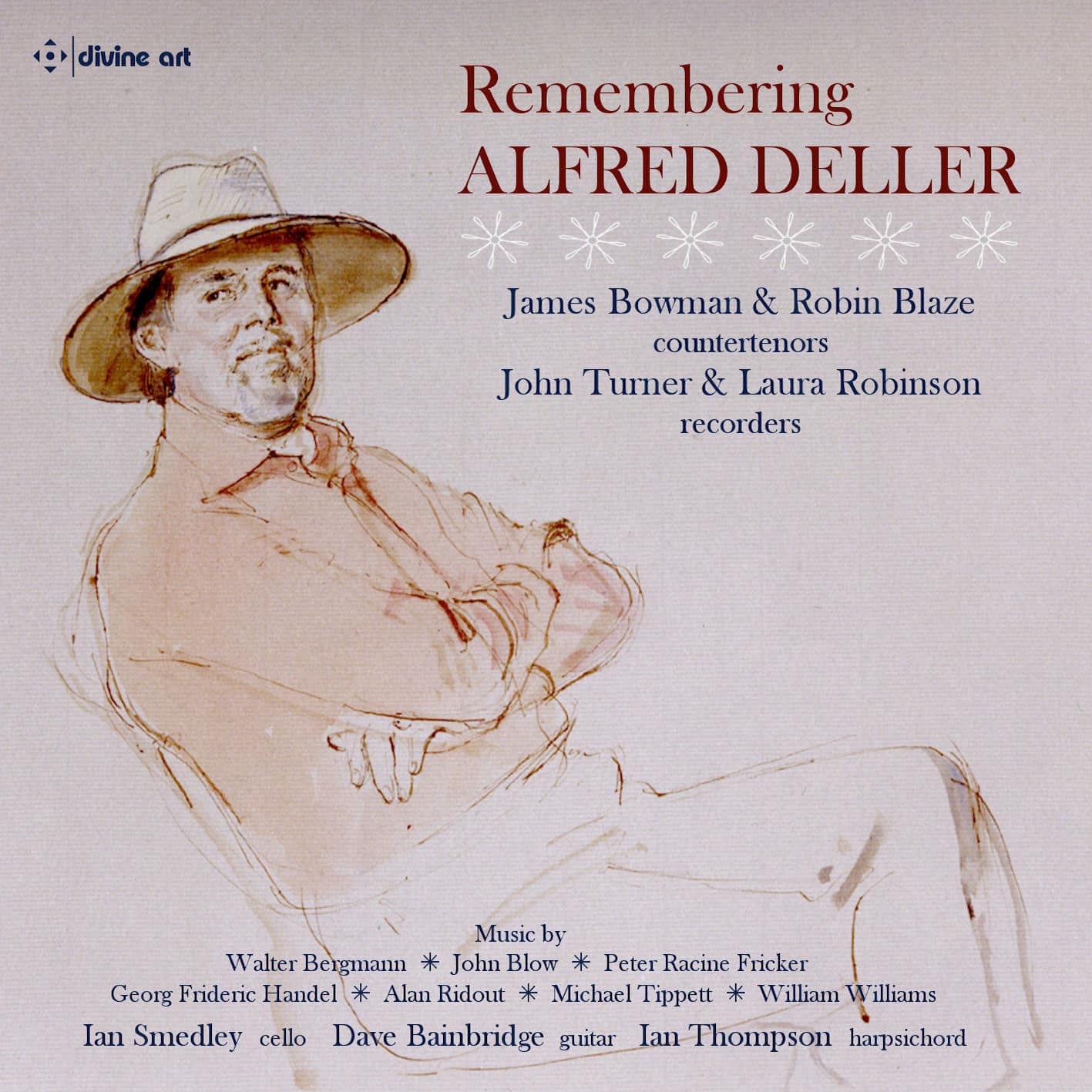
  • Remembering Alfred Deller

    Remembering Alfred Deller

    Alfred Deller was ‘discovered’ by Michael Tippett, and with the supprt of Tippett, Walter Bergmann and others, re-introduced the countertenor voice to the current music repertoire. His influence cannot be overstated. This CD is a tribute to Deller by musicians who have carried on his tradition in major contributions to music both in Britain and around the globe. Music from the late 17th century to the end of the 20th, of incredible beauty and charm.