Catalogue Connection: 25115

  • International Record Review – Mark Tanner – 25115

    Following the release of its debut recording for Linn five years ago, the Avison Ensemble, so named after the great eighteenth-century English composer of keyboard concertos Charles Avison, has carved a privileged niche for itself. This is not measurable just in terms of the ensemble’s impressive clutch of recordings for Divine Art and Naxos, featuring Avison’s complete oeuvre, made up of sonatas and concerti grossi, but in its deliberate adoption of younger musicians, thus helping to ensure a promising future for performances in this milieu. The Avison’s highly acclaimed recording of six cello concertos by John Garth (1721-1810), reviewed by Simon Heighes in December 2007, undoubtedly paved the way for this latest two-CD set, which features the dozen accompanied keyboard sonatas Garth composed between the years c.1768 and 1782.
    In the booklet notes for this new set, recorded in St Martin’s Church, Hampshire, in 2008, I greatly enjoyed reading Simon Fleming’s potted history lesson on the city of Durham and its not inconsiderable relevance to the life and times of the composer. Fleming points out that, notwithstanding its immediacy and charisma, the highly approachable nature of Garth’s keyboard writing, at least by comparison with, say, Avison’s, rendered them within reach of those possessing only a relatively modest technique. Indeed, in part due to the Alberti-bass accompaniments regularly detected in Garth’s sonatas, it is hardly difficult to notice a stylistic leaning in the direction of the aforementioned Italian composer; as likely as not, these works would have been heard within small-scale domestic situations rather than in the north-east’s grander performing spaces. Keyboard sonatas were, in Garth’s time, regarded as an ideal vehicle for composition utilizing small forces and, aside from the ubiquitous solo versions, countless sonatas for keyboards in combination with wind or string instruments sprang up willy-nilly. It was the latter form, writing broadly in the stylistic mould of Scarlatti and C. P. E. Bach, which seems to have particularly fired Garth’s imagination, and the result is a highly refined, elegant mode of writing holding considerable appeal.

    Both the Op. 2 and Op. 4 Keyboard Sonatas offer up possibilities for playing on different keyboards; indeed, there are opportunities to hear some accomplished digitalism from Gary Cooper on harpsichord, fortepiano and organ in both sets of sonatas, and this serves to underscore the innately flexible nature of the music. Cooper is joined by violinists Pavlo Beznosiuk and Caroline Balding, and cellist Robin Michael, superbly disciplined musicians whose presence is invariably sensed rather than heard. All of the sonatas are built from a two-movement blueprint, none of which strays beyond ten minutes in total, and there is invariably a dance-like, light-hearted finale to each, serving as the perfect foil to the more firmly structured opening movements.

    From the Op. 2 set I especially warmed to the Presto movement in the F major Sonata No. 2, in which Cooper pulls off the seemingly impossible by combining wit, sparkle and yet a determined rhythmic attack in one fell swoop on the fortepiano. The Allegro moderato to the E flat Sonata, played on the organ, comes over delightfully at this crisp pace, and the support given by the ensemble here is especially rewarding. From the Op. 4 set, at the harpsichord, a memorably sprightly account of the E flat major Sonata No. 5 is given, particularly in the Spiritoso , which for me ranks as among the most shapely and stylishly captivating playing on the recording. It is not just the adventurous speeds which contribute to the zesty effect in these performances but the intuitive and perfectly aligned nuances and points of emphasis with which the ensemble is able to operate so consistently. The Rondeau to the G minor Sonata, Op. 4 No. 6, on the organ, is as feisty and well crafted as one could imagine. The recording is excellent, as it needs to be, in order to do justice to the top-drawer musicianship on display from these fine players.
  • Fanfare – Bertil van Boer – 25115

    The more entertaining stories of composers, particularly those who are lesser known, seem to revolve around the usual stereotypes, with the best being related to various mishaps (self-inflicted or serendipitous). One has to admit, however, that the majority were workaday musicians who left hard­ly a ripple in history but who wrote copious amounts of music that are competent, interesting, and, alas, neglected. Most countries have legions of these, but my attention is often drawn to England, where in terms of reputation, the last “great” early composer was Henry Purcell, who died young and left the field to foreigners, such as Handel, Johann Christian Bach, or Haydn. The truth, of course, is quite different, and I am quite pleased to see an uptick in the revival on disc of native British composers, many of whom were prolific and active in the various cities about the United Kingdom. One such concerns the composer John Garth (1721-1810), who spent the bulk of his professional life in Durham, where there was a large cathedral and a rather active arts scene. To be sure, cathedral organ­ist James Heseltine (1711-1763) attempted to control all music in the city, even thwarting Garth’s friend and mentor, Charles Avison (1709-1770). By 1752, however, Garth and Avison began a series of public concerts, which the city fathers found superior to Heseltine’s offerings, and the rivalry began to vanish. By the time of Heseltine’s successor, Thomas Ebdon (1738-1811), it was gone altogether. Garth also composed services for the cathedral for the remainder of his life. The only interesting feature of his life is that Garth waited until 1794 to marry, which is odd considering that he and his new wife had been an item for almost a decade and both were well-to-do.

    Garth’s music has been recorded before, and by this same ensemble: a set of six cello concer­tos (op. 1) on the same label in 2008. Michael Carter noted in his review (32:6) that these represent transitional stages from the Baroque to the Classical periods, with structural and harmonic features of both stylistic eras. These two sets of sonatas, published in 1768 and 1772 respectively, are firm­ly planted into the Classical era, indicating that the composer was well aware of the latest style trends and not content to follow any conservative patterns at all. Both sets conform to a two-movement structure following French fashion of the time, generally a sonata form followed by some sort of rondo or dance. These were well established in England through the efforts of J. C. Bach or Karl Friedrich Abel, and even Avison’s late works (the booklet notes stretching things a bit to include others, such as C. P. E. Bach or Domenico Scarlatti into this mix of models). What is most evident in the op. 2 Sonatas is that the opening movements are almost all characterized by a driving ostinato rhythm that seems particularly Mannheim-ish. The opening of the A-Major Sonata (op. 2/5), for instance, has a well-defined theme with a rushing accompaniment that devolves briefly into suspensions and some quite virtuoso playing for the keyboard. What is striking is that the violins and keyboard (even with a continue cellist) are all fairly evenly matched, so that no one instrument pre­dominates. The C-Minor Sonata (op. 2/3) has a folk-like main theme, almost as if Garth were evok­ing a more bucolic spirit despite the minor key. As for the second movements, I was quite surprised to hear a foreshadowing of the French Revolutionary song Ça ira in the E major Sonata (op. 2/4), not to mention a rather nice Mannheim crescendo in the final Presto of the E-Major Sonata (op. 2/6). It is no wonder that this set was the 18th-century equivalent of a bestseller.

    As for the op. 4, Garth follows pretty much the same format; pleasant tunes, sequencing of the­matic sections, energetic bass line (with active keyboard accompaniment), and solid formal struc­tures that evoke J. C. Bach. The exceptions to this are the two minor-key sonatas, No. 2 in E Minor and No. 6 in G Minor. The first movement of the former is filled with tension and a virtuoso key­board part that seems to require both skill and emotional intensity to bring off. This contrasts with the rather delicate and ghostly minuet that practically minces off the disc. The latter is filled with a thicker texture, which would not be out of place in some sort of orchestration (the use of organ here enhances this textural feature). Here too there is considerable emotional intensity, which is diffused in the final section of the exposition with some superficial triplet figures as if to say that one ought not to take the power too seriously. The final rondeau has a theme that seems almost a bit Chopinesque (if, that is, Chopin had lived in the 18th century), and again Garth diffuses this emotional melody with suspensions and a nicely soft coda. But by the end the serious mood increases and when the final theme returns it sounds strangely melancholic.

    The Avison Ensemble performs these two sonata sets with considerable attention to Garth’s clear phrasing. Their tempos are flexible enough to allow his tunes to stand out, and they have an outstanding sense of ensemble. The music itself ranges from the merely pleasant (which is what such sets were meant to provide to both performers and audience) to some quite gripping moments, such as in the minor-key sonatas of the op. 4. Since the keyboard parts, often quite technically demanding even in the accompaniment patterns, are generic, the ensemble has chosen to perform the bulk on the harpsichord (which was probably the main instrument of choice for the country at the time), but in several cases, most notably the texturally rich F-Major Sonata (op.2/ 2), the aforementioned E-Major Sonata (No. 6 of the same set), and the E-Minor Sonata (op. 4/2), keyboardist Gary Cooper has chosen a fortepiano to exploit Garth’s wider range of expression and dynamics, and in the texturally-rich work (opp. 2/4 and 4/6), the organ is used. I find these choices to be entirely warranted by the music itself, though of course the performance practice of the time would have allowed for any keyboard at hand. In short, this is fine music with an excellent performance, and demonstrates that we may well be missing out on a wonderful facet of the music of this period from England outside of London if this is any example.

  • The Classical Reviewer – Bruce Reader – 25115

    John Garth (1721-1810) was baptised in the parish church of Witton-le-Wear in County Durham, England. His first post was as organist at St. Edmund’s Church in Sedgefield, later becoming organist to the Bishop of Durham at his official residence at Auckland Castle. He made the acquaintance of another prominent composer from the North East of England, Charles Avison with whom he was to later organise concerts in Durham.

    His compositions include Cello Concertos, Op.1, Organ Voluntaries, Op.3 and five sets of accompanied keyboard sonatas of which the Op.2 and Op.4 sets have been recorded by Divine Art Recordings.

    Fortepianist and harpsichordist, Gary Cooper joins the Avison Ensemble on this new 2 CD release. Divine Art have already released an acclaimed recording of Garth’s six cello concertos (DDA 25059) as well as a number of recordings of the music of Charles Avison featuring the Avison Ensemble. I already know just how good this ensemble is and have a number of their Avison recordings on my shelves.

    The members of the Avison Ensemble for these performances consist of Pavlo Beznosiuk and Caroline Balding (violins) and Richard Tunnicliffe (cello).

    First on this new set are the six sonatas, Op.2, published in 1768, each of which are in two movements. In the Sonata in G major, Op.2 No.1 it is immediately apparent what a fine sound these four players make in Garth’s lively Allegro with its winning tune. There are lovely harpsichord flourishes around the superb string textures. There is a joyful Rondeau: Allegro with a lovely forward flow and a fine central section with lovely interplay between strings and harpsichord.

    For the Sonata in F major, Op.2 No.2 Gary Cooper moves to the fortepiano. There is a fine balance between fortepiano and strings in this nicely textured Allegro that has a more delicate texture and some terrific playing from Gary Cooper. The Presto has some fine long lines with these players providing a terrific blend of textures. Gary Cooper is so fluent in the fortepiano part.

    Cooper returns to the harpsichord for Sonata in C minor, Op.2 No.3 in which the Allegro has an appealing melody, nicely pointed up by the harpsichord in the opening. Indeed there is something of an equal partnership in this movement with the harpsichord providing much of the accompaniment. The Tempo di minuetto has a lovely rhythmic flow with some very attractive moments for the harpsichord, but it is the strings that provide the lovely textures.

    Gary Cooper plays the organ for Sonata in E flat major, Op.2 No.4 where in the Allegro moderato the strings again dominate in the opening before the organ takes the prominent role. The organ has a suitably small sound that fits well with the ensemble. Again Garth provides another memorable tune. The short Rondeau: Presto is full of life and good humour.

    Garth’s writing for harpsichord is most attractive providing transparency and fine textures. In the Allegro of Sonata in A major, Op.2 No.5 Gary Cooper is terrific with superb articulation and a great sense of phrasing. Nobody could fail to be entranced by this music which has some fine interplay between strings and harpsichord. There is lovely string playing in the lilting Tempo di minuetto that has a lovely flow and rhythm.

    For the final sonata of this set, Sonata in E major, Op.2 No.6, Cooper returns to the fortepiano. There is another attractive rising and falling theme in the Moderato with some lovely moments for fortepiano. A sparkling Presto with some really fine playing from these artists and some particularly florid passages for fortepiano ends this piece.

    There is much variety in the Op.2 sonatas with Garth’s memorable themes a particularly attractive feature.

    The six sonatas Op.4, from around 1772, are also in a two movement form. Sonata in C major, Op.4 No.1 has another fine opening, an Allegro , though this time with a little more thoughtfulness in its forward movement. Again the sounds these players provide are terrific with vibrant harpsichord and the full, yet transparent, combination of two violins and cello. There are some lovely passages for harpsichord, brilliantly played by Cooper. The Vivace has a nice swagger to it, a lovely spring in its rhythms.

    Sonata in E minor, Op.4 No.2 brings Gary Cooper back to the fortepiano with a terrific Allegro that hurtles along with an infectious rhythmic melody. These players are so full of vitality not to mention superb musicianship. The Tempo di minuetto is another of Garth’s fine movements in this form.

    The Allegro moderato of Sonata in B flat major, Op.4 No.3 has a lovely, well sprung theme with these players providing a terrific rhythmic quality before the leisurely, flowing Tempo di minuetto with some particularly beautiful, quieter passages where the harpsichord gently shows and combines with the strings.

    Returning to the harpsichord, Gary Cooper hurtles off in the Allegro assai of Sonata in D major, Op.4 No.4 whilst there is buoyant playing from the strings in this infectious movement. The lovely Tempo di gavotta: Allegro has a simple yet very attractive tune with these players weaving wonders around the music.

    Sonata in E flat major, Op.4 No.5 opens with a lovely, fresh Allegro with the harpsichord and strings responding to each other in the attractive theme. Again there are some fine solo passages for harpsichord, fabulously played. The second movement is a fast moving Spiritoso that receives equally fine playing from these artists.

    Gary Cooper turns to the organ for this final sonata of this set, Sonata in G minor, Op.4 No.6, a work that has as much attraction as some of Handel’s organ concertos. There is a breadth and freshness to the Allegro that is wholly appealing in another of Garth’s fine melodies and a distinctive beautifully turned Rondeau: Allegro that makes for a fine conclusion to this first rate release.

    I notice that I have use the word infectious a number of times in this review but that is the only word to describe these performances. The playing of Gary Cooper and the Avison Ensemble has so much verve and life in sonatas that are full of fine tunes that stick in the mind long after listening to them.

    The recording, from the fine acoustic of St Martin’s Church, East Woodhay, Hampshire, England, is excellent and there are interesting notes giving the background to John Garth and the music making in his home area of Durham.

    This is a highly desirable issue that will give endless enjoyment.

  • MusicWeb – Johan van Veen – 25115

    The Avison Ensemble is a pioneer in the exploration of repertoire written in north-east England, the region around Newcastle-upon-Tyne where Charles Avison worked most of his life. The largest part of his oeuvre has been recorded, and with this disc of music by John Garth the ensemble turns its attention to a friend and probable pupil of Avison. He was born in Durham and after finishing his musical education worked as organist at St Edmund’s Church in Sedgefield. He also became organist to the Bishop of Durham at his official residence, Auckland Castle. As an organist Garth was highly esteemed: he travelled far to give recitals and was asked to inaugurate newly-built instruments.

    In Durham he set up a concert series. His first attempt in 1742 was met with little enthusiasm from the cathedral’s organist whose choir was the dominant force in concert life. In 1752 he organised a subscription series, with the assistance of Avison, in direct competition to the series of the cathedral choir. The animosity gradually dissipated and in time the two series integrated. The fact that the cathedral had a new organist in the person of Thomas Ebdon probably facilitated this process. Together they promoted the concert series until 1772 when Garth gave up his activities in this field. However, it is possible that he continued to play at concerts in Durham.

    He may have performed some of the sonatas recorded here. The accompanied keyboard sonata was quite popular at the time, not only in England but also on the continent, for instance in France. The two series of six sonatas which are the subject of this set, were printed in 1768 and c.1772 respectively. The fact that the op. 2 set had 261 subscribers for 323 copies shows the reputation of Garth as a composer. Among the subscribers were famous names such as Charles Burney, James Nares and John Stanley. The sonatas are all in two movements: an allegro, followed by a piece in the form of a rondeau or a menuet. This is music for domestic entertainment, playable by amateurs. The strings play a subordinate role and only support the keyboard.

    Several sonatas include crescendo markings. This “gives an indication that several of them were conceived for either a pianoforte, or for one of the new developments in harpsichord-making that made subtle changes in dynamics possible”, according to Simon D.I. Fleming in the liner-notes. The latter seems more plausible than the former. Although the new pianoforte was known in England before 1750 it was only in the 1770s that it started to establish itself as an alternative to the harpsichord, especially in the London concert scene. That is not to say that it was also a common instrument elsewhere, and I especially wonder whether amateurs played such instruments at the time Garth published his sonatas.

    Some of the sonatas here are played at the organ. This could be inspired by the possibility that Garth – or other organists – may have played sonatas from these sets in public concerts. There is also a possibility that some aristocrats owned a small organ. The use of an organ is probably more plausible than a pianoforte. It is a shame that the instruments which Gary Cooper plays are not specified in the booklet.

    Musical entertainment for amateurs – that could suggest that this is music which is hardly memorable and goes in one ear and out the other. My experience is different. It was not hard at all to listen to these sonatas at a stretch. This is delightful music, very well written and with plenty of good themes. There is never a dull moment here, and that is also due to the interpreters. Gary Cooper, Pavlo Beznosiuk, Caroline Balding and Richard Tunnicliffe [sic] deliver energetic and differentiated performances. This has resulted in a highly entertaining set of discs, and it is a bit of a mystery to me why these have been on the shelf for six years.

  • The Consort – Michael Talbot – 25115

    These two CDs include 12 accompanied keyboard sonatas by the Durham composer John Garth (1721-1810). The two violinists and cellist of the Avison Ensemble are joined in this recording by Gary Cooper, who navigates between harpsichord, fortepiano and organ. There is a link between the Garth accompanied keyboard sonatas and the Corelli church sonatas , in that exactly the same four players required for the latter (in its most common line-up) can be retained for the former, the keyboard player now assuming the role of a soloist – the sonatas are designed to be playable on keyboard alone – and the strings dropping back into a supportive role.

    These compositions are, so to speak, reformulated trio sonatas: they replace the classic Corellian musical language with an up-to-date idiom which reflects on one hand the mid-century Italian harpsichord style of Domenico Scarlatti, Giovanni Platti and Domenico Paradies, predominant in the sonata-form opening movements, and on the other hand a more French-inflected style, predominant in the many rondos and minuets found in the shorter and simpler concluding second movements.

    This special type of accompanied sonata represents, as Simon Fleming’s excellent notes explain, a specifically ‘north-eastern’ brand originated by Charles Avison. Garth in fact produced no fewer than five collections following that model: op.2 (1768: the most successful commercially in its day), op.4 (c.1762) and opp.5-7 (c.1775-1782: still awaiting recording).

    The task of reviewing this recording induced me to explore for comparison Garth’s better-known set of cello concertos, recorded in 2007 on dda 25059 by the same ensemble, since until now I had known this composer only from his English-language edition of Marcello’s Psalms. In the concertos and sonatas alike, Garth’s musical personality is not particularly original, but his works possess a combination of intensity of expression coupled with compositional proficiency (allowing for a few slightly rough harmonic progressions) that makes them enjoyable and worthwhile as concert pieces.

    The performance of the sonatas by the Avison Ensemble is vivid (perhaps a little too fiercely so) and committed. I occasionally found the balance wanting: in particular, the harpsichord tone frequently lacks power, thereby creating the illusion that these pieces are conventional trio sonatas supported by a continuo player lazily doubling the string lines.

    Garth emerges from this recording as a thoroughly good composer whose music would merit publication in commercial editions. Works of this kind would prove very useful in recitals given by trio sonata ensembles, by rewarding harpsichordists with a moment of glory without forcing any of their partners to vacate the concert platform.

  • Audiophile Sound – Andrea Bedetti – 25115

    The name of the English composer and cellist John Garth, born in 1721 and who died in 1810, is virtually unknown in Italy, as is that (except to specialists) of his fellow countryman and colleague Charles Avison. This double CD, featuring Garth’s Sonatas with accompaniment, Op. 2 and op. 4, now allows those who love the late baroque to appreciate his composition.

    Each collection consists of six sonatas of two movements each (lacking a formal slow movement) for two violins and cello, accompanied by either harpsichord, piano or organ. These are pleasant works, easy to grip (the minuet movements are especially intriguing) which highlight a composer fascinated, as was Avison, by contemporary Italian instrumental style. The interpretation by the Avison Ensemble (one of the most interesting of British ensembles playing baroque music) and harpsichordist Gary Cooper makes the most of these works and highlights Garth’s skillful and versatile compositional technique.

  • American Record Guide – Rob Haskins – 25115

    John Garth (1721-1810) was a friend of the better-known composer and philosopher Charles Avison. Each of the sonatas here is cast in two contrasting movements – the strings (beautifully played by violinists Pavlo Beznosiuk and Caroline Balding and cellist Richard Tunnicliffe [sic: actually Robin Michael] ) often double the keyboard, which sometimes adds solo passages and more elaborate passagework. Cooper varies the sonic palette nicely by alternating between harpsichord, fortepiano, and chamber organ (no information on the instruments or tuning). Garth’s music is charming but for the most part undistinguished. The recording has a bright, clean sound.

  • Wrightmusic – David C F Wright – 25115

    Well done, Divine Art for a welcome set of works by John Garth, probably unknown to most people.

    Garth was born in 1721 at Harperley near Witton- le -Wear and may have been a pupil of Charles Avison . They were certainly friends up to Avison’s death in 1770. Garth supported Avison even when the older man was criticised for dominating the Newcastle concerts.

    The organist at St Edmund’s Church, Sedgefield , was probably Garth’s first appointment sometime before 1742 and, by the 1770s, he was sharing these duties with other organists. He was also the organist at Auckland Castle, the residence of the Bishop of Durham up to 1794. Garth gave recitals and opened organs at various local venues.

    He had moved to Durham in 1742 and became a member of the masonic Lodge. In 1789 or 1790, he moved to Bishop Auckland and then to a farmhouse near Wolsingham . On 20 July 1794, he married Nanny Wrightson at St Cuthbert’s Church in Darlington and moved to her property in Cockerton and,in 1806, they settled in Cockerton Hall. Garth’s advanced age meant that they had no children and he died on 29 March 1810 and was laid to rest in the north aisle of St Cuthbert’s Church in Darlington.

    Of his other works, there are six cello concertos Opus 1 of 1760, available on Divine Art DDA 25059, and Organ Voluntaries Op 3 of 1771. He produced an eight volume set of the English version of the psalms of Benedetto Marcello around 1757.

    The sonatas on these CDs are all in two movements sometimes ending with a minuet or gavotte.

    They are beautifully played with excellent sound and have a vigour that prevents them from being dull and predictable. They have an elegance and gracefulness.

    All the performers are exemplary and Gary Cooper has done much to encourage us with early music, a genre which many foolishly dismiss.

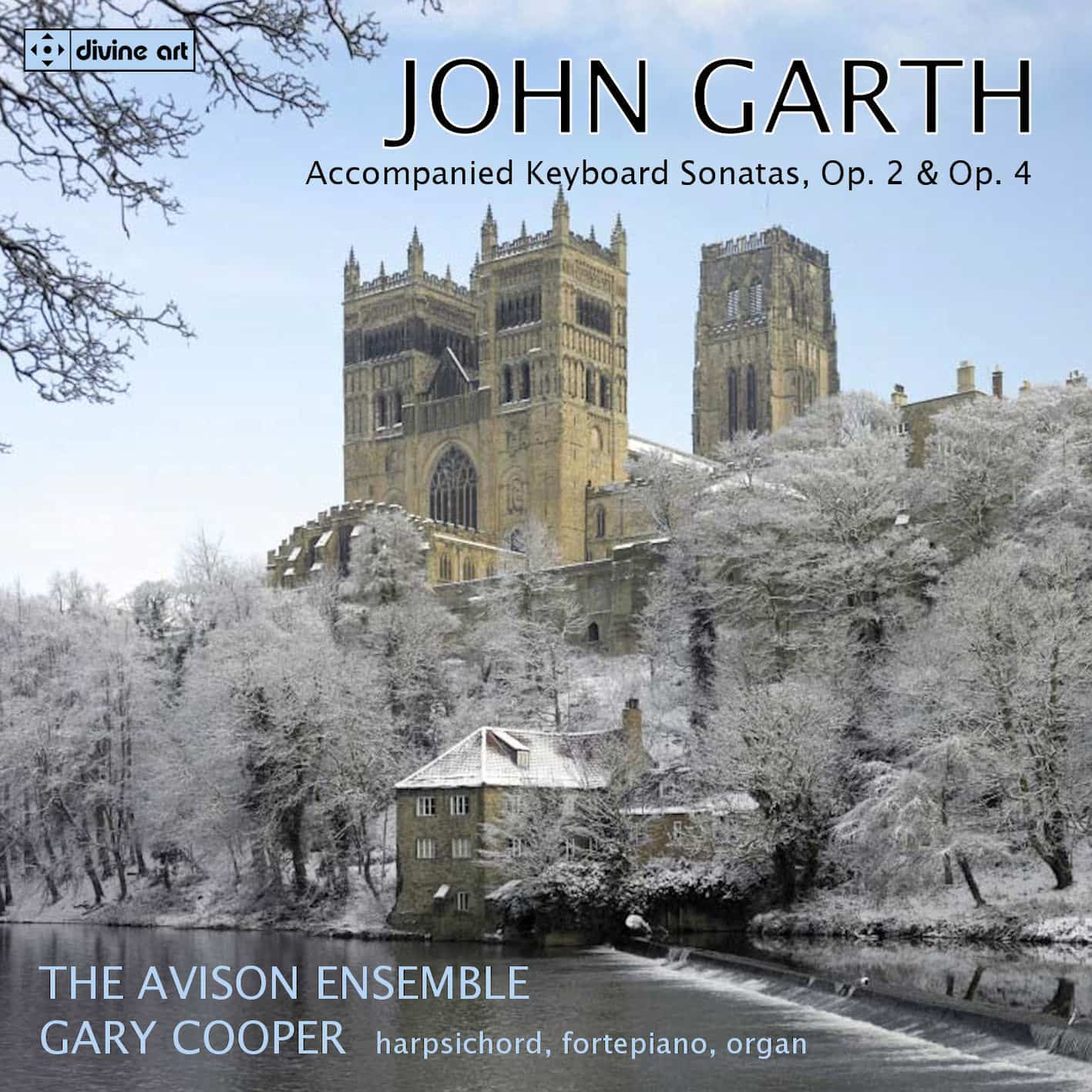
    He has been called a Durham composer and the excellent sleeve notes has a beautiful picture of the glorious Durham Cathedral which, in itself, is inspiring.

    The sleeve notes are by Simon D I Fleming to whom I owe my gratitude. All I can do is recommend this handsome set.

    I do urge you to purchase this set even those of you who may have a closed mind to this type of music.

  • Gapplegate Classical Modern Music – Grego Edwards – 25115

    Can you imagine being composer John Garth (1721-1810), organizing a bi-weekly series of concerts in Durham city, England, where he achieve some modest fame as composer and cellist? When he wrote his Unaccompanied Keyboard Sonatas, op. 2 & op. 4 (Divine Art 2-CDs 25115), he of course hoped for good performances, a good turnout and a favorable reception. But could he have hoped, some nearly 300 years later, that someone such and you or I would get a chance to hear the sonatas again in recorded form? Could he scarcely imagine some such possibility or had he no thoughts of all of the possibility of posterity? I have no answer to this question yet here I sit at my computer typing these lines in 2014, listening to the very music he wrote back then.

    John Garth was no CPE Bach, certainly, yet there is a period flavored freshness and vivacity to these works, as nicely performed by the Avison Ensemble with Gary Cooper as keyboard soloist on the harpsichord, early fortepiano and organ.

    He is chiefly known for these works, the cello concertos and a few similar pieces, much of it available on Divine Arts as played by this ensemble.

    What it certainly does is opens you up to the lesser-known English composers of the era. John Garth was no slouch. On these sonatas the keyboard part is far more the out front, virtuoso vehicle for Garth’s ideas. The two violins and cello that form a part of the music have the role chiefly of reinforcing the accompaniment figures and seconding the solo melodic line. This is more rococo and jaunty than deeply contrapuntal or gravitas. That was the age and he excelled at the rather happy extroversion of his times.

    The individual tang of early pianoforte instruments, harpsichord and organ help individualize each sonata and give it character. The ensemble plays these pieces with enthusiasm, an infectious sort. I found myself listening with pleasure each time.

    Anglophiles of the music of this period will respond readily. But I suspect anyone with an interest and appreciation for the earlier forms will feel positively about the program and its performance. Good show!

  • Limelight – Will Yeoman – 25115

    I’m not entirely convinced of the musical worth of the 18th century Durham composer and organist John Garth’s charming, insubstantial accompanied keyboard sonatas. But if any band was capable of convincing me, it would be superb British early music outfit The Avison Ensemble, whose recordings not only of their namesake’s music but that of Vivaldi, Handel and Corelli are renowned for a refined gutsiness that is quite unique. Their recording of Avison’s Concerto Grossi after Domenico Scarlatti is especially fine.

    Garth (c.1721-1810) was good friends with Avison, who was also an exponent of the accompanied keyboard sonata, which as the Grove Dictionary reliably has it was “used almost exclusively by composers in north-east England (Avison, Ebdon and Hawdon as well as Garth) where a trio sonata ensemble of two violins, cello and harpsichord is required, with the strings either doubling the harpsichord, providing harmonic support or resting.”

    The Avisons have already explored Garth’s tuneful, original Opus 1 Cello Concertos- Garth played cello in Avison’s Newcastle concert series- with the present cellist Richard Tunnicliffe as soloist. Here Pavlo Beznosiuk, violinist Caroline Balding and Tunnicliffe accompany keyboardist Gary Cooper for Garth’s first two sets of keyboard sonatas (he wrote five in total).

    Cooper uses three different types of instruments; some of the sonatas feature dynamic markings in the score and may have been intended to be played on the fortepiano. The change in timbre from harpsichord to fortepiano to organ is both effective and welcome, while the string playing is as finely differentiated and engaging as Cooper’s sparkling keyboard work.

    Sometimes, however – and this is obvious right away in the opening Allegro of the Opus 2 set – the string sound is too forward, resulting in a lack of clarity. Given the string parts are for the most part mere doublings of the keyboard part, which can happily stand alone if need be, this is not such a good thing.

    That aside, there is still much to enjoy here. The dramatic Allegro of the C Minor Sonata, again from the Opus 2 set, is striking in its contained passion and finds its cousin in the final G Minor Sonata of the later set, here forcefully realised with organ. The E Flat Major Allegro of the sonata preceding it – Cooper opts for harpsichord this time – is one of the best and most substantial, with rare fugal writing and a more complex texture overall.

  • MusicWeb – Brian Wilson – 25115

    The only other recording of the music of Durham composer John Garth, comprising six cello concertos, also comes from Divine Art ( DDA25059) and received a warm welcome from me some time ago. I don’t know why they delayed the release of this second album – if anything the music is even more interesting than on its predecessor and the performances are just as fine as on the earlier set. The mp3 transfer is clear and immediate and the pdf booklet comes as part of the deal.

  • John Garth – Accompanied Keyboard Sonatas, Op. 2 & Op. 4

    John Garth – Accompanied Keyboard Sonatas, Op. 2 & Op. 4

    Along with his friend and teacher Charles Avison, Garth was one of the leading lights of the music scene in northern England in the late baroque era (late 18th century). His music was completely neglected until re-introduced by The Avison Ensemble in concerts and with their groundbreaking recording of his Cello Concertos in 2007 (DDA 25059). In his lifetime Garth was best known for his Op. 2 Sonatas, written in the northern English style with accompaniment by two violins and cello; this and the Op. 4 set represent almost the last flowering of the true baroque era. Each sonata is in two-movement form and while thoroughly ‘conventional’ in style, include some masterful composition and endlessly fascinating listening.