Catalogue Connection: 25116

  • Classical Music Sentinel – Jean-Yves Duperron – 25116

    Great music, performed on a magnificent pipe organ, by an organist at the top of his game, all captured in vividly realistic sound. In other words, an outstanding recording. I never give out stars or number ratings on this website but if I did, this CD would get 6 out of 5 stars, or a rating of 11 out of 10. American composer and concert organist Carson Cooman (b. 1982) does not seem to be inflicted with the “sameness” syndrome that most of today’s composers appear to suffer from. His music is highly original and, on this recording anyway, all the pieces are as varied from one another as they are captivating.

    For starters, the Toccata Festiva (which I’ve listened to over and over again) immediately demands your attention and doesn’t let go until the very end. It starts with both hands playing at top speed while the mighty pedals ring out the work’s main melody in a counter rhythm fashion, leading to a middle section where the organ’s impressive reed stops blare out a full fanfare, and then returns to the blazing tempo from the beginning and ends with a full-organ chord so powerful as to crack your windows. It’s a good thing it only lasts for about six minutes because I don’t think any organist’s hands could take this beating much longer. This piece alone is worth the price of admission. At the other end of the spectrum you have a piece like Remembering which showcases this organ’s beautiful softer stops and mellow flute pipes. The final chord is like a pillow of sound.

    All works on this CD are very recent compositions, mostly from 2011 to 2013, and most are probably world première recordings. Organist Erik Simmons , who is an Intel software engineer by day, plays every piece with expression and interpretive freedom that avoids any mechanical pitfalls, and lends each piece a character all its own. And the 1973 Marcussen and Son organ of Laurenskerk in Rotterdam is a magnificent instrument that perfectly balances beauty of sound, tremendous power, and a set of trumpet stops so sharp they could cut through cast iron.

    The recording engineer in this case is the organist himself, and he’s produced for Divine Art a state of the art recording so realistic you would swear you are sitting right there at the organ console. I believe Divine Art have released a benchmark recording. Recommended for everyone and definitely not to be missed by pipe organ fans.

  • Fanfare – David DeBoor Canfield – 25116

    Having received this Divine Art CD as the fifth disc I’ve encountered devoted to the organ music of my Fanfare colleague Carson Cooman, I am beginning to suspect that a good percentage of his copious output has been devoted to works for his own instrument. Past volumes have amply demonstrated the stylistic breadth that Cooman brings to his writing for the organ, and this disc continues such diversity, and utilizes the artistry of Erik Simmons, who has recorded numerous other works in Cooman’s output for organ. All but one of the works heard herein are recent, and span the years 2010-2013.

    The recital opens with the stunning Toccata Festiva. Fanfare listeners know what organ toccatas sound like —almost all readers will have heard the quintessential example from Widor’s Fifth Symphony—and this toccata is well within the parameters of the genre, oriented towards the French species but, as the composer notes, employing a harmonic idiom permeated with American sonorities (mainly through filling in chords with non-chord diatonic pitches). Its optimistic spirit reflects the “Festiva” portion of its title. The following Litany forms a quiet contrast to the ebullient Toccata, and hearkens back to the American tradition of, say, Randall Thompson. It would make an excellent offertory, given its meditative quality.

    With Preludio on a Swedish Tune, the listener is treated to a rather Bach-like treatment of the Swedish tune as a cantus firmus, over which a jubilant running figuration is placed. While the opening harmonic treatment could almost have been written by Bach himself, a middle section that is entirely Cooman provides a contrast before the return of the opening material closes the work. Sonata da Chiesa was written for Daniel Pinkham, and draws upon a 13th-century conductus by Perotin. The harmonic language of this work is a notch or two more advanced than that of the preceding works (I hear some hints of the music of Jehan Alain), but the introspective quality of the first two movements, and the jubilant atmosphere of the third are highly suggestive of the liturgical use implied in the title.

    The contrasting styles and moods set forth in the first several works continue apace throughout the remainder of the CD, from the gentle Ricercar on Two Czech Hymns to the exquisitely sublime Prelude to the Memory of Jean Langlais, to the declamatory Fanfare for a Duchess at St. Andrew’s (based on Haydn’s tune Glorious Things of Thee are Spoken), and so on. Cooman writes as well as anyone I know writing these days for the organ. Every single note from his pen (or, more likely, computer) “works,” as its composer knows his instrument intimately. I was slightly amused to see that the longest work on the CD is entitled Suite Breve.

    The organ used in the recital is a fine Danish Marcussen organ in the Laurenskerk, Rotterdam, but the best organ in the world won’t help ill-conceived registration, and Erik Simmons, apart from his technical proficiency, knows just which colors to extract from the instrument to effectively showcase the works heard here.

  • Choir & Organ – Matthew Power – 25116

    Those who know Carson Cooman’s choral style will understand the easy appeal that his music manages while seldom attracting the damning label of accessibility. This is a collection of vigorous pieces communicated through a tonal yet still personal language. Simmons plays with musical comprehension as well as the clinical precision demanded by the clear-cut, sometimes startling, sounds of the IV/85 Marcussen, which suit the music.

    Cooman is most rewarding in fast-moving minimalistic guise, such as the Toccata Festiva and Carillon-Ostinato. Though sometimes reliant on syncopation and added sixths and ninths, there is still sufficient neo-classical skill at work to satisfy listeners and players alike.

  • The Tracker – George Bozeman – 25116

    I was aware that Carson Cooman was composer-in-residence at Harvard Memorial Church and was curious to know what his music was like. This CD provides an excellent answer. Cooman is an extremely prolific composer; the recording includes works from Opus 140 to 1006! Surprisingly perhaps, his style is completely harmonic and strikes me as being about as adventuresome as typical ‘modern’ organ composers of the 1950s or so. On the other hand he has such a sure control of melody, rhythm and structure that, even though there is nothing difficult or foreign for the listener, his music is always fascinating and worth hearing. One is tempted to compare him with John Rutter, another composer who is always easy to listen to, much to the consternation of many of his non-fans. But Cooman doesn’t seem to be aiming for the hit parade – or the ivory tower. He’s just doing his job of making some nice music, beautifully crafted, and perfect for the occasion.

    Erik Simmons straddles two careers – organist and high tech. He’s an employee of the Intel Corporation, involved in new product development among other things. As a straddler myself – organist and organbuilder – I’m very impressed with his playing but of course I have no way of judging his other performance. He seems to be quite capable of performing anything Cooman throws at him: this is his fourth CD of Cooman’s music.

    The Marcussen organ in Rotterdam’s Laurenskerk was built in 1973 and is quite grand with four manuals and some 85 stops, including a battery of five horizontal reeds. It has the distinction of being Europe’s (I would guess the world’s also) largest instrument that is entirely mechanical. Except for the blower there is nothing electrical in it! The balance and finish of its scaling and voicing, and the state of its tuning for this recording is almost too good. Such perfection can seem sterile but its sheer beauty somehow overcomes that tendency. Among other ear ticklers is a luscious string celeste in the Bovenwerk (Swell) that Cooman and Simmons frequently make use of.

    Charming CD. You will enjoy it.

  • The Classical Reviewer – Bruce Reader – 25116

    The problem with so many organ recital discs is that they often provide spectacular sounds that, after repeated listening seem merely bombast. Those recordings that feature gentler pieces can often be quite bland.

    Now comes an organ recording from Divine Art Recordings of works by American composer Carson Cooman that is none of these things.

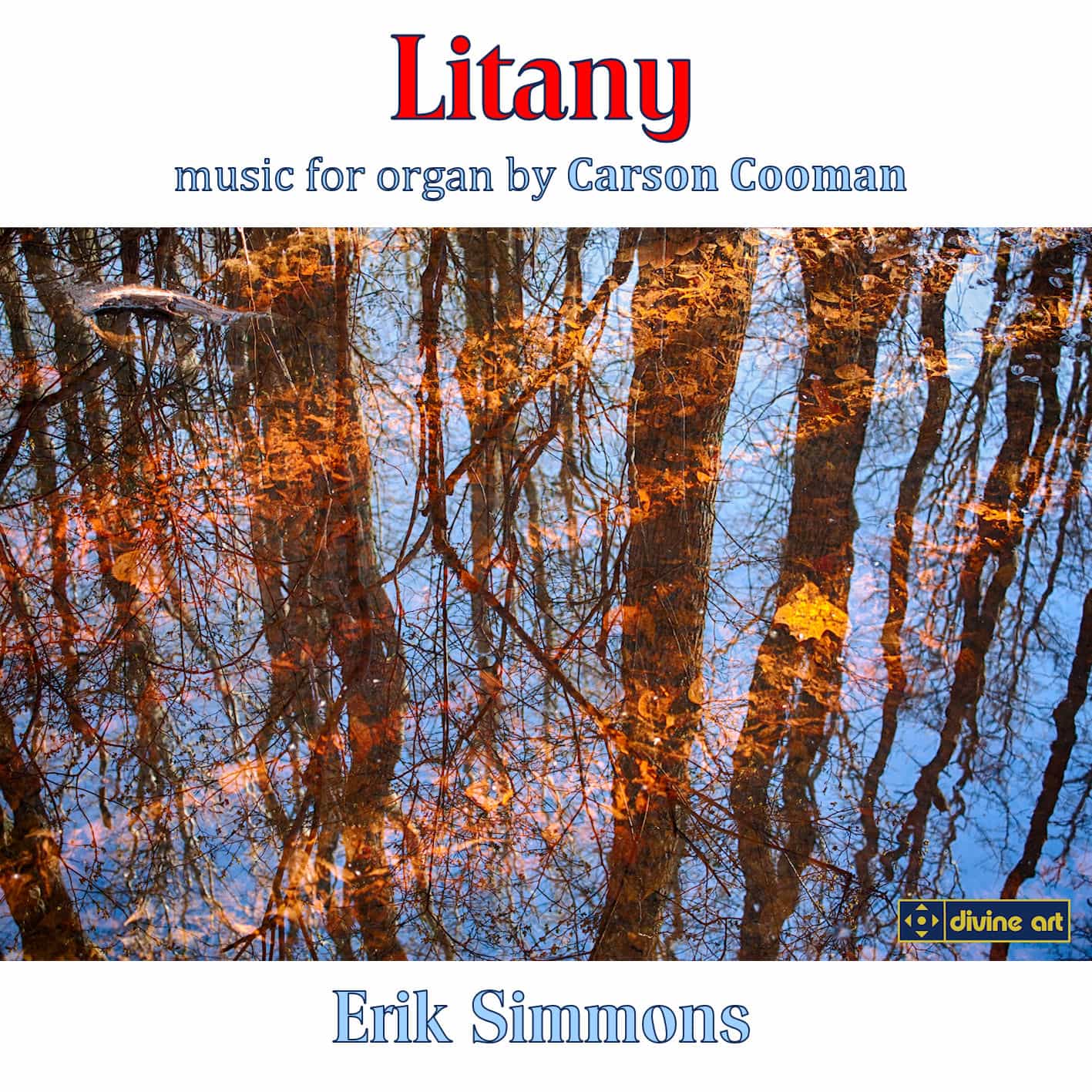
    Entitled ‘Litany’ it features twelve of Cooman’s organ works dating from 1999 to 2013 all played by organist Erik Simmons on the main Marcussen and Son organ of Laurenskerk, Rotterdam, Netherlands built in 1973, an organ that is neo-baroque in design and completely mechanical in all respects.

    Carson Cooman (b.1982) studied with Bernard Rands (b.1934), Judith Weir (b.1954), Alan Fletcher, and James Willey (b.1939). As an active concert organist, Cooman specializes in the performance of contemporary music. With a catalogue of hundreds of works in many forms, from solo instrumental pieces to operas, and from orchestral works to hymn tunes, his music has been performed on all six continents in venues that range from the stage of Carnegie Hall to the basket of a hot air balloon.

    Cooman is also a writer on musical subjects, producing articles and reviews for a number of international publications. His work appears on over forty recordings, including twenty complete CDs on the Naxos, Albany, Artek, Gothic, Altarus, MSR Classics, Raven, and Zimbel labels. Divine Art and Métier have already released recordings of Cooman’s chamber music (Metier MSV 28538) and orchestral music (Divine Art DDA 25117).

    An insistent toccata motif underpins an overarching theme in Toccata Festiva, Op.921 (2011). There is a striking chordal, central section before a fugal development before the opening toccata motif returns leading to the decisive coda.

    Litany, Op.992 (2012), the work that gives the title of the disc, provides a contrast with its gentle opening and some beautifully worked out development of the theme. After rising to a number of gentle climaxes with some lovely layering of textures, there is a beautifully hushed section. Erik Simmons brings out all the lovely timbres of this organ.

    A bright and jolly Preludio on a Swedish Tune, Op.1002 (2013) follows with the main theme played over a repeated motif and varied in a most entertaining manner.

    Sonata da Chiesa, Op.140 (1999, rev. 2001) opens with a haunting Prelude that has an effective and simple little tune beautifully harmonised, often dissonant. The Offertory has a repeated bass motif beneath the melody, creating a gently rocking effect which is quite hypnotic. The lively Postlude rises up gently into a light textured toccata.

    Ricercare on Two Czech Hymns, Op.993 (2012) reveals a stately theme that is gently developed and harmonised before a second tune appears, fitting so well. When the opening theme re-appears the two tunes are woven. It is Cooman’s ability to create such variety that makes this piece so appealing, especially as played by Simmons.

    A rising three note motif opens Prelude a la memoire de Jean Langlais, Op. 1004 before being embellished by a rising and falling theme and developed. Soon there are lovely textures developed often over a repeated motif. It is a repeated three note motif that underpins the beautiful coda.

    Fanfare for a Duchess at St. Andrews, Op.1006 (2013) is a beautifully crafted piece with the underlying theme of Haydn’s Gott erhalte Franz den Kaiser used by 18th-century English hymn writer, John Newton, for the well-known hymn Glorious Things of Thee Are Spoken revealed in various guises and raising this Fanfare to the level of a remarkably fine piece for all occasions.

    With Remembering, Op.981 (2012) a gentle relaxed descending motif develops with richer variations with some lovely light textures and an exquisite coda.

    Joysong, Op.1003 (2013) is just that, a joyous, spring like evocation written on the occasion of a wedding and full of life, happiness and beautifully rich textures too.

    The Divertissement of the Sonatina No.1, Op.991 (2012) is light and buoyant with some beautifully written in staccato phrases. An absolute joy. Pibroch opens with deep pedal notes before a melody with a definite Scotch snap appears, the pedal notes acting as a kind of drone. The melody is developed with an attractive weaving of the theme in this terrific little piece.

    Carillon – ostinato lightens the texture whilst rapidly moving to its conclusion with an attractive little melody over the ostinato motif.

    The gentle exquisite little Berceuse, Op.846 (2010) is in the form of a lullaby and written for the child of a fellow organist who gave the premiere.

    The opening movement of Suite Breve, Op.894 (2010), Variations, is in the form of a theme and five variations. An attractive, fast flowing yet gentle theme is subjected to many variations in rhythm, texture and colour by extremely judicious use of registration. The theme returns at the end with a brief coda. Pastorale opens with a steady tread in the bass but soon becomes livelier and light textured before the two themes are combined. Glorious chords open the scintillating finale of this suite, Sortie, with Erik Simmons showing off the Marcussen organ of Laurenskerk, Rotterdam, Netherlands to full effect before three massive chords end the work.

    It is good to hear works for organ so sensitively written and beguiling to the ear. There are some real gems of the organ literature on this appealing recording. Erik Simmons is a fine organist who reveals all the little details and textures of these pieces. The recording is first rate.

    As usual with Divine Art productions, the booklet is beautifully produced with excellent booklet notes complete with organ specification.
  • Fanfare – James A. Altena – 25116

    Recently in [Fanfare 37:3] I gave a mixed review to a CD of works by Carson Cooman, with one comment in that review leading to an opposing exchange of views between the composer and myself in the “Critics’ Corner” section of [issue 37:5]. Apparently chief editor Joel Flegler likes for his reviewers to live dangerously; for on almost the same day as that exchange went to press, the present disc appeared in my mailbox. (Or, it may be simply because I am one of the very few Fanfare reviewers at present who takes on organ repertoire.) In any case, no need for fear, as I found the contents of this disc to be quite delightful. Among his dizzying array of activities Cooman is also an organist, and so this is very much his home ground. He obviously loves his instrument and its resources, and that shows in the results offered here.

    Overall, though not uniformly, the strongest stylistic influence on Cooman would appear to be the early 20th-century French school of figures such as Dupré, Duruflé, Langlais, and Tournemire. Among the exceptions, the Preludio on a Swedish Tune has an opening strikingly similar to Bach’s celebrated chorale Nun freuet euch, BWV 734, while Joysong (composed for a wedding) and the opening movement of the sonatina pleasingly evoke a Renaissance positif organ and the dance music of that period. Several of the works – the Sonata da chiesa, Preludio, Ricercare, Fanfare, Remembering – freely draw upon existing hymn tunes and medieval plainchant motifs. As their titles suggest, the Litany, the “Prelude” and “Offertory” movements of the Sonata da chiesa, and also the Ricercare, Prelude, Remembering, and Berceuse, are slow in tempo and quiet and contemplative in mood, as are also the central movement of the Sonatina No. 1 (“Pibroch”) and the first two move­ments of the Suite breve (“Variations” and “Pastorale”). The other pieces – the Toccata, Preludio, Fanfare, and Joysong, the “Postlude” of the Sonata da chiesa, the outer movements (“Divertissement” and “Carillon-Ostinato”) of the sonatina, and the concluding “Sortie” of the Suite breve – are brisker and more extroverted, variously fleet and sprightly (with running triplet or 16th-note figurations in the accompaniments) or more martial and muscular in their energy.

    All the pieces on this album are of short duration; the two longest, the Sonata da chiesa and the Suite breve, are the only two to time out at more than seven minutes, and both of those (plus the Sonatina No. 1) have three separate movements. The opening Toccata festiva is the only piece that does not catch my fancy, perhaps due in part to the chosen registration; cast in A-B-A form, the outer sections with their rapidly running repeated triplet figures sound rather risibly like a spastic accordion. Otherwise, organist Erik Simmons is an effective advocate for all of the works featured here. I do have some reservations about the instrument, the main organ of the Laurenskerk in Rotterdam. A modern neo-Baroque instrument built in 1973 to replace a 16th-century one destroyed in the Nazi aerial obliteration of that city in May 1940, it boasts of being “the largest entirely mechanical action instrument in Europe.” To my ears, however, it sounds like a genuine Baroque organ subjected to a degree of disagreeable modern electronic filtering. However, that is likely a subjective reaction which others listeners may not share.

    None of the works here is strikingly individual or original; but, as I have previously noted in these pages, originality pursued as an end in itself necessarily leads to perverse affectation. The proper question to raise is not “Is this piece original?” but “Is this piece good?” Here, in an assortment of occasional works in the best sense of that term, Cooman as a skilled compositional craftsman has given us, in a conservatively tonal idiom, good works (pun intended) that are both pleasing and serviceable. To both organists looking to expand their repertoires of music for church services, and to fanciers of contemporary organ music seeking to add something novel to their collections, this CD is cordially recommended.

  • Gapplegate Classical-Modern Music Review – Grego Edwards – 25116

    The album up today is not totally indispensible. Not, that is, unless you are an organ music afficionado. In other words if you don’t have any or if you have little organ music in your collection, this is probably not the one to get. Bach, Messiaen, Widor, etc., might be better first choices.

    That’s because Carson Cooman’s Litany, Music for Organ (Divine Art 25116), as played by Erik Simmons on the beautiful Marcussen organ in Laurenskerk, Rotterdam, has the entire organ repertoire presupposed as what it follows, and you might get a bit of that first. On the other hand the music itself can be experienced of course independently and you may not hear how it fits in but would certainly find the listening worth your time.

    Carson Cooman lives today, an American composer in his prime. I don’t believe I’ve had the pleasure of hearing his music before but he apparently has orchestral works, etc., and a fair number of recordings out there that one can listen to.

    For now it’s the organ music that concerns us. The album gives us a generous sampling of 12 compositions both in single and multi-movements. They cover the recent era, from 1999 to 2013.

    You can hear in a modern tonal idiom an affinity with the French school of organ composers (Franck through Tournemire, Vierne, etc.) in the symphonic splendor and worked through classicism-cum-romanticism that these composers excelled in over the last 150 years, give or take.

    Cooman writes inventive, modern tonal music that follows in the footsteps of such composers, to my ears. There is much to like. The performances and sound leave nothing to be desired. It’s all there.

    Carson Cooman gives us a body of work here that I hope will continue to grow. He is a bright light that shines for us in this 72-minute program. Organ music fans take note! Recommended.

  • Litany – Organ Music by Carson Cooman

    Litany – Organ Music by Carson Cooman

    Carson Cooman is one of America’s most prolific and feted composers of our time. Also writer, critic, teacher and organist (Organist and Composer in Residence at Harvard), his music is never avant-garde but varies from the mildly challenging in harmonic structure to firmly traditional tonality, all with a fine sense of style and inspiration. This album presents a program of recent organ music (mostly composed 2012-3) of lyrical, Romantic and pastoral nature, but with plenty of variety. It’s a beautiful album enhanced by the marvellous playing of Erik Simmons and the wonderful Marcussen organ of Laurenskerk, Rotterdam (recorded by the Hauptwerk system).