Catalogue Connection: 25117

  • Gapplegate Classical-Modern Music – Grego Edwards – 25117

    Not everyone composing today chooses to be a part of the advanced guard, of course. Some thrive in keeping traditions of the later tonal schools alive, finding their own way to make it new. Carson Cooman is one of the best and most prolific in this realm. There is so much of his music out I can’t say I have been able to keep up, but a recent one has caught my ear and given me much to enjoy.

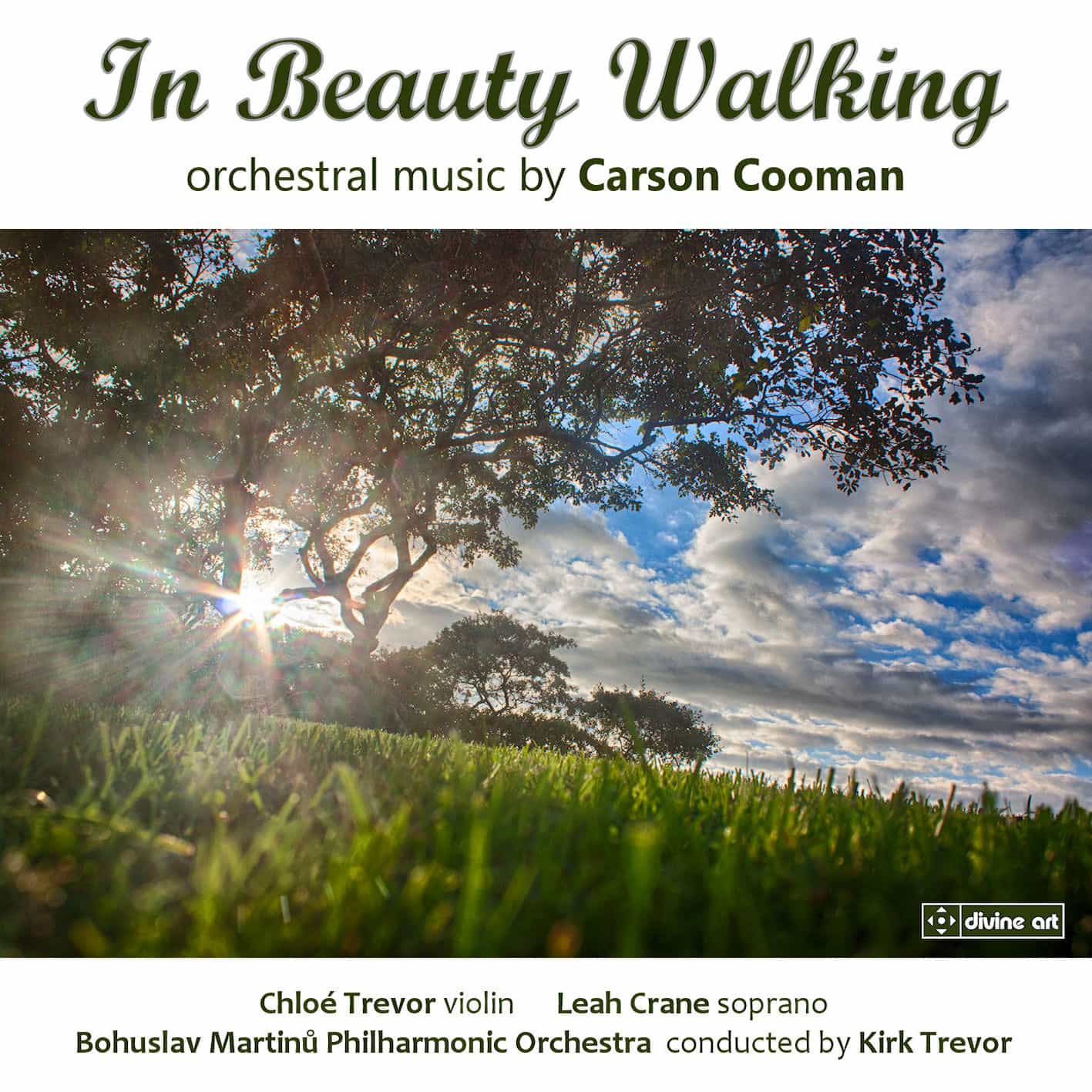
    It is a compilation of four orchestral scores by Cooman, going by the name of the first composition presented in the program, In Beauty Walking (Divine Art 25117). On it the Bohuslav [Martinu] Philharmonic shine under conductor Kirk Trevor.

    These are four works that revel, as the title suggests, in the possibility of a sort of pastoral beauty, some with pronounced folk leanings, others less so. The “Symphony of Light” (2003) for string orchestra is especially ravishing. If Aaron Copland’s Appalachian Spring brings you joy (as it does for me) Cooman here gives you some of that same feeling, albeit in his own way. His “Folk Fantasies” (2005/13) for violin, percussion and string orchestra continues the home-spun pastoral mood even more specifically with great rhapsodic charm.

    “In Beauty Walking” (2012) for soprano Leah Crane and orchestra has, understandably, a more song-like feel much of the time, with five short movements that capture the experiential joy of communing with the natural rural world, with music set to the poetry of Mary Austin. The last movement has a verve that brings the work to a stirring conclusion.

    “Sinfonia Concertante” (2013) for violin and string orchestra has a bit more of a neo-classical element. Chloe Trevor does a fine job as the violin soloist. Medieval and Renaissance influences get transformed to something once again beautifully tonal and very personal. One can hear something of the pastoral Hovhaness in parts of this music, in its lyrical treatment of archaicisms, though very much refashioned to a Cooman sensibility.

    So we have four Cooman works that dovetail well with one another, that express a sense of reverence and elation, of very real beauty. Cooman may be the most lyrical composer alive. He certainly moves to the center of such things on this program. It is in every way delightful. The music is impeccably conceived, orchestrated and performed here. Ravishing!
  • Expedition Audio – Paul Ballyk – 25117

    I had not encountered the music of American composer and organist Carson Cooman prior to picking up his most recent release on CD, 2014’s In Beauty Walking . After thoroughly enjoying this selection of music for string orchestra and deciding to recommend it on Expedition Audio, I set about learning more about this fine composer.

    Carson Cooman was born in 1982 in Rochester, New York. Now only in his early 30’s, he has produced an astonishing catalog of compositions with opuses numbering over 1,100. His ouevre encompasses a wide variety of genres ranging from music for solo piano, organ, and chamber ensembles to works for choir and orchestra, as well as three chamber operas. The present album, released on British/American label Divine Art, brings together four works for string orchestra, two of which include parts for violin solo and a third featuring a soprano soloist. Though Mr. Cooman does not shy away from the occasional piquant harmony where it serves his creative objectives, on the whole this is consonant, melodic music that falls easily on the ear. From the delicate, reflective beauty of the lullaby “Cradle Song” to the ebullient elation of “The Eagle’s Song” and the halting wonder of “Aria” from the Sinfonia Concertante , Cooman’s music is uplifting, inspiring and beautiful to hear, and yet remains fresh and interesting, never approaching the trite.

    A wide variety of influences are apparent in Cooman’s music, but among the most significant are folk music and historical classical music models. On this album alone, Cooman draws inspiration from Native American, Celtic, African, Scottish and Far Eastern origins among others. He is also inspired by music ranging from the Renaissance and Baroque eras through the Romantic period and to modern times. Another prominent characteristic of Cooman’s music is somewhat more difficult to describe, but reflections on the natural world are central to it, as are feelings of calm and happiness, hope, peace and a certain humility that is woven into every bar. In a word, I would describe it as spiritual, and somehow I have the feeling the composer himself would not object to this description.

    I’ve neglected to remark on the superb performances for too long. Conductor Kirk Trevor has long championed Cooman’s music – a quick search for their two names on HBDirect.com yielded five matches. Mr. Trevor leads the distinguished Bohuslav Martinu Philharmonic Orchestra and two splendid soloists grace the performances, soprano Leah Crane and violinist Chloé Trevor.

    If your tastes in contemporary music tend toward the harmonically challenging, this disc may not be to your liking. However, if you’re intrigued by my description of the music and enjoyed the album samples, I believe you will relish the entire program.

  • Pizzicato – Remy Franck – 25117

    “We continue our Cooman series with a disc of sumptuous and unashamedly Romantic works reminiscent of the English pastoral tradition at its best – and this from an American composer with an American voice.”

    So Divine Art announces this CD and it’s not wrong. Carson Cooman ( b. 1982) has ideas, he can orchestrate and knows how his expressive music has to sound. The program begins with the truly beautiful and delicate song cycle ‘In beauty walking ‘ (2012), sensitively sung by Leah Crane . The sophisticated Sinfonia Concertante (2013) is oriented mainly on stylistic elements of the middle ages and the Renaissance, but in places also draws on the themes of traditional fiddle music. For the meditative melancholy Symphony of Light (2003) the composer was inspired by various images and visions on the theme of light: dawn on a quiet winter day, ‘Eternity Canticle: First Light from the book of Ecclesiastes, and dawn on a vital summer morning. In the ‘Folk Fantasies’ Cooman once again remembers his American roots.

    Reliable interpreters and a good recording technology present the music of Cooman in a very good light. He might be a modern romantic, but he gives his music also what I would call an ‘American’ character. There is something very appealing and distinct in the pieces we can hear in this well played and superbly recorded program.

  • Fanfare – David DeBoor Canfield – 25117

    Heretofore, my exposure to Carson Cooman’s music has been to his organ and chamber music, of which I’ve positively reviewed several CDs. Consequently, I was glad for this opportunity to hear some of his larger-scale works, four of which are included in the present recital. All of these works feature a string orchestra. First heard is In Beauty Walking, a setting of five poems by Mary Austin that adds a soprano to the strings. Austin was a nature writer who specialized in writing about the American Southwest. From the beginning, one’s interest is captivated by arpeggiated solo lines in the strings, underpinning the lyrically expressive vocal line of the cycle’s opening “Morning Song.” The following “Star Song” is beautifully effective in its simplicity: Harmonies are disarmingly direct, and at points the soprano even sings under a solitary sustained D harmonic in the violins. The third piece, “Rain Song,” owes something to the driving pulsation of John Adams, and is wonderfully depictive of a desert storm. Throughout the cycle, Cooman has effectively captured the spirit of the region in his subtle and evocative writing, and his handling both of string instruments and the human voice is masterful. Aiding in the effect of the piece is soprano Leah Crane, who handles these songs with loving care as she caresses the texts with a warmly burnished voice.

    Next heard is Sinfonia Concertante, a lovely lyrical exercise full of lush modal chords in the strings, over which the solo violin soars. This work is the most recent of the four, having been written in 2013, and some of the writing reminds me a good bit of the Brook Green Suite of Gustav Hoist. Additionally, the third movement, entitled “Echo Gigue and Cadenza,” has a good bit of Irish lilt and swagger to it, and indeed ends with a cadenza, containing both lyrical and virtuosic elements. Violinist Chloe Trevor, daughter of conductor Kirk Trevor, demonstrates consummate skill in all the important parameters of violin playing. Her bright and expressive tone will please aficionados of the instrument.

    Cooman’s Symphony of Light effectively demonstrates the warmth that massed stringed instru­ments can produce. Its opening movement, “Winter Brightnesses,” could in my opinion just as easily be entitled “Summer Twilight,” but never mind: Its gentle and subdued spirit produces a gorgeous effect, as does the equally gentle following movement, “Eternity Canticle: First Light.” This movement is similar enough to the preceding one that if you’re not paying attention, you might not notice that a new movement is underway. I’m not saying that this is a structural weakness in the work, given the beauty of the music in both movements. With the final movement, “Dawning,” the pace of the piece picks up a good bit, forming some nice contrast to the preceding two movements. Lyrical lines float above the rhythmic activity to splendid effect. I’m not sure I’d call the work a symphony, though, as there seems to be little in the way of symphonic development. I would have opted for a title along the lines of Mystery of Light.

    Chloe Trevor makes a reappearance in the final work, Folk Fantasies, to which Cooman also adds some discrete percussion. As in his Sinfonia Concertante, I hear influence of the folk tunes of the British Isles, both in the melodic contours of the lines, and the modal harmonies employed. There are, in fact, folk tunes utilized in this work, but they are all original tunes by Cooman himself. I guess he considers himself one of the “folks.” The British Isles influence isn’t surprising considering that the first movement is entitled “Highland Ballad (Scotland),” but this influence seems to infiltrate the final two movements, “Ceremonial (Nigeria),” and “Circle Dance (America),” as well although somewhat less overtly.

    These well-performed works do not make too many demands on the listener, but have substance that will reward repeated auditions. The mood of most of the pieces is such that this would be a perfect CD to unwind to after a hard day’s work. Definitely recommended.

  • The Chronicle – Jeremy Condliffe – 25117

    Carson Cooman is a talented New Yorker who, despite being only 32, has composed hundreds of works in many forms, from solo instrumental pieces to operas, and from orchestral works to hymn tunes.

    His work has been performed in venues from Carnegie Hall to the basket of a hot air balloon. If you’ve not heard of him and you like modern orchestral music, you should hunt this down. (Now Congleton’s A&A Music has moved into new premises opposite the town hall, you should try them first).

    On the evidence of this, Cooman has the knack of writing “classical” music that has popular appeal, and the work on here ranges from highbrow to very accessible “pop” classical. At one point, we thought he was drifting into Simon Bates’s Our Tune theme. It’s an enjoyable album, and we’ve had it on repeat all week. The sound is never less than approachable and wanders between the very English (Vaughan Williams) and the American (Copland).

    The opener is the title track, in five movements, featuring mezzo-soprano Leah Crane and a string quintet, using text by Mary Hunter Austin, a nature writer on the subject of the American Southwest. Despite her studying American Indian culture in the Mojave Desert, this could also be England on a sunny day. The Eagle’s Song is perhaps the standout of this composition.

    The next five tracks are Sinfonia Concertante, for solo violin and string orchestra. This has a timeless quality thanks to drawing on medieval and Renaissance music.

    Symphony Of Light (2003) is in three movements, each inspired by different images and visions connected to light: Winter Brightnesses is the coming dawn on a calm winter day, Eternity Canticle: First Light , is inspired by a passage from the Bible, (“He hath made everything beautiful in its time”) while Dawning is inspired by a summer morning.

    The album closes with Folk Fantasies , which takes in Scotland, Nigeria and America.

    A fresh, invigorating album, with a crisp, modern sound. It’s not the countryside of a calming summer walk, but rather one on a blustery day, when you’re not quite sure what the weather is going to do.

  • In Beauty Walking – Orchestral Music by Carson Cooman

    In Beauty Walking – Orchestral Music by Carson Cooman

    As well as being a very busy and highly regarded organist, teacher and music consultant, Carson Cooman is one of America’s most prolific and gifted composers. His work retains the best of traditional forms in a modern and personal idiom; here, he has produced a body of lyrical works which are truly Romantic and pastoral but never soft or shallow. Exquisitely scored, these works tell of the beauty of the world we so often take for granted or pass by.