Catalogue Connection: 25118

  • MusicWeb – John Whitmore – 25118

    I’m something of a Scheherazade fanatic with over thirty versions in my personal CD collection. I first fell for the piece as a ten year old when I bought the Everest Goossens/LSO version (now available on CD) from World Record Club on a reel to reel tape. I’d never heard it before and simply couldn’t stop playing it. Even to this day this recording is “how it should go” so to speak. First impressions often last forever.

    Scheherazade has always struck me as a masterpiece of orchestration so when I came across this piano duet version I was intrigued to hear what it could possibly sound like. Actually, I really enjoyed it. There are downsides. The violin solos just don’t sing out on a piano due to the instrument’s lack of a real sustaining power. This comes as a bit of a shock and a let-down at the very beginning of The Sea and Sinbad’s Ship . The same applies to the numerous legato woodwind and horn solos scattered throughout the score and especially the glorious string tune in the third movement, The Young Prince and the Young Princess . The melody misses that drenched sheen that only a massed violin section can bring to it. Another obvious point is that two pianos simply can’t give you the all-engulfing thrill of a modern symphony orchestra playing at full tilt.

    So what is that makes this CD so enjoyable? First of all, the level of musicianship and pianism is of the highest order. It’s a really good interpretation, full of excitement, subtlety and power. The finale is particularly impressive. The Shipwreck is quite magnificent with its glittering right-hand runs. Secondly, with the orchestral palette stripped away you do listen to the music with new ears. The absence of orchestral timbre brings one point home to the listener in stark clarity: much of the music is repetitive, especially the first two movements. The piano duet version makes this patently obvious and it’s to the pianists’ eternal credit that they continue to delight the ear despite the repetitive nature of the material. In the orchestral version, Rimsky avoids boredom setting in by using instruments with contrasting timbres taking up the themes in turn. This is yet more evidence, maybe, that he truly was a master of orchestration.

    This recording was originally released by Gamut in 1990 (GAM CD521). It doesn’t in any way replace the orchestral version but it is a worthy addition to any Rimsky collection. I can’t imagine another piano duo making a better job of it. The sound quality is suitably big-boned and clear.

    The Antar symphony isn’t a symphony at all, it’s really “ son of Scheherazade ”. Stylistically it’s very similar and there’s nothing really symphonic about it. Antar is actually another of the composer’s oriental suites comprising four contrasting movements. As good as Scheherazade is the Goldstone and Clemmow duo are even more spectacular in this sensational arrangement by Nadezhda Purgold, the composer’s wife. The music itself is more varied than Scheherazade and less repetitive by nature. It’s also probably more interesting and challenging to play. The central climax of the opening movement (at 4:35) is just as exciting as the orchestral version. The Joy of Vengeance is a master-class in virtuosity and the final two minutes of The Joy of Love are as touching and tender as you could reasonably expect. The sound quality from the Royal Northern College is on a par with that given to Scheherazade .

    The encore is the well-known Neapolitan Song Funiculi Funicula . played in Rimsky’s own four-hand version. He was apparently unhappy with the results and withdrew it. It’s hard to see why and it brings this superb disc to a thrilling conclusion.
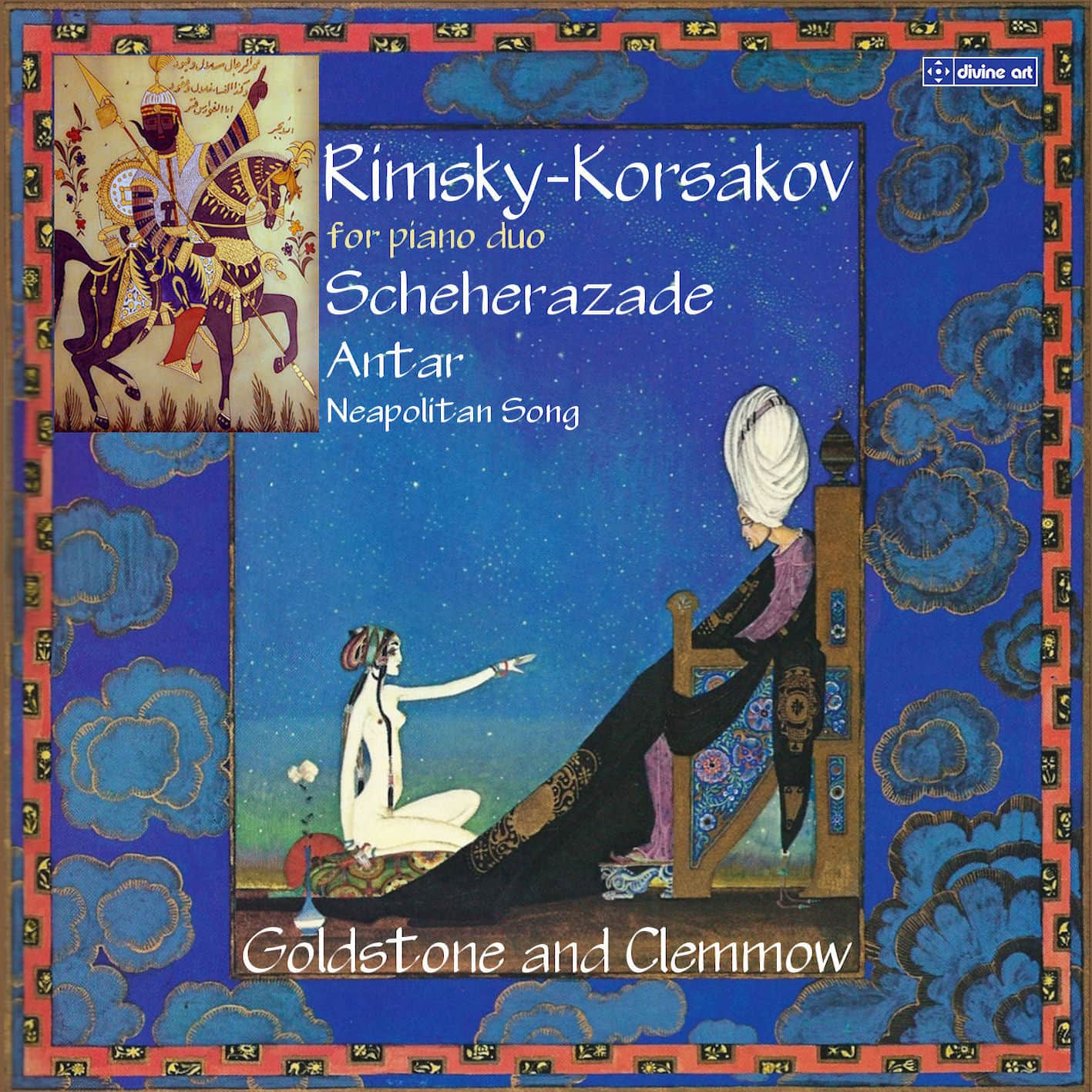
  • International Record Review – Michael Round – 25118

    Duo’ says the title, thereby implying two pianos, but actually all these performances are for four hands on one piano, a trickier medium for arrangers and players alike. Nevertheless, CD catalogues are currently awash with piano-duet versions of standard orchestral works: Beethoven and Brahms symphonies, even some by Bruckner and Mahler, to name but a few. Original orchestral size seems no impediment, nor the inclusion of voices: recordings include four-hand versions of Beethoven’s Ninth and Mahler’s Second (a version of which I reviewed in October 2013). I await, with trepidation for they can surely not be far behind, Schoenberg’s Gurre-Lieder or the whole of The Ring.

    Duet arrangements arose, of course, from sheer practicality, many of them dating from the days of scant opportunities to hear full orchestras in concert. They were, and still are too many of us, infinitely more satisfying to play than to listen to, but many listeners today happily accept the loss of orchestral tone colour, considering the gain in textural clarity and consequent enhancement of the underlying structure as partial or even ample compensation. Others may consider the exercise as much of a makeshift as, say, black-and-white pictures of the stained-glass windows in Saint-Chapelle. It also depends on the piece, and despite the names on this new disc of husband-and-wife team Anthony Goldstone and Caroline Clemmow – cast-iron guarantees of superb performances – my heart sank on seeing that orchestral showpiece par excellence Sheherazade up for four-hand treatment. (I didn’t orchestrate it’, roared Rimsky-Korsakov at a misguided well-wisher, I wrote it for orchestra!’) How could those ethereal violin solos, those majestic brass outbursts, all that percussion, be rendered at all on piano duet without a feeling of inadequacy in every bar?

    In its favour, this particular duet arrangement has considerable documentary value. Rather than delegate the transcription to someone else, Rimsky-Korsakov did it himself, even taking time off work on his current opera for the purpose. Goldstone’s ever-valuable booklet note comments that the duet version offers ‘scope for more spontaneity and flexibility than would be possible with a large orchestra’, though in practice there is – thankfully to listeners familiar with the original – little in the way of whimsical rubato in this performance, and in at least one place, the normally held-back third-movement pick-up to bar 17 (at 0’42”), considerably less. Preparation has been scrupulous, Goldstone mentioning – to the shame of hardened piano hacks among us who might have strolled into a studio and bashed through it at sight – many months of work on the piece. The end result is astonishing: to name but two techniques never taught and rarely tested in conservatoires, long tremolos here are immaculately smooth, soft or loud, and impossibly fast repeated notes are faultlessly precise. Even those stratospheric solo violin notes seem to sustain better than any top-octave piano is supposed to be able to do. Things I missed are actually not in the printed arrangement at all: the soaring ‘trumpet’ from 5’28” in the first movement, tremolos to represent those dramatic one-bar crescendos on held chords from 2’07 ‘ in the second, or the colossal ‘tam-tam’ stroke at 9’05” in the finale, where, astonishingly, Rimsky’s secondo part simply has a dim. The temptation to add an unauthorized ffff bottom B at this point must have been considerable.

    This version of Sheherazade is actually a reissue of a 1990 Gamut Classics release. The companion piece, Rimsky’s Second Symphony, ‘Antar’, is, however, new. The orchestral score is a librarian’s nightmare: Rimsky had four attempts at wrestling it into shape (1868, 187S, 1897 and 1903). The Wikipedia entry on the work makes a gallant attempt to sort out the different versions, though go there – or even read on here – at your peril, for your head will spin. Many orchestral recordings, labelled-‘1897 version’, may actually have used the 1903 score; this duet arrangement parallels die real 1897 orchestral score but, maddeningly, is itself listed as the second (not third) version. This is correct – in the sense of being the second of two made by arranger Nadezhda Purgold (successively of the original and revised orchestral scores, one before and one after marriage to the composer). Thankfully perhaps, only the later duet version was actually published. (Head spinning yet? I did warn you.) Goldstone and Clemmow are immaculate and infinitely persuasive in this its premiere recording, making me re-evaluate a piece I used to consider simply over-repetitive.

    By way of encore, they offer – in their reissued Neapolitan Song – what turns out to be Denza’s tune Funiculi, Funicula, a tune already stolen by Richard Strauss and in Rimsky’s case dodging a lawsuit solely through being withdrawn (on different grounds) before any orchestral performance could take place. This is a hugely enjoyable piece (radio stations please note) and a superb way to end an unexpectedly colourful disc.

  • Rimsky-Korsakov for Piano Duo

    Rimsky-Korsakov for Piano Duo

    After more than thirty years Anthony Goldstone and Caroline Clemmow can lay claim to be regarded as one of the world’s foremost piano duos, displaying stunning precision in their ensemble and remarkable musicality. Following their critically acclaimed Divine Art CDs containing transcriptions of works by Dvorak, Mendelssohn, Tchaikovsky, Schubert and Chopin, they present music by Russian Romantic and exoticist Nicolai Rimsky-Korsakov – in the case of his most famous work, Scheherazade, and the little Neapolitan Song (which he unwittingly stole from composer Luigi Denza thinking it was a traditional folk song), the transcriptions are by the composer himself. Antar was transcribed by his wife Nadezhda Purgold, a skilled composer herself who also arranged Tchaikovsky’s Romeo and Juliet (DDA 25020).