Catalogue Connection: 25120

  • The Chronicle – Jeremy Condliffe – 25120

    Sometimes you’ll read about modern bands whose music closely resembles that of Bach. We think Oasis underwent such analysis once, and they stole it all from The Beatles, for whom similar comparisons can thus be made. In this case, the opposite applies, for the first part of this enjoyable CD of harpsichord music is the work of François Couperin (1668–1733), a French Baroque composer whose melody sounds like a classical version of a modern pop tune. People who understand notes and all that stuff might explain why, but all we can say is that Couperin’s melodies sound very modern and not at all like music that’s 300 years old. Obviously, Karttunen is an accomplished player and perhaps that helps — she specialises in performing and researching Baroque music so she knows her stuff.

    The older pieces are joined by work from modern composer Graham Lynch, who draws iinspiration (at least for Admiring Yoro Waterfall and Present-Past-Future-Present ) from the haiku and travel sketches of 17th-century Japanese poet Matsuo Bash. On his blog, Lynch wrote:
    “The music is very much to do with perception: the sound of the waterfall gradually emerging into the piece before fading away at the end. The new compositions … explore the question of how we perceive the things around us.”

    Present-Past-Future-Present is perhaps a good hook to hang the CD on: despite being played on a harpsichord and featuring music that’s centuries old, it’s got a very modern sound. It’s very more-ish and highly recommended.

  • HBL – Wilhelm Kvist – 25120

    There is something disturbing in Graham Lynch’s compositions that are interspersed as wedges between the harpsichord works of Francois Couperin. Is it actually the Couperin’s works that are like wedges between Lynch’s works?

    Lynch cannot be found in the Wikipedia, but he obtained his doctorate in composition at King’s College, London and studied with Oliver Knussen among others. Just like his mentor, he has developed a bond with a style of music that is already passé – the baroque – but has developed and built on it further. The result is a collection of small pieces inspired by Couperin, but in Satie’s spirit. Often they are stylishly and quietly meditative, sometimes strongly expressive and always tonally ambiguous or expansive.

    The most convincing work is the five-part Beyond the River God , which is built on a similar form to that used by Couperin.

    Assi Karttunen plays everything with flying colours. Ultimately the idea of combining Lynch with Bach’s and Rameau’s contemporary shows that they are not so distant.

  • Finnish Broadcasting Company – Kare Eskola – 25120

    Doctor of music and harpsichordist Assi Karttunen records seldom, but always well. This new CD provides an unusual, but well thought out, combination: François Couperin’s atmospheric ornamentality meets with modern British composer’s Graham Lynch’s timeless and ambiguous music. The experience is poetically light, dense with meanings.

    Karttunen has written the new CD’s revealing and beautiful booklet text, which also uncovers the connections between Couperin and Lynch. According to Karttunen the both composers’ music sounds like the harpsichord was thinking by itself– which is beautifully said. In the rhythmical pieces Lynch feels a bit more angular and repetitive compared to Couperin’s smoothness, but at its best Lynch gets the music to resonate fully with meanings and connotations, and the border between the heard and the unheard gets blurred, like Karttunen wishes. The sound of theharpsichord is so clear-cut that it demands special skills to write for harpsichord in an ambiguous manner.

    In addition to the musical aesthetic, it is the playing of Assi Karttunen that joins the music together. The playing is well-weighted, free and flexible. It feels like Karttunen operates with time and suspensions instead of notes.

    The CD has been recorded from a close distance which on one hand emphasizes the clear-cut articulation of the harpsichord sound, and on the other hand gives its resonance volume, warmth and sounds of the instrument’s mechanisms, which makes the interpretational horizon even broader. As a whole the recording takes shape of an extraordinary and exciting harpsichord CD able to charm music lovers, the period music fans as well as the broad-minded modern music enthusiasts.

  • Tempo – Auli Särkiö – 25120

    Although the period-instrument movement is commissioning new works, it is still only in isolated cases that new compositions are produced for the baroque instrument. British composer Graham Lynch (b.1957) has a fascinatingly rich harpsichord repertory, and a couple of years ago it grew by two harpsichord suites commissioned by Assi Karttunen. Now Karttunen has linked the two new suites together with François Couperin’s compositions. Unlike other recordings presenting new compositions this CD is not a compilation, but instead a carefully crafted and in-depth journey into two harpsichord composers’ musical thinking. The gap between three centuries seems to disappear.

    The CD provides thoughts considering music’s temporality and continuity, the everlasting reiteration. The suite Beyond the River God by Lynch carries within it streams of rococo as well as neoclassicism, but the continuous movement softens the reference to a certain time period. The composers on the CD are give equal prominence and share this philosophical link to life. Karttunen wants to ask if the music isn’t always like this – it doesn’t come out of nowhere, but all music takes part of the same constant flowing.

    Lynch is openly inspired by the French eighteen-century, but similarly enchanted by the Japanese art and flamenco. He is a dreamer, with a very independent, ornamental and liquidly poetical musical language. It gives a timeless impression. Lynch really can write for a harpsichord taking into consideration the possibilities of the wide-ranging touches, and he is able to bring out the flaming palette of colours. Of Couperin’s works Karttunen has chosen largish works with enigmatic atmosphere, like Les Gondoles de Delos , whose carefree theme swells into a broad structure.

    Karttunen lets her interpretations breathe in an elegant manner, and the early and new music undulate against each other. An intuitive pacing, and the variation of the improvisatory, repetitive themes, that are in turns mischievous, and sometimes sentimental including versatile ways of touching the instrument, create a flyaway, mysterious and floating world, that sinks into meditativeness and rises into eruptions packed with tango rhythms.

    The airy touch of the instrument built by Henk van Schevikhoven is sparklingly precise and registered with a singing tone.

  • Fanfare – Jerry Dubins – 25120

    One of my very first reviews for Fanfare back in 27:2 dealt with a disc of keyboard works by François Couperin, “Le grand,” performed on piano by Angela Hewitt. Now Hewitt, of course, is one of my favorite pianists, and I’ve had numerous occasions since then to praise her work, especially in Bach, but I expressed serious reservations about the wisdom of trying to transplant Couperin from harpsichord to piano. My objections had nothing to do with Hewitt’s playing, which, as always, was beyond reproach. Rather, the issue I raised had everything to do with the mechanics of Couperin’s music and the reasons it was not possible to realize its effects on piano.

    I won’t belabor the subject again—you can read the original review on line, if you’re so inclined—other than to make one simple point. The late 17th- to early 18th-century French harpsichord of the type Couperin would have been familiar with would most likely have been a two-manual instrument having five octaves with a disposition of two eight-foot stops, one four-foot stop, and a buff stop (aka a lute or harp stop). That enabled the player to produce tones of distinctly different timbres simultaneously on each of the instrument’s keyboards, sometimes even alternating rapidly between the same note in the right hand on one manual and the left on the other, an effect approximating bariolage technique on a violin. Such an effect on the piano is not possible and would have to be simulated by playing one of the notes an octave higher.

    The foregoing preamble is offered by way of introducing Finnish harpsichordist Assi Karttunen, who gives us the five Couperin selections on this disc played on a gorgeous sounding German-style harpsichord built in 1997 by Henk van Schevikhoven. Complementing the Couperin pieces, and reflecting Karttunen’s interest in contemporary music, are six original harpsichord works by London-born contemporary composer Graham Lynch.

    Karttunen specializes in performing and researching Baroque music, but she also performs with interdisciplinary groups that work in contemporary repertoire and experimental media. As both musician and researcher, Karttunen teaches at the DocMus, Doctoral school of Sibelius Academy, and conducts classes in harpsichord playing and basso continuo at the faculty of Early Music, Sibelius-Academy, University of the Arts, Helsinki. She has recorded solo albums and played in several orchestras and ensembles. The emphasis of her 2006 thesis was on the aesthetic and philosophical background of the 18th-century French cantata.

    It’s a real pleasure to hear the Couperin pieces so expertly and knowingly performed by Karttunen, but I’m guessing that readers would want me to devote more space to the less well known Graham Lynch, who holds a PhD from the Royal College of Music and studied privately with Oliver Knussen.

    Two of Lynch’s pieces on the disc— Admiring Yoho Waterfall and Present-Past-Future-Present —were inspired by the haiku and travel sketches of 17th-century Japanese poet Matsuo Basho. The latter-named work was commissioned from Lynch by and for the Helsinki Music Center. In a lengthy and detailed booklet essay, harpsichordist Karttunen provides a detailed description of the piece and her impressions of the music, which she compares to the meditative sounds and silences of the early French non-mesuré préludes and the lamentations for solo harpsichord, explaining that “the rests, pauses, commas, decays, unexpected breaks, omissions, fragmentations, and interruptions are all important parts of the mechanics of the music.”

    Karttunen goes on to describe what she hears as a “walking movements,” which are irregular and sound as if even more voices are heard beyond the notated ones. “These passages,” she continues, “are interrupted by episodic textures that are like inner thoughts; free and flighty impressions, they appear out of the blue. At times they are flashbacks, a memory of previously heard music.”

    “It requires special skills,” Karttunen says, “to write for the instrument in a deliberately ambiguous manner that blurs the lines between the unheard and the heard. Usually one has to (paradoxically) write a group of voices that can be played like clusters, in a casual and sketch-like style. Lynch uses many ways to arpeggiate the chords, by writing both rhythmical, arpeggiating passages ( Future ) or sprayed, broken sonorities ( Past ).”

    “These varied arpeggiations,” writes Karttunen, “also deliver the music into a horizontal and floating sound world. The vertical chord pillars are realized in a variety of horizontal textures, in a lute-like way; luthé . The chords played luthé become functionally more ambiguous as the voices are heard one after another and are intertwined. This musical feature is typical also for the meditative preludes of 17th and 18th century France; it’s as if the harpsichord was thinking by itself. Lynch goes even further and lets the chords flourish within bitonal colors. Pauses communicate many things; some of them occur after a slowing of the music, some after passages or motives that resemble birdcalls or wing strokes disappearing into the sky. One can experience aural spatiality between the movements and passages, inside the phrases, and in the particular place where the music is performed.”

    Finally, Karttunen asks, “ What is heard when nothing is heard? Moments slow down, and our mind is at rest; the senses are aware and embrace the silence in an observant manner without the need to actually do anything, just yet. Our existence in the present is heightened, elevated, and tuned to the particular instant we are experiencing. The floating thoughts pass away without solutions.”

    I’m not sure what, if anything, I could possibly add to Karttunen’s love affair with this music, other than to say I’m equally taken with it. There’s a timeless quality to Lynch’s Present-Past-Future-Present that seems to occupy a dimension of mind and being that transcends normal states of consciousness. It is as if one is held suspended in a non-corporeal, other-worldly existence. What I find equally spellbinding about this music is that it is wedded to the harpsichord in the same way that the music of the French Baroque clavecinists, personified by Couperin, was wedded to the instrument.

    Lynch, himself, alludes to this in speaking of his Beyond the River God on the present CD. “Out of all the harpsichord music that I’ve written,” he states in the album note, “ Beyond the River God is the work that comes closest to having a dialogue with the French clavecinists of the 18th century, especially François Couperin.” Though the piece does not imitate the ornamental gestures of the period, it does follow the rondeau-couplet form that would have been familiar to Couperin, as it is to us from one of the French composer’s most famous works, Le Tic-Toc-Choc ou Les maillotins.

    From 18th-century France, we travel to Andalucia for Lynch’s Petenera , a quartet of harpsichord pieces each titled after a poem by the great and tragically short-lived Spanish poet, Federico Garcia Lorca: “Bell,” “The Six Strings,” “Dance,” and “De Profundis.”

    No reference is made to Ay! in the otherwise thorough liner note, but I did learn from Lynch’s website that Ay! is a Spanish exclamation that denotes surprise or pain heard in the cries of flamenco singers, and that the piece, which is slow and melancholic, fuses a tango rhythm with elements of modal Spanish harmony.

    The disc concludes with a short piece titled Secret Prelude , which, once again, I was able to discover from Lynch’s comprehensive website, comes from a graded series of pieces for students designated Sound Sketches . There are three volumes, containing 20, 19, and 17 miniatures respectively; Secret Prelude is the very first piece in Volume 1.

    Fashioning a program of works by Couperin and Lynch was a stroke of genius, I assume on the part of harpsichordist Assi Karttunen. That her playing equals her musical perspicacity, not to mention her informative and articulate album note, really pays dividends in this amazing venture to unite the voices of two composers from across a divide of three centuries. Stunning performances of stunning music, stunningly recorded. What more can I say?
  • Music For All Seasons – Rafael de Acha – 25120

    The good people at Divine Art Records are ever coming up with new and off-beat offerings, as is one of their latest albums: Beyond the River God , an imaginative collection of six extended pieces for harpsichord by the British composer Graham Lynch, which are interspersed in this recording with a handful of short pieces by Francois Couperin.

    20th and 21st century compositions for the harpsichord, the delicate instrument for which so many great 16th and 17th century composers wrote are few and far between: Poulenc, de Falla, Rodrigo… The instrument for which Bach and Handel and Rameau and Scarlatti wrote such glorious music has been unfairly consigned mostly to play continuo in Early Music ensembles and little else. So it is with open arms and ears that one welcomes this fascinating album as an important addition to one’s music library.

    Opening with the Fifth Prelude from the French master’s The Art of Playing the Harpsichord and following throughout the program with three more compositions of his, culled from the 2nd, 23rd and 27th Ordres de clavecin , the Finnish harpsichordist Assi Karttunen is the peerless interpreter of this centuries-old music. She is an ever assured yet conservative musician, neither erring on the side of caution nor overplaying the ornamentation. Her touch is definitive and her phrasing elegant.

    The music of Graham Lynch is pensive, anchored in 20th century harmonies, clearly tonal but unpredictably disobedient of any academic tenets. In the title composition, Lynch uses a Rondeau-Couplet-Rondeau-Couplet-Rondeau structure that subtly echoes the 17th century, but with its roots deeply grounded in our time. The results are effective and charming, greatly enhanced by the impeccable musicianship, musicality and technique of Ms. Karttunen.

    In Admiring Yoro Waterfall , Lynch, inspired by a Hokusai watercolor, uses stasis juxtaposed to motion to evoke the stillness and the flow of water, creating a contemplative, hypnotic effect redolent of Japanese music.

    In Petenera Lynch finds his inspiration in the Andalucian world of Federico Garcia Lorca. Dividing the composition into four distinct sections: Bell, The Six Strings, Dance and De Profundis , the effects Lynch elicits from the harpsichord are magical, alternating bell-like sounds, cantejondo riffs, cluster chords and arpeggios, the rhythmic drive of a folk dance, and a deeply spiritual chant-like processional passage.

    In Ay! the music becomes moody, harmonically vague, hesitating between major and minor modes, all to superb effect.

    In Present-Past-Future-Present and in Secret Prelude Lynch is at his most reflective and personal. The first is a lengthy, seemingly continuous three-part meditation. The closing piece of the CD is Secret Prelude, a disarmingly simple succession of arpeggiated chords with a running time of little over one minute: a both cryptic and provocative ending to a musical journey well worth exploring by any lover of music for the harpsichord.

    The album is handsomely packaged and designed by Stephen Sutton, Divine Art Records ‘ heart and soul, with copious liner notes by both the composer and the interpreter, lovingly engineered by Mikko Murtoniemi, produced by Tuuli Lindenberg and impeccably recorded in Helsinki’s Ostersundom Church in June of 2014. Beyond the River God (dda25120) is available from Divine Art Records ) and on digital download from Itunes, Amazon, Classics on Line , and most other providers.

  • Fanfare – Christopher Brodersen – 25120

    Since the pioneering days of Wanda Landowska, Sylvia Marlowe, and Ralph Kirkpatrick, composers have been drawn sporadically to the rarified sounds of the harpsichord. Compared with the piano, however, the harpsichord barely merits a footnote in the history of 20th-century keyboard music. During the first phase of the harpsichord revival, until roughly 1950, composers as diverse as Poulenc, Martinu, Bloch, and Distler were inspired to write concertos and chamber pieces, but relatively little in the way of solo music. Much of the music was unabashedly based on Baroque and Classical models, but clothed in up-to-date harmonies. Beginning with the revival of the historical harpsichord in the 1960s, however, more adventurous music began to be written—in this regard, one thinks of the really “far out” works by Luciano Berio, John Cage, and György Ligeti. Lately, composers have found a more even keel, thanks largely to the work of one woman, Elaine Funaro. Through the auspices of her Alienor Competition, composers have been encouraged and inspired to write more accessible music for the harpsichord. Although to my knowledge he has never been associated with Alienor, the music of London-born Graham Lynch (b.1957) falls squarely in the “audience-friendly” category.

    I was glad to make the acquaintance of Lynch’s harpsichord music. Fanfare has mentioned his music once before, in Raymond Tuttle’s 2010 Want List, wherein a disc of flute and piano music was cited. The harpsichord pieces recorded here clearly draw their inspiration from Baroque models, hence Assi Karttunen’s decision to intersperse them with selections from Couperin, but more about that later. The major work on the program is Beyond the River God , a five-movement suite which also gives the CD its title. In it, Graham explores the idea of flux embodied in the famous saying of Heraclitus ( panta rhei —everything flows) and also engages in a kind of dialogue with the French clavicinists by adopting the rondeau/couplet format.

    Graham’s compositional style is largely lyrical and contemplative, with a modest amount of what I would call “organic dissonance.” In other words, what dissonance there is arises largely through the use of chromatically altered chords within the chosen tonal centers. There is also a modal flavor much of the time. Lynch likes to engage in motivic interplay and contrast, which gives his typically short pieces a fine sense of balance. Another fascinating piece is the three-movement Present-Past-Future-Present. As you might guess, the “subject matter” (if one can truly say that about a piece of abstract music) deals with the nature of time and mortality.

    Finnish harpsichordist Assi Karttunen merited a favorable mention by Barry Brenesal in Fanfare 34:2 for her CD of Rameau and D’Anglebert. Here, her decision to combine snippets of Couperin with the contemporary pieces of Lynch works to a degree, but left me wanting more of the latter—anyone expecting a recital of Baroque music should be forewarned. Aside from that, Karttunen’s playing on this disc is beyond reproach: well ordered, rhythmically flexible, and sensitive. The uncredited harpsichord is sonorous and well balanced, and has been faithfully captured by the recording engineer. Altogether, this is a refreshingly different and satisfying harpsichord recital, one that is warmly recommended.

  • The Consort – Douglas Hollick – 25120

    This recording presents an interesting mix of old and new which is not always a happy combination, but here is very fine and certainly well worth repeated listening. The harpsichord used is based on a two-manual instrument in German style; it was built by Henk van Schevikhoven in 1997, and has a lovely rich, warm and sonorous sound which is well recorded. François Couperin (1668-1733) is represented by the Cinquième prelude, Les idées heureuses, L’exquise and Les Pavots . Assi Karttunen is a fine player with a great sense of colour and shading, and in the works by Couperin her use of notes inégales is beautifully varied and appropriate, and her ornamentation is exquisite. It is interesting that this harpsichord based on a German instrument sounds so very French here – more voluptuous in tone than I would expect from this type of harpsichord.

    Graham Lynch (b. 1957) writes interestingly and intelligently for the harpsichord, using many different textures, and also using the broken sustained patterns of the style brisé very effectively. It is refreshing to hear contemporary music which is so well attuned to the character of the harpsichord. In his comments on the five-movement composition, Beyond the River God , Lynch says ‘Out of all the harpsichord music that I’ve written, Beyond the River God is the work that comes closest to having a dialogue with the French clavecinistes of the 18 th century, especially François Couperin.’

    Lynch uses rondeau form in the first, third and last movements; these are interspersed with movements named Couplet I and II. Broken chord patterns in Rondeau I are followed by sustained melodic line patterns in Couplet I, with more vigorous and lively writing in Rondeau II, slow and languorous music in Couplet II, and rich textures and energetic patterns in Rondeau III. This makes for a satisfying balance.

    Perhaps the most interesting of the other works by Lynch is the set of four short pieces entitled Petenera. Lynch comments: ‘In Petenera the title of each piece comes from the poems of Lorca. The modal musical language draws, in a distant way, on the music of Andalucia.’ This is particularly evident in the second piece, The Six Strings , reflecting the guitar music of Spain, while in the fourth, De Profundis , there are rich dissonant chords reminiscent of Scarlatti and, of course, flamenco playing. The closing work on the disc is Lynch’s Secret Prelude, a brief piece using broken chord patterns, and neatly rounding off this reflective and thoughtful programme. As someone who has often found contemporary harpsichord music rather unsatisfying, this disc is a refreshing one, and I would certainly recommend it strongly.

  • The Whole Note – Alison Melville – 25120

    This intriguing program of music for solo harpsichord makes unexpected but successful partners of Baroque France’s great François Couperin, who died in 1733, and the gifted English composer Graham Lynch, who is still very much alive. Couperin’s music here, a prélude from his L’Art de toucher le claveçin and four other pieces from various of his Ordres , makes up just over one-third of the substantial track list, and Finnish harpsichordist Assi Karttunen’s supple interpretation of L’Exquise from Ordre XXVII is particularly beautiful.

    That said, where Karttunen really shines is in Lynch’s music for her instrument, which reflects both a panoply of stylistic influences and a well-nuanced understanding of how to compose for the harpsichord. Karttunen’s playing is deftly mercurial in the second Rondeau of the five-movement Beyond the River God , and she’s introspective yet always welcoming in the many meditative movements of this and other works. A particular small delight is the short, stand-alone Ay! , which to me sounds a little like what Edgar Allen Poe might have improvised over a French ground bass. The four movements of Lynch’s Petenera make perhaps the best connection in spirit to the unmeasured préludes of Couperin’s time; you can almost see Couperin listening curiously from the doorframe.

    The recorded sound is beautiful, and Karttunen’s notes offer much food for thought. The combining of old and new music can be tricky alchemy, but this experiment is a happy success.

  • Composition Today – Christian Morris – 25120

    Alex Ross describes Graham Lynch’s style as puzzling ‘over the classic distinction between ‘tonal’ and ‘atonal’, writing in praise of the neither-here-nor-there.’ It’s a pretty good analysis, though in the context of the works on this disk it, perhaps, underplays the extent to which the music is made up of recognisable (and therefore accessible) tonal elements. I’d also be coy about using the word ‘atonal’. Whilst often correct in the sense of being ‘not tonal’, the surface of the works abound with generous and attractive melodic writing and, even when the harmony is nicely unpredictable, the extensive use of pivot pitches always keeps the music centred.

    Beyond the River God , for example, presents three tonally derived ideas at the outset: a spread extended chord, a lovely melody and rocking homophonic chords. They appear throughout, sometimes obviously in a cyclical sense, sometimes appearing to lurk under the surface directing harmonic traffic. Ay! is tonal (though always interestingly so), being made up of flowing arpeggios that are given point and poise by the gradually emerging tango rhythms beneath. Admiring York Waterfall and Present-Past-Future-Present are more stark, with In Peterna lying somewhere in between.

    Structural matters are handled with admirable lucidity. The shape of Beyond the River God derives from Lynch’s use of the rondeau/couplet idea associated with the seventeenth century school of French clavecinists, most notably, François Couperin (five of whose works appear on the disk). In Admiring Yoro Waterfall the opening group of material, notably a two note whole tone figure, features several times, then gives way to a more obviously pictorial representation of the waterfall before returning at the end, all occurring over a carefully worked out pitch ground plan. The Six Strings from In Petenera elucidates a repeated phrygian idea based round a single pitch. Present-Past-Future-Present opens with a thoroughly explored ‘walking’ idea that reappears in the final movement. All the works also have a strong feeling of cadence, often underlined by a moment of silence before the launching of a new phrase, making the musical shapes easy to follow. Only in Sound Sketches did I feel that the musical argument was, perhaps, a little too pared down, neither the simple ground plan or arpeggiated surface providing enough interest. It is, anyway, only a very small piece at the end of the disk.

    The pitfalls of a generous (nearly 80 minute) programme of music on a instrument with limited means of dynamic and timbral variation are obvious enough. In some ways, interpolating the music of Couperin with that of Lynch was a necessary practicality; the disc contains all of Lynch’s harpsichord music to date which, by itself, would not have been enough to fill the disk. It also, however, provides a happy solution to the ‘lack of contrast’ issue – the ear is never tired by one style or the other. Also, I have to say, the quality of Lynch’s writing is very much a match for that of his illustrious predecessor. Not that it’s a matter of competition, since the two styles sit very comfortably together: though, Beyond the River God excluded, Lynch seems to want to avoid drawing comparisons between his style and that of his antecedents, in its lucidity, fecundity and understanding of the medium there are definite parallels.

    I’m not in a position to judge the authenticity of the ornamental minefield of the Couperin except to say that the performances strike me as stylish and assured. In the Lynch Karttunen plays with verve, commitment and a total grasp of the structural issues at play. A highly rewarding disk.

  • MusicWeb – John France – 25120

    As every school-boy used to be able to tell you, Heraclitus once stated that you cannot step into the same river twice. Everything is in a state of flux. It is this philosophic thought from the Pre-Socratic philosopher that inspires much of the music on this CD. It is epitomised by the baroque form of the rondeau, which ‘is suggestive of the ever-changing stream’.

    François Couperin is not a composer I know much about. Many years ago I did learn that there was a Couperin dynasty which included family posts at the church of Saint-Gervais in Paris. In 1693 ‘our’ Couperin aspired to be organist of the Chapelle Royale by appointment of the King, Louis XIV. He wrote a wide variety of music, both sacred and secular. Included in this catalogue are four major folios of harpsichord music with 27 suites or, as he called them ‘ordres’. There is also the important treatise L’art de toucher le claveçin (1716). Any interpretation of Couperin’s music involves rigorous understanding of his use of ‘ornament’. This is an area ‘beyond my ken’: all I can say is that I was delighted, inspired and impressed by Assi Karttunen’s playing. This music is imaginative, often exciting and always well-wrought.

    It is unnecessary to give a potted biography of Graham Lynch. His excellent webpage will give the listener all they need to know. Nevertheless, one fact is worth keeping in mind. Lynch has a wide-ranging musical style which includes seriously produced, contemporary ‘art’ music on the one hand and a love of the ‘tango’ on the other. In our post-modern age we can easily accommodate this stylistic disparity.

    Graham Lynch is represented on this disc by three important cycles of keyboard music and three miniatures. Each of these works maintains a trajectory ranging from the baroque to the present day. An Iberian flavour colours some of this music in a more or less subtle manner. All good composers — and Lynch is certainly a fine composer— develop their own voice and musical personality. However, a few markers can be laid down to assist the new listener in evaluating his music. Some of these indicators include Debussy, Messiaen and possibly Kaikhosru Shapurji Sorabji. The composer once told me that the Japanese composer Toru Takemitusu and the Latin American Astor Piazzolla made an important contribution to his music. This is clear in Admiring Yoro Waterfall and Ay! respectively.

    The first of three large-scale works is the eponymous Beyond the River God . The composer has explained ‘out of all the harpsichord music that I’ve written…[this] comes closest to having a dialogue with the French clavecinists of the 18th century, especially François Couperin.’ What this means is that Lynch has provided a five-movement structure that is ‘built on the rondeau/couplet idea’. The first, third and final piece exploit the rondeau which presents a theme three times and is interspersed with episodes of contrasting material. The other two movements are ‘couplets’ which act as episodes in the overall form. The composer cleverly recycles material as the work progresses.

    It would have been helpful if it had not been assumed that the reader/listener understood the nature of rondeau, episode and couplet and its relationship to French literature and music.

    A brief note on the iconography of the ‘river god ‘is helpful. The musical imagery of this nature divinity is created by ‘the repetitious form of the rondeau, in which the music gains momentum as it is gathered into itself … and flows toward its conclusion in a manner – like a river – that is always the same and yet always different.’ The British will think of Father Thames as epitomising the divinity.

    The second cycle is Petenera which appeared on the composer’s earlier CD of piano music.

    Although the present liner-notes do not elaborate on the work’s allusion, the word ‘Petenera’ is a flamenco ‘palo’ or indigenous musical form. An additional connotation is that it is also a legend of a cantadora or singer called ‘La Petenera’. She was a femme-fatale who used her charms to seduce men and drive them to damnation.

    Lynch’s music has been built around a sequence of poems by Federico Garcia Lorca. I have not read these poems but understand that they are ‘dark, erotic, strange and make frequent references to the guitar’. Petenera has four contrasting movements: Bell , The Six Strings , Dance and De Profundis . I noted in my review of the piano version of this piece that it is infused with a Spanish mood rather than being an Albeniz-like exposition of Andalusian folk-music. It works as well for harpsichord as it did on piano.

    The third cycle is Present-Past-Future-Present which the liner-notes rather obviously suggest represent the passing of time. All music deals with this concept. The opening movement is meant to portray the wanderings of the Japanese haiku poet Basho, ‘in inner contemplation’ but is interrupted by irruptions from the external world. The ‘Past’ section is reflective. ‘Future’ ‘rushes forward with joy towards a vision of the full moon over the islands of Matsushima …’ The final section returns to the ‘walking motif’. I enjoyed this ‘suite’, but am not sure that the poetic programme adds much value.

    The reflective Admiring Yoro Waterfall is yet another piece that fits the philosophical theme of this CD. Legend notes the healing qualities of water and tells of a lad giving some to his ailing father. It tasted like saki and inevitably the elderly man revived. This is a complex work that does not necessarily have ‘watery’ harpsichord figurations. I notice some definite ‘oriental’ colouring in this score that points up the location of the waterfall in Japan.

    I was unable to find mention in the liner-notes of the two short pieces by Lynch. The attractive piece ‘Ay!’ has clear Iberian influence which reflects the composer’s particular interest in the Tango. The final number is ‘Secret Prelude’ which derives from a three-volume set of graded pieces called Sound Sketches . I guess that this ‘easy’ piece is equally at home on the piano or harpsichord.

    Assi Karttunen was born in Helsinki and has specialised in baroque music as well as being involved with experimental and contemporary music groups. She has performed as a soloist in many European countries and has played in baroque ensembles and the Finnish Baroque Orchestra. Other professional commitments include lecturing and teaching harpsichord at the Sibelius Academy as well as musical research. Her doctoral thesis concerned the ‘aesthetic and philosophical background of the eighteenth century French cantata’. CD releases include Arioso which explored early Italian repertory, Memento mori Froberger and a disc of music by Jean-Philippe Rameau.

    I found that the liner-notes were a little hard going. The ‘philosophical’ nature of the music seems to have rubbed off on this ponderous and rarefied text. I would have liked a little more detail on the Couperin works. It would also have been good to have the dates of each piece given. For this recording Assi Karttunen plays a German-style two manual harpsichord by Henk van Schevikhoven built in 1997.

    Application of the concept of playing François Couperin and Graham Lynch back-to-back has been highly successful. The Baroque works are full of charm and interest whilst the modern pieces are approachable, well-crafted and musically satisfying. The performance of both Couperin and Lynch is ideal.

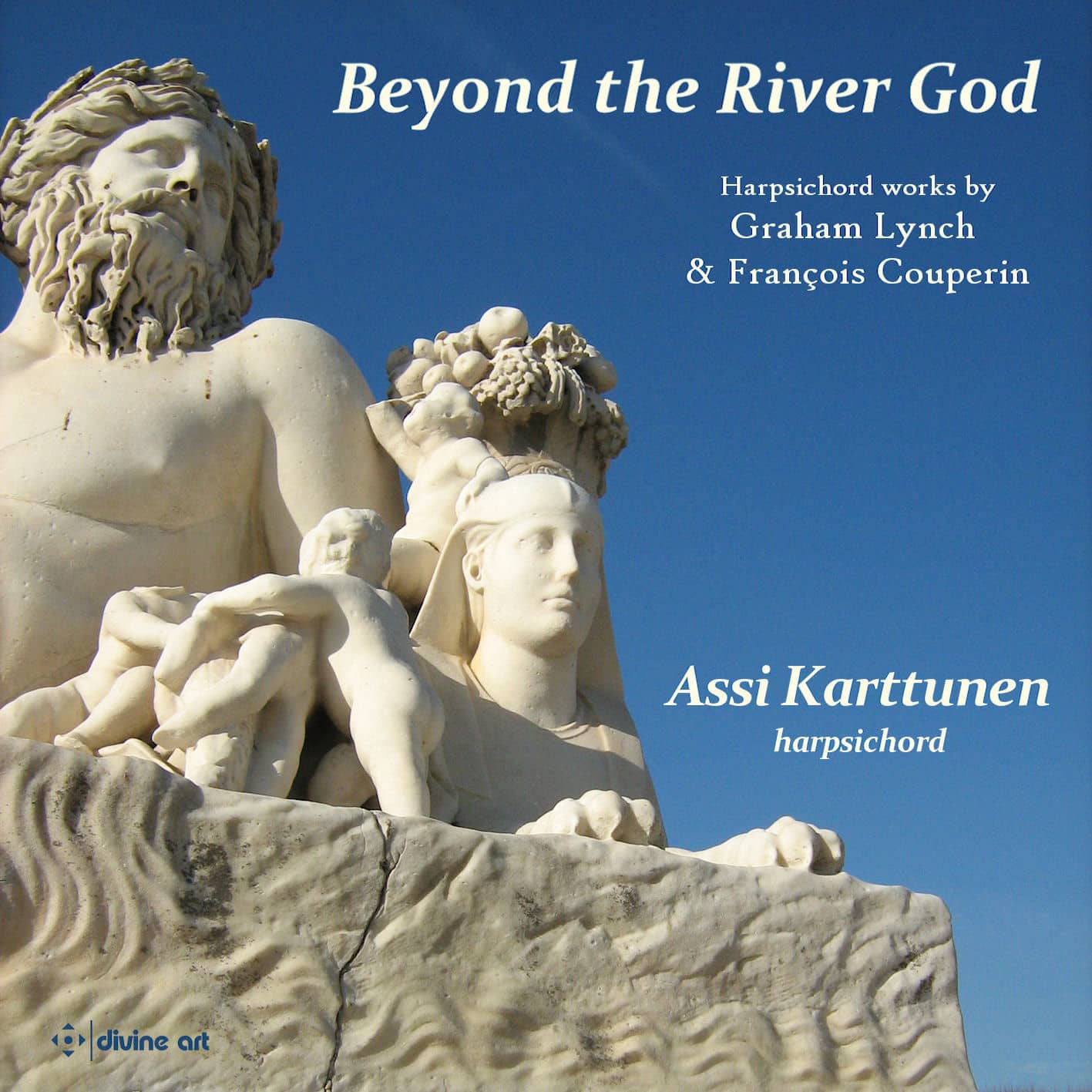
  • Beyond the River God: Music for Harpsichord

    Beyond the River God: Music for Harpsichord

    A selection of works by the greatest harpsichord composer of all — François Couperin, and from contemporary British composer Graham Lynch, who is a very worthy successor with music that is expressive, descriptive, deep and exceptionally rich, showing that the harpsichord is capable of real expression.

    The Lynch pieces are receiving their first recordings. Established virtuoso Assi Karttunen is from Finland and this is her first album for Divine Art, and a showcase for her amazing talent at the keyboard.