Catalogue Connection: 25122

  • The Consort – Colin Booth – 25122

    Despite the CD’s title, it is not dominated by Bach and Handel’s early music. Bach might perhaps have acknowledged his origins as ‘Thuringian’, but the epithet refers to the instrument used for this recording. As the booklet explains, this CD is a ‘portrait’ of a particular instrument: a recent copy by David Evans of the German harpsichord lodged in the Bachhaus at Eisenach.

    We have here the opposite of what often happens with a recording of period keyboard music, where the player chooses the repertoire and then seeks out an instrument which works best for that music. Here, the player has chosen music to suit the instrument, offering a fascinating selection of mainly unfamiliar pieces by twelve composers. All are worth hearing, and were chosen to represent the kind of music which the two great German geniuses grew up with, here played on an instrument with a similar claim to our attention.

    The original Eisenach harpsichord has been a focus of interest only in recent years, as modern makers and players have sought out harpsichords linked in some way with J S Bach. It is a rare survival, but may represent a style of building which was once common: German harpsichords differed in character according to their region, and few have survived.

    The harpsichord’s musical design echoes that of surviving instruments of a much earlier date. A double soundboard results in a tone, when using one of the two sets of strings, quite like that of a Flemish Muselar (a large virginals, popular in the Low Countries a century earlier, in which the strings were plucked close to their centre point, like the one in the painting on the cover of the CD booklet). While powerful and direct, it is surprisingly melodic, although it might be tiring in the wrong hands. It was the copy which inspired the player in this case, and it was presumably chosen for its reliability of action, although the original was restored to playing condition in 1975.

    The sound of this instrument is unusual and attractive, and Charlston remarks that both Bach and Handel may have known instruments like this in their younger days, but the question must remain as to what this particular one was designed for. Charlston is one of England’s finest continue players, who knows that in 18 lh -century Germany, even more than elsewhere, continue was the core of harpsichord training and performance. Solo playing was a relatively minor activity, contrary to today’s recitals, derived from the pianistic tradition.

    Certain characteristics of the Bachhaus harpsichord suggest that it was not designed with solo performance in mind. It was built to be loud, rather than intimate and expressive. It was given a plain, unadorned finish, and the registers were movable only by old-fashioned projections through the side of the case. The keyboard is a minimal four octaves and one note, BB – c’”. Above all, it has what modern makers only now tend to include: a transposing keyboard, covering three semitones. It may well have been built expressly for ensemble use. The various pitches used by wind instruments and organs were irrelevant to solo music, but a transposer would have been invaluable if the harpsichord was used, for example, in church.

    How was the original instrument’s transposer used, though? The present copy employs the central keyboard position, with a pitch of A=440, but it is more likely that it was the other two positions, for a low pitch around 415, and the high pitch two semitones above this, for which it was designed.

    None of this invalidates the recording. We want to hear what this harpsichord sounds like, and the solo repertoire chosen does this very well. A nice balance has been struck between extrovert music (a Bach Toccata begins the CD, and Handel’s Harmonious Blacksmith Variations conclude it) and singing, sensitive pieces played on one register. By responding beautifully to the considerable variety of styles, Charlston illuminates the instrument as well as one could wish.

    In general, he sounds completely at home, and especially so in more improvisatory material, where so many players fail. For me, highlights of his playing are the way he encourages us, when the music allows, to listen to the decay of the instrument’s tone, and the unforced spontaneity of the prelude to the Handel suite – the most successful playing of this awkward piece that I have heard. Several pieces not previously known to me include a stunning, extended Passacaglia lasting 11 minutes, by Johann Philipp Krieger, who died in 1725. More beautiful and inventive than the better-known long Giacona by his brother Johann, it was surely in Telemann’s mind when writing the final movement of his sixth Paris Quartet.

    The booklet, dominated by an extended essay by Charlston on the music and its composers, is packed with information of interest to the specialist listener – down to a list of the several tuning systems used during the recording. Anyone seeking insight into the dating of the Bachhaus harpsichord (given as c. 1715) and the reason for it being in the Bachhaus museum, will, however, be’ disappointed. Perhaps it is unfair to voice slight complaints about the use of photographs: That of the Evans copy shows it finished in a manner quite different from the original – rather a pity – while the player is photographed sitting at yet another kind of harpsichord.

    Nevertheless, and more importantly, we have here an innovative recording, exploring mainly unfamiliar music, on a type of harpsichord which is poorly understood today – one which, as Charlston points out, is very far from what our ears are used to in performance of German keyboard music. While one may ache to hear the original, the distinctive sound of the copy is clear. We may hope, in time, to hear the effect of the instrument when used in ensemble. As for the performer, one of the most satisfying features of the CD is that the restricted specifications of the instrument – one keyboard and two registers – allow us to hear a fine player depending on his own resources, and doing so with obvious enjoyment.
  • Fanfare – Bertil van Boer – 25122

    The purpose of this disc is to show the wide variety of predecessors of Johann Sebastian Bach from his home region of Thuringia. The impetus comes from a reconstruction of a 1715 harpsichord built locally, and therefore the notion of the sound of such an instrument would make an interesting touch. As usual, this is a mixed bag of keyboard music that begins with Bach and ends with his colleague George Frederic Handel, though it is true that the latter can hardly be called Thuringian in the strictest sense of the term. The Bach works, of course, have been recorded before and exist in numerous versions both for organ and harpsichord, but some of the other composers on the disc may be less well known (Handel, naturally, being the exception).

    The opening Toccata and Fugue in E Minor, BWV 914, is a particularly strange work, with the opening movement having some odd modulations and a quirky tendency to switch modes at unexpected moments. The Fugue is particularly gnarly, especially on the harpsichord where the registration requires an absolute touch to get right. The two other Bach works, the Prelude in A Major, BWV 896, and the G-Minor Fantasia, BWV 917, do not rise to the heights of the Toccata and Fugue, the latter being almost like an exercise in counterpoint than a true fantasia and the former having a bell-like dance melody above a meandering bass line that ends almost as quickly as it begins. The earliest work on the disc is a capriccio by Tarquinio Merula (1594-1665) that is based upon an ascending scale of semitones arranged in contrapuntal fashion. Here the voices sort of trip over one another in their entrances resulting in the occasional tortuously close harmony.

    Most of the remaining works are from the era immediately preceding Bach, including a work possibly by his own relative, Johann Christoph (1642-1703). This Prelude and Fugue, once attrib­uted to J. S. Bach himself (BWV Anh. 177), is complex enough to have been his composition, and it is uncertain which of several Johann Christophs could have written it. The intricate inner lines of the prelude may indicate a later date of composition, and the deliberate fugue that has a descending chromatic line is cautious enough to have been an earlier, more conservative work, so it is anyone’s guess who actually wrote it. Johann Pachelbel, of course, needs no further introduction, given that his execrable canon has become ubiquitous, but here he is credited with a Fugue in C Major that is quite livelier than some of his other contrapuntal works. It practically spins off the disc, and the sequencing is particularly effective; too bad that it is so short, barely a couple of minutes in length.

    His colleague at the court of Saxon-Weissenfels, Johann Krieger, was a sort of Mr. Music of the region, making it a habit of performing local composers in his concerts. But he was by no means a slouch when it came to his own works, especially in the realm of the cantata. His giant Passacaglia in D Minor is a keyboard tour de force, beginning with simple chords and expanding out until the theme unravels in a series of virtuoso flourishes before falling back into the homophonic opening theme, ending as simply as it began. His other work is a set of variations on a chorale tune, which demo­strates a flexible and inventive improvisatory style that offers some rather strange chromatic harmony at points. The tombeau for King Carl XI of Sweden by Christian Ritter (1645-1717) is a poignant lament, while the short prelude by Louis Marchand (1669-1732) might have little connection, save that it appears in one of the manuscript books from which these selections have been for the most part drawn. It is a rather commonplace work, more German than French but certainly nothing that might distinguish itself. The Johann Fischer (1656-1746) sample is drawn from one of his keyboard suites, and while the Prelude is suitable improvisatory with antiphonal effects of the instrument, the Chaconne is quite unmistakably French, sounding for all the world like it could have been taken from one of Francois Couperin’s Ordres.

    The entire disc ends with the oft-recorded E-Major Suite by Handel that ends with his theme and variations, often titled “The Harmonious Blacksmith.” The mood for this suite changes considerably. Gone is the contrapuntal complexity, replaced with a more melodious set of movements. To be sure, the opening Prelude still has the same imitative sequences, but these seem to appear without complexity. In the Courante, a lighter registration makes it feel more dance-like, and of course then is a bit more depth to the Allemande. The final variations are done in full-voice style, creating a fit ting ending to a most enjoyable disc.

    The playing by harpsichordist Terence Charlston is adept at finding just the right tempos for this program. He also has some lovely registrations (all within the compass of his reconstructed instrument, of course), and I like his sense of phrasing in which the counterpoint is clear and unhurried and the dances unfold without haste or undue rhythmic distortion. His performance provides a bit over an hour of fine entertainment of the sort that one might believe would appeal to Bach and his extended musical family. This is one disc that would be a delight to have, unpretentious and well performed.

  • MusicWeb – John France – 25122

    This new CD of Baroque harpsichord music gives an extremely pleasant and satisfying exploration of works written by Bach and Handel, as well as a good number of lesser-known contemporaries, dating from the late seventeenth and early eighteenth century. It is played by Terence Charlston on a reconstruction of a surviving German instrument of that period.

    Some of these other composers are relatively well-known, such as Johann Pachelbel and Friedrich Wilhelm Zachow. This latter was the teacher of Handel. Most are names only – except to specialists and enthusiasts of that period: I have never heard of Christian Ritter, Tarquinio Merula or Johann Philipp Krieger.

    Personally, the only works that I previously knew on this CD are the Suite which includes the famous ‘Harmonious Blacksmith’ Air and Variations by Handel and the three Bach numbers. One or two other pieces sound familiar. The remaining programme comprises a wide variety of typically Baroque forms including a toccata, preludes, fugues, a fantasia, a dance, a capriccio, a chorale, an allemande and a passacaglia. Each is typical of this rich keyboard repertoire and most will be commonplace forms to listeners acquainted with Baroque music.

    The liner-notes are a model of their kind. After a considerable essay on the ‘Finding of a Repertoire for the Instrument’ in which Terence Charlston examines the potential for creating a recital of music that would include works of the two great masters of the period as well as music that they would have heard during their formative years. He makes a case for using the ‘contemporary’ Thuringian harpsichord for this programme. This is followed by a long detailed examination of the composers presented and their music. The next essay is a comprehensive study of the German harpsichord of that period and its manufacture. Finally a note about the actual instrument used in this recording: this is a single manual harpsichord made by David Evans of Henley on Thames and completed in 2010. It is a ‘close copy’ of an anonymous Thuringian or Saxon harpsichord made c.1715 and presently housed in a museum in Eisenbach in Germany. A weblink is given to Charlston’s website which gives full specification of the instrument, details of the music editions used to assemble the repertoire as well as a bibliography. There are short notes about Terence Charlston and the instrument maker.

    I would strongly advise against listening to his CD end to end. For my part, I find that relentless harpsichord tone for 70 minutes is a wee bit too much. I approached this disc by first listening to the ‘Harmonious Variations’, followed the Bach pieces and then picked off works here and there, referring to the notes. There is always a danger that a fugue slips into a chorale prelude and before one knows where one is the performer is halfway into a passacaglia.

    The playing on this CD is stunning. The sound is perfect: revealing every detail of the music and gradation and tone of the instrument’s character. A great introduction to the period.

  • Harpsichord & Fortepiano – John Collins – 25122

    This CD offers a very well-chosen selection of 14 pieces from the late 17 th and early 18 th century, associated with the early years of Bach and Handel – some of the pieces may well have been studied by these illustrious names in their formative years – as well as pieces they themselves composed. Some of the composers will be familiar, others far less so, with nine different genres featured on the CD ranging from prelude, fantasia, fugue, toccata, suite to chorale variations and a tombeau. All are taken from sources compiled by members of Bach’s circle, primarily the Gerber, Walther, Andreas Bach and Möller MSS, or within the geographic area such as the Mylau MS. All are played on a fascinating instrument, a reconstruction by David Evans of the surprisingly little-known single manual instrument now in the Bachhaus, Eisenach – an example of local building that would probably have been known to both Bach and Handel and a most important resource with which to explore the native music of the time, possessing two 8ft stops, pitch of A=440, and tuned according to either Temperament Ordinaire (Bavington) with, in some cases, lowered D#, A# C and F, or Hamburg temperament (Drake).

    The opening piece is the Toccata in E minor by J.S.Bach, in which a three-section prelude including a rhapsodic final section, leads to a fugue with a typically driving semiquaver subject comprising triads and diminished seventh intervals, played here with verve and panache. This is followed by the two- movement Suite no. 8 by Johann Caspar Ferdinand Fischer, a popular piece found in several MSS including John Blow’s Elizabeth Edgeworth’s keyboard Book, as well as in Fischer’s published collection “Les pièces de clavecin” of 1696 (renamed Musicalisches Blumenbüschlein in 1698). The opening Prelude is in three sections, a central section of massive chords marked Harpeggiando framed by toccata-like movements, Terence Charlston rising ably to the formidable challenges posed with consummate digital dexterity, whilst the following chaconne is based on the descending major tetrachord; both movements may contain hints of numerical symbolism, and other “mysteries” in the chaconne’s central section in the minor. Terence Charlston offers some moments of neatly applied rhythmic inequality in this French style piece and captures the playfulness and wit of the major sections as well as the more introspectively serious moments of the central section. The French style was also of great interest to the young Bach, and we hear next the Prelude to the first of two suites published by Louis Marchand in 1702, although it is carefully notated, Terence Charlston offers a flexible yet not over-free performance.

    Numerical symbolism may also have been behind the next piece, Johann Philipp Krieger’s Passacaglia in D minor , the longest and most complex played on this recording, starting slowly and working up to cascades of small-value notes in over 200 3/1 bars. The unfolding variations on the harmonic pattern flow almost effortlessly from Terence Charlston’s fingers in this exciting work, and we scarcely realise that over 10 minutes has elapsed. The fast repeated notes in the treble throughout one variation, runs in thirds and the two variations with very rapid passages in the bass are negotiated with careful phrasing, and the explosion of chords marked arpeggio in the penultimate statement bring the work to a most satisfying conclusion – what a pity that only three pieces by this supremely gifted composer seem to have survived. A short Fantasia in G minor by J.S.Bach opens with a flourish and then settles into a stately there-voice piece built on two contrasting motifs. The chorale variations on In dich habe ich gehoffet Herr by the younger Johann Krieger (Handel is known to have used his published collections as teaching pieces in England) are excellent examples of the strophic setting of a hymn playable with or without pedals, popular with the central and South German composers, in this case the melody is heard in the soprano in the outer variations and in the bass in the central variation. The following Allemande in C minor by Christian Ritter was subtitled in descessum Caroli xi Regis Sveciae, and is an example of a tombeau or memorial piece, here given an eloquently moving performance which captures the grief at the death of the composer’s patron.

    A prelude and fugue in Eb attributed to Johann Christoph Bach is given a robust performance with some very neat arpeggiation at the close of the free prelude, and the chromatic nature of the fugue subject also sounds very interesting in the chosen tuning. Two pieces from the Mylau Tablaturbuch (which does lack any known link to Bach or Handel) are heard next, including a short fugue in C with a semiquaver subject attributed to Pachelbel on stylistic grounds, followed by a Capriccio Cromatico by Tarquinio Merula, an intense piece, the subject of which rises through a ninth by semitones.

    A short prelude in A , by J.S.Bach, which has an insistently dotted upper part over equal quavers, is followed by a set of four variations on Nun komm der Heiden Heiland , one of three sets on this hymn by Handel’s teacher in Halle, Friedrich Zachow, the chorale being heard first in the treble, then with semiquaver figuration in the treble, chords in treble over figuration in bass and finally in the bass before a recapitulation of the chorale to finish. After a short prelude by Johann Kuhnau, Bach’s predecessor at Leipzig, the first movement of Partie V from his 1689 publication “Neue Clavierübung, erster Theil”, here played using the buff stop to charming effect, the final work on the CD is the well-known suite in E by Handel, comprising a solidly Germanic prelude, an allemande, a courante, with the concluding Air known as the Harmonious Blacksmith and its increasingly brilliant variations here given an exciting ringing performance of controlled virtuosity.

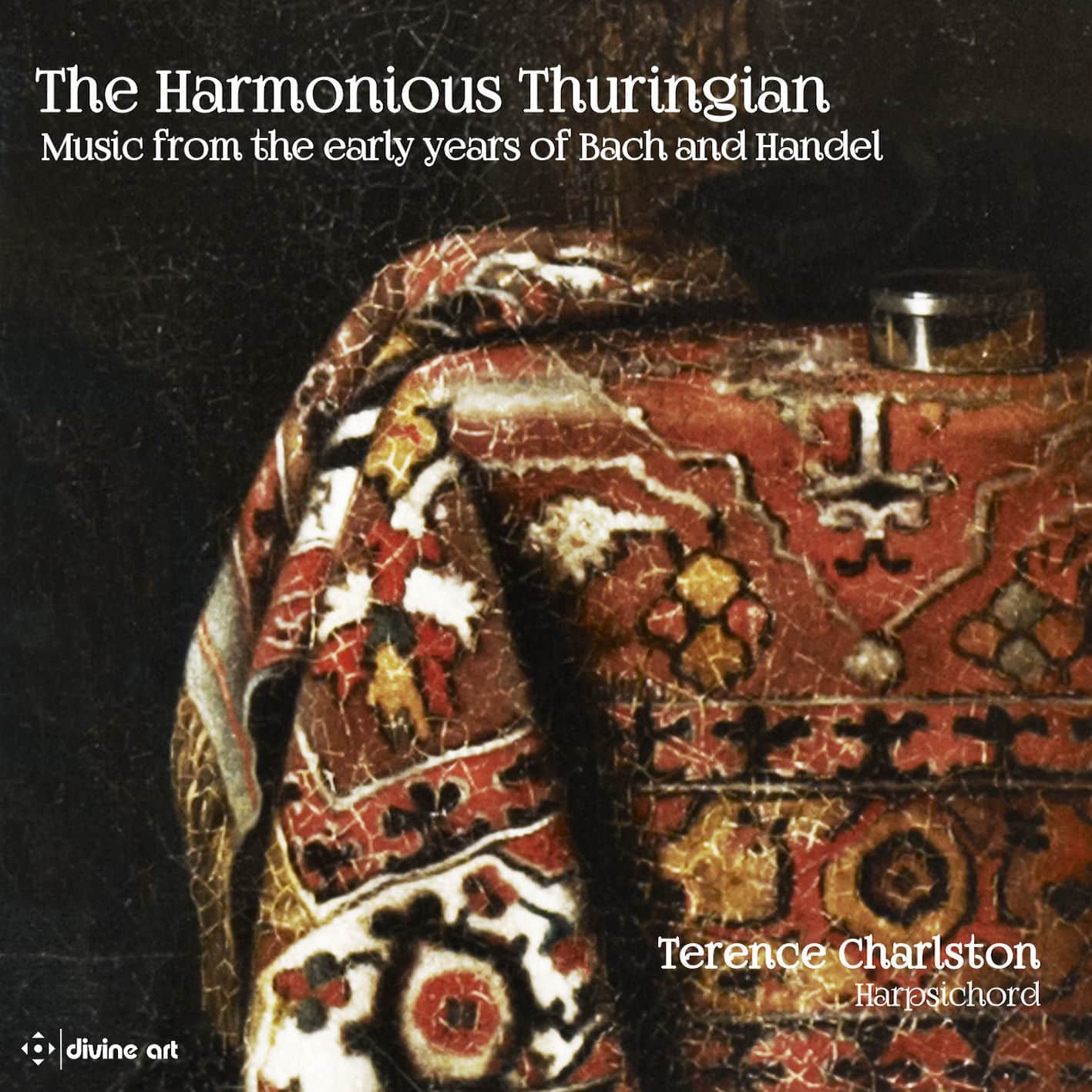
    The booklet provides a comprehensive discussion of how the pieces for the CD were selected and an overview of the sources, the composers and the music, with useful footnotes on source locations, a discussion of German harpsichords of the Baroque period and of the original instrument, design and qualities of this modern reconstruction by David Evans, and the tunings used for specific tracks. There is also a biography of this most accomplished performer and of the instrument maker. The front cover features a greatly enlarged detail of a painting of a Dutch Interior, either by or after Caspar Netscher, which is reproduced in full on the back cover. The standard of playing throughout is of the highest quality with some tastefully added ornamentation and suitably varied articulation to add character to the pieces. This CD is highly recommended, not only because of the interesting selection of pieces and the exceptionally high performance standard but also because of the fascinating and successful matching of the repertoire with the instrument enabling us to perhaps hear the pieces at a far closer remove than on the later German instruments. Terence Charlston is to be commended for his attention to historical detail in both his scrupulous research into performance practice and to his ongoing quest to play the music on instrument which is as close as possible to what the composers themselves may well have known.

  • The Classical Reviewer – Bruce Reader – 25122

    Thuringia is a federal state of Germany set right at the heart of Germany with beautiful countryside and cities and a great history and culture. It is an area with strong links to Goethe, Schiller, Liszt, Wagner, Gropius and Feininger as well as Johann Sebastian Bach (1685-1750) who was born in Eisenach. Saxony is a federal state of Germany, bordering Thuringia and also having a great natural beauty, a rich historical and cultural landscape and particularly linked to George Frideric Handel (1685-1759) who was born in Halle.

    Combine music from the early years of these two composers with music they may have heard in their youth; add a copy, by David Evans, of a lovely old Thuringian harpsichord dating from c. 1715 and you have the basis for a very interesting recital.

    This is exactly what harpsichordist, Terence Charlston has done on a new release from Divine Art Recordings entitled The Harmonious Thuringian .

    David Evans’ instrument is a single manual harpsichord, a 2010 copy of an anonymous Thuringian harpsichord c. 1715 in the Eisenach Bachhaus, Eisenach, Germany . This new CD gives full details of compass, pitch and temperament of this fine instrument.

    Terence Charlston is an early keyboard player, chamber musician, choral and orchestral director, teacher and academic researcher. As a harpsichord and organ soloist he has toured worldwide. His repertoire spans music from the 16th century to the present day, reflecting an interest in keyboard music of all types and styles.

    He was a member of London Baroque from 1995 until 2007 and is a member of the ensemble, Florilegium as well as being a member of The Society of Strange and Ancient Instruments.

    Charlston has performed on a large number of recordings playing harpsichord, organ, virginals, clavichord and fortepiano. He founded the Department of Historical Performance at the Royal Academy of Music in 1995 and in September 2007 he was invited to join the staff of the Royal College of Music, London as professor of harpsichord. He is International Visiting Tutor at the Royal Northern College of Music in Manchester.

    Terence Charlston opens this new recording with Johann Sebastian Bach’s Toccata in E minor, BWV 914 (c. 1706-1710) written around the time he would have been in either Arnstadt, Mühlhausen or Weimar, all Thuringian towns. Charlston brings a beautifully phrased flow to the opening of Toccata followed by some finely structured passages in the second half. In the Fugue he pushes forward with the musical lines very finely drawn.

    We move from Bach to a contemporary, Johann Caspar Ferdinand Fischer (1656-1746) sometime Kapellmeister to Ludwig Wilhelm of Baden and represented here by his Suite VIII in G major. The Prelude has some beautifully florid passages with exceptionally fine playing from Charlston and a lovely, finely detailed Chaconne with, again, this player allowing the lines to clearly flow.

    Louis Marchand (1669-1732) was a French Baroque organist, harpsichordist, and composer some of whose organ works were lauded as classics of the French organ school and may well have been heard by Bach and Handel. Deep resonant sounds are drawn from this fine harpsichord as his Prelude in D minor unfolds; a really attractive piece that moves around considerably as the theme is worked out.

    Johann Philipp Krieger (1649-1725) is represented here by his Passacaglia in D minor. Krieger was the elder brother of Johann Krieger featured below, both being musicians from a Nuremberg family. His Passacaglia opens with a series of slow chords before developing. Charlston is a sensitive musician who knows just how to extract beautiful sounds from such a piece. The piece has an affecting, simple rising and falling theme that is, nevertheless, developed in an attractive and skilful manner with some unusual, repeated phrases towards the end, as well as some beautifully florid passages.

    We return to the great Bach with his Fantasia in G minor, BWV 917. In many ways a quintessentially Bachian piece it receives a really fine performance with a great flow and clarity of line.

    With Johann Krieger’s (1651-1735) Ich dich hab ich gehoffet Herr the different musical lines could prove problematic in some hands but not here, where Charlston beautifully contrasts the two lines as the music is developed.

    Christian Ritter (1645/1650-1717) is believed to have been a pupil of Christoph Bernhard in Dresden. He is thought to have later been Kammerorganist in Halle in 1666 before, later, moving to Sweden. His Allemande in descessum Caroli xi Regis sveciae is very attractive, nicely developed, unfolding naturally for all its intricacies.

    Johann Christoph Bach (1642-1703) was the eldest son of Heinrich Bach, Johann Sebastian Bach’s great uncle. Born at Arnstadt, he was organist at Eisenach and later a member of the court chamber orchestra there. His Prelude and Fugue in E flat major, BWV Anh.177 has a Prelude as fine as any by J. S. Bach, with richly decorated passages finely played by Charlston. There follows a beautifully paced Fugue , revealing its fine invention as it is allowed to unfold.

    The fast Fugue in C minor that follows, full of attractive invention during its short duration, is an anonymous work attributed to Johann Pachelbel (1653-1706), another composer born in Nuremberg, brilliantly played by Charlston.

    The Italian composer, Tarquino Merula’s (1594/95-1665) organ works would have been in general circulation during the 17 th century. His Capriccio Cromatico Capriccio…perle semi tuoni opens on a rising scale which the left hand continues under a right hand motif. This is then developed with Charlston’s fine musical clarity and sensitivity.

    Johann Sebastian Bach is again represented by the Prelude from his Prelude and Fugue in A major, BWV 896 (c.1709). This tiny little piece receives an exquisite performance.

    Friedrich Wilhelm Zachow (1663-1712) was born in Halle, going on to be Kantor and organist of Halle’s Market Church, the church where Handel was baptised. He was Handel’s teacher in Halle. Charlston gives Zachow’s Nun komm, der Heiden Heiland a stature that perhaps wouldn’t normally emerge in the way he develops the ideas, thus adding a degree of depth.

    Johann Kuhnau (1660-1722) was, like Handel, a Saxony born composer. Charlston produces unusual timbres from his harpsichord in the Prelude, a really unusual piece where a single theme is simply worked out.

    Finally we come to George Frideric Handel (1685-1759) with his Suite No.5 in E minor, HWV 430 from his Eight Suites de Pieces HWV 426-433 (1720). Though Handel was in London by 1710, leaving Halle in 1703 and Hamburg in 1706 to travel to Italy, these works were surely assembled for publication from works written earlier.

    Charlston brings a fine breadth and spaciousness to the Prelude with a terrific display of virtuosity in the florid coda. There is a flowing Allemande with Charlston bringing out all the intricacies of this piece. The Courante has a lovely ebb and flow, with finely played little details before the Air and Variations, better known as ‘The Harmonious Blacksmith’. For all its popularity it is a fine piece and gets a terrific performance here.

    There are some extremely interesting and attractive works on this new disc from composers probably not heard of by most listeners. David Evans’ fine instrument adds much to Terence Charlston’s excellent performances. The CD booklet is up to Divine Art’s usual high standards with colour photographs, including one of the instrument, excellent notes by Terence Charlston together with details of the harpsichord including pitch and temperament.

  • Early Music Review – Noel O’Regan – 25122

    Terence Charlston’s latest project, part-funded by the Royal College of Music, is an estimable one, choosing music known to, or composed by, the young J.S. Bach and Handel and played on a copy by David Evans of an anonymous harpsichord of 1715 – the ‘Harmonious Thuringian’ of the CD’s title. As Charlston explains in his comprehensive liner notes, the instrument now in the Bachhaus in Eisenach is a rare survival of the type of local harpsichord once common in Thuringia and Saxony and so is an appropriate one on which to record this music. It is surprisingly resonant – the soundboard extends over the wrest-plank – and is very well recorded here.

    The music covers a wide and varied range, drawn from MS collections of the time. It includes a fine Prelude and Fugue by Johann Christoph Bach (by which of the composers of that name is not clear, as Charlston points out), pieces by Johann C. F. Fischer, both Krieger brothers (including an extended passacaglia by Johann Philipp), Johann Kuhnau (a Prelude which could have been a model for the C major Prelude in Book I of the WTC but also for the Prelude to Handel’s E major Suite which follows it on the recording), Louis Marchand, Tarquinio Merula’s fine Capriccio Cromatico , Christian Ritter and Friedrich W. Zachow. The recording ends with a shimmering and convincing performance of the Handel E major Suite. Charlston handles all this with confidence and style, giving the music time to breathe while keeping forward momentum. The association of a particular instrument with music appropriate to it gives this recording a real sense of purpose which is communicated in the playing. I enjoyed it very much.

  • American Record Guide – Michael Unger – 25122

    In this excellent record by English harpsichordist Terence Charlston, late 17th- and early 18th Century keyboard repertoire is interpreted on a newly-built instrument based on a surviving anonymous Thuringian harpsichord currently housed in the Eisenach Bach-haus. Expertly-written liner notes in English describe unique elements of the Thuringian harpsichord tradition; and the instrument itself records beautifully with a rich, resonant timbre. The program title, “The Harmonious Thuringian”, is a play on the most recognizable work, Handel’s Fifth Suite in E, which concludes with the ‘Harmonious Blacksmith’ variations.

    Listeners will also be familiar with Bach’s Toccata in E minor, one of his earlier surviving compositions. The remainder of the record includes shorter lesser-known works by German contemporaries and predecessors of the young Bach and Handel, such as Johann Caspar Ferdinand Fischer, Johann Krieger, Johann Kuhnau, and Friedrich Wilhelm Zachow. Given the cosmopolitan character of late 17th Century German keyboard culture, French music is also appropriately represented by Louis Marchand, and Italian music with Tarquinio Merula’s ‘Capriccio Cromatico’, which brilliantly demonstrates the character of unequal temperament.

    Charlston performs with elegance and refinement. His ‘Harmonious Blacksmith” projects a virtuosic command, while the other works largely demonstrate his lyricism, with graceful, well-paced phrasing. His ornamentation is sometimes uneven, most observable in the French-influenced ostinato works by Fischer and Krieger. While his approach to sonority is generally rich and spacious, I hoped for more in specific cadences, for example at the conclusion of the Fugue by JC Bach. But these are minor points; this is overall an excellent record with beautiful performances of an unusual collection of repertoire.

  • Musica Dei Donum – Johan van Veen – 25122

    Pieces from a composer’s formative years generally receive far less attention than those from his ‘maturity’. The reason may be that the latter are considered better than the former. Such a view is basically unhistorical: it is impossible to compare music from different periods in music history, by composers of different generations or even from different stages in a composer’s career. Obviously the likes of Bach and Handel were born with talents, but these had to develop. They had to hone their skills, just like every other human being. In the baroque period they did so by studying and playing the music which was circulating in their early years, or music from earlier stages in history which were collected in printed editions or – mostly – handwritten copies.

    Some of the composers who were among the major sources of inspiration of Johann Sebastian Bach are well-known, such as Georg Böhm and Dietrich Buxtehude. In comparison Friedrich Wilhelm Zachow, the only formal teacher of George Frideric Handel, is hardly known at all and badly represented on disc. He is part of the programme which Terence Charlston has put together in which he investigates which music was played and/or studied in the early years of both Bach and Handel. We know several sources which can be connected to Bach. Among them the Möller Manuscript and the Andreas Bach Book are especially well-known. Pieces from these collections have found their way into various recordings. They were put together by Johann Christoph, Johann Sebastian’s elder brother with whom he lived after the death of his parents.

    He is not the composer of the Prelude and fugue in E flat (BWV Anh 177) , but as the title refers to Eisenach it is likely that this is from the Johann Christoph who for most of his life worked in that town as organist and who has left a considerable number of motets and sacred concertos as well as organ works. The subject of the fugue includes some chromaticism.

    Charlston also turned to some lesser-known sources. The Royal Conservatoire in Brussels owns a source of English origin, known as the Wagener manuscript , which includes the Passacaglia in d minor by Johann Philipp Krieger. The anonymous Fugue in C , which has been attributed to Pachelbel on stylistic grounds, is from the so-called Mylau Tablature Book which includes pieces by composers from across Germany. In his liner-notes he mentions several other important sources from Central Germany which he has not used but give much information about the kind of repertoire circulating among keyboard players and composers.

    The nice thing about this disc is that Charlston has mostly included pieces which don’t figure on every disc with music from the early stages of Bach’s career. It makes sense that the programme opens with one of the toccatas by Bach which date from that time and which reflect the influence of the North German organ school. Louis Marchand’s Prélude in d minor refers to the French influence in Bach’s keyboard oeuvre. Merula represents the Italian style, and considering the year of his death it is notable that the Capriccio cromatico has been found in the Mylau Tablature Book . The copy in this source is incomplete; a complete version has been found in another German source of the same period.

    Johann Caspar Ferdinand Fischer is another composer who is little-known but clearly inspired Bach. The latter composed his Wohltemperirtes Clavier under the impression of Fischer’s Ariadne Musica , a collection of preludes and fugues in all the keys. Fischer was one of those composers who composed orchestral music in the French style. The Suite VIII in G is from the Musicalisches Blumen-Büschlein of 1696 and was included in the Andreas Bach Book . It comprises two movements: the prelude includes a number of chords up to seven notes, which are required to be arpeggiated. This piece is reminiscent of the prélude non mesuré of the French harpsichord school but ends with a fugal section which refers to the North German organ school. The second movement is a chaconne which – according to the Dutch organist Piet Kee – is based on number symbolism. Charlston includes a useful summary of Kee’s views in his liner-notes. Fischer’s harpsichord works reflect his attempts to mix German and French elements. Inspiration of French music also comes to the fore in the Allemande in descessum Caroli xi Regis Sveciae by Christian Ritter. It is a tombeau for King Charles XI of Sweden who died in 1697. From 1688 to 1699 Ritter worked at the court in Stockholm.

    The Kriegers were highly respected figures in German music life. Johann Philipp Krieger has become mainly known for his sacred music; his chamber music is also sometimes played. Unfortunately only a handful of keyboard works has survived; one of them is the monumental Passacaglia in d minor (here taking 11 minutes) whose bass pattern – a sequence of six descending notes – appears 43 times. There are some similarities with Handel in that Krieger also went to Italy to expand his horizon. There is an explicit connection between Handel and Krieger’s younger brother Johann. He published two collections of keyboard music and when Handel went to London a copy of the Anmuthige Clavier-Übung of 1698 was in his baggage. On several occasions he made use of musical material from Krieger’s works in his own compositions.

    Handel himself is represented with his best-known harpsichord suite which closes with the so-called ‘Harmonious Blacksmith’ variations which clearly inspired the title of this disc. It was part of a collection of eight suites published in 1720, but exists in earlier versions which may date from Handel’s time in Halle. It is a little disappointing that Charlston plays the version of 1720 rather than one of the earlier versions, especially as these are hardly known. Such a version would also better fit the character of the present programme.

    It is nice that one piece by Zachow is included. I would have liked more of them, especially one of the free works as his chorale arrangements are the better-known part of his oeuvre. A more thorough investigation of his output is long overdue.

    There is one particular aspect which makes this disc even more interesting. Charlston plays the copy of an anonymous Thuringian harpsichord from around 1715, made by David Evans. The original is preserved in the Bachhaus in Eisenach and was restored in 1975. It is strung in iron and brass and has one manual. “Such an instrument would have been played at home and in church and it is very likely that Bach and Handel’s first experience of plucked keyboards was on an instrument of this type rather than the later, more sophisticated instruments they came to know in their subsequent careers”, Charlston states in his liner-notes. The sound is more penetrating than that of later instruments and is quite close to that of 17th-century Italian instruments.

    This is a very interesting recording which combines a compelling programme with a rather unusual sound from an intriguing instrument and an inspired and incisive interpretation. Everyone interested in Bach and/or Handel and their world should investigate this disc. The harpsichord used here should give food for thought as far as the choice of keyboard instruments is concerned.

  • The Harmonious Thuringian (Harpsichord)

    The Harmonious Thuringian (Harpsichord)

    Thuringia is a region of Germany in which both Bach and Handel grew up. It was here that a distinctive form of harpsichord was built, very different to most others, with a wonderful tone. This was most likely the type of intrument with which the composers were familiar. One survives and has been replicated beautifully by David Evans, this being its recording debut. Possibly we are hearing these great baroque works more accurately presented than ever before.

    Leading early-music specialist Terence Charlston plays music by the relatively young J S Bach and G F Handel and several of their contemporaries from the late 17th and very early 18th centuries.

    Charlston plays another unique instrument in 16th and 17th century music: “Mersenne’s Clavichord” DDA 25134.