Catalogue Connection: 25124

  • The Whole Note – Alison Melville – 25124

    Putting out a CD of Handel’s recorder sonatas might seem a slightly strange choice these days, as numerous versions are already available; but then, if musicians want to record music they’ve known and long enjoyed, who’s to argue? Featuring three Australians active as performers and teachers for over three decades, this disc opens with a twist: an intimate version of the Music for the Royal Fireworks , arranged in the 18th century (like much of Handel’s opera music) for treble instrument and basso continuo. It’s a pleasure to hear this piece in miniature, and quite entertaining if you’re familiar with the heartily orchestrated original!

    The four recorder sonatas from Handel’s Opus 1, lovely pieces all, follow in their usual order, and there is much tasteful and cheery playing here. The perennial balance problems in the A minor sonata are solved by the removal of the bass viol from the mix, though that’s a bit of a pity because Handel’s bass lines are so robust, but that said, harpsichordist John O’Donnell whips through the feisty second movement with aplomb. The seasoned and well-knit ensemble playing of recorder player Ruth Wilkinson and her colleagues O’Donnell and gambist Miriam Morris is immediately evident, as is their affection for this music. The booklet notes are informative and the recorded sound is particularly beautiful; because of this, the session photo of the musicians with their tech team is a very nice touch.

  • MusicWeb – John France – 25124

    Readers of these pages may have noticed that I do not have a great enthusiasm for the sound of the recorder. It probably goes back to primary school days when someone bought me a plastic instrument and insisted I learnt to play ‘Greensleeves’. I never did get the hang of it. Fortunately I still enjoy that wonderful old English melody. A number of years later, I had to endure a church concert of music by a ‘recorder group’: it was horrendously out of tune. So it came as an agreeable surprise to discover that I enjoyed and appreciated every bar of this latest CD of recorder and continuo music from Divine Art.

    I am one of those listeners who enjoys Handel’s music, but I am not an out and out enthusiast. I have explored the keyboard music, the Concerti Grossi, a handful of oratorios and operas and a few of the songs. From an early age the ‘Musick’ for ‘Fireworks’ and ‘Water’ have been part of my musical landscape, be it in authentic versions or transcriptions by Hamilton Harty or Thomas Beecham. I have not previously come across this delightful contemporary (of Handel) arrangement of ‘The Musick for the Royal Fireworks’ made by John Walsh (1665/6-1735).

    The original composition was written in 1749 to mark the end of the War of Austrian Succession and the signing of the Treaty of Aix-La-Chapelle in 1748. It was first heard in London’s Green Park played by a wind and brass ensemble of some eccentricity. This was later scored by the composer for full orchestra. Walsh transcribed the music for ‘German Flute, Violin or Harpsichord’ however on this disc that wind instrument is replaced by the recorder in D, which has a similar range. The liner-notes are not clear as to whether Handel approved of the arrangement.

    The thing that struck me most about this version of the ‘Firework’ music was its clarity. Every detail and nuance of this hugely popular work is well-defined and consistently fresh and exploits the unique character of each instrument.

    I am equally enthusiastic about the four Sonatas for recorder and basso continuo presented on this disc. I have not consciously come across this music before. The Sonatas were published in ‘Solos for a German flute a Hoboy (q.v.) or Violin with a Thorough Bass for the Harpsichord or Bass Violin composed by Mr. Handel’ by John Walsh around 1732. Handel originally wrote them for ‘flauto’ which refers to a recorder. The Sonatas are presented on this disc with harpsichord and a sustaining bass instrument; however the viola da gamba part may have been optional. In Sonata No. 4 the string instrument is not used due to scholarship suggesting that the bass part was too complex for that instrument and demanded a harpsichord.

    The liner-notes point out that Handel ‘cashes in’ on some of his popular operatic and choral works. Self borrowings include music from Agrippina , Filli adorata and one of the Chandos anthems. The Sonata No.11 was later rewritten as an organ concerto and that is why I thought that I had heard this elsewhere.

    These Sonatas are full of interest. The slow movements can be heard as ‘songs (or arias) without words’, the dance movements are full of vitality and sheer fun. The liner notes suggest that they are like ‘mini-operas. It is a good comparison.

    The three performers are noted for their contribution to ‘the growth and popularity of early music’ in Australia for more than thirty years. All of them are teachers and lecturers at the University of Melbourne and have encouraged many students in early music performance.

    The liner-notes (anon) are excellent and give all the information required to enjoy and appreciate this music. The ‘period’ instruments used are of recent construction and were made in Australia.

    My only criticism of this CD is that it appears a wee bit short of music. At just shy of 49 minutes the listener will feel that a few more Sonatas could have filled up the empty space.

    This is an excellent disc and will be in demand for all Handel enthusiasts. It is stunningly played and beautifully presented.

  • The Consort – Elizabeth Rees – 25124

    This is an interesting and original CD of music performed by three fine Australian soloists. Its originality lies in the fact that the first 15 minutes of the CD feature a transcription of the Musick for the Royal Fireworks ‘set for the German Flute, Violin or harpsichord’ and published by John Walsh. It is not known whether Handel made or approved the transcription, nor is its date of publication known. Handel’s original scoring was for 24 oboes, 12 bassoons, 9 trumpets, 9 French horns, 3 pairs of timpani and side drums. It is therefore initially something of a shock to listen to such a scaled down arrangement as this.

    However, the effectiveness of the dance movements, such as the Bourree, Largo alia Siciliana and the Menuets, is immediately apparent in this chamber performance, and after listening to the whole work several times, I found that it formed a cogent and satisfactory whole. In the days before recordings, this intimate arrangement must have been greatly enjoyed, as both listeners and players recalled its exciting and somewhat deafening first performance together with fireworks in London’s Green Park.

    The rest of the CD is devoted to Handel’s Sonatas no.2 in G minor, no.4 in A minor, no.7 in C and no. 11 in F, which were published by John Walsh, perhaps in 1732, as ‘Solos for a German Flute, a hoboy or violin with a thorough bass for the harpsichord or bass violin composed by Mr Handel’. In the score, the solo line is designated ‘Flauto Solo’. This is likely to refer to the recorder, and Ruth Wilkinson performs them beautifully on the voice flute, an alto recorder in D. Ruth studied both recorder and viol at the Schola Cantorum Basiliensis with Hans-Martin Linde and Jodi Savall; she is well known as a performer and teacher in Australia and beyond.

    For all but Sonata no.4, Ruth is sensitively accompanied by viola da gamba as well as harpsichord. Gamba player Miriam Morris is also a fine teacher and performer who has pioneered viol teaching in schools. The viol is not employed in Sonata no.4 because its bass line is unusually detailed and rich, with Handel providing much keyboard figuration. It is suggested in the informative notes that, since Handel was a tutor to the daughter of his patron, King George II, these sonatas may have been used as exemplars for her figured bass practice.

    The harpsichord continuo is played by the musicologist and performer John O’Donnell: he is the first person to have performed Bach’s complete keyboard works (for both organ and harpsichord) in public since J S Bach himself- a formidable feat. On this CD the ensemble uses a ‘Bach’ tuning system researched by O’Donnell after his re-interpretation of the scroll found on the title page of the autograph of J S Bach’s Das wohltempierte Klavier.

    The sound and balance on this recording is excellent. I recommend this CD, particularly for the performers’ audacious skill in demonstrating how the Musick for the Royal Fireworks, which was the 18 th -century equivalent of a blockbuster, was brought into the living room and the small concert chamber.

  • Fanfare – Ronald E. Grames – 25124

    No, you have not read wrong, and I did not leave anything out of the headnote. This is a recording of the Music for the Royal Fireworks, arranged for German (transverse) flute and continuo by Handel’s London publisher, John Walsh. Here it is played by Australian recorder player Ruth Wilkinson and two University of Melbourne colleagues, bass viola da gamba player Miriam Morris and harpsichordist John O’Donnell. All have specialized in period performance of Baroque repertoire for many years and have trained many of Australia’s growing number of early music artists. This is, as far as I know, the only recording of this period arrangement, at least on a commercial release. While it is, in scale, as “wrong” as Hamilton Harty’s full symphonic treatment is in style, it is an appealing take on the original, emphasizing the dance origins of the music and providing a window on how music was marketed to the home audience in the mid-18th century. It appears in a collection which includes popular pieces such as Zadock the Priest, and marches from Atlanta, Joshua, Saul, and the Ode for St Cecilia’s Day. The arrangement’s biggest deficiency is found in the inability of the recorder and harpsichord to register anything like the dramatic dynamics of the original, especially noticeable in the Overture, but really an issue throughout. Once past that obvious limitation, though, the listener will find this to be a quite entertaining reading of the work, with nice lilt and unhurried pacing.

    The sonatas are a more mediocre commodity, though these fine performances would be welcome no matter how crowded the field. My favorite recordings of the four opus 1 recorder sonatas are those of Michala Petri and Keith Jarrett on RCA and those by Rachel Beckett et alia from Hyperion’s com­plete edition of all 20 accompanied solo sonatas for diverse instruments. Ruth Wilkinson is an excellent player, but does not have the astounding technical precision and nearly infallible intonation of Petri or Beckett. In fact, allegro movements are taken at a consistently slower tempo, and pitch, always a challenge on the recorder, frequently droops at the end of phrases. I do not want to make too much of this, as the performances excel in the projection of Handel’s energy and charm, and I thoroughly enjoyed hearing this recording. O’Donnell is an assertive and resourceful partner in this, as is Morris, who plays in all but the Fourth Sonata (for reasons explained in the notes), and whose bass viola da gamba adds a pleasing warmth and texture that modern cellos generally cannot.

    This recording uses the John Walsh edition of the sonatas as its source, with “reference” to the autograph manuscripts, but I am unsure how that might differ, if at all, from editions used by other artists who have recorded these works. The notes also reveal that O’Donnell is using a tuning suggested by his own interpretation of the looped drawings on the title page of Bach’s Well-Tempered Clavier that are a much debated topic among period performance scholars.

    The performers seem particularly proud of the Australian origins of their instruments, “histori­cally accurate instruments which have their own individual voices,” and well they should be, as they are attractively voiced and blend nicely. The recording itself, done in collaboration with the Australian Broadcasting Corporation, is fairly close, but warm and detailed, with sufficient air that it does not seem claustrophobic. This fine release is happily added to my collection of the Handel sonatas, and especially appreciated for the unusual Fireworks Music arrangement and the opportunity to become acquainted with the work of these fine antipodean musicians.
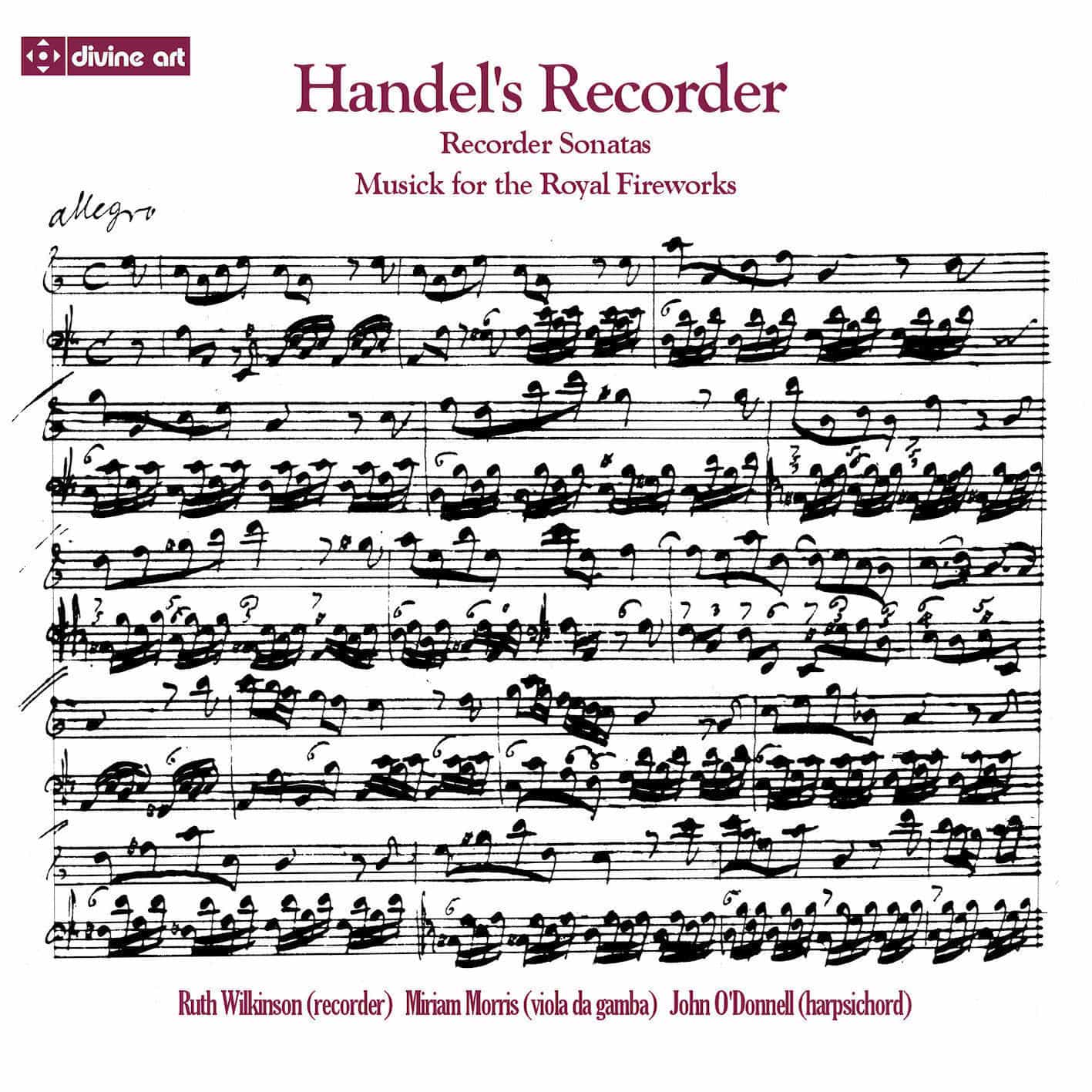
  • Fanfare – Bertil van Boer – 25124

    This disc comes from a period instrument group from Australia that I must confess not to have heard before. The program is in and of itself rather intriguing, as the trio’s main work is nothing less than George Frédéric Handel’s monumental music celebrating the end of the War of the Austrian Succession in 1749. (A side note: Handel was born Georg Friedrich Händel, but by the 1730s he had decided to use the French version of his name for his official correspondence and publications. He never used the often-seen “Frideric,” and only rarely the English “Frederick.”)

    On that occasion, as one will recall, the Treaty of Aix-la-Chapelle was celebrated in royal style, with a huge fireworks display and a gigantic orchestra. Of course, there were the usual incidents (such as the crush of 12,000 people all trying to fit into a smallish garden, rainy weather, and finally the apparent explosion of one of the skyrockets that set a pavilion alight). And that was just the first performance, for on May 15 of that year an even larger ensemble was moored out in the Thames River for a display, at which a near riot ensued on shore. Nonetheless, this is probably Handel’s most iconic work (although the Water Music might also make the same claim), and since its time has been ubiquitous as an accompaniment to various important pyrotechnical displays throughout the world (along with Tchaikovsky’s 1812 Overture ).

    At its premiere, it was of course an immediate hit, and Handel wasted no time in getting the “Fireworks Light” out for performance by chamber groups. In short order his publisher John Walsh issued a set of pieces arranged for traverse or violin and harpsichord, though Handel’s exact involvement in the transcription is unclear. In any case, it is presented here with a recorder substituting for the traverso that was one of the alternative instruments. Although one does miss the boisterous trumpets, horns, and drums, this rendition is a lot of fun. It sounds like the sort of mild Imperial music one might find on a BBC period show, solid and stiff upper lip but with an underlay of frivolity. Much of its reedy pomp depends upon the nicely nuanced performance of recorder player Ruth Wilkinson, who gives it just the right ornamentation and speed.

    Of course, this arrangement by itself is far too brief to carry an entire disc, and so it is coupled with four solo sonatas that Walsh also published about 1732 as for traverso or violin or oboe and continuo. The autograph simply states violin or flauto, which Wilkinson takes to mean recorder in its normal interpretation (and Handel or Walsh “corrected” some earlier flaws, according to the title page of this edition). The term “flauto” was probably a bit more generic, meaning either flute or recorder since Handel was not picky about such chamber instrumentation, and so the recording does not depart from his intentions. These four-movement sonatas have been relatively common in the performance repertory, and so this recording represents nothing particularly new. The performance itself, however, is quite clear and well phrased. Like in the arrangement, the ornamentation is tasteful and often discrete. In such rapid sequencing, such as the final movement of the A-Minor Sonata, she does the various runs and roulades with skill and precision. The continuo playing of her partners is also quite well matched. Harpsichordist John O’Donnell knows instinctively when to fade into the background and when to be more forceful. In some of the lighter movements the powerful gamba playing by Miriam Morris is done away with in favor of a thinner texture that allows for the recorder to dominate, but elsewhere, such as in the gentle walking bass line of the C-Major Sonata, her performance is as solid a foundation for the bass as one could wish for. The only glitches are the occasional hesitancy when Wilkinson changes registers. Though this gets glossed over, sometimes it cannot help but be exposed, a danger of performance on this instrument. Still, all in all this is a nice disc, and well worth acquiring for the Fireworks arrangement alone, giving one a glimpse into the manner in which the average well-to-do household of Georgian England admired Handel’s music.

  • The Chronicle – Jeremy Condliffe – 25124

    This album is pretty well what it implies: Handel, played on recorder.

    It’s noteworthy because it features three of Australia’s leading early-music specialists (it was recorded in collaboration with the Australian Broadcasting Corporation), playing instruments made to as closely resemble the ones of the time as possible, tuned as per in their day.

    The major work on the album is the Music for the Royal Fireworks in a chamber version, arranged for recorder and viola da gamba with harpsichord. Also featured are four recorder sonatas.

    Some people have a po-faced attitude to “classical” music (which began with Beethoven, according to a recent article in New Yorker magazine) and the sleeve notes make it clear that the famous composers, or at least their publishers, were as adept at separating the punters from their money as Simon Cowell is today. These recorder pieces are from a John Walsh edition from the 1740s of Handel’s music. It may or may not have been approved by the composer, but contained tunes with which its target audience would have been familiar.

    It’s not Christmassy per se, but early music creates an atmosphere that suits the festive season. It’s a pleasant album and the pieces convey mood well.

  • Windkanal – Heida Vissing – 25124

    “The Musick for the Royal Fireworks [and Other Works] set for the German Flute, Violin or Harpsichord” and “Solos for a German Flute a Hoboy or Violin with a Thorough Bass for the Harpsichord or Bass Violin compos’d by Mr. Handel” were published by John Walsh in 1732 and distributed as an autograph manuscript by Studio per Edizioni Scelte in Florence. The recording of this transcription of the ‘Feuerwerksmusik’ (Fireworks) employs a voice flute in D instead of the original traverse flute, Sonata Nr. 2, g-Moll, HWV 360, Sonata Nr. 4, a-Moll, HWV 362, Sonata Nr. 7, C-Dur, HWV 365 and Sonata Nr. 11, F-Dur, HWV 369 are heard in the original instrumentation for alto recorder and basso continuo.

    The strength and clarity of the performers Ruth Wilkinson (recorder), Miriam Morris (viola da gamba) and John O’Donnell (harpsichord) is unmistakeable, they are among the most important musicians in Australia’s Early Music scene and teach at the university of Melbourne. Aesthetic ornamentation in the slow movements and expressive interpretation make this CD a fine listening experience.

  • Handel’s Recorder

    Handel’s Recorder

    Three of Australia’s leading early-music specialists recorded this album in collaboration with Australian Broadcasting Corporation. It contains four of Handel’s famed recorder sonatas in the early John Walsh edition, in exemplary performances.

    The major and most unusual work on the album is the John Walsh edition from the 1740s of the Music for the Royal Fireworks in a chamber version, arranged here for recorder and viola da gamba with harpsichord continuo. It was one of many variations of the work which were popular before the full orchestral version became the ‘norm’ at a much later date. While of short duration this is a program that is complete and has full integrity as a concert program.