Catalogue Connection: 25125

  • The Classical Reviewer – Bruce Reader – 25125

    Phenomenal playing from Anthony Goldstone and Caroline Clemmow on the latest release from Divine Art in their Schubert series The Unauthorised Piano Duos. Anthony Goldstone and Caroline Clemmow continue to add to their impressive catalogue of recordings for Divine Art with the third volume in their series Franz Schubert: The Unauthorised Piano Duos . Anthony Goldstone is something of a Schubert specialist having recorded three volumes of Schubert Piano Masterworks for Divine Art.

    As a piano duo Anthony Goldstone and Caroline Clemmow have already recorded piano duo arrangements of Schubert’s Trout Quintet and Overture to Rosamunde (Volume 1) and Piano Trio in B flat major, D. 898 and Arpeggione Sonata (Volume 2) all containing many other fascinating and rewarding Schubert arrangements.

    This new release has just two works, Schubert’s Death and the Maiden Quartet arranged by Robert Franz (1815-1892) and the Unfinished Symphony which combines Anton Hüttenbrenner’s (1794-1868) transcription of the first two movements with Anthony Goldstone’s own transcription of Schubert’s sketches for the third movement and Friedrich Hermann’s (1828-1907) arrangement of the Entr’acte in B minor from Rosamunde acting as the finale.

    The Allegro of the String Quartet in D minor, ‘Death and the Maiden’, D.810 opens with a great assurance, this Duo bringing out all of the intensity and forward drive of the original. They reveal so much of Schubert’s wistfulness and passion whilst providing an accuracy that is quite frankly phenomenal. But there is much more. Their sense of poetry, contrasting Schubert’s many moods, brings so many rewards. Theirs is quite simply an intuitive partnership. There is a hauntingly withdrawn opening to the Andante con moto before it moves through some wonderful variations, quite mesmerising in these artists’ hands. They have a fine subtle rubato, beautifully controlled with limpid piano sounds, making this music seem so right for the piano. Indeed, one soon forgets that it was originally a quartet. It is wonderful how they slowly build the music in concentration and power. Later, there is an exquisitely delicate passage, beautifully done before the music builds again with both these fine pianists bringing a terrific concentration before the sad resigned coda.

    The Scherzo and Trio: Allegro molto has a lovely buoyancy and a Trio section where this duo hold a fine balance between charm and nostalgia. The duo’s fine, light and lithe touch opens the Finale: Presto – Prestissimo finale with playing of such energy, panache and drive. They follow every detail and nuance with spectacular intricacy bringing a terrific gallop to the music and weaving through some terrific passages of great strength and power. They bring a fine restraint in some passages moving quickly to a terrific coda. This is great Schubert.

    Despite its title Schubert’s Symphony in B minor, ‘Unfinished’, D.759 and D.797/1 was not the only symphony to be left incomplete. Indeed, Schubert was notorious for laying aside many works before completion.

    In the Allegro moderato of Anthony Goldstone and Caroline Clemmow’s piano duo performance of the symphony they bring a lovely restraint to the opening that contrasts so well with the stormier passages. There are many thoughtful, haunting, intensely searching moments. One soon finds oneself forgetting the orchestral clothes of the original; such is the power and poetry of this performance. There is an emotional pull in this movement that is often missed in many orchestral performances with the coda bringing a sense of emotional ambivalence. The Andante con moto has a directness of utterance in the opening theme before the second subject brings a more withdrawn reticence offset by passages of intense passion. Every turn of emotion is perfectly caught here, this duo picking up on so many of Schubert’s subtle little moments of melancholy. They imperceptibly ratchet up the drama each time the opening theme re-appears, again offset by the most exquisitely poetic moments. The Scherzo and Trio: Allegro – Poco meno mosso receives a lovely dance like swagger yet harmonically there seems to be an emotional cutting edge, something that this transcription and performance reveals. There are passages of restrained power brilliantly caught. For the Finale: Allegro this duo use, as in other ‘completions’, Schubert’s Entr’acte in B minor from Rosamunde giving the music a lighter air. – This duo brings out so many fine moments revealing this as a ‘movement’ with moments of great variety and power before a terrific coda.

    This is an impressive series from Britain’s premiere piano duo. The recorded sound from St. John the Baptist Church, Alkborough, North Lincolnshire, England is first rate. Anthony Goldstone provides the excellent booklet notes.
  • Fanfare – Radu A. Lelutiu – 25125

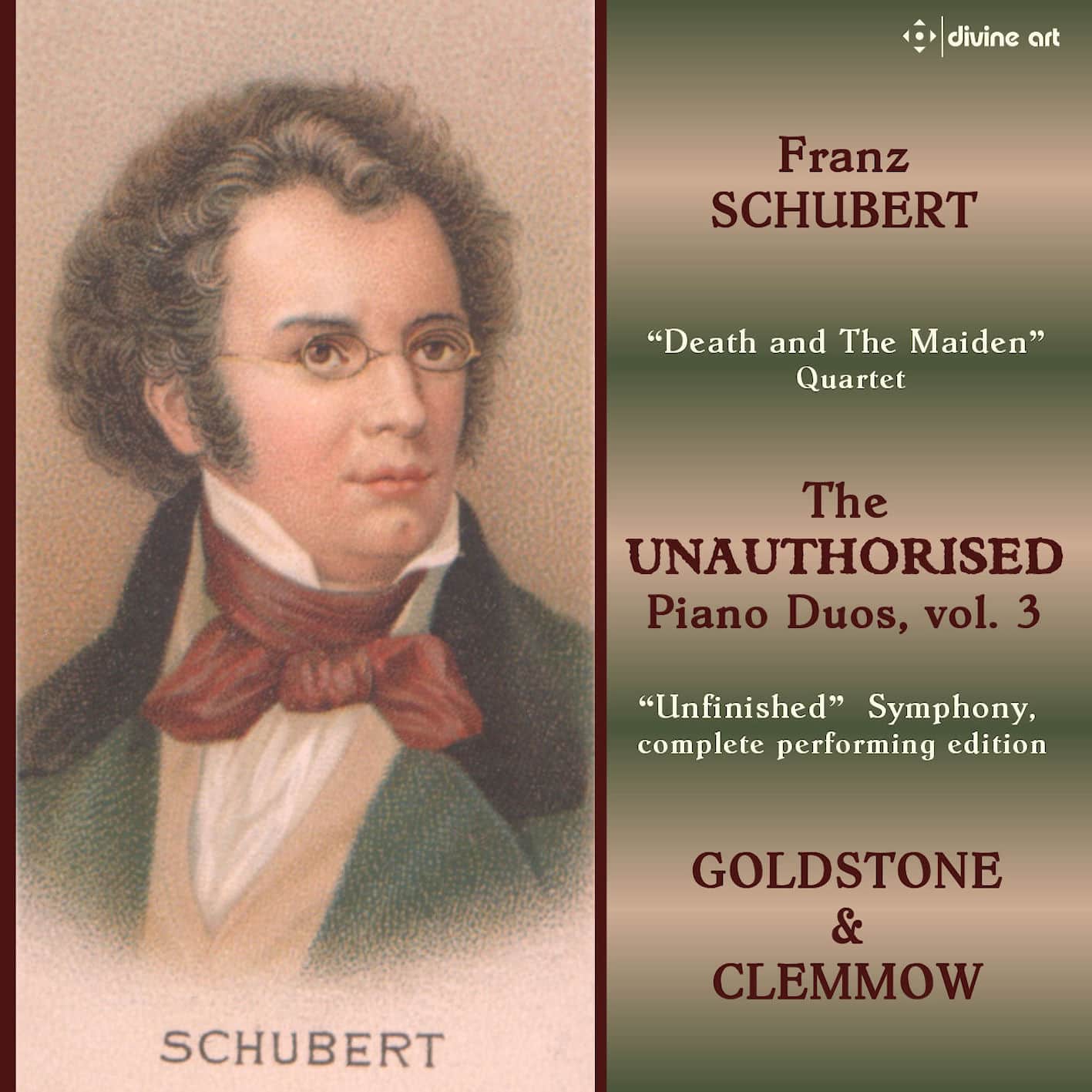
    This is a world premiere recording (titled The Unauthorised Piano Duos vol. 3) featuring arrangements for piano duet of two of Schubert’s most beloved masterpieces. The arranger of the “Death and the Maiden” is Robert Franz, a German organist, conductor, and composer whose work was apparently held in high esteem by none other than Liszt. The arranger of the “Unfinished” is Schubert’s friend Anselm Huttenbrenner, who maintained Schubert’s orchestral manuscript in trust until its first performance in 1865. Accompanying the canonical two movements of the “Unfinished” are a scherzo completed and transcribed by pianist Anthony Goldstone from Schubert’s sketches, and a finale, which consists of the entr’acte from the incidental music Schubert contributed to Helmina von Chezy’s play Rosamunde, Princess of Cyprus. The finale was arranged by Friedrich Hermann, a German composer who died in 1907, and is performed here with “minor modifications” by Goldstone.

    Now, the million dollar question: Is this album worth the asking price ($18.99 on the Arkivmusic web site)? Well, let me answer with a personal anecdote. I first listened to this recording in the apartment of Fanfare alumna Susan Kagan, whose affection for and understanding of this music has few, if any, peers. Naturally, I expected a stimulating conversation once all would be said and done. But, much to my disappointment, the verdict was in upon a quick review of the disc’s cover. “Why would anyone want to hear this?” Then, the “Death and the Maiden” began, and by the time the miraculous transition to the Allegro’s F-major theme was completed, the verdict was re­versed. “Oh, that Schubert!” Nothing else was said until some 35 minutes later.

    The bottom line is that if you love Schubert’s music, you ought to hear this, and I very much doubt that you will ask for a refund. It is true that the “Unfinished” does not really work as a piano transcription —the blame rests not with the arrangers’ efforts, but rather with the instrument’s inability to fully sustain Schubert’s soaring melodies, much less replicate the tonally diverse voice of Schubert’s orchestra. The “Death and the Maiden,” on the other hand, works wondrously on the piano, and Goldstone and his partner Caroline Clemmow deliver an impassioned, gripping performance that may occasionally make you forget that you are in fact hearing a transcription. What’s more, Schubert’s unique ability to move from darkness to light as if by a sleight of hand really hits home here. Oh, that Schubert!

    The sound is excellent, as are Goldstone’s informative notes. A most stimulating release that has my highest recommendation.

  • OzArts Review – Neville Cohn – 25125

    Schubert’s Death and the Maiden Quartet is one of the composer’s most loved and frequently heard works; it had its origins in Schubert’s lied of the same name. It is also a work of central significance in a famous play. But having over the years listened to too many indifferent arrangements of this and similar works in versions for piano duet, I was sceptical of this recent release.

    I’m happy to say though that my doubts rapidly evaporated as I listened to this recording; it’s a version of excellence which I recommend warmly.

    Its opening pages come across with immense authority. It makes for engrossing listening. The contrasts between lulling episodes and moments suggestive of stark terror are impeccably handled. I’d like to think that if Schubert himself had had the opportunity to listen to the Goldstone Duo, he’d have approved not only of the performance but of the very real skill invested in making this arrangement so approachable. Laurels, too, to the sound engineers who score high at every turn.

    In the second movement, the duo is in top form, allowing the music to speak for itself by avoiding any tendency to excessive “expression” which can so easily ruin the moment. It’s a fine foil for the finale which is informed by high musicianship. Throughout, discreet but effective pedalling and buoyancy of momentum make this a model of good taste.

    Whether or not Schubert felt that the two movements of his Unfinished Symphony were in and of themselves a complete statement and not needing the addition of other movements, will be haggled over interminably by music scholars.

    What is clear about this recording is the excellence of the playing not least the quality of the secondo accompaniment which is, as is the primo part, a model of good taste. It’s a delightful musical outcome, the players reaching for the stars. The second movement, too, is a model of good taste.

    Goldstone has transcribed the third movement from Schubert’s sketches. It’s beautifully done and fits the overall presentation like a glove. Some of Schubert’s incidental music for Rosamunde is drawn on for the finale. This is pleasant enough but, but for all the care lavished on it both and performance, it is not in the same league, substance-wise.

  • MusicWeb – John France – 25125

    Until very recently I have been repelled by arrangements and transcriptions. This applied to something like the ‘Rienzi’ Overture played on the concert organ through to the piano versions of Beethoven’s symphonies dished up by Franz Liszt. Ah well, age sometimes brings a more generous approach to matters that youth abhorred. There are three reasons why I have to a large extent changed my mind.

    Firstly, for many generations a full symphony orchestra or even string quartet were not available without the cultural capitals of Europe. The only way that music-lovers would get to hear some works was by way of piano arrangements and transcriptions. It was a market that composers and publishers of the day catered to. I judge it is better to hear a masterpiece in an arrangement than not to have heard it all.

    Secondly, I have come to be impressed by the ‘added value’ of some of these transcriptions. They can bring fresh life to what is often a hackneyed original. Schubert’s Unfinished was one of the very first symphonies that I heard, and I thought I knew it pretty well. Yet in the current piano duo version it is possible to hear nuances and details that have been submerged or blurred by repeated hearings.

    This brings me to the third point. What can be found here are effectively ‘new’ works that have to be approached with renewed attention to detail. Clearly, the listener will recognize the progress of the work and the exposition and development of the themes. However, the new media can be so unfamiliar that it is like encountering a novelty. I think it is the ‘freshness’ of the present recordings of Schubert that have impressed me most of all.

    The Death and the Maiden (Der Tod und das Mädchen) string quartet in D minor, No.14 was composed between 1824 and 1825. It was first performed on 29 January 1826. The title derives from the fact that the second movement of the quartet quotes part of the melody from Schubert’s eponymous song. Arguments have raged over the ‘programmatic’ nature or otherwise of this quartet. Is it supposed to be be meditation on ‘Fate and Death’? Other commentators have been impressed by the sheer skill that Schubert brought to the development of the musical material. It is ‘absolutely’ perfect and requires no underpinning ‘story’. The quartet has four movements: a gloomy ‘allegro’, followed by the more relaxed ‘andante con moto’ in the form of a theme with five variations. The scherzo has well-defined rhythms and the work concludes with a sonata-rondo movement of great power and speed. There is a direct quotation from the song ‘Erlkönig’ in the final pages.

    The quartet was transcribed by the composer Robert Franz for four hands in 1878 as part of the commemorations to mark the fiftieth anniversary of the composer’s death.

    The Unfinished is the popular title of what is Schubert’s Symphony No. 8 in B minor. Only the first two movements were completed, although sketches for the scherzo survive. In 1823 Schubert was made an honorary member of the Graz Musical Society. He composed the symphony for this society with a sense of obligation. The reason that Schubert did not complete it was most likely commercial. The composer needed money: this gift was unpaid.

    The first two movements were presented to Anselm Hüttenbrenner, the Society’s president. The work was not heard in the composer’s lifetime although he survived for another five years after completion of these two movements. The score languished at Hüttenbrenner’s home until it was unearthed by Johann von Herbeck in 1865. It was duly performed in December of that year.

    The work has been ‘completed’ on a number of occasions, including efforts by Felix Weingartner and Niels W. Gade.

    The ‘complete performing edition’ of the Symphony in B minor, “Unfinished” presented here is derived from a number of sources. The opening two movements were transcribed for piano duet by Anselm Hüttenbrenner (1794-1868). The Scherzo and trio were completed and transcribed by the present pianist, Anthony Goldstone. The Entr’acte from the ballet music Rosamunde used for the finale was originally transcribed by Friedrich Hermann (1828-1907) and was adapted by Goldstone.

    The liner-notes by Anthony Goldstone are indispensable reading for anyone who wishes to understand the background to these transcriptions.

    I have not heard the first two volumes (dda 25026 and dda25039) of the ‘Unauthorised Piano Duos’ which include the ‘Trout’ Quintet, the ‘Rosamunde’ Overture, the ‘Arpeggione’ Sonata and the Trio in B flat. Based on the sheer delight that this present recording offers, they will be essential listening.

    Anthony Goldstone and Caroline Clemmow (Goldstone and Clemmow) give a hugely attractive and competent rendition of these two popular works by Franz Schubert. However, it is the opportunity to hear these works in what to me is a new guise that makes this disc so rewarding. It banishes any residual aversion to transcriptions that I may still entertain.

  • Brattleboro Reformer – Frank Behrens – 25125

    Doctors of all sorts begin their studies with the structure of the human body, one subtopic of which is the skeletal system. Knowing the latter gives one a deeper appreciation of the human body and how it functions.

    Well, that is how I feel about piano redactions (or transcriptions, if you will) of orchestral works, in as much as they reveal the bone structure, so to speak, of the piece. Excellent examples of redactions are those played on many Divine Art CDs by Anthony Goldstone and Caroline Clemmow. I already have several such discs in my collection and I am delighted with their latest release, “Franz Schubert, The Authorized Piano Duos, vol. 3.” Here we have transcribed for one piano, four hands, the “‘Death and the Maiden’ Quartet” and the “complete performing edition” of “Symphony No. 8,” better known as the “Unfinished.”

    However, for reasons set out in the program notes, the latter has been “finished.” That is, Goldstone has created a third movement, while an older transcription by one Friedrich Hermann of a selection from Schubert’s “Rosamunde” is used for the fourth movement. Well, it does no harm and certainly adds to the interest of this recording.

    I always look forward to more from this excellent couple.

  • Amazon – Hexameron – 25125

    It has taken a whopping eight years for the third volume in this series to appear. Better late than never. Judging from the lack of reviews of the previous volumes, this series is woefully unknown. Goldstone and Clemmow are arguably the best piano duo active today. I have not yet heard a bad or mediocre performance by them. In this volume, two of Schubert’s greatest works are presented in attractive four-hand arrangements.

    For some of us, listening to a chamber masterwork like the “Death and the Maiden” quartet in a piano arrangement is a tall order. Whether for purist reasons or legitimate concerns that one loses the timbres, color, and interplay between instruments, some feel piano duet versions are a skeletal and less-than-full experience. I am not in this camp and think piano arrangements clarify harmonies and melodic lines. Goldstone argues for hearing the arrangement of the “Death and the Maiden” as if it were a four-hand piano sonata, which is persuasive. The arrangement by Robert Franz, a good composer in his own right, is surprisingly sonorous and convincing as a four-hand piano work. The first movement retains all its bold drama and motoric energy on the keyboard. But the greatest moments are heard in the poignant second movement, which is simply beautiful on the piano. Its plaintive theme is put through five variations of expressive contrast. I really don’t miss the strings here. I think the “ride of death” finale, a wild tarantella of Erlkonig character, is the most effective movement arranged for piano. Franz employs repeated notes, runs, and massive chords at climax points, which are surprisingly idiomatic and rich. In some ways, the texture sounds more voluminous, which may also be credited to Goldstone and Clemmow, who sound palpably animated in their performance.

    Schubert dedicated his Unfinished Symphony to the Graz Music Society, of whom Anselm Huttenbrenner was a high-ranking member. When he received Schubert’s manuscript of the two movements–plus the sketch of the third scherzo–Huttenbrenner kept it a secret for over 40 years, depriving the public of a great work. At some point during his possession of the manuscript, he arranged the symphony for piano duet. As Goldstone suggests, the arrangement is quite literal with little attempt to simplify the texture and accommodate four hands. This is especially noticeable in the development section of the first movement, which really rises to dramatic volumes of sound. By contrast, the slow movement is utterly delicate, serene, and sublime. Not content to present Huttenbrenner’s arrangement by itself, Goldstone “finishes” the symphony. He completes Schubert’s sketch of the boisterous scherzo by adding a sunny waltz-like accompaniment, and then fleshes out the trio. The result is convincingly Schubertian to me, full of charm and delight. What to do about the non-existent finale? Goldstone and Clemmow insert the Rosamunde “Entr’acte,” which makes sense because it’s in the same key and resembles the arresting seriousness of the opening movement.

    Bottom line: Possibly the best volume of this series, Schubert’s “Death and the Maiden” quartet and Unfinished Symphony are masterpieces worth hearing on the piano. It will take suppressing any purist tendencies to listen to them with an open mind, but I think Franz’s arrangement is particularly effective. Goldstone and Clemmow are at the height of their powers.

  • The Chronicle – Jeremy Condliffe – 25125

    There’s something strangely comforting about this CD. Although it’s billed as the premier recording of two pieces of Schubert’s music, it’s obviously mainly tried and tested old music brought up to date by Anthony Goldstone, who, with Caroline Clemmow, is one of the world’s leading pianists. (There are extensive and details sleeve notes by Goldstone and we don’t intend to wheel them out as if we’ve suddenly gained all the wisdom of the piano).

    his is the first recording of the piano duet transcription by Robert Franz of the Death And The Maiden Quartet, and the first recording of the “unfinished” symphony, including arrangements by Anselm Hüttenbrenner, Friedrich Hermann and Goldstone himself.

    It includes a completion of Schubert’s part finished Scherzo and the Rosamunde entr’acte, which is thought to have been intended as the finale. The CD opens with String Quartet No. 14 in D minor , aka Death And The Maiden, widely known as a piece of chamber music but here, obviously, for piano only. It’s based on a poem about a young maiden meeting death but was composed when Schubert realised his own end was near. The theme of death runs throughout it’s not the not-going quietly Dylan Thomas death but rather a Terry Pratchett one, where death is more a character coming to collect. Mere sleep rather than a sudden ceasing of existence. All this is explained in the sleeve notes.

    For the “Unfinished” Symphony in B Minor , Goldstone does some tweaking and adds an ending, and it’s possible that what he’s produced is better than what was intended. In some ways Goldstone is bit like a DJ sampling old tunes to make something new, adding his own timings and rhythm as he sees fit, so it’s both new and old; the original drew on the sound of Beethoven and others, so several sections sound familiar.

    As might be expected, Goldstone and Clemmow play to the highest standard, and if you’re fans of them or Schubert, you’ll enjoy this. For the rest, as far as piano music goes, it’s in the midrange of palatability; it’s not the easiest on the ear but then again it’s not demanding either. Given the superb sleeve notes, you’ll be able to listen with knowledgeable ears whatever your depth of comprehension.

  • The Guardian – Philip Clark – 25125

    On the Divine Art label, pianists Caroline Clemmow and Anthony Goldstone have just released what is described as a four-hand “complete performing edition”: two movements becoming four, with the addition of a third-movement Scherzo and concluding Finale.

    Ever since its first performance in 1865, the Unfinished Symphony has faded towards an uncertain resolution, the second movement not so much ending as dissolving into the harmonic ether. Schubert had been dead already for nearly 40 years by the time his symphony was first heard, but had he still been around – and nearing his 70th year – what would he have advised? Would the promise of a first performance have galvanised him into completing the sketches he left for a Scherzo and conceiving a Finale? Or would he have sanctioned, preferred even, that his existing structure stand on its own two-movement feet?

    Why Schubert failed to follow through on the promise of those opening movements remains a mystery. Suggestions that his delicate health scuppered completion feel dubious. Schubert had begun to suffer symptoms that would subsequently lead to a diagnosis of syphilis – but his illness did not prevent him composing his Wanderer Fantasy, his song cycles Die schöne Müllerin and Winterreise and, of course, his blockbuster Great C Major Symphony.

    When I talked to [Nikolaus] Harnoncourt a few weeks ago, he brushed aside any conjecture; for him listening into the notes cracks the code: “I am convinced,” he said, “that Schubert found it impossible to continue after the second movement. Which is not to say he didn’t try. There are sketches for a few bars of a Scherzo. But after Schubert finished the first two movements, and wrote out a neat copy, there came a time where he thought this cannot be continued. The form is perfect; there is simply nothing else to say.”

    Speculation about the sounds that might have resonated beyond Schubert’s double-bar line has never gone away, and Caroline Clemmow and Anthony Goldstone’s album provides an answer … of sorts.

    Building on an existing four-hand transcription by Schubert’s friend Anselm Hüttenbrenner, Goldstone used Schubert’s sketches to extrapolate a Scherzo – adding a waltz figuration under the great man’s existing melody then plundering melodic fingerprints from earlier in the symphony as answering material. The Finale is derived from incidental music Schubert wrote for Helima von Chézy’s play Rosamund: right key, the same instrumentation, appropriate proportions – surely Schubert, perched on the edge of a theatre deadline, simply copied and pasted music originally intended for his symphony?

    But, with Harnoncourt’s words ringing in our ears, ought we to give Clemmow and Goldstone’s version credence? Goldstone fesses up in his booklet notes that nothing even Schubert might have written would have likely matched the expressive splendour of those opening movements. And there is a pragmatic musical problem too. With the first two movements both in triple time (3/4 and 3/8) would Schubert really have stuck to his plan of a third movement Scherzo also, as convention dictated, also in three?

    These glimpses inside Schubert’s working mind of course prove irresistible, but the lessons of Harper Lee should not be forgotten. Goldstone’s Scherzo is as faithful to Schubert’s Unfinished as the Atticus Finch of Go Set a Watchman is to his persona in To Kill a Mockingbird: same name, different character. This is not a definitive completion, nor does it claim to be. And probably the only sound conclusion to be made is that through unique historical and musical circumstances this symphony has set its own rules of engagement. I’d like to suggest a new title: the Unfinishable.

  • Schubert: The Unauthorised Piano Duos, Volume 3

    Schubert: The Unauthorised Piano Duos, Volume 3

    A fascinating and historically consequential recording, which follows the enthusiastic praise of the earlier volumes in this intriguing series. Here, we have firstly the world premiere recording of the ‘Death and the Maiden’ Quartet, transcribed by Robert Franz, better known for his lieder and who was almost contemporary with Schubert (he was 18 years younger).

    Even more exciting is the first ever recording of the transcribed version of the ‘Unfinished’ Symphony – but also in its complete new 2014) performing edition; the first two movements were transcribed by Schubert’s friend Hüttenbrenner; the third completed from Schubert’s part-finished movement by Anthony Goldstone, and the finale (also known as the Entracte from Rosamunde), transcribed by Friedrich Hermann with further adaptations by Anthony Goldstone. Essential listening.

    Volumes One (DDA 25026) and Two (DDA 25039) also available.