This is one of the finest discs of music for flute and piano I have heard in years. The programme, mainly French, suits these gifted musicians very well – particularly the Widor, a genuine masterwork in this repertoire. The Taktakishvili Sonata is also well-known, as is Chaminade’s lovely Concertino, but this version of Piazzolla’s Histoire du Tango is new to me. The performances are immaculate: suffused with notable musicianship throughout, they are very well recorded. An excellent disc.
Catalogue Connection: 25126
-
South Australian Flute News – Robert Brown – 25126
Established in 2007, the flute and piano duo Cantilena is based in Britain. Since then Odinn Baldvinsson and Patricia Romero have been performing regularly and recording major works from the flute and piano repertoire. ‘Cantilena II’ is their second CD, with mostly Romantic repertoire presented (‘Cantilena’ was released in 2009, Diversions DDV 24137). Most of the pieces are well-known to flautists. The Flute Sonata in Georgian composer Taktakishvili is fast becoming an established item in recital programmes. This is, surprisingly, the first recording of Piazzolla’s Histoire du Tango in the version for the flute and piano.
Odinn Baldvinsson and Patricia Romero have developed a sensitive rapport as joint performers with controlled virtuosity and musicianship evident in their performances. An impressive and enjoyable CD.
-
MusicWeb – John France – 25126
It is always interesting to come across a piece of Widor that is not written for organ. Recent years have seen a greater exploration of this composer’s works which include symphonies, concertos and a considerable range of chamber works. The statistics of record releases (Arkiv) tell the full story – 246 CDs including his organ music, 50 reflecting chamber music, 8 recordings of orchestral music and one of his songs. There are more than 82 versions of his ubiquitous Toccata from the Fifth Organ Symphony.
The Suite for flute and piano is regarded as one of Widor’s finest chamber works. It was written in 1877 for the flautist Paul Taffanel (1844-1908). The liner-notes explain that it was as a result of Taffanel’s development of flute technique that many French composers were inspired to write for the instrument.
The listener could be forgiven for imagining this technically demanding Suite is really a Sonata by another name. Yet, the composer felt that as the first movement was not written in sonata-allegro form with traditional exposition, development and recapitulation, it was best to refer to it as a Suite. Irrespective of its status this is a stunningly beautiful work that well reflects the ‘contrasting timbres of the flute and piano’.
Cecile Chaminade’s Concertino was originally written for flute and orchestra in 1902. A few years later she made an arrangement for flute and piano. The liner-notes suggest that it was an examination piece for flute students at the Paris Conservatoire. There is a long-standing (doubtless untrue) legend that Chaminade wrote this work to punish a flute-playing lover after he had left her for another woman. She decided to write a piece so fiendishly difficult that even this Lothario would be unable to play it. The resultant work, whatever the true story, is clearly technically difficult, yet it never becomes merely an academic exercise. This is an attractive piece that deserves its place in the flute and piano repertory. Interestingly there are a number of recordings of this work in its orchestral guise, but the present CD seems to be the only one of the chamber arrangement currently available. I have found that James Galway included the piece on his 1997 album Music for my Friends but this seems to have been deleted from the catalogue.
Like many works that are entitled ‘Sonatine’, Henri Dutilleux’s example is certainly not a ‘prentice work designed to hone the neophyte’s playing skills. This work displays ‘formidable technical demands’ on both players, but especially the flautist. It was written as a commission from the Paris Conservatoire in 1942.
Dutilleux was a fastidious composer who unfortunately destroyed most of his early music. His official Op. 1 is the 1947-8 Piano Sonata. The notes suggest that the Flute Sonatine is the only work predating this that has survived: this is not correct. There is also an oboe sonata, a Sarabande and cortège for bassoon and piano, Au gré des ondes , 6 petites pièces pour piano and a number of songs.
The Sonatine is in three sections but is heard as one continuous movement. The work combines lyricism, a certain mysticism and fiendishly difficult cadenzas.
The Flute Sonata by the Georgian composer Otar Taktakishvili sounds like Malcolm Arnold meets Prokofiev. A largely lyrical work, there are some darker moments. The outer movements are characterised by considerable wit and a vivacious style of writing. The middle ‘aria’ is deeply felt and rather wistful in mood. Taktakishvili is a composer I have not come across before, but based on this Sonata, he seems a worthy cause for exploration. Alas, apart from numerous recordings of the present work there are only two other CDs mentioned in the Arkiv catalogue – the Piano Concerto No.1 and the Violin Concerto No. 2.
Astor Piazzolla’s Histoire du Tango (1986) is too well-known to require much commentary. However it is interesting to note that the present recording for flute and piano is a premiere of this arrangement. Piazzolla, in his fusion of the tango with the ‘wide range of Western musical elements’ has done for the tango what Bartok did for Rumanian folk music and Erik Chisholm has done for Scottish ‘piobaireachd’. The present ‘Histoire’ charts the historical progress of the tango from the bordellos of the early 1900s to the concert halls and recital rooms of the 1980’s. Two stopovers are made at a Café in 1930 and a Night Club in 1960. It is a fine work that has become justifiably popular. I enjoyed this attractive version for flute and piano and it deserves to become successful.
All in all, this is a fascinating CD. The playing by Odinn Baldvinsson, flute and Patricia Romero, piano is superb in every way. All of these works are technically demanding. The recording is excellent. The notes are clear, easy to read and immediately helpful.
For all enthusiasts of flute music this disc is a must. My favourite work was the Widor, but all the other pieces are of huge interest and musical value.
-
MusicWeb – David R Dunsmore – 25126
The definition of ‘cantilena’ is a sustained, smooth-flowing melodic line. Listening to the varied pieces on this very well filled disc the word seems highly appropriate. Both the soloists here were trained at Trinity College in London and have performed as a duo since 2007. This is their second recording. I have not heard their first CD which offers more standard repertoire.
I’m sure that for many of us the name Widor conjures up the Organ and his “Symphony No.5”, much loved at weddings. Widor wrote the Suite op. 34 for a fellow Professor at the Conservatoire, Paul Taffanel (1844-1908). Taffanel must have been a highly accomplished player because the piece, throughout its four movements is full of mechanical difficulties. These are ably overcome by Odinn Baldvinsson. My opinion of this work is largely favourable even if I have to admit that the flute is not my favourite instrument. The music has a clear French identity that is appealing, I particularly liked the interplay of the two instruments in the final movement Vivace . Whilst I have not heard any other recordings of this piece the present version seemed well accomplished.
Cécile Chaminade was a new name to me although there are quite a few recordings of her works that have been reviewed here. Like the Widor this charming piece was written for Taffanel and once again the technique required is considerable. In the excellent but unattributed notes there is the sadly dubious story that Chaminade wrote the work for a former lover after he jilted her. This would certainly be an unusual reaction. This interesting and melodic work shows that Chaminade was a composer who deserves to be better known and one I shall return to. I want to hear more by her.
The next piece by Dutilleux does not seem to be in the same league as the first two. It seems slightly aimless and to be fair the highly critical composer himself didn’t think much of it. The next piece by the Georgian composer Taktakishvili is most attractive. It is in three movements and is one of his most popular works. It displays a contrast between humour and a more sober tone. The second movement Aria is most moving and it would be interesting to know the background to his inspiration. The finale Allegro Scherzando is much more lively and brings this excellent piece to an end. I will be looking out for more by Taktakishvili.
Piazzolla’s Histoire du Tango is pretty well known these days but I remember the excitement when I first heard this work, about fifteen years ago, introduced by a brother-in-law. This is the first recording for flute and piano and whilst there are certain constraints on how a piano can replicate a guitar Patricia Romero makes a good effort. This unusual arrangement, which works extremely well, makes for a highly suitable ending to this disc.
Throughout the CD one is impressed by the artists’ technical prowess but also there appears to be a real insight and empathy between them.
Nearly eighty minutes of flute and piano may seem too much of a good thing but as so often, I’d suggest listening to this disc in several stages although there is certainly no lack of variety. The work that most appealed was the Taktakishvili but all have something to say and none of them can be said to have been over-recorded. The recording, made appropriately enough in Trinity School, is very sympathetic to the players who on my high-end system sound as if they’re in the room. The notes too are very fine and informative without any condescension.
All in all, this recital surprised me by its quality of composition and diversity. I look forward to more from this duo.
-
The Chronicle – Jeremy Condliffe – 25126
The main appeal of this charming album is how the flute and piano meld — the two musicians work really well together. We’re struggling to say much about the music itself (and curse the fact that no-one seems to review other than the big-name classical CDs): these are delicate summery pieces that range in sound from rather serious music, to which you can imagine people listing earnestly, to music that would be suited to a slightly scary Gothic movie and then to a sound that’s not too far from jazz. It seems slightly harsh to call it background music, but we’ve listened to it several times this week in the evening while reading and it makes for, er, a very good background music.
-
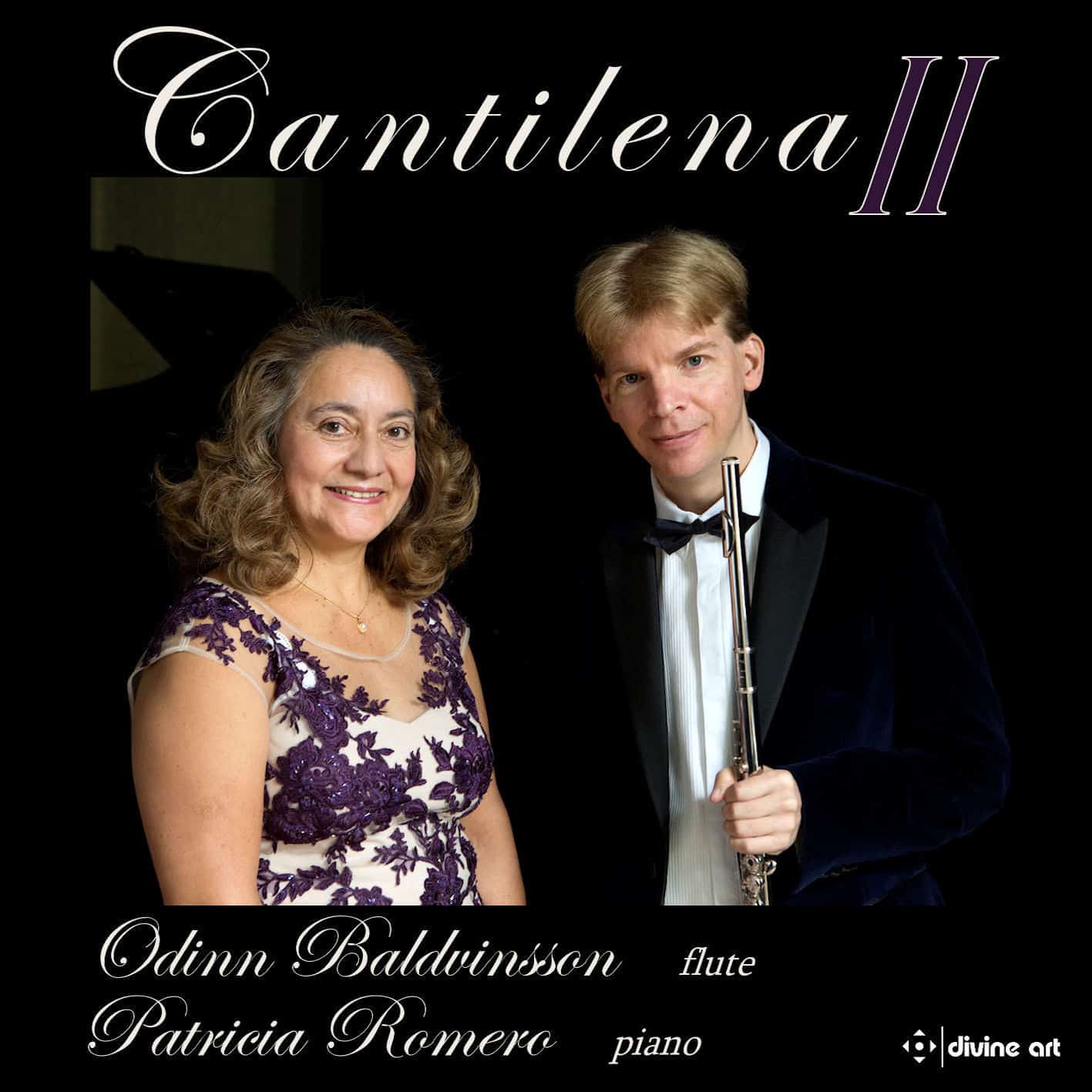
Cantilena II – flute and piano
The flute and piano duo Cantilena, made up of flautist Odinn Baldvinsson and pianist Patricia Romero, are based in the UK and are establishing a fine reputation since the release of their debut CD (also eponymous), for a wide range of repertoire, mainly Romantic, both popular and less well known. So on this superb album, we have the beautiful Concertino of Chaminade, and Dutilleux’s Sonatine, both quite well known; the Suite by Widor is a little known piece by a composer more famed for his organ music and is very much in the French Romantic mould: also exquisite is the rare Sonata by Georgian composer Taktakishvili; finally Piazzolla’s Histoire du Tango – a very well known piece but amazingly this is its first ever recording in the version for flute and piano.