Lucia Micallef is without doubt the most significant pianist to have emerged from Malta in very many years, and I welcome this superb new disc without reservation. Her Bach playing is quite magnificent, and she is most admirably partnered by the EUCO under Brian Schembri. The recording is also first-class in every respect. A truly outstanding production in every way.
Catalogue Connection: 25128
-
American Record Guide – James Harrington – 25128
Here we have four of Bach’s seven completed solo keyboard concertos: S 1052, 1054, 1056, 1058. These are absolutely beautiful piano performances by Maltese pianist Micallef. She was trained in Malta, Italy, and Great Britain. Every dynamic capability of the piano is used, especially long crescendos and diminuendos. Bach would probably not have had this ability with the instruments of his day, but would heartily approve if he heard this performance. There is a precision in the ensemble that I credit to conductor Schembri. Many of my other recordings of these works are conducted by the pianist or harpsichordist from the keyboard, which would be historically accurate. The attention to detail, especially at the slight ritardandos at the end of sections and movements, make these performances as perfect as I have ever heard.
Micallef’s chamber music and accompanist credentials are clearly behind her approach to these works. I’d prefer a little more piano concerto feel, but her approach is perfectly in style and appropriate. The piano by its very nature stands out a bit from the string texture, and the recording balances are quite good, so chalk up my desire for more brilliance in the piano part to growing up on the big romantic literature. Micallef subtly blends her doubling of the bass line with the strings when the solo part is tacet.
This wonderful recording makes me hope for another that would complete the set (and maybe add in Brandenburg Concerto 5 and the A-minor Triple Concerto, S 1044?). Divine Art’s booklet notes and production values are up to their usual high quality, and they have found a sensitive and engaging new pianist. More will be most welcome.
-
The Chronicle – Jeremy Condliffe – 25128
Just as the opera Pomona (above) is a good way to ease into that genre, this album is a good introduction to classical music itself, though for a different reason: it’s top quality. If you feel you want to buy a classical CD, this is an excellent first investment (after which, Peter Sheppard Skaerved’s Beethoven Explored Vol 6).
According to the sleeve notes, Bach invented (more or less) the solo concerto for keyboard and one of the pieces on here, Concerto in G minor, BMV 1058 , is thought to be the earliest of his solo pieces.
Maltese-born Micallef is accompanied by the European Union Chamber Orchestra but it’s her input that lifts this CD up from the good to the excellent.
Her playing is precise yet subtle, and she brings out the best in the music. Bach originally wrote these pieces to entertain, and be played by, his sons and himself; he was said to play them “with the greatest perfection” but Micallef must give him a run for his money. Like Skaerved’s Beethoven, this sounds fresh and modern and not in any way imposing. If you like Bach already: this must be one of the better recordings of his work, so neither neophytes nor the knowledgeable can go wrong.
-
Audiophile Audition – Gary Lemco – 25128
Here, two Maltese musicians collaborate (28-29 April 2014) in the music of Bach, recorded at St. John’s Smith Square, London. Bach contributed seven complete solo concertos which survive on a manuscript dating from 1737-39, while Bach served as Cantor of St. Thomas’ Church in Leipzig. The concertos were probably composed for performance at Zimmermann’s coffee house by members of the Collegium Musicum with Bach at the harpsichord.
Bach’s oeuvre comprises some of the earliest keyboard concertos to have been written. The liner-notes (Anthony Burton) mention the Fifth Brandenburg Concerto and Handel’s Organ Concertos which were written in London as other early examples of the form. Likely, all Bach’s keyboard concertos – based on Vivaldi’s paradigm of the concerto format – were transcriptions that the composer made from his earlier works for other instruments, particularly the oboe and the violin.
Schembri’s European Union Chamber Orchestra opts for a sound that appears a compromise between “authentic” and contemporary sonorities, certainly transparent enough to allow Micallef’s pearly articulation to shine through while allotting Bach’s often pungently chromatic textures their due. The resonant string line in the D Minor Concerto first movement lends ample support to the keyboard’s hypnotic repetitions of the ritornello motif. The G Minor Adagio extends a somberly serpentine theme not far from the Ligeti piece – Musica ricercata – that haunts Kubrick’s Eyes Wide Shut . The four-part harmony of the supporting strings sighs in the manner of anguished naiads in a lyric stream of sadness. The bouncy, fluid realization of Bach’s 12-bar ritornello for the final Allegro conveys a joie de vivre that remains within sober limits, unlike the famed Gould/Mitropoulos collaboration in Amsterdam.
The Concerto in D Major proffers us an arrangement of the familiar E Major Violin Concerto, BWV 1042 . The left hand of the keyboard part has undergone significant support from by arpeggios and tissue from the original orchestral part of BWV 1042 . Micallef thoroughly relishes the various flourishes and episodes of melodic, arioso filigree that mark the opening Allegro . We can feel the Vivaldi touch even as Bach expands the rich tapestry of the ternary development.
The application of extended melos applies to the B Minor Adagio e piano sempre , which borrows further melodic tissue from the ritornello. The clever Allegro finale synthesizes a passepied rhythm with a rondo format, a witty combination of symmetry that appears to be inventively spontaneous. Micallef and Schembri deliver a most congenial rendition.Ever since I heard Clara Haskil and then Gina Bachauer in the compressed F Minor Concerto – alongside that of Edwin Fischer’s and Agi Jambor’s classic renditions – the diaphanous wiles of this affective work have mesmerized me. The Allegro ritornello theme alternately marches and dances in plastic rhythm. Pure magic inhabits the A-flat Major Adagio whose procession permits variety of the bass line under an exquisite vocal line and its trill. Little string pizzicatos, antiphonal interruptions, and deft counterpoint make the Presto finale a persistent delight.
The G Minor Concerto arranges the A Minor Violin Concerto, BWV 1041 from Bach’s Coethen period for pianoforte realization. The piano right-hand duplicates the violin original, while the left adopts the low string part with added fioritura. The Vivaldi formula enjoys a new sonority as Bach alternates ritornello fragments with solo banter. Micallef sings plaintively in the B-flat Major Andante o ver a throaty ostinato in the strings. The contrapuntal antics of the 9/8 Allegro assai , a hearty gigue, virtually hop, skip, and jump to the lyrically alert sensibilities of our enthusiastic principals.
-
MusicWeb – John France – 25128
I have never worried too much about Bach being played ‘authentically’. I recently
reviewed John Kitchen playing the great Passacaglia and Fugue in C minor, BWV582 on the organ of the Usher Hall in Edinburgh (Delphian DCD34132). In this recital he made use of registrations that would have been customary in the Edwardian era. I was thoroughly impressed and moved by this realisation. My introduction to Bach, around 1970, was an old EP featuring the pianist Ronald Smith playing the beautiful Myra Hess transcription of ‘Jesu, Joy of Man’s Desiring’. Shortly afterwards, I was bowled over by a recording of the Chromatic Fantasia and Fugue in D minor, BWV903 played — I have forgotten who the pianist was — on the piano. Thereafter my own efforts to play ‘manageable’ Bach have continued on that instrument. In recent years, I have been seriously impressed by Angela Hewitt’s survey on Hyperion of the keyboard works – all played on the piano.Like the American pianist and harpsichordist Rosalyn Tureck, I do not dislike the harpsichord or clavichord, but I do think that Bach sounds great on the piano. I feel that the ‘endless controversy’ about ‘authentic performances’ has become a bit boring. Remember that true authenticity would force us to listen to the music in candlelight, probably in the freezing cold and with badly tuned instruments and there would be no Aspirin to relieve the headaches.
Bach contributed seven complete solo concertos which survive on a manuscript dating from 1737-39. At this time, Bach was Cantor of St Thomas’ Church in Leipzig. The concertos were probably composed for performance at Zimmermann’s coffee house by members of the Collegium Musicum with Bach at the harpsichord.
They are some of the earliest keyboard concertos to have been written. The liner-notes mention the Fifth Brandenburg Concerto and Handel’s Organ Concertos which were written in London as other early examples of the form. It is likely that all Bach’s keyboard concertos were transcriptions that the composer made from his earlier works for other instruments.
The notes by Antony Burton point out that the original instrument used in these concertos would have been the harpsichord; however he adds that they have been in the pianist’s repertoire for many years. Burton further notes that when these works are played using modern orchestral instruments, ‘the piano provides arguably a better balance than all but the largest (and least authentic) harpsichords.’
I have not heard Lucia Micallef play before. The Maltese-born pianist has had an impressive career. After early appearances as a soloist she regularly played with the Johann Strauss School of Music orchestra under its conductor Alexander Maschat. She won a scholarship from the Associated Board to study at the Royal Academy of Music.
Micallef has toured Europe and North America and has played at a number of festivals including Edinburgh, and the International Spring Orchestra Festival in her home country. She has performed as a soloist and accompanist with a number of chamber groups. In 2011 Micallef released an album of The Love Songs of Paolo Tosti with the soprano Gillian Zammit. In addition to her concertizing, Lucia Micallef is artistic director of a number of festival and cultural activities.
The European Union Chamber Orchestra was founded in 1981 with players from the member states of the EU. It gives young musicians the opportunity to gain experience in orchestral playing at the start of their professional careers.
This vibrant recording was made in St John’s Smith Square, London with its excellent acoustic: it is perfectly balanced between soloist and orchestra. Lucia Micallef’s playing is superb with a fine and nuanced interpretation of this great music. Her ability to imbue the concertos with just the right amount of vivacity or reflection as appropriate is ideal. The booklet is helpful and includes details of the soloists, the conductor Brian Schembri and the orchestra.
I suggest that each concerto is approached separately and listened to with attention. This is not a CD for through-listening. I can only hope that the remaining three concertos — plus the short twenty second fragment of the 8th — will appear very soon on Divine Art under the auspices of the same performers.
-
Fanfare – Bertil van Boer – 25128
The keyboard concertos of Johann Sebastian Bach have been part of the staple repertory of pianists for over a century, as they provide examples of early music by an iconic figure. Of course, the original instrument was almost certainly a harpsichord, and even an early fortepiano cannot be ruled out for the time they were written, somewhere in the 1730s. At least, that is the date of the principal manuscript from which they are drawn. Still, there is something interesting to be gleaned with a modern piano and modern strings, though the contention that these provide “a better balance than all but the largest (and least authentic) harpsichords” must be taken with a huge dose of salt. Moreover, the works also represent some sort of transcriptions themselves; for example, the D-Major Concerto (BWV 1054) had its origins in a violin concerto.
In general, period instruments provide a more subtle and clear idea of what Bach probably intended, but using modem instruments probably has its proponents as well. The textures are indeed rather fuller, and Bach’s somewhat relentless music does fit well into a more modern context. One cannot go down the road of supposition that Bach might indeed have preferred them, had he been magically transported to St. John’s Smith Square where this disc was recorded last year. But certainly the performances are clean and distinctive. One can certainly see the benefit of having a small chamber orchestra of only 15 players against a rather powerful modern piano to bring out a more modern concept of Bach’s works. The orchestra playing is extremely precise, sounding as if they are fewer in number than they are. Lucia Micallef’s playing does occasionally tend to be a bit mechanical, though this is in part caused by the rolling sequences of Bach’s music, and she acquits herself quite well. She is quite precise and fits the orchestral accompaniment so that it sounds chamber-like rather than a fuller, thicker orchestral texture that one might expect.
My personal preference still remains with period instruments, such as the wonderful, crystalline performances by Aapo Hakinnen and the Helsinki Baroque. If one is looking for what Bach might sound like in a more modern venue, then this is a disc that will serve that purpose quite well.
-
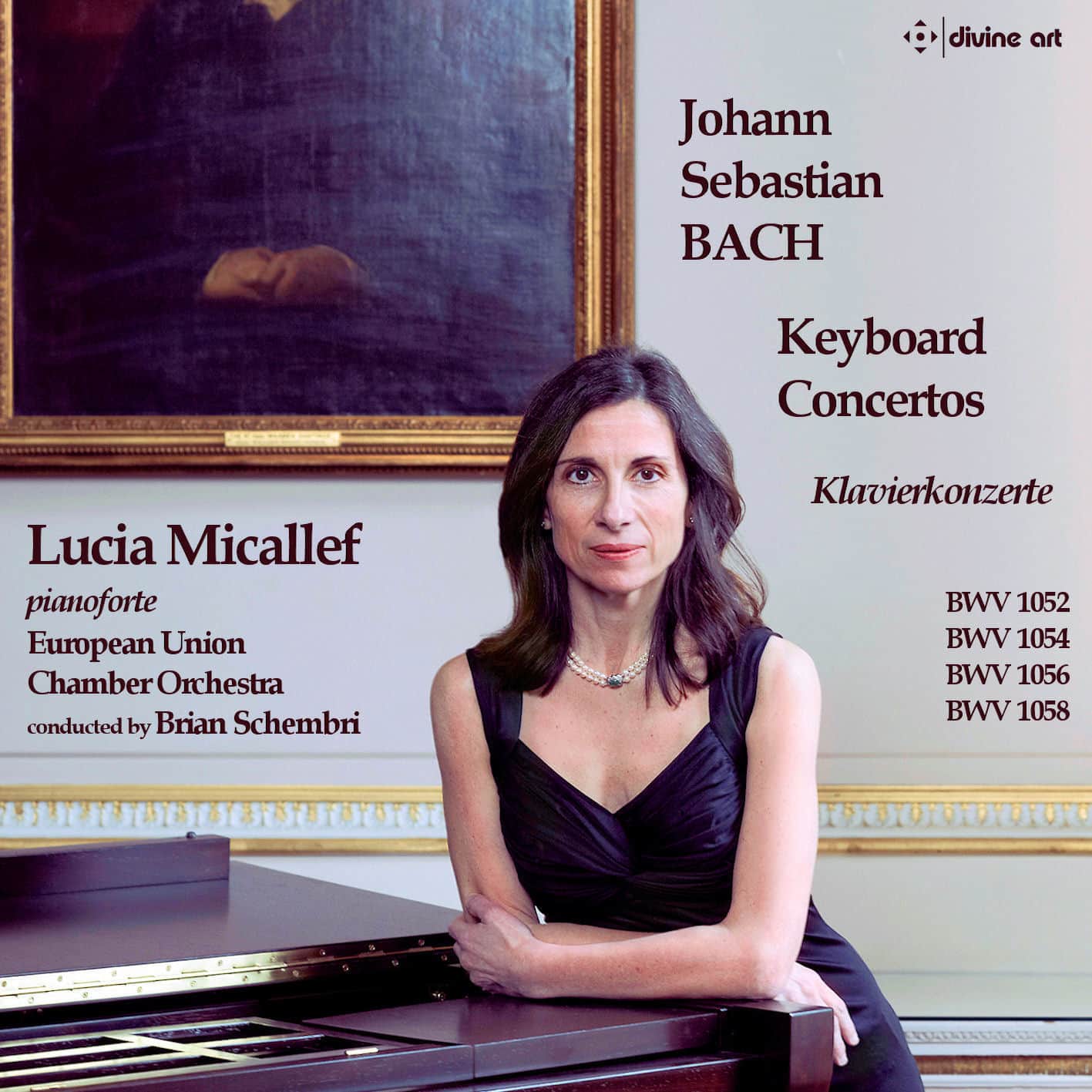
J S Bach: Keyboard Concertos
The Bach Keyboard Concertos are cornerstones of the baroque repertoire, for performance both on modern instruments as here, or on ‘authentic period’ fortepianos, harpsichords or clavichords. Maltese pianist Lucia Micallef is lauded wherever she performs for crisp, articulate phrasing and nuance and this shows through clearly in this beautifully balanced and lively performance. The EUCO under Brian Schembri shine and support perfectly. Among the hundreds of recordings made of these works, this one has a freshness that will make it stand out for a very long time.