Catalogue Connection: 25129

  • MusicWeb – John France – 25129

    The advertising blurb for this CD is not reserved. It states that Roman Statkowski is ‘one of the most brilliant successors to the Romantic genres popularised by Chopin … yet he is hardly known outside Poland’. It declares that his ‘music is full of sparkling energy, rhythmic vitality and a mass of wonderful melodies.’ Even the briefest of encounters with these piano works will prove that this assessment is not an exaggeration. He is yet another one of many ‘forgotten’ composers who deserves to be rehabilitated.

    A few biographical pointers may be of interest. Roman Statkowski was born in Kalisz on 5 January 1859. Whilst pursuing a degree in law at the University of Warsaw, he also began to study composition at the Conservatory. Statkowski later moved to St Petersburg where he studied under Nicolai Soloviev (1846-1916), Anton Rubinstein (1829-94) and Nicolai Rimsky-Korsakov (1844-1908). After teaching at Kiev, he returned to Warsaw in 1904 as professor of composition at the Conservatory.

    Statkowski’s catalogue is not huge: he composed two operas, a number of chamber works and a good deal of piano music. There are two orchestral pieces, a Polonaise and a Fantasy, which were once relatively popular in his native land. His opera Filenis won first prize at the International Opera Competition in London in 1903.

    His music has a number of influences including Chopin, Schumann, Mussorgsky, Tchaikovsky and Richard Strauss. Statkowski died in Warsaw on 12 November 1925.

    I suggest listening to this music in largely chronological (opus number) order, taking each set of pieces at a time. There is not a great deal of development in the content and musical style of this music. It is believed that most of the music presented here was composed between 1886 and 1906. Virtually all these pieces are attractive, post-romantic and ‘imbued with lyricism, poetry and noble tenderness.’ The Toccata, op.33 in particular pushes towards Rachmaninov in it sheer powerful romanticism. If I could only hear one piece it would be ‘Auprès de la fontaine’ from the stunning Six Pieces, op.16.

    The liner-notes give a good introduction to the life of this ‘unsung’ composer, as well as a detailed discussion of each work. I do wonder why Barbara Karaskiewicz has chosen not to give the dates of each of these works: five minutes in Grove gave me nearly all the information I required, although there it is clear that some scholarship needs to be applied to Statkowski’s works list. I could find no reference to the date and location of the recording, save that it was made in 2012. Both these items are important for many listeners.

    I have found reference to two previously released volumes of Statkowski’s music performed by Karaskiewicz. They were issued on the Polish record label Acte Préalable APO126 and APO176. Volume 2 was reviewed on this site by Jonathan Woolf in 2009. I have not heard these recordings. There does seem to be a considerable overlap of repertoire.

    Polish-born pianist Barbara Karaskiewicz has taken Statkowski’s music to heart and clearly has a great love and understanding of all these pieces. They are beautifully played.
  • The Chronicle – Jeremy Condliffe – 25129

    We played this through a couple of times before looking what it was and it came over as an entertaining and lively collection of piano music. It’s got a real sense of energy about it; there’s nothing serious about this and no dark tones, and we half-thought it was a compilation of favourite piano tracks — it’s got the accessible feel of being much-played music.

    We were a little surprised to see it’s the work of a forgotten (at least outside his native Poland) composer, and, listening to it more intently, at how complex the playing is.

    Statkowski (1859-1925) was described as a successor to the Romantic styles popularised by Chopin. The virtuoso Polish pianist Barbara Karaskiewicz has championed her countryman’s music, and she’s a formidable player.

    There are a number of works on here (23 tracks in all) with opener, Toccata Op33 being the most impressive piece of playing, according to the sleeve notes. There are also Four Mazurkas Op24 , and the delicate and graceful Immortelles Op19 . The CD closes with Six Pieces Op16 , again a demanding work for the pianist.

    This collection will be enjoyed by proficient pianists, who can appreciate the complexity of the playing, and people who just like piano music; there’s nothing stuffy about this, and there’s a nice folky feel to it. We like how it works both as background music — where its energy makes it sound a bit jolly — and as listened-to serious music, where its complexity and general cleverness takes it to a different level.

  • New Classics – John Pitt – 25129

    [This disc] features works by one of the most brilliant successors to the Romantic genres popularised by Chopin. Hardly known outside Poland, Roman Statkowski’s music is full of sparkling energy, rhythmic vitality and a mass of wonderful melodies. For anyone who loves the classical romanticism of the mid to late 19th century, Statkowski is a composer to be checked out and investigated in depth. The virtuoso Polish pianist Barbara Karaskiewicz has championed his music for some time, and has a close affinity with his work. She brings a formidable technique to the glittering fast passages and is the ideal interpreter.

  • Wrightmusic – David C F Wright – 25129

    Roman Statkowski was a Polish composer whose piano music is very well written. Although Polish , his music does not sound like Chopin. Statkowski studied at St Petersberg from 1886 and one of his teachers was Anton Rubinstein, although his first teachers were Sygietunski and Zelenski in Poland.

    He was born near Kaliz on 24 December 1859. His family were landowners and there was always an appreciation of the arts. Not only did he study with Rubinstein, but with Rimsky-Korsakov and developed an admiration for the music of Richard Strauss. This is why his music is not worshipping at the shrine of Chopin with those ghastly cliches, tinklings at the top of the piano and nauseating predictability. One recalls the words of one of our finest pianists, “Great pianists play great music; the rest play Chopin.”

    It has been expressed that Statkowski was not like a dreamy romantic poet of the piano but had the attitude of a lawyer or an architect. Russian music, which influenced him, had greater depth, passion, drama and character and watery music does not.

    The Six Pieces Op 16 is a challenging work full of inventiveness and variety and lasts for about twenty minutes. There is the depth of expression already mentioned with mainly conventional harmony and the occasional backward look at the music of French harpsichordists. Melody is always to the fore and while there is lyricism there are moments of exciting dash. There is the evident style of a lawyer or architect and, generally, there is no padding and time wasting. The variety in the music holds the attention; there is always something new happening. The third movement is a waltz and is the weak link because of its predictability but, apart from that, there is much good music here,

    Immortelles Op 19 are six pieces. The word means everlasting and may refer to the flower from which Everlasting Oil comes .There are more than six pieces in the set but many of Statkowski’s manuscripts were destroyed in the War.

    The Four Mazurkas Op 24 are not written in the style of Chopin being more complex with such devices as polyrhythms. There may be an influence of Polish folk music, however.

    The Toccata Op 33 is very impressive and calls for a pianist with a cool head and tough fingers. This is real encore music; it is simply splendid.

    The Six Preludes Op 37 are a delight. The first in C is predominantly reflective; the second in A is somewhat stormy whereas the fourth in G is cheerful and the fifth in E minor has been likened to Rachmaninov’s famous C sharp minor prelude. They require real skill from the performer, who is excellent and has made two CDs of Statkowski’s music on Acte Preable.

    The composer died in 1925.

    This CD is a joy and we should hear some of this music in recitals. Is the monopoly of Chopin preventing this?

  • Pizzicato – Remy Franck – 25129

    The Polish composer Roman Statkowski (1859-1925) was a pupil of Nikolai Rimsky-Korsakov . He himself worked primarily as an educator and composed relatively little . His 60 piano pieces are rooted in Polish dance traditions and are quite conservative for their time of origin . On the other hand Statkowski is a very imaginative composer who borrowed much of the passion of Russian music . Barbara Karaskiewicz plays a selection of his piano works , ‘ Six Préludes ‘, Op. 37 ,’ Four Mazurkas ‘ op . 34 , the ‘ Immortelles’ op . 19 and ‘ Six Pieces ‘ Op. 16. Her interpretation is fluid and subtle and reflects the diversity and moods excellently.

  • American Record Guide – Rob Haskins – 25129

    Roman Statkowski (1859-1925) studied with Soloviev, Rubinstein, and Rimsky-Korsakoff; he was employed as an educator and purveyor of pianos. All the works on this program are miniatures, none longer than five minutes. They are well conceived for the piano and marked by surprising kaleidoscopic har­monies. Ms Karaskiewicz plays them with style and affection; and the recording, while a little too dry, captures the instrument very well.

  • The Classical Reviewer – Bruce Reader – 25129

    Composer and teacher, Roman Statkowski (1859-1925) was born in Szczypiórno near Kalisz, Poland. He was born into a musical family, studying piano from an early age, but gave up music for law studies at the University of Warsaw. However, he soon gave up his law studies in order to enter Warsaw’s Music Institute (now the Warsaw Conservatory) to study composition under Wladyslaw Zelenski. He later moved to St. Petersburg where he studied composition with Nicolai Solovjov and instrumentation with Nicolai Rimski-Korsakov at the St. Petersburg Conservatory. After obtaining his diploma he travelled to Germany and Belgium before returning to St. Petersburg where he worked at an agency of the Warsaw Herman & Grossman piano storehouse.

    In 1903 Statkowski won the first prize for his opera Filenis at an international competition in London. A year later in Warsaw he won the first prize for his opera, Maria . The opera was first staged in Warsaw in 1906 to favourable reviews and remained popular thereafter. He was respected by his fellow composers but his style was considered more conservative than the neo-Romanticism evident in the works of Szymanowski, Karlowicz, Rózycki and Fitelberg. In 1904 he became a professor at the Warsaw Conservatory, initially teaching the history of music and aesthetics but later the composition class. Statkowski composed several symphonic works, six string quartets, some violin pieces and nearly sixty piano works, many inspired by Polish dance traditions.

    It is a number of these piano works that pianist Barbara Karaskiewicz has recorded on a new release for Divine Art Recordings.

    Statkowski’s lively Toccata, Op. 33 is played with a fine light touch by Karaskiewicz with moments of much virtuosity in the broader passage that follows. The lively opening returns but it is the broader theme that takes the music to the coda.

    Six Preludes, Op.37 take the listener through a wide range of moods with a slow thoughtful opening to No. 1 in C major through a livelier moment before returning to its gentler nature. No. 2 in A minor is quite volatile with a fine forward rolling drama before No. 3 in G major picks up on the forward rolling movement though with a much gentler quality.

    Forceful chords open No. 4 in E minor before the music rushes forward, concluding with a calmer coda. No. 5 in D Major has a most affecting little opening before the music slowly finds its way forward with more lovely moments before the end. There is a lovely, lightly dancing No. 6 in B minor with Karaskiewicz bringing a lovely lift to the music before it broadens and richens as it is developed. This is a particularly fine piece.

    The Four Mazurkas, Op.34 open with a gentle No. 1 in E minor with this pianist subtly picking up the rhythm in the opening before it develops into a true mazurka. A more deliberate passage emerges with more forceful chords before the end. The gently rhythmic No. 2 in F minor has a light and reflective theme given a lovely fluent, yet crisp performance. It occasionally rises to passages of more drama before the calm coda.

    No. 3 in A minor brings some lively rhythmic phrases as well as more flowing passages before the quizzical little coda and the set concludes with a joyful No. 4 in G flat major , full of fine ideas and flowing through some beautifully developed passages.

    Barbara Karaskiewicz brings us six of Statkowski’s Immortelles, Op.19 (Immortal or Everlasting). It seems that these may be the only surviving pieces from the whole set, the others possibly lost during the Second World War.

    The first, B major has a lovely freedom as it slowly reveals itself and develops through more complex passages before a gentle coda. The calm gentle C major moves ahead at a gentle pace with some lovely harmonies midway as the music starts to rise in drama and dynamics before concluding gently. There is a tempestuous rocking motion to the F sharp minor before the music becomes more rhythmic with this pianist showing a fine subtle rubato.

    The E flat major has a fast flowing theme with a lovely ebb and flow before a quiet coda followed by the calm delicate little E flat minor that has a rather nostalgic feel. With the A flat major a longer theme overlaps an insistent motif for the right hand with moments of lovely freedom and flow in this attractive piece.

    The final work on this disc is the Six Pieces, Op.16 that opens with a jaunty Capriccio full of good humour and played quite brilliantly here with a lovely crispness and some very fine intricate, fast passages before a terrific coda. There is a lovely rhythmic flow to the following Impromptu that leads through some thoughtful passages caught nicely by this pianist. The fast moving Valse is given a terrific fluent rhythmic lift by Karaskiewicz as it moves through some rollicking passages. This is a terrific work, full of rhythmic bounce with another great coda.

    All’antico is full of varying rhythms, light and dexterous with a lovely central, quiet and delicate section before a lovely coda. The Alla burla takes off at a great pace, the composer bringing some fine sonorities and textures in his writing, drawn out finely by this pianist. There is a slower passage before the music rushes to the coda. There is a lovely rippling opening to Aupres de la fontaine , the final piece in this set with some fine fluent, rhythmically fast moving passages.

    This is a valuable new release of music that deserves to be heard. Many of these pieces would sit well in any recital. The recording is close and detailed with a fine piano tone. The booklet is well up to Divine Art’s usual high standards with excellent booklet notes from Barbara Karaskiewicz.

  • Expedition Audio – Elaine Fine – 25129

    The Polish composer Roman Statkowski (1859-1925) studied at the St. Petersburg Conservatory with Anton Rubinstein and Nicolay Rimsky-Korsakov, and in 1890 he began his teaching career in Kiev. He then spent about a decade managing various piano stores, and spent the rest of his career teaching composition at the Warsaw Conservatory.

    Statkowski wrote two operas, six string quartets, music for violin and piano, some songs, and a great many short pieces for piano, but his name and much of his music remained virtually unknown for the better part of a century.

    The music on this CD would be right at home in the metropolitan European salons of the second half of the 19th century. It is music of extreme sensitivity that is written beautifully for the piano. The Preludes and Mazurkas are direct descendants of the works of Chopin, though they often go to harmonic places that sound more like Rachmaninoff, and the salon pieces are whimsical, light, and evocative.

    Statkowski is by no means an innovator, but he does have a unique and personal voice as a composer. I am very happy that the Polish Pianist Barbara Karaskiewicz, who plays this music exquisitely, has recorded his excellent piano music. I look forward to hearing more music by this nearly-forgotten composer.

  • Roman Statkowski: Piano Music

    Roman Statkowski: Piano Music

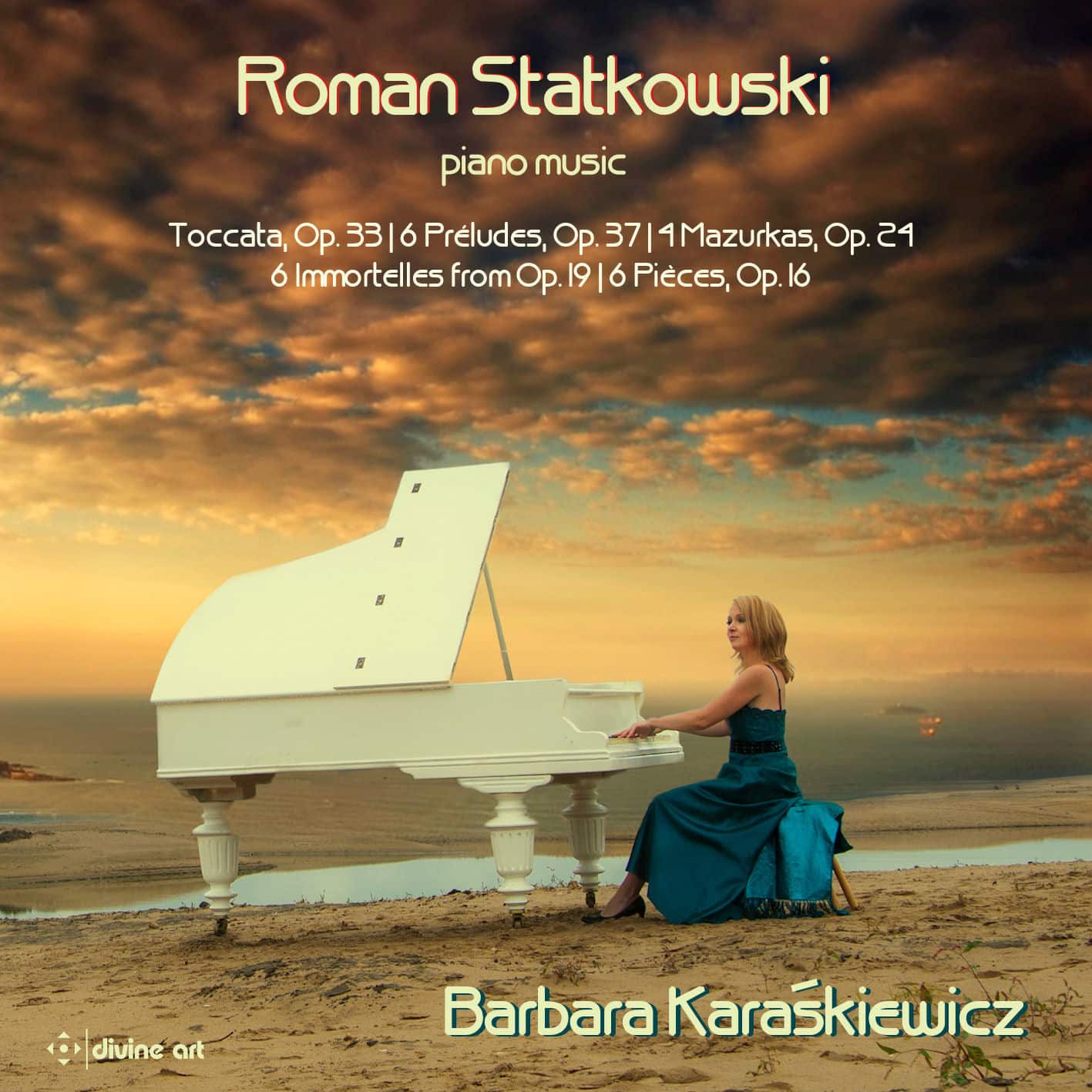
    One of the most brilliant successors to the Romantic genres popularised by Chopin, yet hardly known outside Poland, Statkowski’s music is full of sparkling energy, rhythmic vitality and a mass of wonderful melodies. For anyone who loves the classical romanticism of the mid to late 19th century, Statkowski is a composer to be checked out and investigated in depth.

    The virtuoso Polish pianist Barbara Karaskiewicz has championed Statkowski’s music for some time, and has a close affinity with the music. With formidable technique in the glittering fast passages she is the ideal interpreter.