Catalogue Connection: 25132

  • France Revisited

    A husband and wife piano duo. For decades, the artists would have been Goldstone and Clemmow, but Goldstone died last year and we won’t get any more new recordings from that wonderful duo. Robert Stoodley and Linda Ang are clearly capable of filling the shoes of their predecessors on Divine Art. Piano a Deux was formed in 2010, two years after they were married, and this is their second CD. Stoodley is also a composer, and the two have made a number of original arrangements, such as the Poulenc group.

    George Onslow (1784-1853) is the primary composer here. His first Sonata for Four Hands (1811) is a big, half-hour work. Onslow was most noted for his 36 string quartets and 34 quintets and has been referred to as the French Beethoven. Though not recorded here, it is worth noting that his second Sonata for Four Hands was performed by Liszt and Chopin at a concert organized by Berlioz. His music was well known and respected in his lifetime. The style is late classical to early romantic and reminds me of Kuhlau.

    The 6 Piano Pieces were composed in the 1830s. The pianists each play three of these nocturne-like pieces. Debussy’s Petite Suite is one of the cornerstone’s of French piano duet repertoire and is given a loving, detailed performance. Ang did the very idiomatic arrangement of six Poulenc songs. With the title Songs of Love and War, the group is organized as a suite and is quite effective.

    I expect this to be the first in another long line of excellent piano duo recordings.

  • France Revisited – Fanfare review

    The duo-piano ensemble Piano à deux, consisting of the husband-and-wife team of Robert and Linda Ang Stoodley, has entitled this recital of works by three French composers France Revisited The idea of “revisiting” French music could reflect the fact that none of the works on the disc, except for Debussy’s Petite Suite, are well known. George (or Georges) Onslow (1784-1853) was a French composer of mixed French and English parentage. He is known mainly for his string quartets and quintets, of which he wrote a great many, but he wrote only a small amount for piano. His op. 7 Sonata for Piano Four Hands, one of two such works he composed, dates from 1811, early in his career and not too long after he began formal composition study under Anton Reicha. The sonata is a fairly large-scale work, about 28 minutes in this performance. Its three movements are marked Allegro espressivo, Romanza, and Finale: Agitato. Echoes of Mozart and Beethoven abound, but there are also some surprisingly Schubertian moments in the first two movements. Since Schubert was only 14 years old in 1811, it is very unlikely that Onslow had any direct contact with or influence from him, but both Schubert and Reicha, it could be mentioned, studied with Antonio Salieri and Johann Georg Albrechtsberger, so perhaps there is some common musical ancestry at work here. The sonata is a pleasing work, especially in the beautiful Romanza, although it does not impress me as being on the same level as Onslow’s later quartets and quintets. The performance by the Stoodleys is spirited and energetic, although it sometimes could benefit from greater incisiveness. I haven’t heard any of the three other recordings of this work that are currently available.

    The Stoodleys follow up the sonata with a collection of short pieces for piano solo composed by Onslow during the 1830s and published as a set only after his death. The two pianists divide the pieces among themselves, with Linda performing Nos. 1, 2, and 4 and Robert Nos. 3, 5, and 6. The first five pieces are all under two minutes in length and are very simple and technically undemanding, like pieces written for children. The final piece, lasting six minutes, is more substantial in content as well as length. The playing of Robert Stoodley in this set impresses me as being more nuanced and shapely than that of his wife, but this repertoire is probably not a fair test.

    The Stoodleys offer a winning performance of Debussy’s Petite Suite. Their tempos are more leisurely than the rather brisk ones chosen by Michel Béroff and Jean-Philippe Collard (EMI), especially in “Cortège” and “Ballet.” Their linearity, elasticity, gracefulness, and blended tonal palette contrast with the more percussive and détaché playing, textural clarity, and urgent forward pressure of Béroff and Collard. Although it’s hard to dispute the pedigree of those two eminent French pianists if forced to choose I would opt for the Stoodley performance as a more satisfying realization of this charming music.

    Chansons de l’amour et de la guerre (Songs of Love and War) is a suite transcribed for piano four hands by Linda Ang Stoodley from songs written by Francis Poulenc in the 1930s and 1940s. I am on record as expressing skepticism about the value of such transcriptions, unless they are by the composer, but since I am mostly unfamiliar with the Poulenc songs, I can judge the results here only on their merits as a work for piano. I have to acknowledge that I enjoyed hearing this suite, although the style and even the thematic material are sometimes borrowed from others. Two of the numbers, “La Couronne” (The Crown) and “Les gars polonais” (The Polish Lads) are drawn from a collection entitled Eight Polish Songs that Poulenc wrote in 1934 for a Polish singer then residing in Paris. The melodic material of the first of these seems purloined from Chopin. I do have a recording of “Les chemins de l’amour” (The Pathways of Love) in its original form, a 1940 song for soprano and written for inclusion in Jean Anouilh’s play Leocadia. In the transcription, it sounds very much like something out of a ballet by Glazunov, but that connection is somehow less obvious in the original. At four and a half minutes, “Violon” is the lengthiest number in the suite. A slow, nostalgic waltz, it is also fortunately one of the most engaging. As a whole, the suite elicits from these duo-pianists playing that is lively, graceful, and shaped by tasteful, unexaggerated expressivity.

    Sound quality is good, although a bit more reverberant than is ideal. The music on this release may not be of the greatest importance, but it is enjoyable and well performed.

  • Piano a Deux CD review

    Robert and Linda Ang Stoodley style themselves as Piano à Deux. Their new disc, France Revisited – Music by Onslow, Debussy and Poulenc (Divine Art dda 25132) is an example of piano four hands performance at its very best. One of the disc’s many treats is the appearance of music by George Onslow. Because his oeuvre is largely for chamber strings, his very few piano works tend to be overlooked. The unique voice of this 19th-century composer is deeply intriguing as heard in the Sonata for Piano Four Hands No.1 in E Minor Op.7. It’s surprisingly forward looking despite its early catalogue entry.

    Petite Suite delivers all the rich impressionistic orchestrations with which we associate Claude Debussy, and Piano à Deux are consistently excellent in how they portray the composer’s lightly programmatic intent.

    The duo has also transcribed the Poulenc Chansons de l’amour et de la guerre, and done so with a gifted ear that preserves the wistful nostalgia that Poulenc infused into each song.

  • France Revisited review

    An album we have played a number of times without being able to decide what its main attraction is: sprightly air, nice atmosphere or the rather luxurious effect of having two pairs of hands playing. It’s an engrossing and entertaining album.

    Piano A Deux is husband and wife Robert and Linda Stoodley. This new album features a programme of French music, including Debussy and George Onslow who, despite sounding like a British MP from 1923, was a contemporary of Mozart.

    It’s all beautifully played and while it’s not heavy going, it has an air of gravitas/solemnity. It’s also relaxed, despite the complexity in places, so we guess the Stoodleys know the music well. The sleeve notes are detailed, and we’re not going to repeat them — you can download the booklet from Divine Art’s website.

  • France Revisited – review

    A brief resumé of George Onslow’s career. He was born in Clermont-Ferrand in France on 27 July 1784 of British descent. He studied the piano in London with the Jan Ladislav Dussek and Johann Baptist Cramer. Onslow returned to France for composition lessons with Anton Reicha. His compositional achievements include four operas and four symphonies. His main interest seemed to lie in chamber music: he wrote 34 string quintets, 36 string quartets, many trios, a few piano pieces etc. His musical style is suffused with romanticism; it is little wonder that he was known as the ‘French Beethoven’. George Onslow died in his birthplace on 3 October 1853.

    The Sonata for piano, four hands No. 1 in E minor, op.7 is a splendid piece. It was composed in 1811 and dedicated to his composer friend Camille Pleyel, who was the son of the piano-manufacturer Ignaz. It was to become one of Onslow’s most popular pieces with performances by Franz Liszt, Ferdinand Hiller, Frederic Chopin and Louis Gottschalk.

    The musical content of this sonata owes more to the four-handed piano works of Schubert than to Beethoven’s solo piano music. The entire work is characterised by vibrant harmonies, lively rhythms and considerable contrast between themes, which present tragedy, grandeur and reflection. The middle movement is a genial ‘romanza’ with an attractive tune. There is a slightly troubled middle section. The finale, ‘agitato’ is written in sonata form, with an opening toccata-like theme. This is balanced by vibrant chords and an airy second subject.

    The Sonata was published with many titles, including ‘Duo’, ‘Grand Duo’ ‘Sonate’ and ‘Grande Sonate’.

    The other work by George Onslow on this CD is a compilation of six short pieces for piano solo. They were composed in the 1830s and collected some years after the composer’s death in 1864. These intimate numbers are like ‘nocturnes’ in mood. Nos. 1,2 and 4 are played by Linda Ang Stoodley and 3, 5 and 6 by Robert Stoodley.

    Claude Debussy’s Petite Suite was originally written for piano/four hands between 1886 and 1889. It was premiered by the composer and his publisher Jacques Durand on 1 March 1889, to little acclaim. The work is in four movements. The opening ‘En Bateau’ presents a Verlaine-inspired musical picture of boating on the Seine. This is followed by a ‘Cortège’ which is a little livelier than its title, with its funereal associations, would imply. The music of the ‘Minuet’ is elegant, and contains a few felicitous passages with a couple of nods to Spain. The final movement is a lively ballet that features a charming waltz in the middle section.

    This ‘invitation to the dance’ could have been composed by any of the late nineteenth century French composers including Fauré, Massenet or Chabrier. There is certainly little that is ‘impressionistic’ about it. However, it is of interest because ‘En Bateau’ is the first of the ‘water’ pieces that was to characterise some of Debussy’s music. It is a work that is full of charm and poise.

    The Petite Suite has been subject to several transcriptions over the years with the best-known being Henri Busser’s 1907 orchestration.

    Francis Poulenc requires no introduction to listeners. On the other hand, the present work, ‘Chanson’s de l’Amour et de la Guerre’ is a new production. Several songs from Poulenc’s catalogue have been transcribed by Linda Ang Stoodley. I am not sure that the title ‘Songs of Love and War’ is an essential adjunct to appreciating these wistful pieces. I accept that ‘La Couronne’ majors on lovers separated by war and ‘Les Gars Polonais’ on the “brazen idealism of the young as they head off to combat”. Other pieces were originally settings of poems written during the dark days of the German occupation of France. Yet, if one did not know the back-story, the listener would be charmed rather than challenged by these wistful, and sometimes vivacious pieces, especially the popular waltz inspired ‘Les Chemins de l’Amour’. For information, the songs and their sources are:
    – ‘La Couronne’ (The Crown): Huit Chansons Polonaises (Eight Polish Songs) (1934) FP69
    – “C” (The Bridge of Cé): Deux Poèmes de Louis Aragon FP122 (1943)
    – ‘Les Chemins de l’Amour’ (The Ways of Love): FP106 (1940) Jean Anouilh
    – ‘Fêtes Galantes’ (Noble Celebrations): Deux Poèmes de Louis Aragon FP122 (1943)
    – ‘Violon’ (Violin): Fiançailles pour Rare FP101 (1939) Louise de Vilmorin
    – ‘Les Gars Polonais’ (The Polish Lads): Huit Chansons Polonaises (Eight Polish Songs) (1934) FP69

    The two pianists have added some ‘late’ modifications into the transcriptions to enhance the unity of the work. This includes a reprise of ‘Fêtes Galantes’ at the end of the work and a jazz-infused ending to ‘Violon’. There is no date given for these transcriptions.

    The liner notes (in English and French) are extensive and include a discussion on ‘The Role of Transcription Past and Present.’ There are biographical details of the performers. Texts of the Poulenc songs may have been helpful.

    The playing by Piano à Deux (made up of Robert and Linda Ang Stoodley) is excellent. They have chosen a vibrant and imaginative programme, and have succeeded in introducing the listener to two works by the unjustly neglected George Onslow.
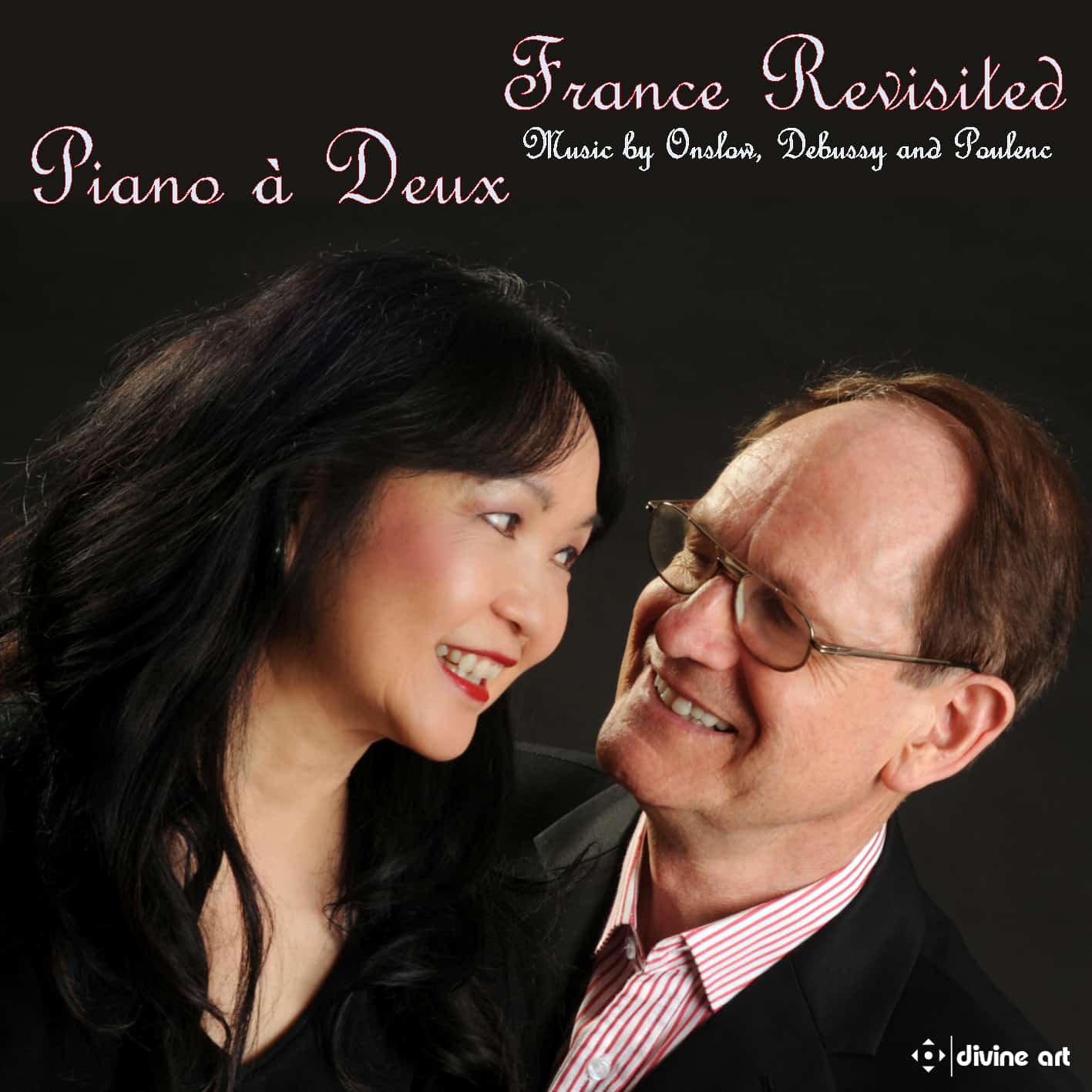
  • France Revisited

    France Revisited

    Piano-a-Deux – Husband and wife team Robert and Linda Stoodley are an adventurous duo with a very wide range of repertoire from the pops to major classical works which they present to appreciative audiences all around the world, spending much time as recitalists on cruise ships.

    This new album features a programme of French music, including Debussy’s well known Petite Suite and the superb First Sonata for Piano Duet by George Onslow, contemporary of the young Mozart and on this showing an equal in compositional skill. Add to that Poulenc’s ‘Songs of Love and War’ arranged by Linda into a new suite of pieces, and we have a very entertaining and instructive album beautifully played.