Catalogue Connection: 25136

  • Mozart Wind Serenades review

    This disc is unusual in that both works here are serenades for wind instruments only: no strings, no trumpets or trombones, no percussion. According to the notes, pieces like this were normally composed for only six to eight musicians, sometimes with an ad hoc double bass line, but more often without. Mozart apparently wrote eight such works: five between 1775-1777 and three more in 1781-82. This CD presents two of these last three.

    The first of them, subtitled “Gran Partita,” is clearly the meatier of the two, having long movements with quite complex development, unusual for a work clearly intended to be entertaining. According to Roger Hellyer, this one was written as a wedding day present for his new bride, Constanze, but the program of the actual wedding day festivities is somewhat confused and it is uncertain that this fairly long work (it lasts a full 50 minutes) was actually performed at that time (August 4, 1782). Its first public performance wasn’t until nearly two years later, on March 23, 1784.
    This serenade, which uses a double bass in some sections (lightly played but audible), opens with a fairly light, jolly first movement but turns more serious in the first minuet, which lasts almost nine minutes. This has a much more complex development section than one normally finds in such pieces, including several transpositions into the relative minor. The second minuet features a surprisingly dark-sounding theme in the minor and some surprising extended harmonic clashes, as well as audible pizzicato bass playing in the background. The full serenade includes seven movements, the sixth being an even more complex “theme and variations” that runs over 10 minutes. One of the most striking features of this work is the way Mozart scored it, using the higher winds (flutes and clarinets) to play the melodic lines (and variants) while the horns and bassoons were used like a brass section. Happily, Mantas conducts this with a light hand, so to speak, giving the music a nice rhythmic springiness throughout. He also takes the Adagio at a true adagio tempo, which is a bit quicker than an Andante and certainly faster than a Largo, which is how many older conductors interpreted Mozart Adagios in general (think of Bruno Walter or Karl Böhm).

    The Serenade K. 375, of which this is the first complete and corrected recording, had an odd history. Originally written for a sextet (two each of clarinets, bassoons and horns), Mozart expanded it to an octet the next year, adding two oboes and making some alterations to the score, particularly in the Finale where he added seven bars of recapitulation to the rondo’s main theme. But somehow, when the score was published, it omitted the second minuet. Even more curious, only the odd-numbered movements were found in manuscript form in Mozart’s own hand, the even-numbered ones being written by some unknown copyist, and in the 1950s musicologist Karl Haas discovered that bar 19 of the second minuet was faulty and “the score only makes sense when this bar is cut out.” This score also left out the second trio. Haas fixed both problems and recorded the corrected version of that minuet himself (in the sextet version), but did not live to record the complete serenade as amended.

    But we’re talking about a less “serious” Mozart work here, not as complex as the other Serenade. Although it is well-crafted with some surprisingly sober-sounding themes and transpositions here and there, the winds play many more mundane scale passages which to my ears are merely functional and not really inspired. It is much more a piece designed for entertainment, although Mantas conducts it with energy and commitment.

    The EU Chamber Orchestra Wind Octet plays with energy as well as a clean line with bright sonorities. All in all, a very fine disc.
  • Audiophile Sound – Andrea Bedetti – 25136

    artistic quality: EXCELLENT
    technical judgment: EXCELLENT: Dynamics 4 Soundstage 4 Timbre 4 Detail 4

    The wind instruments had a significant evolution in the second half of the eighteenth century, when the repertoire for this type of sonority was enriched enormously. Until then a role was reserved for these instrumental groups almost exclusively of pure entertainment, which was to perform music specially composed for parties and ceremonies, in court or larger private residences, often performed outdoors. Even Mozart was able to try his hand at this genre and being the King Midas of music that he was, he was able to turn any work to gold; even then his contribution was decisive. In fact, he was able to compose Divertimenti and Serenades that exploited in an admirable way the colors of the different instrumental pairs, exhibiting a freshness and melodic inventiveness that went beyond any standard of the day. This meant, of course, the fact that those who performed his works had to have exceptional expressive and dynamic virtuosic skills, i.e. those that are required in those players dedicated to the great chamber repertoire. This disc has two of the most famous Serenades of the divine genius of Salzburg, K. 361 (Gran Partita) in B flat major K. 375 and in E flat major. It is believed almost with certainty that the Serenade K. 361 was written around 1781 in Vienna. The title of “Gran Partita”, reported on the first page of the score, is not attributable to Mozart, but more likely to Georg Nikolaus von Nissen, Constanze’s second husband and first biographer of Mozart; it is believed that this Serenade was a gift from Mozart for their wedding celebrated August 4, 1782.

    Mozart’s Serenade occupies a position of great importance catalog for the grandeur of the formal structure (which has seven movements), for the lovely melodic and harmonic invention and originality of the instrumentation: to the expected two clarinets, two bassoons and two horns, Mozart added a second pair of horns, bass clarinet and two basset horns as well as the more conventional presence of two oboes. In October of that same 1781 Mozart also composed the Serenade K. 375, originally written for six instruments (that is, two clarinets, two horns and two bassoons) and then reworked at a later time, in July of the following year, for eight instruments including two oboe that reflect part of the lines of clarinets. Boasting an unusually severe style, the Serenade K. 375, composed in five days, shows many original features because it uses ambivalent conventional elements together with innovative solutions, producing the extroverted tone and airiness typical of the genre and giving at the same time glimpses of a melodically introspective, almost romantic flavor.

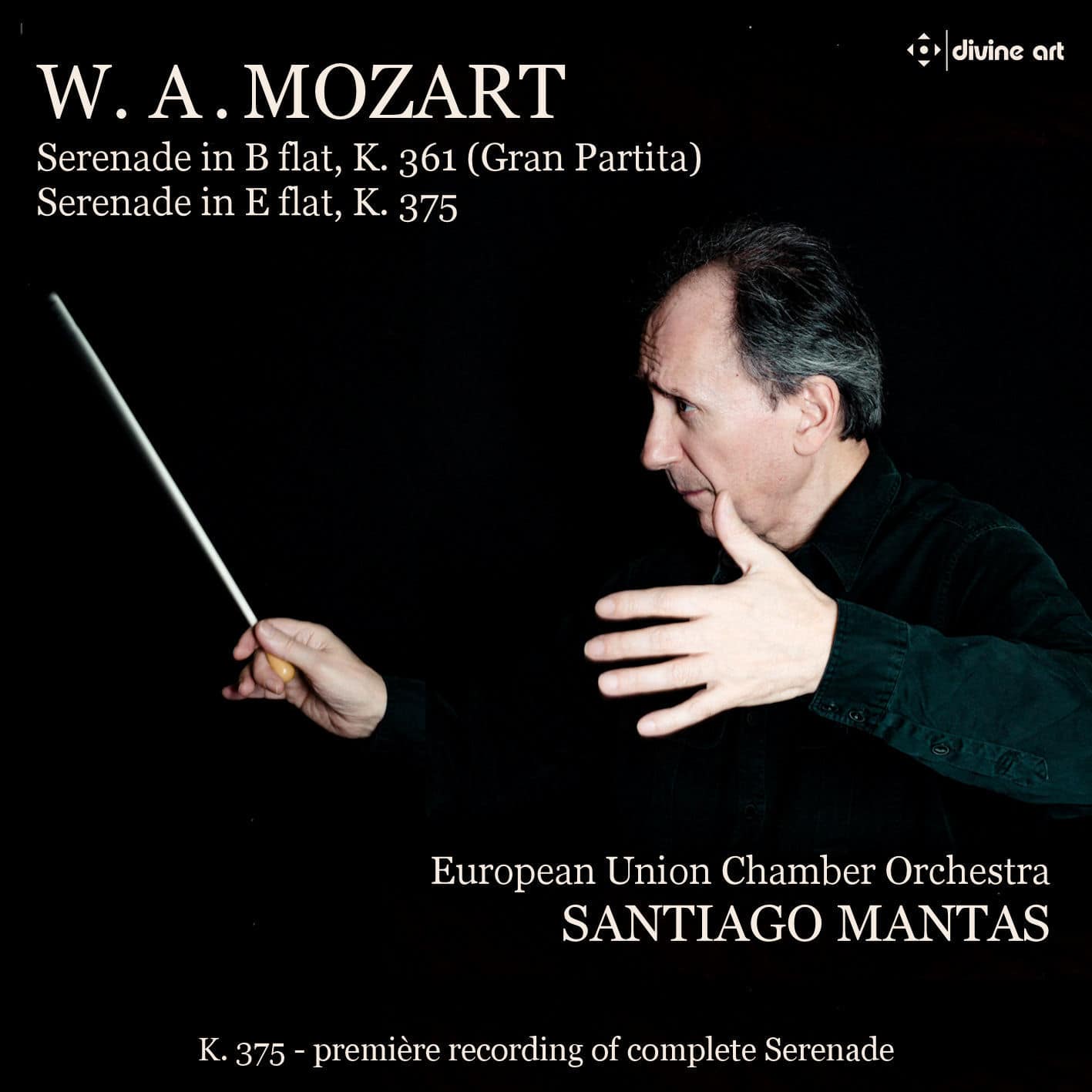
    This recording is actually the premiere full version of the K.375 Serenade, as Santiago Mantas has restored the trio in the second Menuet written by Mozart but excluded from the published score, and has corrected errors that appeared in the published score. The octet of wind instruments of the European Union Chamber Orchestra, directed by Mantas, are very convincing, with instruments that really sing in Mozart’s magic writing.

    The artistic excellence of the CD is further enhanced by the sound engineering by Tony Faulkner, who has given the sound of the wind instruments, both dynamically and tonally, a more than adequate and high standard recording.

  • Fanfare – Huntley Dent – 25136

    The word “sublime” is applied so often to Mozart’s greatest wind serenade, the “Gran Partita” for 13 instruments, that we don’t consider the genre’s humble origins as party music. Being a house Kapellmeister, Haydn produced many divertimentos and Parthie, some for outdoor as well as indoor performance, and in advance of composing the “Gran Partita,” Mozart had his own run at similar entertainments scored for strings or winds. The leap into a seven-movement serenade, either in 1781 or 1782, perhaps as a present for his bride Constanze, was a major advance. From the majestic opening Largo the music announces itself on a symphonic scale, and its imaginative range is unprecedented for anything like a divertimento, much less a party. Mozart must have realized that he was taking yet another step away from being a liveried hireling, and the first known public performance of the “Gran Partita,” in 1784 under the auspices of the famed clarinetist Anton Stadler, took place at a theater, not a nobleman’s home.

    This new release from the highly skilled Octet of the European Union Chamber Orchestra, who deliver a delightful reading, made me think stylistically for a moment. How grand should his partita be? (No one can say where the name comes from, although certainly not the composer.) Traditional readings like the glorious ones under Furtwangler from 1947 and Klemperer from 1963 (both EMI/Warner) look the music’s significance very seriously, perhaps too much so. As tempos slowed and profundity rose, the party side of Mozart’s creation sank out of sight. The music-making was inspired, yet, with repeats, the “Gran Partita” lasts around 50 minutes—a long time to sit with furrowed brow. How far the pendulum has swung can be heard on a recent recording under Trevor Pinnock (Linn), which is so perky and insouciant that the piece becomes a frivolity at times. (In 40:1 Jerry Dubins called the Pinnock account “probably the most superficial, glib reading of the piece I’ve ever heard.”)

    I’d like to think that this new reading, under London-based conductor Santiago Mantas, owes its lilting, relaxed air to his studies in Vienna. Having a conductor is crucial in a work of this scope— admittedly, recordings led by one of the musicians, usually the first clarinet, can be impressive—and Mantas nicely balances the general optimism of the “Gran Partita” with its excursions into stateliness, melancholy, wistfulness, and self-reflective seriousness. Nothing unusual happens in terms of basics like tempo and dynamics, yet this reading sustains its interest over the long span, which is what the music needs. Incidentally, the informed program notes tell us that Mozart’s manuscript assigned the continuo to a double bass, even indicating pizzicato passages, so the old practice of using a contrabassoon, although allowed in the published score, wasn’t the original instrumentation.

    A little further down the Köchel trail in 1781, Mozart wrote his next masterpiece of Harmoniemusik, this lime for an octet composed of oboes, clarinets, bassoons, and horns. The oboes were added as a revision of the original scoring for wind sextet. (The fact that we know the precise date of composition, October 15, 1781, means that recent musicology, which dates the “Gran Partita” to 1782, would reverse the numbering of Serenade No. 10 and No. 11.) There’s also the charming anecdote that on his name day that year, October 31, some musicians told Mozart to leave his outside door open, and around 11 o’clock as he was about to retire, he got a surprise “in the most pleasing fashion imaginable with the first chord in E flat.” That performance of K 375 is unique in music history, but we get a surprise here, too, because the booklet proclaims that this is the “premiere recording of the complete Serenade.”

    The main reason for this, besides the excision of a faulty extra measure of music, is the inclusion of the second trio in the Menuetto, which was omitted when the octet version was transcribed from an imperfect manuscript of the sextet version. All is mended now, and Mantas leads a perfor¬mance as musical and alive as the “Gran Partita.” The highly respected producer/engineer Tony Faulkner delivers faithful, vivid sound. On every count this is one of my preferred CDs of two lovable masterpieces.

  • The Consort – Elizabeth Rees – 25136

    This most elegant performance of two of Mozart’s wind serenades is given by members of the European Union Chamber Orchestra under their conductor, Santiago Mantas. They perform on modern instruments, and the original double bass is retained in the Gran Partita. Mozart directs that the bass line may be played by double bass or contrabassoon, but he evidently intended a string bass, because the indications pizzicato and arco are found in the bass part. The double bass’s pizzicato creates a pleasing yet subtle accompaniment, evident on the recording.

    It is possible that the Gran Partita was intended as a gift to Mozart’s wife Constanze Weber, for performance on their wedding day in 1782. It was scored for thirteen musicians – a pair each of oboes, clarinets, basset horns and bassoons, four horns and double bass. The Serenade in E flat is smaller in scale: it was written in 1781 as a sextet, and Mozart arranged it as an octet in the following year, adding a pair of oboes. Six of his friends serenaded Mozart with the piece on his name-day, 31 October 1781 at 11pm, as he was about to go to bed. He wrote to his father that he was surprised ‘in the most pleasant fashion imaginable with the first chord in E flat’.

    This second serenade has had a more chequered career than the Gran Partita. The original manuscript is in the Prussian State Library in Berlin. Only movements 1, 3 and 5 are in Mozart’s hand; movements 2 and 4 are by an unknown copyist. It was published by a friend of Mozart, a music-loving official at the Viennese court, Aloys Fuchs (1799-1853), who was a bass singer in the Imperial Chapel and an employee in the War Department. Fuchs compiled the score of the serenade by collating early parts. However, he inserted an extra bar (bar 19 of the second minuet), and omitted its trio. The published octet version contains the same errors.

    The musicologist Karl Haas (1900-1970) corrected these errors using the manuscript copy in his possession. He intended to conduct the octet version with the erroneous bar omitted and the restored trio, but died before doing so. This CD is the first recording in which we are able to hear the original version; this performance therefore constitutes an important contribution to Mozartian studies. The recording is extremely balanced and clear; the interpretation by Santiago Mantas is graceful and well-informed. This is a thoroughly enjoyable recording, of the highest calibre.

  • American Record Guide – Todd Gorman – 25136

    In our Woodwind Overview (Nov/Dec 2005) we recommend members of the American Symphony/Stokowski (Vanguard), Bavarian Radio Orchestra/Davis (RCA), Marlboro Alumni/Moyse (Sony or Boston), and on peri¬od instruments, Nachtmusique/Hoeprich (Glossa) and Ensemble Philidor (Calliope). The first one, from 1966, was outstanding for its time but owing to the unvarying vibrato from the first oboist might now be better replaced with newer recordings, such as mem¬bers of the Orchestra of St Luke’s/Mackerras (Telarc). Stokowski’s recording has a spacious¬ness not found here, and the ensemble sounds larger than nearly all others, including this one. Given the considerable competition, what distinguishes this release?

    Karl Haas, the German-British musicolo¬gist and conductor who died in 1970 (not the German-American radio personality who died in 2005), discovered that the fourth movement in the E-flat Serenade, a minuet, had not one but two trios, and recorded the additional trio section in 1959 in the work’s original sextet instrumentation. This appears to be the first recording with eight instruments. Haas also discovered that measure 19 in that movement did not belong and should be cut. Is it worth purchasing a CD to hear about two minutes of Mozart you’ve never heard before and about two seconds less that didn’t belong?

    This performance of the serenades on modern instruments is mellifluous and blend¬ed. In the Grand Partita’s opening movement the phrasing can be somewhat literal and the accents harsh. Tempos in the B-flat Serenade suit the piece, but all the fast movements in the E-flat Serenade need more energy. The Adagio is perhaps too fast, especially if you were to compare this earthbound rendition at 4:12 with members of the Orpheus Chamber Orchestra (DG) taking a heavenly 6:02. There are places where the group plays slow appoggiaturas rather than fast ones. If you’d like a fine performance of the B-flat Serenade, nearly though not quite top tier, and a dull, unsatisfy¬ing performance of the E-flat one, here it is.

    Not long ago (M/A 2014) Patrick Hanudel praised members of the Stuttgart Radio Sym¬phony for their renditions of the Serenade in B-flat and Fantasia, K 608. Consider that choice.

  • Audiophile Audition – Gary Lemco – 25136

    Of all the recorded music in rather generous collections of German conductor Wilhelm Furtwaengler and the Russian Serge Koussevitzky, the one curiosity persists in their Mozart repertory, and that is the 1781 Serenade in B-flat Major , the so-called Gran Partita . I assume that is because the work presents a mammoth design for chamber wind instruments, it provides a masterful display piece for any philharmonic’s principal players.

    The seven movements of the Gran Partita consist of a sonata-allegro with a Lento introduction, a Menuetto and double trio, an Adagio , another Menuetto and double trio featuring an obvious ländler, a tripartite Romance: Adagio , a theme and variations with a curious interruption, and a spritely finale, Molto allegro , totaling nearly an hour of music. The one performance during Mozart’s lifetime occurred 23 March 1784, at a benefit concert created by clarinet virtuoso Anton Stadler, though he auditioned only four of its movements. Since answers to the questions of eingangen (little cadenzas), double-dotting, ornamentation, grace notes, tempos, and more can only be guessed at, each conductor makes his own choices, and I must admit I find those (rec. 6-17 November 2015) by Mantas compelling.

    The opening Largo sets a sonority definitely symphonic breadth, with lovely sound reproduction, courtesy of veteran Recording Engineer Tony Faulkner. Mozart pays particular attention to the different timbres that distinguish clarinets from basset horns, and the peppy Molto allegro moves with fleet dexterity and no shortage of humor from the bassoons. The sheer energy Mozart compels from a “wind band” may encourage more converts to this expressive medium that Mozart found to his taste 1781-82.

    The first Menuetto follows a resolute progression, with two trios, the first of which features clarinets and the second the oboes. The sobriety of affect continues into Adagio , which bears a melodic relation to the Masonic music and to opera seria . The accompanying figures seem restless in the accompaniment, even while oboe, clarinet and basset horn develop a plangent melody. The second Menuetto , however, moves into a mirthful character, rather militant, but softened by the second trio, in which the colors shift to a flowing melody in combination of oboe, basset horn, and bassoon. The Romanze engages Mozart’s capacity to steal moments from Eternity – but he breaks off after three minutes into a lively Allegretto with bassoon puffery that sparkles until a return to the minor key imposes once more a reserved sadness.

    Mozart had utilized the tune for his Thema mit Variationen in his Flute Quartet K. Anh. 171 (1778). The theme’s similarity to the Un poco adagio, cantabile from Haydn’s Symphony No. 47 has arisen among commentators. The series of variants proves Mozart at his most inventive, especially in the scoring for oboe, clarinet, and bassoon. The finale, Molto allegro , seems impatient to end the pleasures of the divertissement, and its earthy energy might have provided crisp impetus might have given Brahms a thought or two for his own first Serenade.

    Conductor Mantas can rightly boast that his version of the E-flat Serenade, K. 375 (1781) gives us the premiere of its complete score as Mozart intended. Mozart scored the work in 1782 as an octet, adding oboes and altering the coda to the finale. The score – in a sextet version – as it sits in the Prussian State Library, Berlin has movements two and four in the hand of an unknown copyist. Karl Haas discovered errors in the second Menuetto , besides which the version published by Aloys Fuchs omits its second trio. Conductor Mantas restores the missing trio and corrects – removes – the spurious bar 19 of the Menuetto.

    The resultant performance gives us a model of Mozart’s large-serenade style, albeit a curiosity in that all the movements remain in the same key. The second bassoon often serves as a continuo to support the upper harmonies. The opening Allegro maestoso conveys the feeling of a major concerto or concertante work, and the animated optimism carries over into the first Menuetto . Mozart assigns entry passages to each instrument to proceed into the Adagio movement’s serene tunes. The clarinets play important roles in the second Menuetto , which moves with the grace of style the omitted measure permits. The second trio bubbles in a manner reminiscent of the E-flat Symphony, K. 543 . In the rousing finale, Allegro , the oboes and clarinets pair off in antiphons, quite energetic. I enjoyed the playing of the French horn throughout this recording, sometimes a bit nostalgic for Dennis Brain to participate. Still, a model job by all principals.

  • MusicWeb – John France – 25136

    It is difficult to imagine that the two great works presented on this CD were originally meant to be heard as ‘muzak’, more than likely al fresco. In fact, I guess that most guests would wander around the gardens of the great courts of Europe and barely be aware that Mozart was being performed. Nowadays, if someone rustles a sweet wrapper, or heaven forfend, a mobile phone should bleep, daggers are (rightly) drawn. It is how music and our world changes. I would now feel a little guilty listening to these Serenades whilst reading or typing up a review!

    Mozart’s Serenade in B flat major, K.361 has been recorded many times. There are more than 60 versions currently listed in the Arkiv catalogue. The work is a regular feature of concerts and recitals. Although ostensibly ‘outdoor’ music there is a depth and seriousness about this, the longest of the composer’s instrumental/orchestral works, that demands more concentrated attention. The forces called for, which include two additional horns, two basset-horns and a double bass, suggest that the occasion it was composed for was not in any way trivial or downmarket. In fact, this piece was written to display the composer’s virtuosity in writing for woodwind. The Serenade, given the subtitle of ‘Gran Partita’, is regarded by many as the greatest work composed for the medium. Remarkable features of this Serenade include the symphonic ‘largo’ introduction, the minuet in the minor key and the thoughtful adagio. It is thoroughly pleasurable from the first minute to the last.

    A particular feature of this CD is that it contains the ‘premiere recording of [the] complete Serenade’ in E flat, K.375.’ Not being a Mozart aficionado or scholar caused me to read the note on the cover twice. Surely I have heard this piece before? The Arkiv catalogue convinces me that I have not been dreaming There are some 36 recordings of this work: all seem to have the required five movements. What has been missing since 1781 that has only been supplied by the European Union Chamber Orchestra under Santiago Mantas? Fortunately, the excellent liner notes give the full story. The five movement Serenade was composed in 1781 in Vienna, as a wind sextet – two each of clarinets, bassoons and horns. The following year, Mozart rescored the work for Octet by adding a pair of oboes: some alterations were also made to the music. For example, the composer added ‘seven bars recapitulation of the rondo’s principal theme.’ So far so good.

    The original holograph of the Sextet is in the Prussian State Library in Berlin. Only the 1st, 3rd and 5th movements are in Mozart’s hand. The two Minuets are by a copyist. The entire score was used by Aloys Fuchs (1799-1853) in his edition, which seemed to perpetuate a couple of errors. Karl Haas, a musicologist and conductor discovered that the 19 th bar of the second minuet was faulty. The only solution for the logic of the music was to cut the bar out. The fault had been transferred into the Octet version. Another important issue was the suppression of the second trio from this Minuet. Haas recorded this minuet, in the sextet version with restored second trio in a 1959 recording he made of the Serenades (Octets) No.11 and No.12 for the Pye Label (CCL30119). He intended to include the ‘lost’ trio in the Octet version the next time he recorded the work. Alas, his death denied him this opportunity.

    The present recording has indeed restored the ‘second trio’ and has also excised the faulty bar. So, some 57 years on we have the corrected version of the Serenade in E flat major. If I am honest, I probably would not have noticed the changes, unless I was following with an older score, as it is not a work I am particularly familiar with. On the other hand, it is good to know that the corrections have been made and finally recorded.

    The European Union Chamber Orchestra and their conductor Santiago Mantas for this enterprise, give an excellent performance of these two works. There is excitement, occasional melancholy and almost constant delight and enjoyment. They are up against considerable competition for both works. However, the above noted corrections to the score make this a valuable version to possess.

  • Mozart: Serenades for Wind Instruments

    Mozart: Serenades for Wind Instruments

    Mozart’s Wind Serenades need little introduction as staples of the repertoire and true works of genius. This fine performance by the EUCO brings fresh life to these well-loved works, but something more: Mozart revised the E-flat serenade into Octet form (it was previously a septet) but the publishers made serious errors in the score, omitting part of the minuet and inserting a spurious bar. Santiago Mantas has prepared a new performing edition to correct these errors, and this is the first recording of the complete Serenade as intended by Mozart.