Catalogue Connection: 25137

  • Wind Blown review from Clarinet and Saxophone magazine

    Peter Hope has three commercial CDs to his name, as well as a rather impressive body of orchestral works, chamber music, choral music and songs. On top of this is a list of film music orchestrations for James Horner and John Williams; and let’s not overlook arrangements for José Carreras, the late Jessye Norman and Dame Kiri te Kanawa, to name just a few.

    This CD contains four wind sonatas and two smaller works. While this is tuneful, melodic and tonal music, it is far from the world of film music. Yes, you can hear hints of the cinema, and there are influences from the worlds of jazz and klezmer, but these are serious pieces and would not sound out of places in a venue such as Wigmore Hall in London.

    The four sonatas are well written for the instruments, and the interaction between the solo instruments and piano is interesting and varied. All four are performed on the CD by the players that gave the first performances, and you can hear the conviction that these performers have for this music.

    There is much to praise in these sonatas; however my favourites were the Oboe and Clarinet Sonatas. The Oboe Sonata opens with one of the most yearning, melancholic melodies I have heard in a long time, and the work is fittingly dedicated to the memory of Lady Barbirolli. The second movement is a jolly scherzo with a lovely trio, and the final movement is a great eight-bar jazzy movement full of verve and toe-tapping material. It is a captivating work that deserves to be heard more.

    The Clarinet Sonata is well worth investigating. The entire range of the instruments is used, and the musical material is interesting and varied. It is also technically demanding – not a work for the beginner. The standout movement for me was the last movement, called ‘The Clarinettist on the Roof” – a reference to the familiar fiddler. The music certainly has a quality that one associates with that film, and a feel of klezmer music.

    Both the Bassoon and Recorder Sonatas are pieces that demonstrate the composer’s knowledge of writing for these instruments. Again, these are not works for the beginner, and there are some great passages that push the instruments to their limits. The moto perpetuo in the Recorder Sonata is a non-stop run of semiquavers for both the recorder and the piano, with a heavy hint of jazz thrown into the mix. The Bassoon Sonata has a lively finale too, contrasting well with the more introverted and contemplative high central melody in the first movement.

    The CD closes with two shorter works, which I must mention. Tallis Remembered was first performed at the William Alwyn Festival in 20123, originally for violin, recorder and piano. It is presented here in an arrangement for recorder, clarinet and piano. It is a set of variations on Wendy Cope’s poem Tallis’s Canon, and for a work just over three minutes it is one of the most beautiful pieces on the CD. The CD notes include the poem, and it is worth reading this to enhance your understanding of the music.

    The CD concludes with a fun piece called A Walk with my Dog, Molly – a tour de force for solo recorder written in memory of Molly. The performance includes a narration, read on this recording by the composer’s wife, Pam Zinnemann-Hope. The music portrays events including a game of fetch and an episode where the dog is chasing a cat. Of all the works on the CD, this is the closest to film music. I can see an audience enjoying this work.

    In conclusion, these works are fantastic additions to the modern woodwind repertoire and display Peter Hope’s skill as a composer in writing such finely crafted music. They would sit nicely on any UK examination syllabus – so, Peter, get them sent off for consideration.
  • Wind Blown: Peter Hope: review by The recorder

    A CD of John Turner is always a pleasure. Wind Blown features the Sonatas for Oboe, Clarinet, Bassoon and Recorder. Idiomatically written, they demand the highest levels of technical facility and expressive maturity. The Recorder and Piano Sonata’s opening Fantasia features long, melismatic legato phrases. Threnody is a haunting feast of melodic invention, with a piano accompaniment which is endlessly varied. The final movement, Moto Perpetuo is a breathtaking ride with a lively recurring rhythmic figure punctuated by sections of more melodic content. Tallis Remembered, for clarinet, recorder and piano, is a set of variations on the famous Canon. I enjoyed the unusual scoring, and was impressed by how well each voice’s part was written; such invention makes this a work which deserves to be performed often. A Walk with my Dog Molly, for speaker and recorder, is another imaginative composition. The recorder is the dominant voice, the spoken text is occasional and the whole is characterfully realised by John Turner and Pam Zinnemann-Hope (the composer’s wife), with a sense of joyful fondness for Molly.

  • Peter Hope – Wind Blown review

    Wind Blown: Sonatas for Wind Instruments by Peter Hope comes from the Divine Art label (DDA 25137) and is available for purchase as a digital download through iTunes or as a CD at www.divineartrecords.com. Peter Hope (b. 1930) is a new and welcome discovery, but his biography suggests his music is more familiar than his name, especially for those residing in the United Kingdom. BBC TV News used his music for over a decade as its theme music. Hope frequently arranged for the BBC Concert Orchestra and artists such as Jose Carreras, Kiri te Kanawa and Jessye Norman. His compositional voice is accessible and self-described as “unashamedly tonal.” This recording, his first complete disc of compositions, contains sonatas for oboe, clarinet, bassoon and recorder. In addition, there are two chamber works for unusual combinations: one for recorder, clarinet and piano and one for speaker and recorder.

    The clarinetist is Thomas Verity, principal second and E-flat clarinet in the Royal Liverpool Philharmonic Orchestra. Throughout Hope’s Sonata for Clarinet and Piano, Verity performs with a focused and vocal sound that is complex and rich in overtones. This is especially noticeable in the upper clarion and altissimo registers, with excellent intonation throughout the range of the instrument. He phrases every passage with conviction, which is a delight to hear. Pianist Simon Passmore, director of music at St. Ann’s Church in Manchester, joins Verity for this recording.

    Hope structures his sonata in three contrasting movements. Verity spins beautiful, lyrical phrases over Passmore’s supportive accompaniment in the first movement titled “Moderato.” The second movement, “Vivace,” contrasts as it is largely “conversational.” Listeners should notice Verity has admirably polished technique – his rendition, executed with apparent ease, generates excitement. The closing movement, “Freely, Allegro,” includes elements of klezmer style, evident from Hope’s choice of modes, dance-like music and energetic portamentos! Despite all the exuberance in this movement, it concludes in a poignant, reflective manner.

    Tallis Remembered, written for the unusual instrumentation of recorder, clarinet and piano, originated as a work for violin, recorder and piano. John Turner joins Verity and Passmore for this chamber work, which is a theme and variations written in response to Wendy Cope’s poem Tallis’s Canon. This charming, smallscale work provides clarinetists the rare opportunity to collaborate with a recorder in 21st century repertoire.

  • Recorder Magazine – Andrew Mayes – 25137

    For many years a frequent arranger for the BBC Concert Orchestra, and composer of the theme music for the BBC television news used from 1969 until the 1980s, Peter Hope is a composer whose experience shows in his craftsmanship and idiomatic instrumental writing. This is particularly apparent in the four sonatas for wind instruments composed between 2009 and 2015. All are in three movements and each opens with a slow introduction which, apart from that for oboe, begins with a falling semitone for the soloist – a particular Hope fingerprint. His compositional language is at once evident; frequently episodic and lyrical, but also energetic and virtuosic, rewarding as much for listener as player.

    The oboe sonata is the earliest, dating from 2009, and was composed in memory of the celebrated oboist Evelyn Rothwell (Lady Barbirolli). The first movement is marked Moderato, but there are successive changes of tempo and mood introducing fresh thematic material, but later superimposing the opening melody above a more lively accompaniment, before closing much as it began. Vivace is the tempo indication for the fleet second movement which amid its energetic progress a more lyrical episode occurs, again providing contrast. The final Allegro has the unmistakable influence of jazz, but the opening melody of the first movement again makes a brief appearance before the emphatic close.

    Composed for a concert at the Royal Northern College of Music celebrating the opening of the Ida Carroll Walkway in 2015, the first two movements of the clarinet sonata have the same tempo indications as the oboe sonata. In this instance, however, the intense mood of the opening of the first persists throughout. The second is syncopated and distinctly jazzy, its opening melody having hints of that which pervades the oboe sonata, but again a slower episode interrupts what is otherwise a scherzo. The finale is marked Freely: Allegro, and is subtitled “The Clarinettist on the Roof”, a reference to its unmistakable Klezmer inspired influence. The close is nevertheless somewhat introspective.

    It is the expressive second movement, headed Threnody, of the recorder sonata that was composed before the other two, it having been dedicated to the memory of distinguished historian Nicholas Henshall, and performed at a concert in Stockport in 2016 celebrating his life and work. It is a heartfelt utterance for treble recorder with an underlying calm. The Fantasia opening movement, as of the other sonatas, begins broodingly, before taking on more urgency. A central section for descant introduces yet more energy, but a return to treble and the opening material brings the movement to a close in the mood with which it began. A flurry of repeated note figuration on descant, reminiscent of Telemann, begins the final Moto perpetuo, but a middle section for treble and tenor introduces a Jazz element before a return to descant for the sparkling ending.

    A short improvisatory passage for the soloist, marked Freely, opens the Bassoon Sonata’s first movement before the piano interrupts and introduces the main Allegro inquieto. A calmer episode forms the centre of an arch structure, the free solo opening leading directly to the Lento which although calm and expressive reaches a dramatic climax. Busy figuration opens the final Giocoso, an energetic Rondo.

    “Tallis Remembered” is a delicious miniature for recorder, clarinet and piano. It is based on Tallis’s well-known canon, and was inspired by Wendy Cope’s poem that reflects upon it; a very personal meditation, the text of which as presented in the CD booklet. The music in turn captures its essence.

    A request by John Turner for a solo piece for treble recorder resulted in “A Walk with my dog, Molly”. Various events on the way are introduced by a narrator (here the composer’s wife Pam) and expressed with descriptive musical episodes that features a rather “bluesy” ritornello that forms the final sleepy coda.

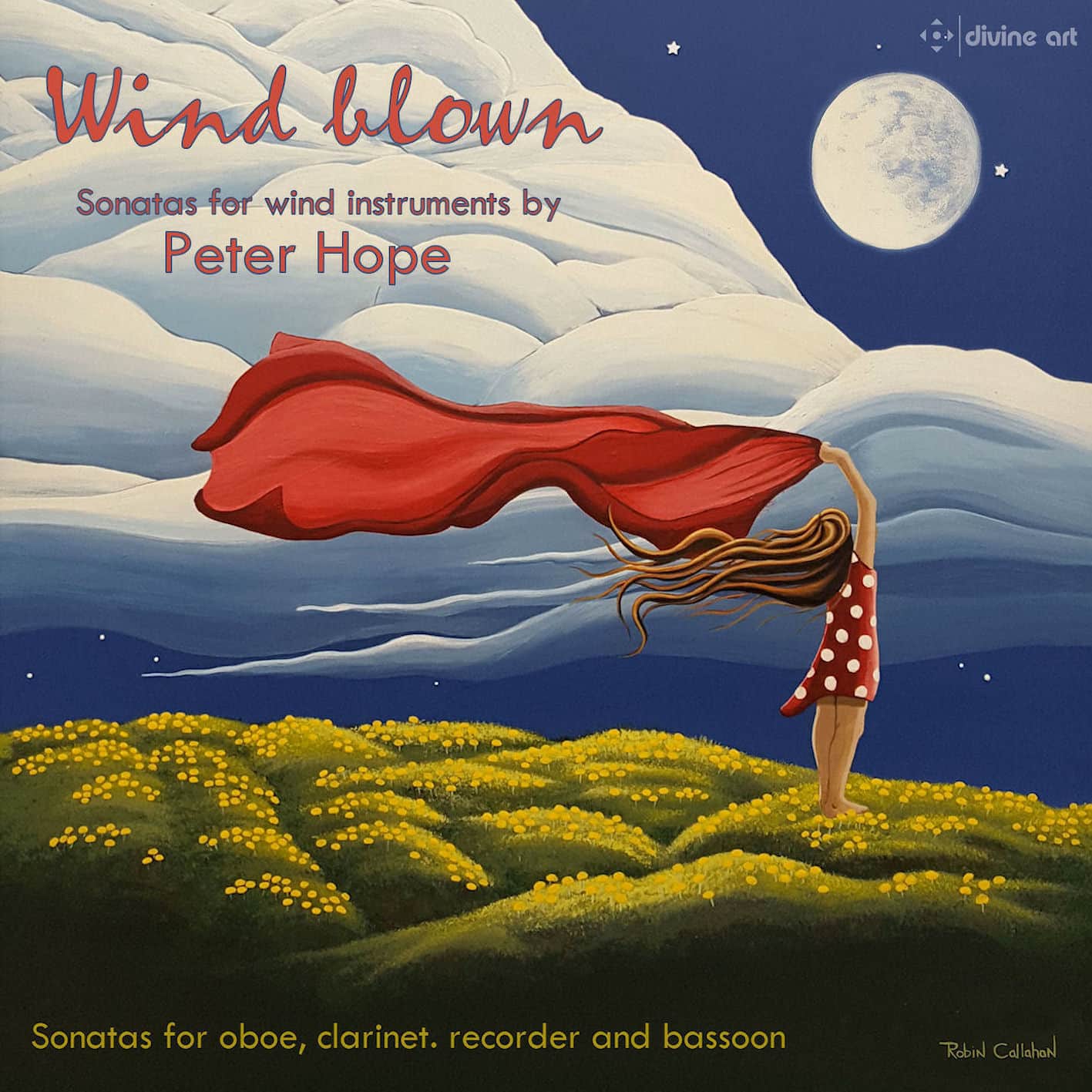
    Having been present at the first performances of three of the sonatas, this fine recording, featuring the musicians who gave them, is a reminder of the impression the music made at the time. Presenting them all together, and with very attractive art work on the booklet cover, is a very welcome release from the ever-enterprising Divine Art label.

  • Fanfare – James V. Maiello – 25137

    Given Peter Hope’s long career as an arranger, orchestrator, and composer of light and commercial music, it should come as no surprise that the sonatas on this recording are colorful, entertaining, and an eminently pleasant way to spend an hour. Moreover, Hope has stayed true to the conception of the sonata as a chamber work, a collaboration between equals that is as rewarding for the performers as it is for the audience.

    The disc opens with a sonata for oboe and piano, played by Richard Simpson and Janet Simpson, respectively. The evocative music is reminiscent of a film score, though one might wish for a bit more ebb and flow in the lyrical sections, especially from the oboe. The recording balances the two players well, but in doing so some of the oboe’s richness may have been lost. A jazz-inflected finale shows off tight ensemble playing, the piano’s walking bass lines dovetailing seamlessly with oboe obbligatos and riffs. The Clarinet Sonata that follows is cast in the same mold, with a lyrical opening movement and a vernacular-styled finale, this time swapping a jazz idiom for that of a Klezmer band. As with the oboe, it seems that the clarinet’s sound has been restricted in the recording or mixing in the service of a balanced recording, but this does Thomas Verity a disservice, cutting off the highs and lows of his dramatic phrasing, especially in the third movement’s Klezmer-inspired inflections and ebullient passagework.

    The Recorder Sonata is perhaps the most interesting work on the program, in part because of the various textural contrasts and the relative novelty of hearing a recorder in modern repertoire. Hope’s orchestrations are especially noteworthy here. He is sensitive to the dynamic constraints of the recorder, using creative—almost Impressionistic—voicings in the piano that never obscure Turner’s delicate, subtle playing. Turner’s virtuosity is also on display in the third movement, which features descant, treble, and tenor recorders and a number of difficult technical passages. Frank Forst and Yukiko Sano turn in a restrained performance of the Bassoon Sonata, and Forst’s lyrical lines are mournful without being sappy. Some of the articulations in the finale are a touch pecky, but this does not detract significantly from the excellent technical execution.

    The final two works on the program are not sonatas as such. Tallis Remembered is a short set of variations for (in this version) recorder, clarinet, and piano (Passmore), inspired by Wendy Cope’s poem “Tallis’s Canon,” which is reproduced in the liner notes. Verity’s silken clarinet presents Tallis’s well-known canon in a manner that recalls Copland’s Appalachian Spring. Clarinet and recorder intertwine with variations and obbligato lines. The only distraction in an otherwise smooth performance comes at 1:40, when Verity’s arpeggios outline the harmonic progression a little too percussively. The disc closes with a whimsical piece for solo treble recorder and speaker (Pam Zinnemann-Hope), A Walk with my Dog, Molly. The recorder’s “walking tune” acts as a ritornello amid rhapsodic episodes, which are punctuated by vocal interjections that one might accompany a walk with one’s dog, including an exhortation to “stop chasing the cat.”

    Although all the performances on this disc are more than competent, it is Peter Hope’s music that is the main attraction, tuneful, inventive, and accessible; the works on this recording are wel-come contributions to the wind repertoire. Certainly on the lighter side, they were wholly successful at brightening my day, a reminder of why we need this kind of music. I suspect Mr. Hope would not take offense at my assessment.

  • American Record Guide – Mark Lehman – 25137

    Peter Hope (born 1930) is an English composer and arranger of songs who also writes occasional accompaniment for radio and other commercial endeavors. His music is tuneful, harmonically lush or pungent as appropriate but always comfortingly tonal, unpretentious, and likable—all these qualities enhanced by his characteristic use of vernacular dance rhythms. I didn’t find any string quartets or symphonies by Hope on recordings, and I don’t know whether he’s ventured into such more ambitious genres. But he appears on a half-dozen or so CDs, including a collection of his serenades, dance sequences, and divertimentos for smallish ensembles on Dutton 7192 that Paul Cook liked (M/J 2008), finding them akin to Malcolm Arnold’s efforts for similar forces. Hope also shows up on various anthologies of orchestral “English light music” This new release of Hope’s recent music on Divine Art includes four sonatas for wind instruments: one each for oboe, clarinet, recorder, and bassoon, each with piano and cast in three well-contrasted movements, with lengths from 11 to 15 minutes. Two short items fill out the program: Tallis Remembered for clarinet, recorder, and piano and A Walk with my Dog, Molly for speaker and recorder. Alle¬gros are light-footed and breezy, with many (sometimes whimsical) borrowings from popular styles; moderatos and andantes are lilting and pastoral, some shaded with wistful melancholy, some interweaving more active dance interludes into the slower tempos.

    A good portion of this music is quite fetching—for example, the 5-minute first movement of the clarinet sonata; much of it is clever; and all of it is shapely, idiomatic, and ingratiating. The piano writing and exchanges between accompaniment and solo instrument are models of clarity and effectiveness; listen, for instance, to the sparkling interplay in the oboe sonata’s vivace or the tender central section of clarinet sonata’s scherzo that hauntingly recalls (could this be intentional?) the gorgeous clarinet sonatina of Douglas Lilburn. And there’s plenty of variety, as Hope obviously enjoys displaying his versatility; why else would he finish off the clarinet sonata with a klezmer-style portrait of ‘The Clarinetist on the Roof’ that first dances, then muses quietly in the darkness? Performances are sensitive and polished and sonics clear, clean, and realistic. Wind players and listeners drawn to their repertoire will find much of interest in these unpretentious and enjoyable sonatas.

  • Pizzicato – Remy Franck – 25137

    The British composer Peter Hope, now 86, has distinguished himself mainly as an arranger and composer of light music – he also wrote the title music for the BBC News, which was used for 11 years.

    Since 2000, he has also composed more serious music, even if the pieces of this CD are not a heavy diet. Hope, however, knows exactly how to deal with each of the instruments used and to emphasize his specific sound qualities. Thus, each of the sonatas is characteristically rich in pleasing melodies, and anyone who does not expect an explosive convulsion from contemporary music will be as fascinated by the imaginative design of the works as by the excellent color and virtuosity.

    The performances and recording are of very good quality.(awarded 5 stars)

  • The Whole Note – Max Christie – 25137

    Wistful senti¬ments dominate the opening moments of most of the works on this collection of wind music by British composer Peter Hope. His music can be called contemporary in terms of date (all six works were composed in the space of six years, between 2009 and 2015) but in character it’s all unabash¬edly anachronistic. As capably written as the pieces are, one can only imagine Hope has determined that the harmonic and rhythmic language of the most conservative 20th-century composers is sufficient to his artistic needs. The writing for recorder goes even further back in time, echoing the pre- Baroque era with open parallel harmonies. He ventures into the popular idioms of jazz and klezmer styles, which sadly come off as cliché to such a jaded ear as mine. It is music that remains by the hearth in the library, caftan-wrapped, brandy snifter at hand, faithful hound at its feet. It is comfortable and, for those seeking such, comforting.

    All performances are quite good, and the production is untainted by excessive reverb, the sound clean and direct. The piano balances the soloists on all the sonatas, while remaining clear and forthright. The instru¬ments are each presented with all their idio¬syncrasies, close-miked enough to catch tone-hole whistles yet not such that any warts are apparent. Kudos to engineer Richard Scott for capturing a soundscape so familiar to the undergraduate ear – that of the academic recital hall – in this case the one at Royal Northern College of Music in Manchester.

  • Wind Blown – Sonatas for Wind Instruments

    Wind Blown – Sonatas for Wind Instruments

    Peter Hope is one of those remarkably talented composers whose music is far netter known than his name. An arranger and composer of light music for decades, working with the BBC Concert Orchestra and writing themes for public events, his music has been heard worldwide – and by millions of British watchers of BBC TV News which used Peter’s theme for over a decade.

    A selected set of wind soloists present the first CD devoted to Peter Hope’s compositions which are fresh, vigorous and enchanting – and as the composer says, ‘unashamedly tonal’.