Catalogue Connection: 25138

  • Mind Music review in The Clarinet

    The English clarinetists Elizabeth Jordan and Lynsey Marsh had an unusual motivation for producing this two-disc set: each woman experienced the death of a parent in 2014 due to complications related to Parkinson’s disease. Beginning with a concert to raise money for a charitable organization called Parkinson’s U.K., the idea expanded to include a studio recording. Most of the works in the set have some connection, through their composers, to neurodegenerative diseases, and all proceeds from the sale of the recording will be donated to Parkinson’s charities.

    Some readers of The Clarinet may not be familiar with the featured performers on this recording. Both have been associated with orchestras in and around Manchester. Elizabeth Jordan is principal clarinetist with the Northern Chamber Orchestra and has also played as guest principal with other important English orchestras. Lynsey Marsh served as principal clarinet with the Hallé Orchestra between 2001 and 2015, and has numerous recordings to her credit.

    The liner notes for this recording explain why these particular composers have been chosen for inclusion. It is well-known that Mendelssohn died tragically young, but apparently the “Nervenschlag” that killed him is now believed to have been a type of brain hemorrhage that is sometimes associated with Parkinson’s. One might wonder if the world needs another recording of either of the Mendelssohn Concert Pieces, but certainly the performance given here of the F major (with Marsh on clarinet and Jordan on basset horn) is a fine one. Marsh conducts, as well as performing.

    Of more interest, at least to this reviewer, is the other repertoire in the set. The Strauss Sonatina “From an Invalid’s Workshop,” has received a number of recordings over the years but is nevertheless relatively little played, which is a shame – it’s a wonderful work. Strauss was ill when he wrote the piece (hence the subtitle), but his malady had nothing to do with anything neurological, so the connection with the theme of the disc is absent in this case. No matter. This performance by the wind personnel of the Northern Chamber Orchestra (with Jordan on C clarinet and Marsh on B-flat/A, along with three other colleagues in the clarinet section) is beautifully shaped by conductor Stephen Barlow. The ensemble plays with impeccable intonation and great expression.

    John Adams’s Gnarly Buttons, premiered in 1996, has received relatively few recordings since that time, and Elizabeth Jordan’s is a welcome addition to the discography. Here the connection with the theme of the disc is apparent; Adams’s father, a clarinetist, died of Alzheimer’s disease, and the work was at least partly a reaction by the composer to that event. Jordan’s performance is excellent. She plays with a consistently warm tone, and has complete command of the stylistic idiom and technical difficulties of the work.

    The final piece on the recording, The Last Memory by Kevin Malone, is for solo clarinet and digital delay. Like Adams, Malone witnessed his father’s decline due to Alzheimer’s, writing this work in response. Both the piece and Lynsey Marsh’s performance of it are very effective. All in all this CD is worth purchasing not only for the repertoire and performances, but also because it raises awareness of (and money for) an important cause.
  • Mind Music CD review

    Like that recent Deutsche Grammophon recording of Mussorgsky’s Pictures at an Exhibition with Gustavo Dudamel and the Vienna Philharmonic, issued to help support Superar—a project designed to bring music to Vienna’s impoverished Tenth District—the point of this very odd collection of pieces is no less laudable. Subtitled “Music related to neurodegenerative conditions,” Mind Music features music, performers, and composers with the common denominator of depression, Parkinson’s disease, or Alzheimer’s, with all proceeds from the album’s sales being donated to various related charities. While the Adams and Malone pieces were both reactions to their fathers’ struggle with Alzheimer’s, the connection to the other works is a bit more tenuous. Richard Strauss was suffering from a severe bout of depression while he was writing his Wind Sonatina during the waning years of the World War II—a depression brought on not by the on-going slaughter or the persistent rumors of the Holocaust but rather (given the composer’s worm’s-eye-view of history) the destruction of his beloved Munich Court Theater, while Mendelssohn, as the liner notes suggest, may have been suffering from Parkinson’s (or something very much like it) during the last years of his brief life.

    While you’re justifiably feeling good about yourself for supporting a very worthy cause, you’ll also be enjoying an immensely accomplished album. The Northern Chamber Orchestra proves itself both deft and more than versatile in this wide-ranging collection, from playing in the Strauss so lively and observant that it makes it seem much better than it probably is, to performances of the Adams and Malone pieces that easily get under the skin of both of these challenging works. The recorded sound is equally impeccable, while the extremely readable notes—the Adams and the Malone by the composers themselves—come with a sensitive appraisal from the music therapist Jonathan Trout. Clearly, an album that really means something.

  • Mind Music review from Gapplegate

    A most unusual volume today. MIND Music: Music Related to Neurodegenerative Conditions (Divine Art 25138) gives us four compositions on two CDs. It was an outgrowth of a concert given by clarinetists Elizabeth Jordan and Lynsey Marsh in honor of their two parents who died in 2014 from complications arising out of Parkinson’s Disease. The concert was to raise money for Parkinson’s UK.

    This album was conceived in the same spirit. Its proceeds will go to Parkinson’s UK as well. All four works on the program have something to do, as the title suggests, with neurodegenerative afflictions.

    Felix Mendelssohn died at age 38, probably of a subarachnoid hemorrhage, which is sometimes linked to Parkinson’s. His “Concert Piece No. 1 in F Major, Op.113” for clarinet, basset horn and orchestra has nothing directly to do with his ultimate end, nor need it. It apparently came about via Felix’s craving for Bavarian dishes, which were unavailable to him while he lived in Berlin. A deal was struck with the father-son clarinet soloists Heinrich and Carl Baermann. They would prepare two of Felix’s favorites, steamed dumplings and sweet cheese strudel, and he would at the same time write them a concert piece they could perform on tour. Hearing the work so nicely performed by Jordan, Marsh and the Northern Chamber Orchestra, I would imagine that the clarinet duo were on the winning end of the deal. It is a delight to hear.

    The work that follows, Richard Strauss’s “Sonatina No. 1 in F Major for 16 Wind Instruments ‘From an Invalid’s Workshop’” was a product of the period following Strauss’s completion of the opera “Capriccio” in 1942, after which he vowed to compose no more. He broke that vow regardless with some very beautiful music. The Sonatina was one such work, written while Strauss suffered from a series case of influenza and also was in depression, the latter in part because of the wartime destruction of the Munich Court Theater, which had important associations for him. The music is bracing and in turn regretful. The performance is quite worthwhile to hear.

    The central work of this program to my mind is John Adams’ “‘Gnarly Buttons’ for Clarinet and Small Orchestra.”  It has much to do with his clarinet-playing father, who succumbed to Alzheimer’s. The music is magical, with ordered variations on cellular motives but also a sort of quasi-naive, folk quality that reflected his father’s involvement with marching band music (as well as jazz and classical). His decline is reflected in the music as well.

    Kevin Malone’s “The Last Memory” for Solo Clarinet comes out of his experience with his father and the degeneration from Alzheimer’s he endured. His father’s struggle to differentiate from current events and the memories of past events has thematic implications in the realization of the work for clarinet and digital delay as a sort of mind as echo chamber, where past memories recur in the mind again and again, creating an internal state as strong or even stronger than external real-time presence. It is a haunting work and well done for all that.

    In sum this is very worthwhile music. The Adams work alone is worth the price of admission. Yet all of it fascinates and pleases. And you will be helping Parkinson’s UK! So go for it.

  • Mind Music review from Fanfare

    This two-disc set is a logical extension of a 2016 benefit concert for the charity Parkinson’s UK organized by the solo clarinetists, each of whom lost a parent to Parkinson’s disease in 2014. Proceeds from the sale of the CD will be donated to Parkinson’s UK. This context adds a certain poignancy and significance to a recording that stands on its own as a finely executed program of chamber works.

    The first disc is devoted to two substantial 19th-century chamber works, beginning with Felix Mendelssohn’s Konzertstück No. 1 in F Major, op. 113. Although the tempo of the first movement feels a touch too slow, the soloists—in particular Elizabeth Jordan on basset horn—more than compensate with warm sound and refined playing. Their interplay in the second movement is nuanced and understated, perfect for Mendelssohn’s conservative style. Like the opening, the presto finale lacks some of the verve implied by the tempo marking, but the technical playing of the soloists is pristine, especially in the passagework. Richard Strauss’s expansive Sonatina No. 1 in F Major, AV 135 follows, full of the chromaticism and sweeping lines one associates with the composer of tone poems. The Northern Chamber Orchestra winds are in fine form here, rich horn lines emerging effortlessly from the texture and mingling with flute and clarinet figures. Crescendos reach their peaks in complete synchronicity and the balance among players is virtually flawless. The high register playing is occasionally too strident, but this is a minor issue.

    The second disc features two contemporary works, first among them John Adams’s Gnarly Buttons, an homage to his father, who suffered from Alzheimer’s disease. The three-movement work opens with an unaccompanied clarinet twisting and turning through the melodic material that forms the basis of the music that follows. As the music builds in intensity, more voices join in. The orchestra’s sound is more focused and raw here, and they seem well at ease in Adams’s Postmodern idiom. Amid the more novel sounds of a banjo and synthesizers, it is easy to overlook the precision of the strings and incisive performances by the brass and winds. Jordan’s solo performance is particularly impressive here, a combined feat of technique, musicianship, and endurance. The final work on the CD is another composer’s homage to a father lost to Alzheimer’s, Kevin Malone’s The Last Memory. Using a digital delay unit to evoke a world of fractured and repetitive memories, the piece is a familiar and painful experience for anyone who has witnessed a loved one suffering from the kind of dementia Malone depicts. Lynsey Marsh manages to capture the confusion and obsession that plague the condition brilliantly, from disoriented fear to the comfort of a familiar polka. This is neither an easy piece to play nor a pleasant one to hear, and a wholly appropriate way to end such a program.

    Mind Music is polished, expressive, and programmed coherently. More than that, however, it is a provocation to think more deeply about neurodegenerative conditions, the relationships between music and health, and the role of music as a social force. Mind Music should not be dismissed as a “fundraiser,” though that is indeed one of its raisons d’etre. It is equally successful as a recording divorced from any extramusical factors, but it is surely enhanced by them.

  • Mind Music review from Planet Hugill

    This disc is the culmination of a project, conceived by clarinettists Lynsey Marsh and Elizabeth Jordan after each lost a parent to complications with Parkinson’s Disease. A concert in 2016 raised funds for Parkinson’s UK and the musicians then went into the studio to make this disc, all proceeds from the sale of this recording will be donated to Parkinson’s Disease charities.

    Mind Music on the Divine Art label, presents four pieces all with links to neuro-degenerative conditions. Some of the links are slightly tenuous, but overall it makes for a striking and unusual programme: Felix Mendelssohn’s Concert Piece No. 1 in F major Op.113 for clarinet, basset horn and orchestra, Richard Strauss’s  Sonatina No. 1 for Wind instruments in F major, AV 135 “From an Invalid’s Workshop”, John Adams’ Gnarly Buttons and Kevin Malone’s The Last Memory. The performers are Elizabeth Jordan (clarinet/basset horn), Lynsey Marsh (clarinet), Northern Chamber Orchestra, conductor Stephen Barlow. Barlow is the artistic director of the Buxton Festival where the Northern Chamber Orchestra is the orchestra in residence, he conducts the Strauss and the Adams whilst Lynsey Marsh directs the Mendelssohn from the clarinet.

    Mendelssohn’s Concert Piece Op.113 was written in 1833 for the father and son clarinettists, Heinrich and Carl Baerman, supposedly in return for them preparing Bavarian culinary classics for Mendelssohn when they visited Berlin. It is a relatively short piece, and evidently the Baerman’s did a lot of editing but all concerned were happy and Mendelssohn went on to write his opus 114 for them as well. The opening Allegro con fuoco combines a rather dramatic recitative with a charming Allegro in a manner which recalls Carl Maria von Weber (whose clarinet concertos were written for Baerman senior). The second movement Andante is a rather Bellini-esque duet, the two instruments undulating in parallel over a simple accompaniment, and both Bellini and Weber seem to hover over the perky, up-tempo final movement which ends with a wonderful farty low note for the bassett horn. It is a lovely piece and I don’t understand why it is not better known. The terrific solo parts are played with wit and charm by Jordan and Marsh.

    Whilst Richard Strauss had written works for large wind ensemble in the 1880s, it was not a form that he returned to until the 1940s. In fact, after Capriccio in 1942 he resolved to stop writing music, though a number of late pieces date from this final period. The Sonatina No. 1 was written for a wind ensemble with a larger than usual clarinet section, a clarinets in C, B flat and A, a basset-horn and a bass clarinet. Strauss has used a larger clarinet section in some of his operas and like the timbre. The work’s subtitle From an invalid’s workshop could refer to the composer’s recent worrying bout of influenza (then still potentially fatal), but he was also depressed due the war and in particular the recent destruction of the Munich Court Theatre.

    It is a long work, nearly 40 minutes, and if the music is not immediately familiar the style certainly is, this could not be anything but late Richard Strauss. The opening Allegro moderato is lyrical, yet not uncomplex and full of long-breathed Strauss melodies with a series of solo moments. The middle movement combines a Romance based on a long unfolding melody with a rather more perky Minuet. The Romance does indeed have moments of full blown romanticism, whilst the Minuet provides a complete change of mood. The Finale  is played with an engaging vivacity and sense of lyricism. The music varies from the perky to the full blown romantic, here played with a lovely freedom. This movement lasts a little over 15 minutes with Strauss using his familiar technique of the constantly promised and constantly delayed climax. The extra clarinets do indeed provide a very distinct timbre to the music, and the whole is played with great warmth and affection.

    John Adams clarinet concerto Gnarly Buttons is tied up with his memories of his father (who was a clarinettist and who taught Adams the clarinet), and his father’s Alzheimer’s Disease. The work is performed by for solo clarinet (Elizabeth Jordan), string quartet and double bass, guitar (doubling banjo and mandolin), piano (doubling sampler) and keyboard sampler).

    The first movement, The Perilous Shore, uses a melody based on a Protestant shape-note hymn. First presented by the solo clarinet, the melody is elaborated from the beginning and Adams gradually adds different colours (the sampling keyboard has a remarkable range of timbres) and harmonies to the solo line, and ultimately a hint of klezmer. The movement is toccata-like in the way the melody line is in constant movement. Jordan is tireless in the terrific solo part, and everyone plays with infectious vitality. The second movement, Hoedown (Mad Cow) has a sense of a country band playing a waltz gone a bit crazy. It is mad, but engaging and full of vibrant colour. The final movement, Put Your Loving Arms Around Me is a lush romantic number, with moments of really high intensity and again some intriguing colours. For all the engaging performance from all concerned, I did worry that at 27 minutes long the piece might just outstay its welcome.

    The final piece on the disc, Kevin Malone’s The Last Memory is for clarinet (Lynsey Marsh) and digital delay unit. Malone’s father was diagnosed with Alzheimer’s disease in 1996 and this piece explores Malone’s feelings about forgetfulness, flawed memories and such. The clarinet plays into a microphone which repeats each not 12 times, trapping the player and the audience in a series of inescapable loops. The results are amazing, and Malone’s writing incredibly clever as he exploits the delay to add a remarkable richness. Though the piece might come out of his father’s struggles, the music is extraordinarily inventive and rather powerful.

    This is a lovely disc, and whilst you might prefer individual works played by other ensembles the performances here have such warmth and engagement that they make a delightful disc. The programme has the advantage of being full of relatively rare gems, which makes it so much more intriguing.

  • Mind Music – Gramophone review

    As the title indicates, on this disc the composers, performers and the music itself are linked by depression, Parkinson’s disease or Alzheimer’s. The recording followed a 2014 fundraising concert put together by the two soloists, who had both lost a parent to Parkinson’s. John Adams’s Gnarly Buttons (1996) and Kevin Malone’s The Last Memory (for solo clarinet and digital tape delay; 1996) arose in part from their fathers’ struggles with Alzheimer’s. Strauss’s magisterially misnamed Sonatina may be the result of wartime influenza and depression (occasioned by the destruction of the Munich Court Theatre). Only Mendelssohn’s Concert Piece is unencumbered by association, though its composer’s early death has been linked potentially with a Parkinson’s-like ailment.

    With all proceeds from the sales being donated to Parkinson’s charities, this two-CD set is immensely worthwhile. The performances are immaculate. Rarely have I have been so engaged in this repertoire as by the Northern Chamber Orchestra’s accounts. The Strauss in particular is a delight, the kind of performance that convinces – were it needed – that these ‘wrist exercises’ (Strauss’s self-deprecating term) do have lasting value. Gnarly Buttons is rendered with electric virtuosity by soloist (Jordan) and orchestra, while Lynsey Marsh’s performance of Malone’s discomforting The Last Memory is haunting.

    Production values are first-rate, with excellent sound and an informative booklet note supplemented by a ‘music therapist’s view’ from Jonathan Trout. In a world where music tuition and therapy are under siege from politico-economic philistinism, this is an important release. Go buy it!

  • MusicWeb International – Michael Wilkinson – 25138

    All proceeds from this collection go to a worthy cause, Parkinson’s UK, but this is much more than a merely worthy addition to the recorded repertoire. It is a fine collection of works, admirably performed, and of pieces imaginatively chosen and too rarely performed.

    The recording is the follow-up to a concert performed in April 2016 to raise funds for Parkinson’s UK. Both soloists had lost a parent to complications of Parkinson’s Disease. The connecting thread is degenerative mental illness. Adams’ Gnarly Buttons seems to have been the starting point as Elizabeth Jordan was involved at the time in a performance of this piece, inspired by Adams’ father, a clarinettist who performed in a local marching band and suffered from Alzheimer’s towards the end of his life. The scoring is unusual, including sampled sounds, banjo, mandolin and strings. It is an interesting piece – in its variety of inspirations, from Benny Goodman to Protestant hymn tunes and Hoedown, firmly in the tradition of Ives, but with some lovely simple passages. I shall play it often.

    Kevin Malone’s piece is technically more complex – the clarinettist plays into a microphone, which connects to a delay unit repeating each note 12 times through a loudspeaker. The idea is that both player and audience are caught in loops just as the composer’s father had been through Alzheimer’s. The piece works on several levels, not all of which I have yet explored, but the journey is worthwhile.

    Perhaps the highlight is the performance of Strauss’ Sonatina for 16 wind instruments, in three movements. The piece was written during the Second World War after a bout of flu and its consequent depression, depths compounded by the destruction of the Munich Court Theatre, something which he described as leaving him without consolation or hope. But the music does not lose itself in gloom, despite dark moments. An interesting feature is the weight given by using a large complement of members of the clarinet family – two regular clarinets in B flat and A, a bass clarinet, a clarinet and C and a basset-horn. This is a substantial work here given a thoughtful and characterful performance.

    The Mendelssohn which opens the collection is a less substantial work, though very charming, composed in his later years. Apparently, it was written during a visit to Bavaria in return for the clarinettists Heinrich and Carl Baermann providing his favourite meal of Dampfnudel and Rahmstrudel. Not the healthiest combination – but a delightful one! The work itself is light and very charming.

    Performances throughout impress. Stephen Barlow and the Northern Chamber Orchestra are on excellent form (Lynsey Marsh directs for just the Mendelssohn) and the collection will give enormous pleasure.

    Buy it – and not just for the good cause. The two discs sell for the price of one.

  • The Whole Note – Roger Knox – 25138

    For those who are unfamiliar with Artyomov, the second of these discs probably is a better place to start, because the music’s emotional content is a little easier to grasp. On the Threshold of a Bright World (1990, rev. 2002) is the second symphony in the “Symphony of the Way” cycle. Artyomov has structured it in 18 continuous episodes, and the symphony’s total length is 36:31. The title ap¬pears to be an allusion to a section of the Book of Enoch, which Artyomov has used as an epigraph to the score: “These wonderful places are intended for the collecting spirits—souls of the dead … until the Last Judgment will take place over them.” After the fact, the title also has become a com¬mentary on today’s Russia, although this was “completely unexpected, [and] it was not one of my goals,” according to the composer. The beginning is sepulchral. Bass rumblings are answered by moaning phrases in the strings, somewhat similar to Penderecki’s The Awakening of Jacob. The Penderecki-like writing persists as the symphony continues, although not Penderecki from his earlier Sonorist phase, but later Penderecki in which his avant-gardisms were (and still are) softened by late-Romantic moods and gestures. An emotional apex is reached in Episode 7, and for the next several episodes crises comes in waves, culminating in Episode 14. The remaining four episodes seem to serve as a conciliatory postlude, and here, Artyomov’s writing becomes increasingly beautiful. The closing minutes of the symphony are very moving. At many points during the symphony’s course, solo instruments—violin, viola, piano, oboe, celesta, and organ—take on prominent roles, and the appropriate members of the orchestra are credited in the booklet.

  • The Chronicle – Jeremy Condliffe – 25138

    It’s a game of two halves in this approachable programme from Elizabeth Jordan and Lynsey Marsh (clarinets and basset horn, with the Northern Chamber Orchestra and Stephen Barlow). But it’s all in a good cause — profits go to Parkinson’s UK.

    The programme features music written and/or performed by people who either suffered from a degenerative disease or lost parents to Alzheimer’s or Parkinson’s Disease. Both the soloists lost parents to the diseases.

    The two halves are because CD1 is more traditional, CD2 modern — living composers — but the two go together well.

    The opening piece is Felix Mendelssohn’s Concertpiece No.1 in F major, Op. 113, written in return for food: at the end of 1832 Mendelssohn was living in Berlin and two Munich musicians promised to bring portions of steamed dumplings and rahmstrudel — regional dishes the composer clearly loved but couldn’t buy — if he would write them a piece. This charming piece was the result.

    Mendelssohn died at a young age due to degenerative disease, and the next composer Strauss wrote Sonatina No. one in F major during a period of severe influenza and depression.

    CD2 is more modern and slightly quirkier: Kevin Malone and John Adams struggled to cope when their fathers both succumbed to Alzheimer’s, and the works are serious but also humorous.

    Adams’ father was an amateur clarinet player who gave Adams lessons on the instrument when he was in school, though the composer never wrote a piece for it until he was 50.

    His dad at this stage had Alzheimer’s Disease and became obsessed with the clarinet. Once his mother was emptying out a load of laundry into the washing machine, and saw his father had taken the clarinet apart and hid it in the dirty laundry.

    Adams’ piece is Gnarly Buttons, which includes Hoe-Down (Mad Cow), written during the mad cow epidemic in the UK, complete with cow effects. Malone’s piece uses clarinet and electronica, the latter repeating the notes to try and replicate the trapped-memory world of an Alzheimer’s sufferer.

  • Pizzicato – Remy Franck – 25138

    Friends of music for woodwinds will be 100% satisfied with an album of ‘divine art’ entitled “Music related to neurodegenerative conditions” by Mendelssohn (Concert Piece No. 1), Strauss (Sonatina No. 1 for wind instruments), John Adams (‘Gnarly Buttons’ for clarinet & orchestra) Kevin Malone (‘The last memory’). The clarinetists Elizabeth Jordan and Lynsey Marsh brought this project to life after their parents died of Parkinson’s disease. Apart from this context, these recordings with the ‘Northern Chamber Orchestra’ under Stephen Barlow seem to us to be particularly interesting musically. They radiate a great deal of temperament and agility. The Strauss sonata thus becomes a slender and vigorously rejuvenated piece without pathos and without the fatigue that sometimes spreads in this work. The composition of John Adams also inspires, because it compels the listener into the bright, flaming excitement of the musical experience.

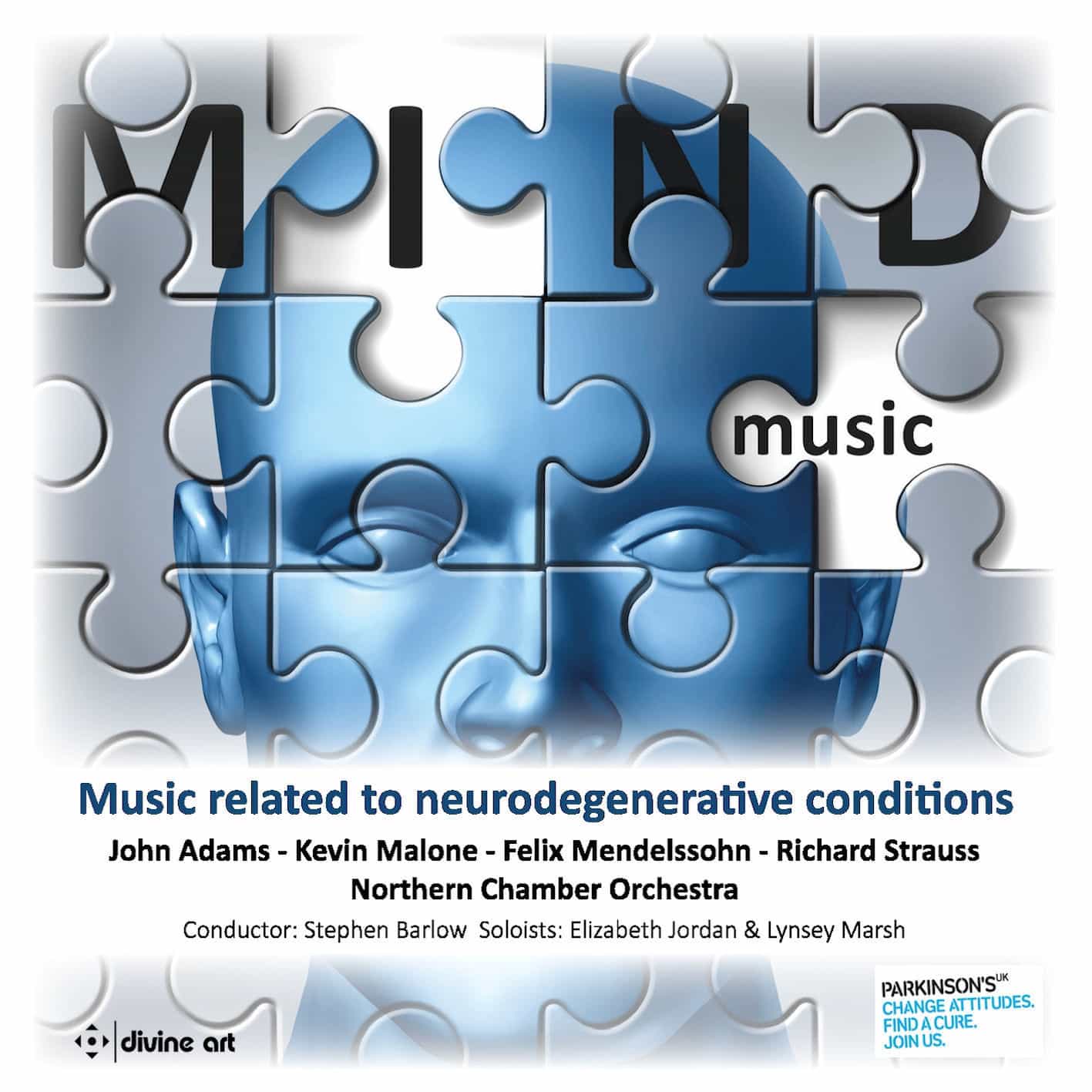
  • Mind Music

    Mind Music

    An Album for Charitable Support.

    Parkinson's UK
    Proceeds from the sale of this CD are in aid of Parkinson’s UK

    Degenerative brain diseases (Parkinson’s and Alzheimer’s in particular) cause immense distress to sufferers and their families. This album is released to raise funds for research into cures, through Parkinsons UK. Both the soloists lost parents to these diseases hence their wish to support the research. They have chosen works by composers all of whom were similarly afflicted – either in themselves or their close families. Mendelssohn died at a very young age due to degenerative disease, Strauss wrote his work during a period of severe influenza and depression, and Kevin Malone and John Adams struggled to cope when their fathers both succumbed to Alzheimers.

    The works here are serious, often poignant, but also humorous and full of hope. A delightful performance by the two clarinet soloists is bolstered by the excellent Northern Chamber Orchestra.