Catalogue Connection: 25139

  • Fanfare – Colin Clarke – 25139

    The booklet notes alone, penned by the pianist herself, make this disc worthwhile. Natalia Andreeva is a thoughtful pianist who has already impressed the present writer several years ago with her recording of the Piano Sonatas of Galina Ustvolskaya (again for Divine Art; and again on that occasion, she wrote her own commentary), reviewed by myself in Fanfare 39:3). Here she presents a succession of Preludes and Fugues with an added “bonus” of two Rachmaninoff Etudes-tableaux.

    The first offering (pun away, if you like) is Bach’s Prelude and Fugue in C sharp Minor from Book I. The delicacy of Andreeva’s Prelude is masterly. The Fugue is cast in five voices, emerging slowly in the aftermath of the Prelude. Of course, five has a specific symbology in Christian thought (specifically. the five wounds of the Christ on the cross). Andreeva shapes this Fugue expertly, finding an underlying pulse that acts like a heartbeat to the thematic tapestry it supports. It’s fascinating to hear this in juxtaposition with Liszt’s transcription for piano of the A-Minor Organ Prelude and Fugue, BWV 543 (S 462/1 in Searle’s catalog of Liszt’s works), and nice to note how Andreeva marks the left-hand octaves of the Prelude as if to imply an organ-like sonority—an intelligent and telling interpretation.

    Franck’s piano works remain undervalued in the concert hall. Richter, Perahia, and Moravec are among the great names that have added to the Prelude, Choral et Fugue‘s discography. Andreeva’s way is pliable in the “Prelude,” contrasting nicely to the prayer-like “Choral,” where sheer beauty of sound at the spread chords is held in balance with its place in the structure of the work as a whole. Andreeva laudably keeps the Fugue free of excess and textural overwhelm. Heard in the present con¬text, Shostakovich’s C-Minor Prelude and Fugue appears like an internalizing and darkening of the Franck. The Prelude is harrowing in its stark demeanor, Andreeva’s understanding of this barren world is really quite remarkable, pointing out in her interpretation just how Shostakovich’s conso¬nances can themselves be heartbreakingly colored by their surroundings. The Fugue is an extension of this Russian melancholy, tender and suffused with dark profundity.

    As if to emphasize the “encore” status of the Rachmaninoff, the liner notes for those pieces are reproduced as an addendum in a smaller font size. Certainly the opening of the G-Minor piece is almost like an accompaniment to credits rolling after some particularly poignant art film. Tellingly, Andreeva finds in Rachmaninoff a pure Russian heart; there is no trace of false sentimentality here. The big-boned op. 33/8, which takes us full circle back to C sharp-Minor, at times seems to paint a roiling ocean.

    The recording is generally good but can feel soft-edged at times. The playing needs no such qualifying. Natalia Andreeva is a highly talented, intelligent pianist who here offers a most rewarding program in superbly musical interpretations given with a rock-solid technique. This is music to get one’s teeth into, superbly presented.
  • Pizzicato – Guy Engels – 25139

    After a rather dry Bach, Natalya Andreeva shows inspiration and spontaneity in the works of Franck, Liszt and Shostakovich.

    Preludes and Fugues – a genre that has survived centuries of music history and has constantly been revived. It is a very suitable program for a CD recording, but equally risky. You have to show yourself as an artist of high skills in all the different styles.

    Natalya Andreeva succeeds in this balancing act only conditionally. Her Bach is played with measured step, the music flows elegantly, without breaks. The naturalness conceived, however, lacks some freshness, perhaps the form stands in the way. In Liszt’s Prelude and Fugue as well as César Franck’s Prélude, choral et fugue, the pianist lets the music flow from the leash, and she allows herself space to let the music unfold – above all, in the sensitively sampled chorale. With Shostakovich (Prelude and Fugue in C minor) the Russian pianist has reached familiar domestic terrain. This is heard and felt in the inner tension of the work, which Natalya Andreeva aptly displays.

  • American Record Guide – San Woo Kang – 25139

    Andreeva’s textbook playing marks her compendium of preludes from different composers. Though a straightforward approach is often appropriate for Baroque-infused works such as these, her interpretations often suffer from lack of verve. The Bach Prelude and Fugue is on the slow side. The Prelude is too affected for my taste, and the Fugue feels a little too labored.

    Though rests and rhythms are followed impeccably in her playing of the Franck, his rich harmonies and dense textures deserve more luxurious, expansive treatment, and I want to hear a better sense of the musical lines. The Rachmaninoff also misses a sweeping sound—I hear details I’d rather not, such as every single subdivision in the left hand.

    Her sound is spacious and atmospheric, which does work well for these works, especially the Franck.

  • The Whole Note – Alex Baran – 25139

    Another recording of comparisons is on the shelves this month in Natalia Andreeva plays Preludes and Fugues; Bach, Liszt, Franck and Shostakovich (Divine Art dda 25139). This Russian pianist has given considerable thought to her program and liner notes, and lays out a wonderful rationale for the enjoyment of a series of preludes and fugues that includes some form of shared material.

    She begins, logically, with Bach, giving the Prelude and Fugue in C-sharp Minor BWV 849 a disciplined and sensitive reading. Proceeding through Liszt’s transcription of Bach’s Prelude and Fugue in A Minor S462 No.1 she arrives at Franck’s Prelude, Chorale and Fugue in B Minor Op 21. By now it’s clear that Andreeva is making serious connections. She concludes with Shostakovich’s Prelude and Fugue in C Minor Op.87 No.20 leaving the impression that 350 years have not diminished the appeal of fugal form, especially when paired with the Prelude. Altogether a very worthwhile artistic and intellectual exercise.

  • Gapplegate Classical-Modern Music – Grego Edwards – 25139

    Everybody knows and appreciates, for the most part, how Glenn Gould played fugues. Fast as it goes, exciting, dynamic. But of course there are other ways. Natalia Andreeva, the Russian pianist who gave us a beautiful volume of Ustvolskaya’s complete piano works (see index box above) comes through with an album of Preludes & Fugues(Divine Art 25139) where the emphasis is on a kind of meditative, poetic cast, grandly unfolding without hurry, studied but extraordinarily direct.

    I’ve been listening closely to this album, and the more I hear it, the more I get inside of her way. Covered here are two preludes and fugues by Bach (one in C Sharp minor, BWV 849, and one in A minor, S. 462, originally for organ, transcribed for piano by Liszt), plus Franck’s “Prelude, choral et fugue,” Shostakovich’s “Prelude and Fugue in C minor, Op 87 No. 20” and finally, as a bonus, two “Etude-Tableau” by Rachmaninoff–one in G minor, Op. 33, No. 7, and one in C sharp minor, Op. 33 No. 8.

    The minor key, as seen above, predominates, and Ms. Andreeva makes much of this with a mesmerizing clarity and spirit, very gravitas. She gives us every reason to appreciate her approach. She allows each segment much space to breathe, much to say by drawing out every passage with that Russian, singing quality we have in some of the best pianists from there.

    It is an album to hear repeatedly, each time you uncover more detail and subtlety. It is a marvel of poetic interpretation. And a very coherent selection of gems as well.

    Hurrah for Natalia Andreeva! Highly recommended.

  • The Chronicle – Jeremy Condliffe – 25139

    Anyone who saw the Young Pope on Sky will have enjoyed the soundtrack, the programme juxtaposing the classical and the modern — there was a lot of electronic music — to highlight the story, a radical new pope taking on the staid Catholic Church. There was also the shock of the unexpected — a nun playing basketball to Jefferson Airplane for example — while electronic musician Recondite’s Levo was used a number of times, its trance feel lending a spiritual air.

    But then take this absolutely superb collection of piano pieces by Natalia Andreeva, featuring the work of JS Bach, Franck, Liszt, Rachmaninov and Shostakovich; if the titular young pope had been an old school spiritual leader keen on taking the Church back in time not forward, this would have been the music.

    Andreeva, a Russian pianist but currently lecturer in piano at the University of Sydney, has developed her own mental picture of these works and tried to draw out the religious spirit. In the interesting (and readable) sleeve notes, she lists the links between the works — Liszt, Franck and Shostakovich were all influenced by Bach, Franck and Bach were both church organists, and the cross motif appears in the work of Bach, Franck and Shostakovich.

    She also analyses each work: the first, Bach’s Prelude and Fugue in C Sharp Minor, uses mathematical and musical symbols to express religious belief, though her explanation is too complex to go into now.

    All that aside, what you get is sublime music that’s infused with spirituality and atmosphere. Bach’s opening piece has something of the Goldberg Variations in the way it wends in and out of the ear, sometimes loud and sometimes quiet. Wikipedia reports that the first edition of the Variations had a title plate that included the phrase: “Composed for connoisseurs, for the refreshment of their spirits,” and that’s true for this CD.

    Despite the quality of the Bach, our favourite section is a rich, rolling piece in Franck’s Prelude. The order of the tracks is effective; the CD leaves the Shostakovich until last, its harsher (but still beautiful) sound a contrast to the more soulful Bach.

    This was recorded live at St Catherine Lutheran Church, St Petersburg, Russia, in 2013. There are two lovely Rachmaninov pieces at the end as bonus tracks.

  • MusicWeb – John France – 25139

    Last year (2015) I reviewed Natalia Andreeva playing the piano music of the Russian composer Galina Ustvolskaya (1919-2006). I did not particularly enjoy her compositions, yet I considered that the pianist ‘exhibit[ed] superb technical mastery of the music.’ She could explore the ‘bleakness, the barbarity and the abstraction of this music.’ It was this in mind that I turned to these two new releases of Natalia Andreeva playing a wide-ranging selection of piano works, majoring on Preludes, Fugues and Sonatas. This was more my cup of tea. Let me say that I thoroughly enjoyed every piece on these two discs.

    Natalia Andreeva is a Russian-born pianist and musical researcher who is currently based in Australia. For these two recordings, she returned to her birthplace, St Petersburg. Andreeva began piano lessons aged five and later graduated from the Rimsky-Korsakov Musical College and the State Conservatoire of Music. Further studies ensued in Chicago. In 2013 Andreeva completed her PhD in ‘Piano Performance’ at the Sydney Conservatorium of Music and studied with the pianists Professor Viktor Abramov and the concert pianist Andrej Hoteev. She has enjoyed a successful recital career in both Australia and Russia. Currently Natalia Andreeva is Lecturer in Piano at the Sydney Conservatorium.

    The first CD, ‘Preludes and Fugues’, is presented as a ‘concept album.’ The liner notes explain that there are various links between the pieces (not really including the two ‘bonus’ tracks of Rachmaninov) and their composers. The main connection that impresses Andreeva is that ‘Liszt, Franck and Shostakovich were influenced by Bach’s works.’ Other facts are Liszt’s interest in fugue and that three of the four composers worked as church organists.

    The CD opens with the fourth Prelude and Fugue BWV 849 from the first book of the Well-Tempered Clavier. This is a profound, moving work that has echoes of Bach’s ‘passion’ music: it lies in complete contrast to the gaiety, light, laughter and joy of the previous number in C sharp major, BWV 848. Cecil Gray has suggested that the C sharp minor Prelude is so technically simple that ‘any child could play it’, yet the depth of interpretation required is such that ‘the greatest artist can hardly do [it] justice.’ ‘Any child’ may be an exaggeration, but his point is clear. This is music that seems to emerge from the very ‘ground of all being’, from before Creation itself. The fugue on the other hand is complex. One of the longest in the collection and one of only two written in five parts. Not a ‘grade’ piece. It is surely one of Bach’s most beautiful creations. I enjoyed Natalia Andreeva’s performance of this splendid work. My touchstone for the Well-Tempered Clavier is Andreas Schiff, however I was moved and impressed by the present recording of this boundless work.

    The second Prelude and Fugue by JSB is the wonderful example for organ in A minor, BWV 543. It is presented in the arrangement by Franz Liszt and included in his Sechs Präludien und Fugen für die Orgel-pedal und manuel von Johann Sebastian Bach ‘Für das Pianoforte zu zwei Händen gesetzt von Franz Liszt’ , S462. They were amongst the first of a long series of Bach transcriptions that have exercised pianists over the years, including Brahms, Busoni, Reger and Tausig. In the case of the present Prelude and Fugue it has been given a wonderful new lease of life. Much as I love the original incarnation for organ, I believe that Liszt adds value to this work by presenting it for the piano. I do wonder about his over insistent use of the octave to replicate the pedal part, though.

    Cesar Franck’s Prelude, Choral and Fugue in B minor has never really caught my imagination, though I do understand that it is one the great works of nineteenth century piano literature. It was composed in 1884 growing out of Franck’s admiration of JSB. He sought to expand the elder composer’s two-movement form by the addition of a central ‘choral.’ In fact, what has happened to the form of this piece is that the ‘choral’ has become the most important section of the work. The entire composition makes use of a minimal amount of melodic material which is developed in a wide variety of ways. Musical influences on this work include Bach, Liszt’s ‘Weinen Klagen’ variations, and elements from Richard Wagner’s Parsifal . The Prelude, Choral and Fugue is stunningly played by the soloist here: I need to revisit this work and try to find out why it has not appealed to me so far.

    The dark colours of Dmitri Shostakovich’s Prelude and Fugue in C minor, op.87, No.20 can be a bit depressing. The prelude is introverted whilst the fugue becomes as little more open to the light: it ends with a degree of resignation. I have no doubt that Natalia Andreeva will one day make a recording of the complete cycle of these Prelude and Fugues.

    The two bonus tracks on this CD are taken from the first of two books of Études-Tableaux , op.33 by Sergei Rachmaninov. They were composed in 1911. The elegiac Etude No.7 in G minor seems to act as a commentary on the First Ballade in G minor by Chopin. It was inspired by a [lost?] painting by Arnold Böcklin called ‘The Morning.’ The second Etude heard here is No.8 in C sharp minor. This is forceful, complex music that owes something to Richard Strauss’s Also Sprach Zarathustra and Chopin’s Prelude in D minor.

    The informative liner notes, complete with musical examples, were written by Natalia Andreeva. The recording of all the music is ideal. It is always clear, vibrant, powerful and alive.

    I enjoyed all the music on this CD: the playing is always definitive. I look forward to hearing much more of the pianist Natalia Andreeva playing ‘discoveries’ and standard repertoire.

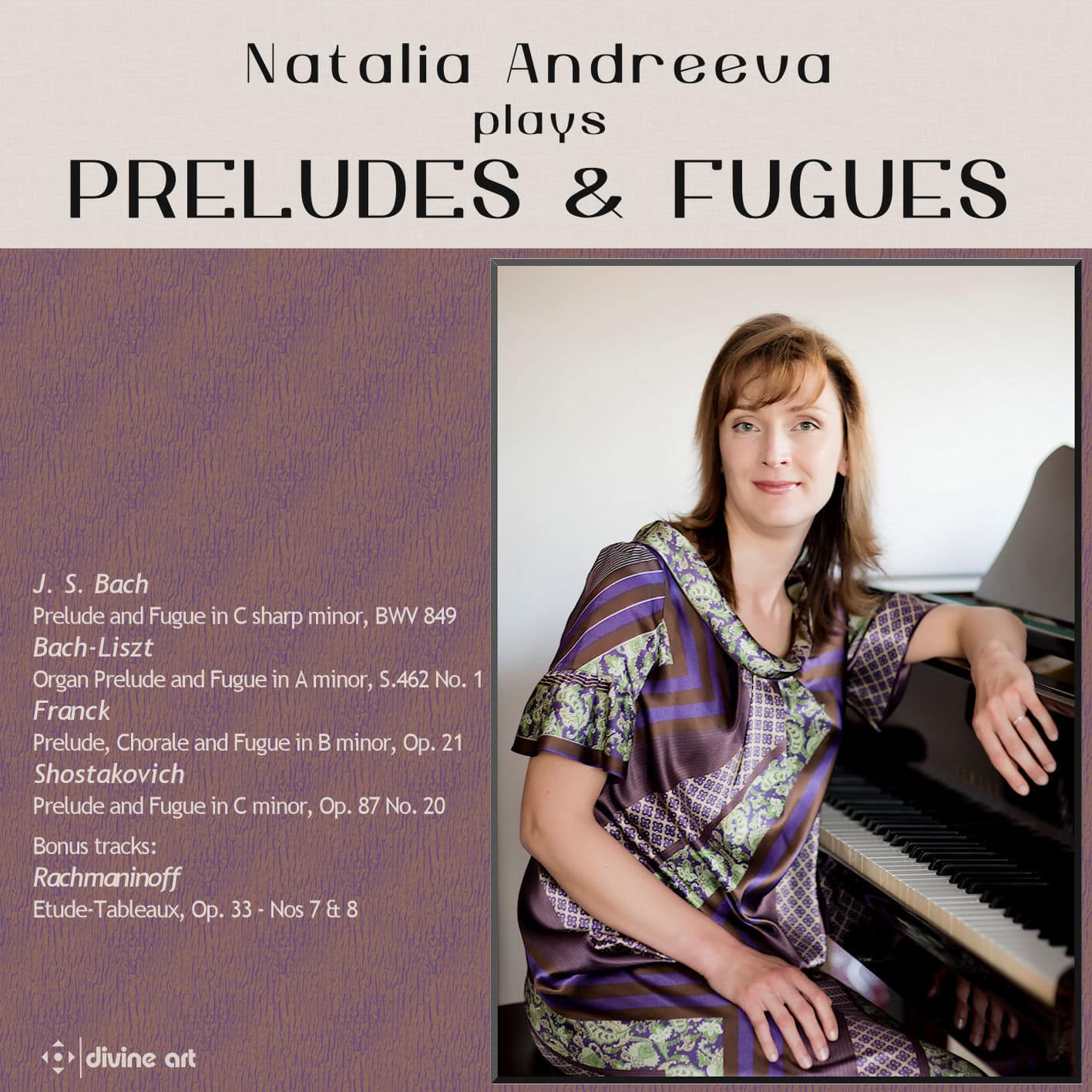
  • Natalia Andreeva plays Preludes & Fugues

    Natalia Andreeva plays Preludes & Fugues

    After the highly praised recording of music by Ustvolskaya (DDA 25130), Natalia Andreeva presents a brief survey of the Prelude and Fugue – one of the most prevalent of keyboard forms over the centuries. From Bach to Shostakovich, this concert-format album is a useful introduction to the genre, and also a fine interpretation for the experts to enjoy. Two of Rachmaninoff’s Etude-tableaux are included as ‘bonus encores’.

    Companion album: ‘Piano Sonatas’ from Beethoven, Scriabin and Prokofiev (DDA 25140). Plus: Ustvolskaya’s Violin and Piano music on DDA 25182

    Natalia Andreeva is a Russian pianist who is currently Lecturer in Piano at the University of Sydney, Australia. Her 2015 recording of the music of Galina Ustvolskaya was very well received, and like that album, this new recording of better-known classical and Romantic works is the result of many years of study, developing her own mental picture of these masterpieces and of what the composers were trying to communicate.

    There are various links between the works – in fact Liszt, Franck and Shostakovich were all influenced by Bach generally, as well as composing in the Prelude and Fugue form that he made a staple of the keyboard repertoire.