Catalogue Connection: 25142

  • Musical Opinion – Gregor Tassie – 25142

    Sergei Bortkiewicz (1877-1952) is a composer who left his homeland after the 1917 revolution and who sought to continue his career in the West. Having not previously heard anything by this composer, his music at first reminds one of Rachmaninov and Scriabin whilst somewhat in the overly romantic style which quickly became outdated with the emergence of Prokofiev and Stravinsky. Bortkiewicz studied with Lyadov and Karel van Ark in St Petersburg, and in Leipzig with Reisenauer (a pupil of Liszt).

    Bortkiewicz was a dedicated melodist and despised the new ‘modernism’ and to the end maintained his style. His career was disturbed greatly by the worst events of the 20th century and was placed in house arrest in Germany during the Great War, lost his family property after the revolution and his publishers were destroyed during allied bombing in 1943 and when almost all his printed music was burnt to a cinder. Between the two wars Bortkiewicz was based in Vienna and he enjoyed a busy career conducting, teaching and playing the piano. He also translated Tchaikovsky’s letters to Nadezhda von Meck.

    All of these pieces are written superbly with myriad beautiful ideas emerging from the very capable fingers of Soldano who has accepted the challenge of bringing this composer’s music to a wider audience. Yet well written as they are, there lacks a distinctive personality which makes his compatriots the more distin¬guished of composers. The most significant work is the Piano Sonata No. 2 in C sharp minor which is Scriabinesque yet has many finely written pages, also I liked his Esquisses de Crimee, and which is in the mood of Liszt’s late impress¬ionism with an oriental colour. Much of this music is for the ‘salon’ and this is not meant to be dismissive for indeed much of Scriabin was composed for the ‘salon’ and anyone buying this disc will find many hours of pleasure.

    The Italian pianist Alfonso Soldano is a dedicated interpreter of this composer and there is a fine affinity with this music clearly apparent in his beautifully wrought melodies at the keyboard. Bortkiewicz composed four piano concertos, two symphonies and an opera and certainly this disc makes me want to hear those too but one would hear late romanticism without the depth of emotion and invention prevalent in the finest Russian composers of the last century. The recording is excellent as are all of the CDs from this company and the notes by Wouter Kalkman and Mr Soldano are informative. Recommended.(Five stars)

  • Fanfare – Jerry Dubins – 25142

    This is Volume 12 in Divine Art’s Russian Piano Music series. Each album features the music of a different Russian composer, and it appears from the
    Fanfare Archive that eight of the previous volumes in this collection have been reviewed as follows:
    Vol. Composer Pianist Issue Reviewed by
    1 Shostakovich McLachlan 34:1 Rabinowitz
    2 Rebikov Goldstone 33:5 Bayley
    3 Glière Goldstone 34:1 Brenesal
    5 Arensky Goldstone 34:2 Brenesal
    6 Rachmaninoff Dukachev 35:2 Rabinowitz
    7 Prokofiev Dukachev 35:2 Rabinowitz
    9 Weinberg McLachlan 36:4 Beegle
    10 Weinberg McLachlan 36:5 Clarke
    11 Ustvolskaya Andreeva 39:2 Anderson

    Only missing, as far as I can tell, are Volumes 4 and 8, covering, respectively, works by Sergei Lyapunov and Mussorgsky.

    Unlike one or more of the earlier volumes, this one, devoted to the works of Sergei Bortkiewicz (1877-1952) is not a reissue of material previously available on other labels. Recorded in March, 2016, at the “Aldo Ciccolini” Concert Hall of the European Arts Academy in Trani, Italy, this is brand new.

    Of the many Russian pianist-composers that were roughly contemporaneous with Bortkiewicz— a list that would include, in addition to the above, Alexander Gretchaninov, Scriabin, and Nikolai Medtner—he seems to be the one least recognized or remembered. Born in what is present-day Ukraine, Bortkiewicz’s surname is more Polish than it is Russian, and that’s because his family was of the Polish nobility. After completing his training under Anatoly Lyadov at the St. Petersburg Conservatory, the young Bortkiewicz decided to further his studies at the Leipzig Conservatory, where he became a pupil of Salomon Jadassohn, who, in turn, had been a pupil of Liszt. Upon returning to Ukraine in 1904, Bortkiewicz married, but didn’t settle down. He seems to have been restless and a bit rootless, traveling around Europe with his wife, and then moving temporarily to Berlin, where he taught for a year at the Klindworth-Scharwenka Conservatory. Soon thereafter, however, his relocations became forced rather than of his choosing. Caught between the Russian Revolution and two world wars, Bortkiewicz spent much of the rest of his life escaping from one advancing army after another.

    Losing his estate and practically everything he owned to the Communists, Bortkiewicz landed virtually penniless in Istanbul in 1919. There he worked for two to three years, teaching and playing concerts. Next, it was off to Bulgaria, where Bortkiewicz and his wife cooled their heels waiting for entry visas to Austria. In 1925, the couple look Austrian citizenship, and from their home base in Vienna, Bortkiewicz traveled to Paris and then to Berlin, where he next decided he wanted to live. That was a mistake, for as a Russian, he was forced to flee Germany in 1933 when the Nazis look power. Not foreseeing that Germany would annex Austria, Bortkiewicz moved back again to Vienna, and though not being Jewish and in no danger of his life there, as a Russian he was suspect and as a result suffered serious financial privation, to the point where he had to impose on friends for help.

    Following the war, life improved only marginally for the Bortkiewiczes. The marriage was childless, and in 1949, the composer’s wife was diagnosed with manic depression. Bortkiewicz was able to make ends meet with what he earned as director of a masterclass at the Vienna City Conservatory and, upon his retirement, the city awarded him an honorary stipend. He died in 1952, following surgery for a stomach condition. Perhaps the saddest commentary of all on the life of Sergei Bortkiewicz is that a Bortkiewicz Society, founded in Vienna in 1947 to keep the memory of the composer’s music alive, was dissolved in 1973 for lack of membership and interest.

    Why Bortkiewicz’s music has fallen into such neglect is easily explained but hard to accept. Heavily influenced by Chopin and Liszt, and by his Russian compatriots Tchaikovsky and Rachmaninoff, Bortkiewicz was a child of the Romantic age; yet as a man of the 20th century, he remained untouched by the trends of his lime. And while he did compose two symphonies, a symphonic tone poem, a number of concertos, a handful of chamber works, and even an opera, the bulk of his output consists of pieces for solo piano, most of which, like those on this disc, are perfumed with more than a whiff of the palm court and salon sentimentality. Unfortunately, our ability to appreciate this music today is thwarted on the one hand by cynical peer attitudes that pressure us to look down on it as maudlin and insufficiently sophisticated, and on the other hand by our distance from and in-ability to relate to the cultural milieu that produced it.

    l’ve listened to this program twice through now and gone back to sample individual pieces, and l’ve come away feeling that if prejudices are left at the door and Bortkiewicz is given half a chance, his music will evoke strong emotions and cast a magic spell over you that will last long after it ends. The first number of the four Esquisses de Crimée (Crimean Sketches), titled “Les rochers d’Outche-Coche” (The Rocks of Uch-Kosh) is of a breathtaking beauty, which, if it were better known, might well give Liszt’s Sospiro and Rachmaninoff’s Vocalise runs for their money. Call me an incurable romantic, a sentìmentalist, or whatever you like, but this has to be some of the most gloriously beautiful and deeply moving piano music l’ve ever heard. Nor, by any means, is it all easy listening or easy to play. Bortkiewicz had to have been an enormously powerful player possessed of a prodigious technique to compose and perform these pieces, for a number of them sound as technically formidable as anything by Liszt or Rachmaninoff. Listen to the large-scaled C-sharp-minor Piano Sonata and to the last of the Esquisses de Crimée, titled “Les promenades des d’Aloupka: Chaos,” for evidence of Bortkiewicz’s virtuosic demands. Then listen to the Prelude, op. 40/4, a piece that could be the love-child of Debussy and Scriabin.

    Alfonso Soldano, who is new to this Divine Art series of Russian piano music, is a young, prize-winning Italian pianist blessed with Mediterranean good looks and a phenomenal technique, the latter of which I’m sure he worked at long and hard to achieve. This is absolutely a fantastic disc. If you’re not already acquainted with Bortkiewicz—and I wasn’t either, except for his Piano Concerto No. 1 on Volume 4 of Hyperion’s Romantic Piano Concerto series—prepare to be transported to a place of spell-binding splendor.

    I notice that in addition to the concerto, Stephen Coombs has also recorded two discs’ worth of Bortkiewicz’s solo piano works which are now available in a Dyad set, but if you happen to have those CDs, rest assured that there are no duplications between them and this new Divine Art program by Soldano. If I could, l’d buy up every copy of this album and send it to every Fanfare subscriber; that’s how much I love it. If you’re as susceptible to this music as I am, you will love it too; I promise.
  • The Chronicle – Jeremy Condliffe – 25142

    This is an excellent CD from Divine Art, pianist Alfonso Soldano playing the work of Ukrainian Sergei Bortkiewicz to a high standard, and Bortkiewicz proving to be an interesting composer.

    Wikipedia reports that he had a life that was at times very hard: in World War I and living in Berlin, he was placed under house arrest and then forced to leave Germany. In WW2, he had it even tougher and wrote to a friend that he was writing from the bathroom, which had the advantage of being small and so could be warmed with a gas light. “Life is becoming more and more unpleasant, merciless,” he wrote.

    This CD doesn’t have anything of that and only sounds Russian in places. Bortkiewicz’s style was based on Liszt and Chopin, as well as Tchaikovsky, Rachmaninoff and Ukrainian folklore, and the opening work Lyrica Nova, Op. 59 is charming, with a folky feel. Its four pieces are descriptions of the view around a city on the Crimean Peninsula.

    As a whole the CD leans towards the romantic; we were expecting a rather austere Russian sound but there’s little of that. In places, it’s perhaps a little ornate, almost to the point where you could imagine a player deliberately hamming it up, but not quite. Very enjoyable, and accessible for the more casual listener.

  • The Whole Note – Alex Baran – 25142

    Divine Art’s growing Russian Piano Music Series has a new addition in Russian Piano Music Vol.12 – Sergei Bortkiewicz (dda 25142). It features Italian pianist Alfonso Soldano playing the music of Bortkiewicz (1877-1952), who produced a substantial body of works, both large and small scale. The majority was for piano but he also wrote for violin, cello and piano trio. He opposed modernism and evolved his musical language using the vocabulary of the late 19th century. He demonstrated unwavering adherence to melody, harmony and structure. His piano writing reveals an affinity for Chopin and Liszt, yet there are occasional, if brief, references to 20th-century harmonies and resolutions of popular nature.

    Pianist Alfonso Soldano takes on this music for what it plainly is, a form that refused to budge with the changing currents of its time. What emerges is not an apology for the music but an argument for its credibility. Soldano argues from the keyboard, that Bortkiewicz had a voice of his own, that subtly reshaped the familiar late Romantic sound. Bortkiewicz placed great importance on how his inner voices moved to create a richness of colour too often lost to virtuosic imperatives.

    While this is evident in the short pieces on this disc, the Sonata No.2 in C-sharp Minor Op.60 is where the composer truly shows his respect for structure, applying his unique subtleties to show us that the late Romantics may have given up too soon.

  • The New Listener – Grete Catus – 25142

    In the series “Russian Piano Music” the label “divine art” now publishes an album with music by the composer Sergei Bortkievicz. That Bortkievicz was a Ukrainian by birth and also a very untypical representative of the music scene during the Soviet period, confuses me in connection with the appearance in this series. Interpretatively, the album has a lot to offer for this not unproblematic music thanks to the courageous commitment of the pianist Alfonso Soldano.

    The ridge between “Oh, I like that but good” and “Ui, but I do not like it” is often narrower than one thinks. This is the case with me as regards the music of the composer Sergei Bortkiewicz, little known here, who lived from 1877 to 1952. Although he spent most of his creative life in the twentieth century, he wrote music that could best be compared with composers like Frédéric Chopin, John Field, or Mili Balakirev.

    Bortkievicz studied with Anatoli Liadov, who was a composer who was also a conservative (with all respect for Liadov’s music, which I greatly appreciate). In spite of this, Bortkievicz, who composed mainly piano music, was hardly a continuation of Liadov’s style, but the pupil went a step further than the teacher, and so Bortkievicz, for example, took off almost all the “Impressionisms”, which Liadov, who was born 20 years earlier) still employed abundantly all of his career.

    Bortkievicz’s music is, therefore, quite tricky: playing it like Chopin would be just wrong, for Bortkievicz is, despite all his retroversion, a composer who had a different view of the history of music. As far as the means of composing for the piano is concerned, he is undoubtedly at the height of his time and always uses effects, which can also be heard in Rachmaninov or Prokofiev. But if you play him like Rachmaninov, the remarkable historicity of Bortkievicz’s music would be underscored, because even if many people do not approach him so, Rachmaninov was a modern composer, much more modern in his approaches than might first appear.

    Now a CD has appeared, which finds an ideal middle road and presents an interpretation in which Bortkievicz’s music comes in an optimal way. This is thanks to the pianist Alfonso Soldano, who plays this music with so much devotion and heart blood that one can not be but charmed. Soldano is also a pianist, who plays a completely sovereign role in the performance and has no problems at all with the execution of these highly virtuoso pieces over long durations. The almost heart-warming emotionality that Soldano puts into his interpretation is simply disarming. Moreover, Soldano represents Bortkievicz exactly what he is: as a composer of the twentieth century, who might have been born 80 years earlier. A remarkably beautiful piano sound in a marvellous recording also makes this CD a reference recording Bortkievicz. I’d say this beats pretty much anything else I’ve heard of this composer from other pianists on other labels (because Bortkievicz’s music is practically not heard at all).

    A sentence to the end: It is slightly irritating that this CD appears in the series “Russian Piano Music” of the label “divine art”. Is not Bortkievicz born in Ukraine? If you listen to your music, the influence of Liadov is noticeable, but otherwise there are hardly any reminders of the great Russian school. In part, the composer takes a clear and clear reference to the German tradition: Bach, Beethoven, Schumann, Brahms. Above all, he seems to have been a Chopin and Field admirer. That is why it is at least misleading to bring him into this series, especially since he is not even particularly typical of Soviet music. His style, on the other hand, seems more like an escapism from the Soviet-Russian musical compulsion. Bortkievicz’s music is sweltering, dreamy, utterly superficial, and not at all true to life. [note: the reviewer is wrong on two counts, as regards this CD being in the Russian Piano Music series; first, though Bortkiewicz was born in Ukraine it was then part of the Russian empire and the composer personally regarded himself as totally Russian – this is well documented. Second, this series is for Russian piano music – not only Soviet…!]

  • Classical Modern Music – Grego Applegate Edwards – 25142

    The 20th Century was a high-water mark for classical music, with the recorded medium greatly expanding our ability to hear a great number of works by composers we might otherwise never have had a chance to experience. That situation continues in our present-day world. And we continue to uncover composers and works that have generally been unavailable to us previously.

    Today we have an example in the music of Sergei Bortkiewicz (1877-1952), whose piano pieces are nicely represented in Russian Piano Music, Vol. 12 (Divine Art 25142). Alfonso Soldano authoritatively mans the piano chair for a full program of solo works that cover the period of 1908 to 1946.

    Bortkiewicz was born in the Ukraine, trained for a musical career in St. Petersburg and Leipzig, settled in Berlin. During WWI he was deported and lived again in Russia. The Revolution and WWII found him again fleeing his various homes until the end of the war allowed him to settle one last time in Vienna, where he lived until his death in 1952.

    Perhaps these continued dislocations can explain why his music has been all-but-forgotten today. That and a rather stubborn will to remain within a late romantic style. Today we care less that someone did not follow the trends and fashions of his or her times, and the music sounds surprisingly fresh, somewhere between Rachmaninov and early Scriabin, yet continuously original in its thematic-melodic creativity. So the end result sounds not so much derivative as an integral voice, another pianistic force within the style-set.

    Soldano makes a convincing case for these works, with virtuoso dramatics, sparkle, shimmer and dash.

    I find in Bortkeiwicz as presented here a real discovery, not in some history-changing sense but in the quality and originality of the music. Bravo!

  • MusicWeb – Steve Arloff – 25142

    I see that I reviewed another disc of the piano music of Sergei Bortkiewicz four years ago and am glad to have another opportunity to do so. The website devoted to the composer, whose homepage is written by one of the booklet contributors, Wouter Kalkman, reads: “Bortkiewicz described himself as a romantic and a melodist, and he had an emphatic aversion of what he called modern, atonal and cacophonous music. Bortkiewicz built his musical style on the structures and sounds of Chopin and Liszt, with the unmistakeable influences of Tchaikovsky, Rachmaninov and early Scriabin”. It also notes,“A gentle melancholy also formed a basic feature of his character, which is also echoed in his music and gave it a special charm”. These two observations tell you all you need to know about a composer whose music will appeal to all those who find romantic music attractive. Such music doesn’t get much more romantic than this. It would be hard to understand anyone who did not find his music to their taste, such are the rapturously gorgeous melodies that he weaves into these delightful compositions.

    The four pieces under the title Lyrica Nova are typical of the music you can expect throughout the disc. They are dreamily lovely. One could not ask for anything more calculated to help one unwind after a stressful day. The description of those whose influence can be discerned in the music could not be more accurate as any of those names would. I’m sure that they would come readily to mind if one was trying to identify the composer as it were ‘blind’. Each has such a ‘catchy’ tune at their heart that they vie with each other as to which your memory will replay to you later. Any of them would have benefitted from expansion into something longer, but as they are, they are totally satisfying and one wants to hear them again and again.

    That last statement goes pretty much for each and every piece on the disc, and it is quite impossible to single any out as being more attractive than any other. There is a delightful story connected with Bortkiewicz’s Etude in D flat major, which Bortkiewicz himself tells in his autobiography Erinnerungen (Reminiscences), explaining that two of his friends credited this etude with their eventual marriages. In one case, his friend had played it to the fascination of a young Dutch woman who came to talk to the pianist afterwards. This lead, in one case, to courtship and marriage. In the second case, the reverse occurred when it was a female pianist whose playing of the same piece attracted the interest of another of Bortkiewicz’s friends, resulting in the same thing. This led to Bortkiewicz naming his etude the Betrothal Etude.

    His Esquisses de Crimée (Crimean sketches) are powerfully descriptive of the area around the small town of Alupka, 10 miles west of Yalta and with their whiff of the orient are charming. The last of them subtitled Chaos brings Liszt immediately to mind.

    While it is easy to come to the conclusion that this composer is a musical ‘clone’ of other well-known ‘romantic’ composers, it would be both unfair and inaccurate, such is the inventive nature that Bortkiewicz demonstrates in every bar. Neither can one merely say that this composer’s music was ‘stuck in the past’ and didn’t show any influence from the burgeoning modernism that was evident in the early years of the twentieth century. Surely it is more down to the unfortunate nature of chance that seems so often and so unfairly to single out some for greatness and others for obscurity. While it may be difficult, it is best to approach this music without any preconceived ideas because then you cannot fail to be won over by Bortkiewicz’s facility in writing the most wonderfully attractive and deliciously satisfying tunes. I challenge any music lover not be to totally charmed by his Piano sonata no. 2 in C sharp minor, with each of its four movements indescribably beautiful. The same can be said for both the Nocturne from Trois Morceaux and Three Preludes. One can only shake one’s head in disbelief that this composer is not as equally well known or indeed equally popular as Chopin, Liszt, Scriabin, Rachmaninov, and Liadov. Back in 2012, in my previous review of Bortkiewicz’s music, I said, “In the pantheon of great composers Bortkiewicz would not find a place it’s true”. Now I’m inclined to say, why not? How does one define greatness and should we even try to do so for it can get in the way of objectivity? Is it not far better that we judge music on its own merits? Does it make us feel better? Does it satisfy and give enjoyment rather than wanting to rank things? Invariably, people will come to different conclusions about what they consider ‘great’ or ‘worthy’ and often will disagree profoundly with others about who should be placed where in the lists of ‘most popular’. At the end of the day, it is an unhelpful point of view that hinders our getting to know other music that remains in the margins.

    Alfonso Soldano is a pianist I hadn’t come across before, but he certainly seems at home playing this music and his obvious enthusiasm for it comes through strongly. I urge any lover of romantic music to hear this. Others who may remain unconvinced about it should try it too, for they may just change their mind about it!

  • American Record Guide – James Harrington – 25142

    This is Volume 12 in Divine Art’s Russian Piano Music series, and it joins other fine recordings of this composer, whose music will appeal immediately to anyone who enjoys the music of Rachmaninoff. I recently reviewed many of the same pieces played by Nadejda Vlaeva (Hyperion 68118, July/Aug 2016). I have also reviewed six of the nine discs by Jouni Somero on the Finnish FC label (9723 & 9736, Sept/Oct 2012; 9740, 9741, 9742, Jan/Feb 2013). Soldano’s work here and the recording and booklet qualities all stand up fully to the other recordings.

    Bortkiewicz’s piano writing is stylistically influenced by Chopin, Schumann, Tchaikov¬sky, and Liadov. The technical requirements are similar to what is found in Rachmaninoff.
    With few exceptions, Bortkiewicz’s piano writ¬ing calls for a very secure technique. He is skillful at writing beautiful melodies, and I find his music generally positive and bright. There is drama, poetry, brilliance, and even some sadness and melancholy (though not to the level we usually associate with Rachmaninoff). He described himself as a romantic and a melodist, with an aversion to what he called modern, atonal, and cacophonous music. In the four Lyrica Nova one hears touches of Scriabin, but these are still solidly in the late romantic style and display Bortkiewicz’s melodic skill.

    Sonata 2 is a big (22 minutes) four-move¬ment work that was first published in 1995. Composed in 1942 and premiered by the com¬poser, it was assumed lost for many years. It is striking in its use several times of short phras¬es from Rachmaninoff’s Piano Concerto 2— not a complete tune, but enough for any melody detective to sit up and take notice. The Esquisses de Crimee are four pieces united by a common theme that have a little oriental fla¬vor. The short pieces are all excellent represen¬tations of Bortkiewicz’s compositional skill with small forms.

    Soldano (b. 1986) is one of the last long¬time students of Aldo Ciccolini. He clearly has an great affinity for this music and has also written a biography of Bortkiewicz. I have enjoyed this many times.

  • MusicWeb – John France – 25142

    There are a number of CDs dedicated to Sergei Bortkiewicz’s music: I first came across him in the wonderful ‘heart on sleeve’ Piano Concerto No. 1 in B flat minor, op.16 played by Stephen Coombs and the BBC Scottish Symphony Orchestra (Hyperion CDA66624) which in many ways seems to out-Rachmaninov Rachmaninov. It has a definite film music feel to it and could easily have been used as an alternative sound track to Brief Encounter . A few years later Coombs issued a retrospective of piano music also on the Hyperion label (currently CDD22054) which included the Ten Preludes for piano, op.33, the Musical Picture Book, From Anderson’s Tales, op.30, the Lamentations and Consolations, op.17 and the Piano Sonata in B major, op.9. Further important releases embrace Martyn Brabbin’s account of the two Symphonies with the BBC Scottish Symphony Orchestra (CDA67338) and the complete music for violin and piano played by Nils Franke, piano and Cristian Persinaru, violin (Warner Apex 2564 61990-2). In April of this year Nadejda Vlaeva issued a recording of Bortkiewicz’ piano music on Hyperion (CDA68118). This included the Piano Sonata No.2 in C sharp minor, op.60 and the Lyrica Nova which are featured on this present CD, plus a number of other works such as the Jugoslavische Suite op 58 and Fantasiestücke op 61.

    The most important edition of Bortkiewicz music is the cycle of piano music recorded by Jouni Somero on the Finnish label FC Records. At present, there are nine volumes in this series and this would appear to include the complete corpus of Bortkiewicz’s piano music. Until preparing this review, I was unaware of this edition, and have not heard any of it. Some of them are available on Amazon at phenomenally high prices: I am not quite sure what their availability is from the company.

    Sergei Bortkiewicz was born in Kharkov, Ukraine in 1877. He studied at the St Petersburg Conservatoire under Anatol Liadov and also at Leipzig in Germany. Originally destined for a career in law he devoted himself to music. In the years before the Great War he lived in Berlin before moving back to his homeland to join the Russian Army. After the Russian Revolution of 1917 he moved to Constantinople (Istanbul), Berlin once again and then to Vienna. He suffered persecution in the lead up to the Second World War because of his Russian heritage: much of his music was destroyed and he was refused concert performances. Sergei Bortkiewicz endured many hardships in Vienna during the war years, but continued to compose. After the war, he gained some financial security from a post as head of a musical education programme as well as a pension from the Vienna city administration.

    Bortkiewicz’s works include a two symphonies, the opera Acrobats, four piano concertos, (including one for left hand alone), two violin and one cello concertos. His major contribution, however, is to the literature of solo piano music with sonatas, studies, character pieces and preludes. He died in Vienna on 25 October 1952.

    In many ways Sergei Bortkiewicz’s music will remind the listener of Rachmaninov, however the stimuli are much wider. Various influences include Chopin and Liszt and the music of Wagner and Scriabin, as well as native Ukrainian folk tunes. The composer described himself as a “romantic and a melodist.” He had an aversion to what he regarded as “modern, atonal and cacophonous music.” Listening to the music on this CD would suggest to the listener that his style did not develop to any great extent over a period of nearly 40 years.

    The earliest work on this CD is the ‘Esquisses de Crimée’, Op. 8 which was composed in 1908: it is actually a piece of programme music in the manner of Liszt’s Années de pèlerinage . The work, which has four titled pieces is a reflection of different views of the city of Alupka and the nearby landscape on the Crimean Peninsula. The titles of the four movements are ‘The High Rocks’, ‘The Play of the Sea’, ‘An Oriental Idyll’ and ‘Chaos’. These last two are deemed to be ‘promenades’ inside the city itself. The music varies from the stormy to the impressionistic. The liner notes suggest that this work can be seen as a ‘multifaceted Symphonic poem for piano solo’.

    The ‘Lyrica Nova’, op.59 dates from 1940 when the composer was living in straightened [sic] circumstances in Vienna. It is almost impossible to discover any allusion to this deprivation in these charming pieces. They are romantic, with just a tinge of impressionism. These are beautiful pieces that make an ideal introduction to Bortkiewicz’s romantic, but not overblown musical style.

    The main event on this CD is the Piano Sonata No.2 in C sharp minor, op.60. It was premiered by the composer in Vienna on 29 November 1942. The liner notes suggest a biographical content to the sonata – Bortkiewicz seems to ‘summarise his life in musical language: love for this Russian homeland Russia, adversity, hope and perseverance.’ There are some suggestions that the sonata owes a hat-tip to Scriabin’s Sonata No.3 in F sharp minor. It is an impressive and powerful work.

    Alfonso Soldano has included a number of Preludes extracted from collections composed over the composer’s lifetime. There is a technically demanding Etude, op.15 No.8 dating from 1911 as well as a beautiful Nocturne, op.24 that owes more to Scriabin than to Chopin or John Field.

    The liner notes give detailed information about the composer, the pianist and each of the recorded works. They are written by Wouter Kalkman and the pianist on this CD.

    This is a fine introduction to Sergei Bortkiewicz’s piano music. The playing is impressive, technically assured and quite simply beautiful. I look forward to hearing more from Alfonso Soldano, possibly exploring more Russian music.

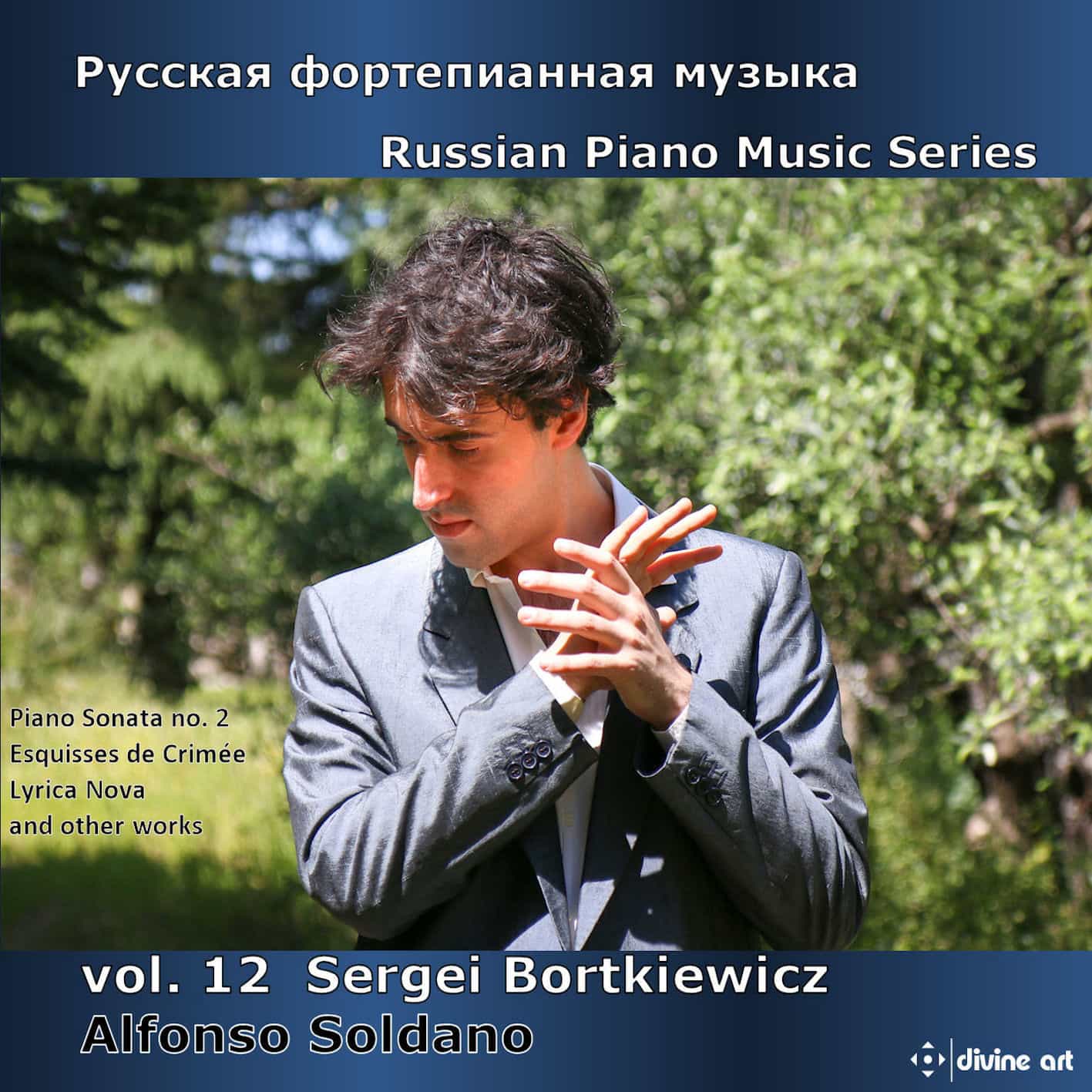
  • Russian Piano Music Volume 12 – Sergei Bortkiewicz

    Russian Piano Music Volume 12 – Sergei Bortkiewicz

    It is quite puzzling why, until very recently, the music of Bortkiewicz has not been widely known and loved: his high Romantic style makes him a natural to the legacy of Tchaikovsky, and he was a close contemporary of Rachmaninov. Born of Polish parentage, and later an Austrian citizen, Bortkiewicz lived in many parts of Europe but always considered himself truly Russian. This recording gives a wide sample of his work and will surely whet the appetite for more. Performed by Alfonso Soldano in his CD debut for Divine Art, a professor at the Conservatorio G. Braga in Teramo, Italy; he is also the biographer of the composer, a role which has given him unique insight into the mind and spirit of Bortkiewicz.