It has been a while since any new releases of Vyacheslav Artyomov’s music have appeared, and now we have two from the same label—both in memory, by the way, of Mstislav Rostropovich. (Rostropovich, among other things, was the composer’s friend, and he premiered Gentle Emanation in 1991 during his tenure as conductor of the National Symphony Orchestra in Washington.) In Fanfare 15:2, David Hurwitz hated and was bored by Artyomov’s music (“like Penderecki on an es¬pecially bad day”) whereas, 15 years later (Fanfare 30:2), when the composer’s Requiem was reissued, I designated the CD (“most interesting”) as a Want List candidate. Perhaps the moral of the story is that I am easily amused!
Gentle Emanation was revised in 2008, and it is that revised version that has been recorded here. It is a “symphony in 28 continuous episodes,” although the 28 are divided into three larger movements. The title is taken from the Book of Job in its Russian version, and refers to “a moment preceding an appearance of God.” This is the third symphony in the composer’s four-symphony cycle that he called “Symphony of the Way,” although you don’t need to be familiar with the other symphonies to appreciate this one.
What does it sound like? Overall, it reminds me of an unlikely synthesis of Scriabin and Berg, and at times it also reminds me a little of film music (Jerry Goldsmith, maybe?) because of the music’s literally episodic structure and micro-structure (a gesture here, a contrasting gesture here, as if a movement were being illustrated). Sometimes we seem to be hearing the soundtrack to an invisible movie. I don’t mean that in a negative way, but if you are expecting to hear a forest, you’re more likely to hear a bunch of trees. On the other hand, conductor Currentzis calls Artyomov “the Bruckner of the 21st century,” and annotator Robert Matthew-Walker, who published a book about the composer in 1997, writes, “The spacious nobility of Artyomov’s expression recalls the unhurried contemplation of the deeply religious Bruckner—notable in the occasional suggestion of organum as a fundamental building-block of Artyomov’s large structures.” That’s fine. I’m hearing the music in my own way, at least for now, and maybe later I will hear it another way. I can be persuaded that, over the course of its 41 minutes, Gentle Emanation is arch-shaped—the first movement is an escalation, the second movement is the meat of the work, and the third is a long dying fall. This symphony is unmistakably serious and spiritual, and its many colorful or even exotic details (for example, the almost Middle Eastern wind writing in Episode 5, and elsewhere, and a variety of bird calls—including a cuckoo— in Episode 13) prevent the music from seeming grim, even though there are no smiles here.
Tristia II is a “fantasy for piano and orchestra in 11 continuous episodes,” composed in 1998 and revised in 2011. The first thing that listeners will notice is that there is a long passage near the very beginning of the work, and again near the end, where someone is speaking in Russian. (The recording perspective suggests that the speaker was recorded at a different time and place, and mixed in later.) These passages, we are told, are a prayer and a section of prose by Gogol, and it is unfor¬tunate that Divine Art has included neither the texts nor the translations. Matthew-Walker indicates that the texts are the writer’s supplications to a guardian angel, or to God, to smile on his work to come. For what it’s worth, actor Mikhail Philippov reads the texts eloquently—or so it seems to me.
As with Gentle Emanation, Tristia II flows on without a break, but with plenty of contrasts, and the impression it gives is one of a serious discourse kept from monotony by the music’s steadily changing textures and colors. The piano part contains some difficult writing, but there is no virtuos¬ity for its own sake. Instead, the piano seems to be a protagonist, responding to the music’s progress sometimes not at all, at other times quietly, and at still other times with more agitation, but always thoughtfully. Pianist Kopachevsky handles all of it very well.
The performances seem excellent. A photograph depicting Currentzis and the composer together during a recording session implies that Artyomov oversaw the recording of Gentle Emanation, at least.
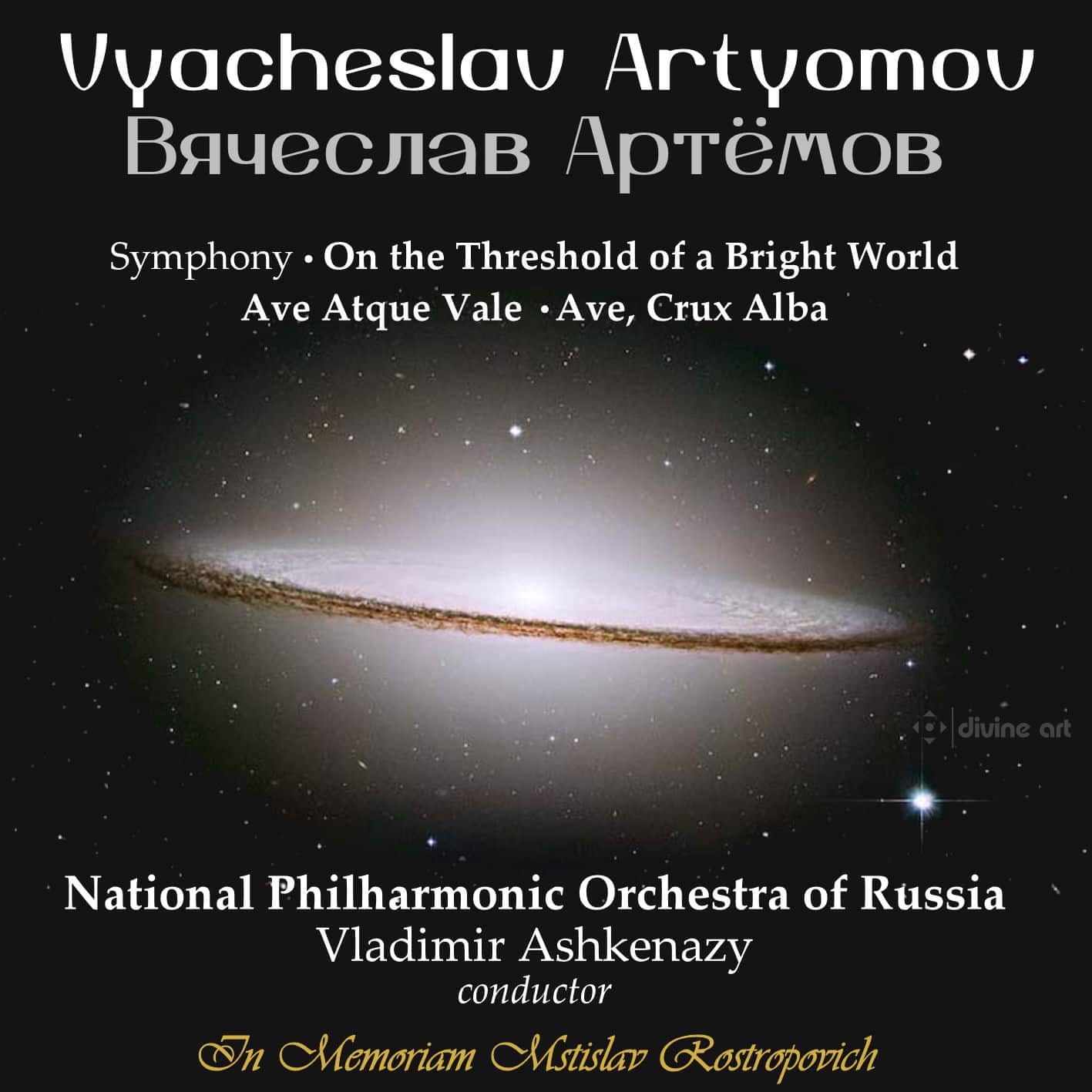
For those who are unfamiliar with Artyomov, the second of these discs probably is a better place to start, because the music’s emotional content is a little easier to grasp. On the Threshold of a Bright World (1990, rev. 2002) is the second symphony in the “Symphony of the Way” cycle. Artyomov has structured it in 18 continuous episodes, and the symphony’s total length is 36:31. The title ap¬pears to be an allusion to a section of the Book of Enoch, which Artyomov has used as an epigraph to the score: “These wonderful places are intended for the collecting spirits—souls of the dead … until the Last Judgment will take place over them.” After the fact, the title also has become a com¬mentary on today’s Russia, although this was “completely unexpected, [and] it was not one of my goals,” according to the composer. The beginning is sepulchral. Bass rumblings are answered by moaning phrases in the strings, somewhat similar to Penderecki’s The Awakening of Jacob. The Penderecki-like writing persists as the symphony continues, although not Penderecki from his earlier Sonorist phase, but later Penderecki in which his avant-gardisms were (and still are) softened by late-Romantic moods and gestures. An emotional apex is reached in Episode 7, and for the next several episodes crises comes in waves, culminating in Episode 14. The remaining four episodes seem to serve as a conciliatory postlude, and here, Artyomov’s writing becomes increasingly beautiful. The closing minutes of the symphony are very moving. At many points during the symphony’s course, solo instruments—violin, viola, piano, oboe, celesta, and organ—take on prominent roles, and the appropriate members of the orchestra are credited in the booklet.
Ave atque vale (Hail and Farewell), initially conceived as a solo percussion piece, was recast as a work for solo percussion and orchestra. It dates from 1997, and is in nine continuous episodes, with a total length of 12:15. At first, the percussion is used for color more than for rhythm, and the overall mood is tense and confrontational. The title is associated with Catullus, usually, but I don’t know if this was what Artyomov had in mind. According to the booklet note, “Artyomov is concerned with the gradual coming-together of disparate elements—personified in the various solo instruments.” It’s a good workout for the percussionist—something Evelyn Glennie would sink her teeth into (al¬though Shatayevsky is just fine)—and, as sound, it’s interesting, although I do not get a strong sense of direction from this music.
The disc ends with Artyomov’s setting (1994, rev. 2012) of the Hymn of the Order of St. John, Malta. Barely three minutes long, Ave, Crux Alba is the most immediately impressive work on these two CDs. Artyomov has created a strong and noble melody for the chorus, and dressed it in splendid orchestral garb. “Wrong” notes and harmonies intensify the emotional impact. In concert, this would get a standing ovation. It wouldn’t be bad at the end of the Hollywood movie, either. The chorus is solid as a rock.
Again, without having anything to compare them to, it would be premature to describe these recorded performances as definitive, but they give me no reason to hold back a full recommendation. The National Philharmonic Orchestra of Russia (is this the same as the Russian National Orchestra on the first disc?) is a world-class ensemble, and Ashkenazy advocates for the music perhaps even more strongly than Currentzis and Ponkin do on the other disc. Perhaps these forces will revisit those works by Artyomov that once were available on Melodiya or Olympia, but now are hard to find (and the engineering wasn’t that great to begin with).