Catalogue Connection: 25144

  • Artyomov ‘Gentle Emanation’ review on WTJU

    How to describe the music of Vyacheslav Artyomov? Imagine combining the structures of Arvo Pärt, the ethereal sound clouds of Kaija Saariaho, the intensity of György Ligeti, and the deep spirituality of John Tavener.

    Artyomov has a unique compositional voice that, while sharing elements with the afore-named composers, communicates in a musical language that’s all his own. When I first heard Artyomov, I was enraptured by his mystical world of tones and colors. Unfortunately, my introduction was through an old Melodiya CD with no liner notes. All I had was the music — and really, that was all I needed.

    Artyomov’s music isn’t tonal or atonal — it’s beyond those considerations. Rather, there’s a strong internal logic that dictates the unfolding of the music. Every note sounds like it’s exactly where it should be — even in the passages free of tonal centers.

    These new recordings of Artyomov’s music from Divine Art are welcome, indeed. The performances are more solid and assured than those of vintage Melodiya releases. The Russian National Orchestra plays cleanly and precisely — two essentials for the impact of Artyomov’s music to be fully realized.

    The liner notes (in a language I can read) are welcome, too. It helps put the works in context. I was aware that “Gentle Emanation” was part of his larger “Way” symphonic tetralogy, but I didn’t know that it was the third in the series, or that it was based on the Book of Job. According to the composer, this work represents “the facets of one soul in its aspiration to overcome challenges [to] find a way to the light.”

    The album’s companion piece is his 1997 “Tristia II, fantasy for piano and orchestra.” It features a reader reciting a poem by Nikolay Gogol. Spoken word in a piano concerto? It works — and it works well. The rhythm and inflection of the poetry become a contemplative melody. And it retains its emotional power even when the listener (like me) doesn’t understand a word.

  • Artyomov – Gentle Emanation – Allmusic

    How to describe the music of Vyacheslav Artyomov? Imagine combining the structures of Arvo Pärt, the ethereal sound clouds of Kaija Saariaho, the intensity of György Ligeti, and the deep spirituality of John Tavener.

    Artyomov has a unique compositional voice that, while sharing elements with the afore-named composers, communicates in a musical language that’s all his own.

    When I first heard Artyomov, I was enraptured by his mystical world of tones and colors. Unfortunately, my introduction was through an old Melodiya CD with no liner notes. All I had was the music – and really, that was all I needed.

    Artyomov’s music isn’t tonal or atonal – it’s beyond those considerations. Rather, there’s a strong internal logic that dictates the unfolding of the music. Every note sounds like it’s exactly where it should be – even in the passages free of tonal centers.

    These new recordings of Artyomov’s music from Divine Art are welcome, indeed. The performances are more solid and assured than those of vintage Melodiya releases. The Russian National Orchestra plays cleanly and precisely – two essentials for the impact of Artyomov’s music to be fully realized.

    The liner notes (in a language I can read) are welcome, too. It helps put the works in context. I was aware that “Gentle Emanation” was part of his larger “Way” symphonic tetralogy, but I didn’t know that it was the third in the series, or that it was based on the Book of Job. According to the composer, this work represents “the facets of one soul in its aspiration to overcome challenges [to] find a way to the light.”

    The album’s companion piece is his 1997 “Trista II, fantasy for piano and orchestra.” It features a reader reciting a poem by Nikolay Gogol. Spoken word in a piano concerto? It works – and it works well. The rhythm and inflection of the poetry become a contemplative melody. And it retains its emotional power even when the listener (like me) doesn’t understand a word.

  • Fanfare – Peter J. Rabinowitz – 25144

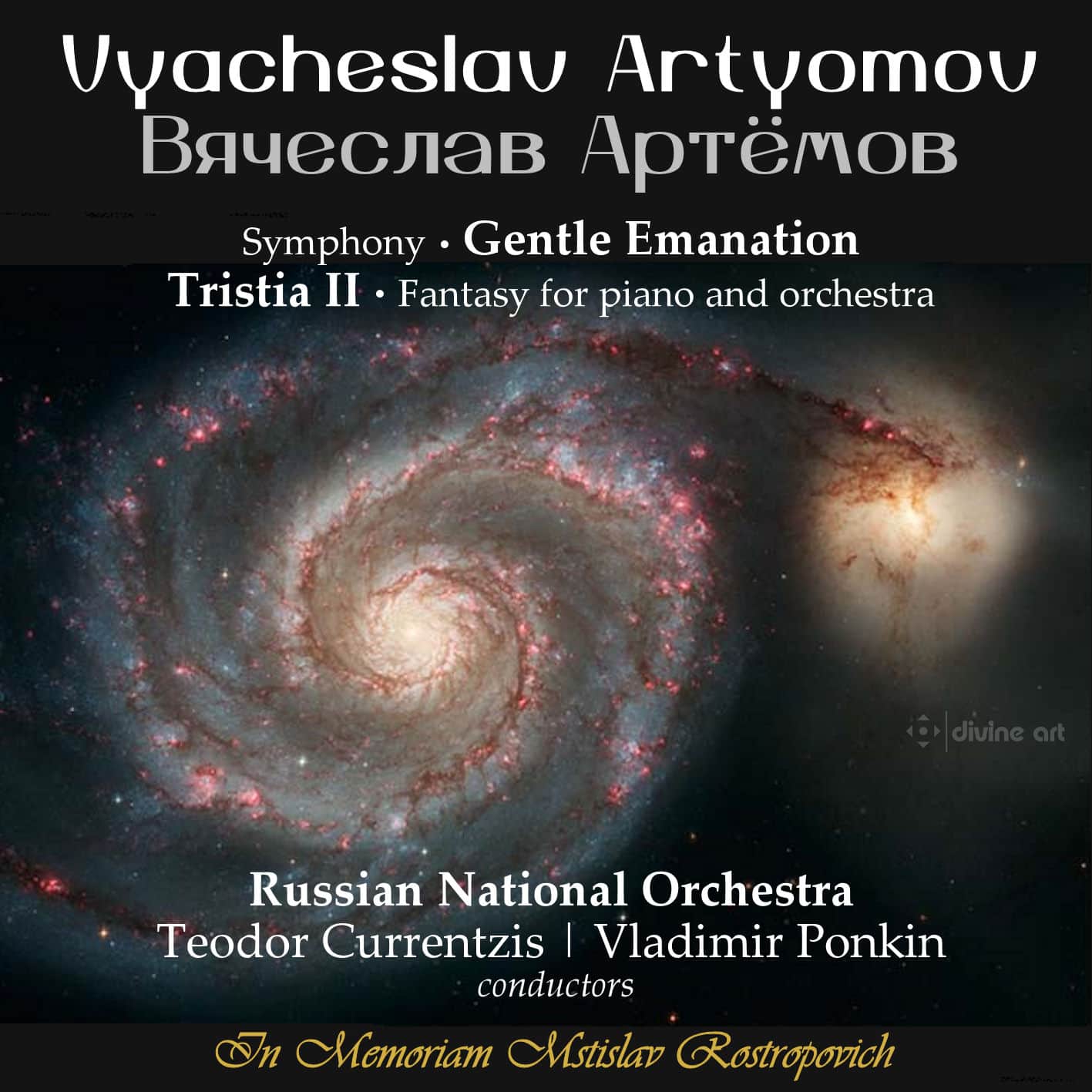
    Even before you start to listen to Gentle Emanation (1991, rev. 2008), you know what to expect. The title itself, of course, is a give-away: it is taken, we are told, from a phrase in the Russian Bible describing the pregnant moment just before God appears to one of Job’s comforters (the King James equivalent is “there was silence”). But there’s also the booklet cover, featuring a breathtaking photo of the Whirlpool Galaxy; the program notes’ description of the composer’s preference for music that is “deeply spiritiual, Christian-based at times, against the public demonstration of large-scale orches¬tral music”; the notes’ further reference to the work’s “spacious nobility” and “unhurried contempla¬tion”; the description by Octavio Roca, from a Washington Times review, that this is “music that dares simply to exist, shining like the sun, allowing us to bask in its warmth”; and the even stronger quotation from conductor Teodor Currentzis, “Artyomov now is the only composer creating serious monumental compositions of tremendous strength and beauty.” We are clearly in for transcendent, even hypnotic music, slowly moving in vast spans.

    In fact, from the painful opening drum whacks (reminiscent of the Mahler 10th), the work is so radically different that you might legitimately think the disc had been mislabeled. Vyacheslav Artyomov apparently dislikes traditional musical labels, preferring instead the trans-historical term “musica perennis” (a term also associated with John Tavener and translated here as “eternal music”). But for those seeking some point of orientation, this large-scale work—with its huge dynamic range, its bouts of gnarled Bergian harmonies, its vehement percussion outbursts, its anguished strivings, its Messiaenic bird-chattering in the woodwinds, its Schoenbergian flutter-tonguing—is far closer to neo-Expressionism than it is to anything by the so-called New Spiritualists. It’s also—despite the reference to “unhurried contemplation”—a surprisingly hyperactive piece, one in which quick and striking ges¬tures carry the primary aesthetic weight. Although it’s a continuous work of 42 minutes, it falls into three larger sections, each divided into anywhere from eight to 11 “episodes,” most of them less than two minutes long—and it shifts direction with bewildering frequency. The final section is more reflec¬tive than the first two, but even here, uneasy quiet is more prevalent than serenity. Overall, to the extent that this work is tied to Job, it seems more a reflection of his sufferings and his doubts than of his faith.

    Gentle Emanation is the third in a four-part symphonic tetralogy called Symphony of the Way. Reviewing the first section, The Way to Olympus, nearly 30 years ago (Fanfare 12:2), I suggested that the “the road to Olympus twists through the Pines of the Appian Way”; and while this later installment is less garishly Respighian, it emanates (if I can use that word) the same love of spectacle. Over the years, I’ve become less of a snob, more susceptible to the rowdier sections of the Roman Trilogy. But if anything, that has made me less susceptible to Artyomov, where—even in the bizarre passage of the second movement where the music sounds like a post-modern response to Leopold Mozart’s “Toy Symphony”—the Respighian spirit of good fun is crushed in the name of piety. Still, you should probably treat my objections with a strong dose of skepticism: Artyomov seems to have garnered the enthusiastic support of Rostropovich, Ashkenazy, Rozhdestvensky, Currentzis, and other performers—and Raymond Tuttle waxed enthusiastic over his Requiem (30:2). Certainly, if you’re interested in large-scale contemporary orchestral music, you should give this a listen.

    Tristia II, for piano, speaker, and orchestra (1998, rev. 2011), is shorter, gentler, and more hyp-notic, a piece that’s apt to whisper as often as Gentle Emanations is to scream, and (even though it too is divided into shortish “episodes”), more willing to work in longer spans. It’s not quite a piano concerto—the pianist’s role is closer to that in Scriabin’s Prometheus than it is to that in traditional concertos; and it’s got the added oddity of being bracketed by the reading of two brief bits by Gogol. although for some unaccountable reason, we’re not offered either the texts or the translations. It’s a far less striking piece, but it may, for precisely that reason, have greater staying power.

    Both works get what sound like committed performances—and the sound is no obstacle. Warily recommended.
  • Pizzicato – Uwe Krusch – 25144

    The music by Russian composer Vyacheslav Artyomov (born 1940) can be outlined (outside of regular style categories) by the corner points ‘archaic’, ‘Christian’ and ‘Eastern Meditation’. This in combination with Russian folk music creates his own style, which he describes as ‘eternal’.

    In 1975 Artyomov, together with the composers Wiktor Suslin and Sofia Gubaidulina, founded the improvisation ensemble ‘Astreja’, which improvised on folk instruments in order to get inspiration for their compositions.

    This CD combines two large format pieces, first the Symphony ‘Gentle Emanation’ which is the third part of the symphonic Tetralogy ‘Symphony of the Way’, and the other ‘Tristia II’ for piano, orchestra and narrator.

    Symphony ‘Gentle Emanation, with 28 continuous segments and over 40 minutes in duration, is based on one section in the book of Job, in which Job awaits God. With Currentzis the piece is interpreted by a conductor who sees Artyomov as the 21st century’s Bruckner. Correspondingly he develops the piece with intensity and effectiveness for its whole duration.

    ‘Tristia II’, which is conducted by Vladimir Ponkin, was originally a piano concerto, which has been amended by the addition of a narrator who appears for extended periods at the beginning and again at the end accompanied by a calm orchestral sound-carpet. The number of works with narrator is limited, as a concerto probably unique. The emphasis of this composition however, is on the piano part, which blends naturally in the orchestral movement. The texts are prayers for God’s support of future tasks; the music is inspired by religious motives.

    The Russian national orchestra is an established, successful body which devotes itself expertly to Artyomov’s work. With Ponkin and even more so with Currentzis they found conductors, who are able to shape the large forms and create tension which persists. Pianist Kopachevsky mastered the piano part with excellence. The role of narrator played by Russian actor Philippov is intense, but still appears as an accessory.
    (Awarded 5 stars)

  • Grego Applegate Edwards – Classical Modern Music – 25144

    Here we are at the edge, the periphery of modernity and, really, nothing is working from where we sit. Yet I still believe in the future, in modernity, and so I also out of habit and appreciation respond favorably to the experimenters, those who go boldly in music where the vast majority of musical humanity has never trodden, not at least until the turn of the last century when humanity found musical wunderkind who opened up the fertile vistas of harmonic, rhythmic and melodic possibilities we as a species had never considered before.

    And for all that intro I do introduce a new (to me) high modernist voice, from Russia, one Vyacheslav Artyomov (born 1940) and a CD of two choice orchestral works,Symphony Gentle Emanation and Tristia II, Fantasy for piano and orchestra (Divine Art 25144). Surprise! This is a fully developed voice in new music, someone who has carried over the mysterious cosmos of late Scriabin and Messiaen and made something new out of the unrealized potentials that lurked behind those composers’s most prescient creations.

    In spite of my grouchy social-critical beginnings today the music of Artyomov truly speaks to me. He has a full grasp, a vision of the modern orchestra and what he might make it do, and on these two symphonic works, two sides in a way of his vision, he combines brash and bracing dissonances punctuated by mysterious ruminations on the universe in play, at work, simply being in all its shining glory and mystery, its endless processual flux that presumably has purpose that we only have a dim idea of in our religions and our science, an idea of our place in it that we continually confront with the facts and revelations that humanity thus far has managed to gather about ourselves and the cosmos. That to me is fundamental to the modernist project, in music a sonic analog of what we do and do not know.

    That is what Artyomov speaks to me, in elegant and vivid eloquence. The Russian National Orchestra under conductors Teodor Currentzis and Vladimir Ponkin bring this complex and very personal music into vivid relief against the seeming silence of the universe. Artyomov is a Russian who travels in the wake of those before and manages to say something new and different. That is a remarkable achievement and he most certainly deserves a hearing.

    All you modernists and seekers of the new look no further, at least today. Give a listen to Vyacheslav Artyomov on this very moving sample of his work. It gives us another way to thread the futurist needle.

    And bravo to that!

  • Pizzicato – Norbert Tischer – 25144

    The Divine Art label has released two albums of orchestral works which each contain a significant and substantial symphony from Vyacheslav Artyomov one of the lesser known Soviet/Russian composers and a unique voice.

    Born in Moscow 1940 Artyomov is one of a generation whose compositional career commenced during the time of the so-called ‘Khrushchev Thaw’ when the climate of state oppression and censorship in the Soviet Union became less draconian. Originally intending to become a physicist, Artyomov changed course by attending Moscow Conservatory and studying composition with Nikolai Sidelnikov and piano with Tovi Logovinsky. As one of Russia’s leading composers Artyomov has been the recipient of several prestigious commissions.

    The second album contains two works, with the opening and most substantial work the Symphony: ‘Gentle Emanation’ taken from the Book of Job from the Russian Bible which is No. 3 of the cycle Symphonic Tetralogy titled ‘Symphony of the Way’. Composed in 1991 this is a three movement score with each movement inhabited by a contrasting character yet all representing, according to the composer, an aspect of “one soul in its inspiration to overcome challenges or obstacles in its inner drama and find a way to the light.” Mstislav Rostropovich premièred the work with the National Symphony Orchestra in Washington and subsequently, in 2008, Artyomov decided to make extensive revisions to the score, which is the version played here. Opening with four spaced, extremely loud drum thwacks this is a remarkably powerful score that for its considerable length maintains a mood of inexorable mystery, of an almost ethereal luminosity contrasted with tension-filled episodes of menace and anger.

    Next comes Tristia II, described as a fantasy for piano and orchestra, written in 1997 to commemorate the 60th birthday of Vladimir Ashkenazy. Artyomov revised the score in 2011. Integral in Tristia II is a spoken part in the first and last episodes with Mikhail Philippov here narrating the poem and prayer by Nikolai Gogol. Opening with densely woven strings, an atmospheric mood of nervous edgy and orchestral colour is soon created and maintained. The prominent piano chords used percussively not lyrically add to the anxious disposition. Narrator Mikhail Philippov’s vocal is deep and richly resonant. Unfortunately none of Gogol’s Russian text is provided in the booklet, only a single sentence explanation which is scant consolation for missing out on this aspect of the composer’s inspiration that he clearly felt was so important. The Russian National Orchestra excels under baton of Teodor Currentzis, giving a compelling performance that feels well-paced, producing wonderful orchestral textures. Pianist Philip Kopachevsky provides alert playing of real clarity.

    Both albums were recorded at Mosfilm Sound Studio, Moscow with excellent sound, crystal clear and nicely balanced too. These two albums of works by Vyacheslav Artyomov, one of Russia’s unsung composers, make a substantial impression with his unique soundworld.

  • Artyomov: Gentle Emanation Symphony, etc

    Artyomov: Gentle Emanation Symphony, etc

    The foremost composer living in Russia today, Artyomov is producing works in the grand symphonic and post-Romantic traditions, unquestionably masterpieces of the modern age. The ‘Gentle Emanation’ symphony, part of his tetralogy ‘Symphony of the Way’ is typically underpinned by his deep spirituality but is universal and cosmic in scope. Tristia II is a fantasy for piano and orchestra which incorporates prayers and readings from the writings of Nicolai Gogol.

    A companion CD contains the symphony ‘On the Threshold of a Bright World’ and other works (DDA 25143). The Artyomov series now consists of 11 albums in all.