Catalogue Connection: 25145

  • Enigmas – review in Absolute Sound

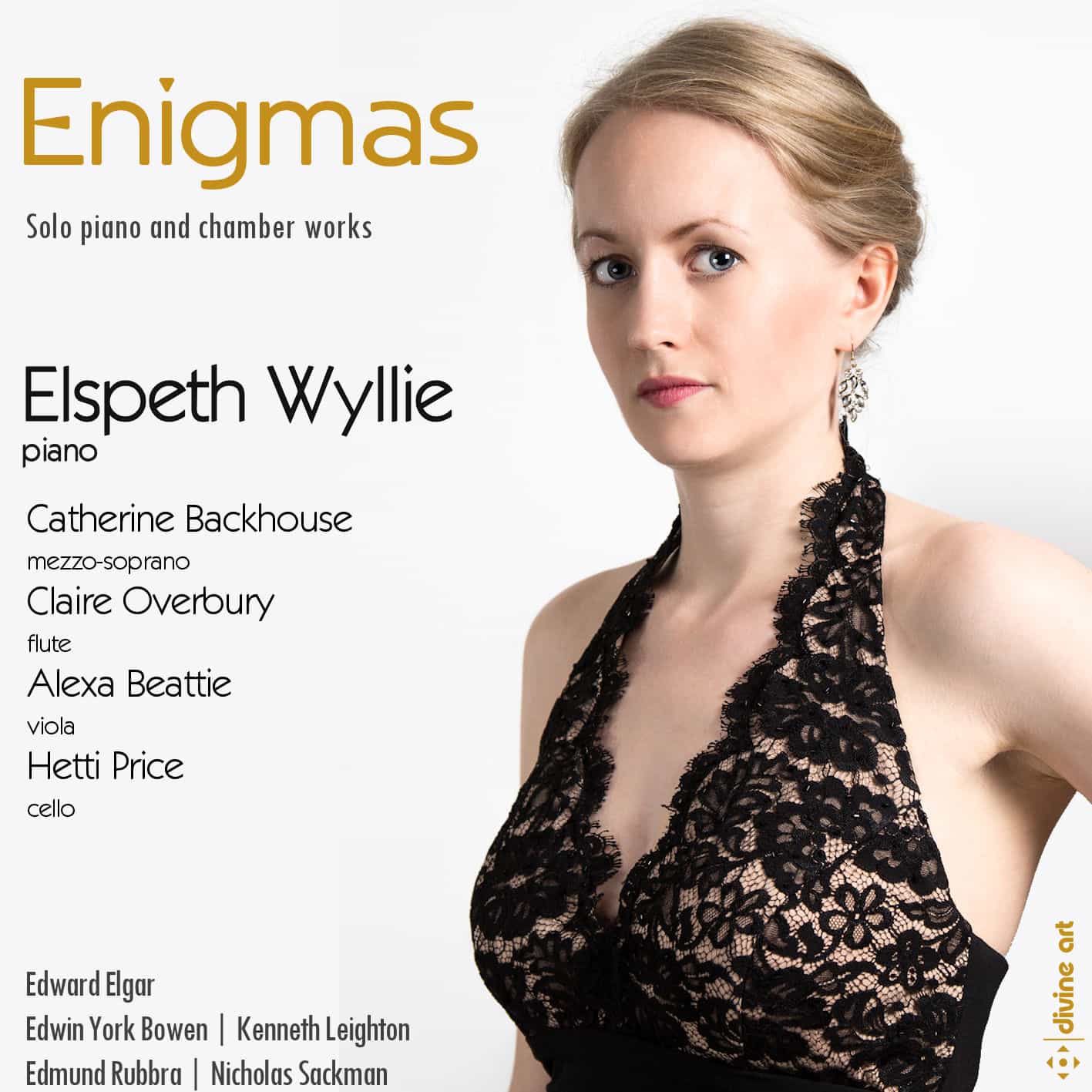
    Edward Elgar’s 1899 Enigma Variations is a much-loved staple of the orchestral repertoire, its 14 transformations of a richly suggestive theme ranging through moods tender, delicate, musing, ceremonious, and celebratory – a sort of fond farewell to all that was noble and good in the Victorian Era. Though first composed for piano, it’s seldom recorded on that instrument, and it comes as a treat to hear Elspeth Wyllie’s thoughtful and expressive rendition of the original version, which offers an intimacy and sweetness that the orchestra can’t match, while revealing harmonic nuances and textural felicities that don’t come through in the concert hall.

    Wyllie’s program is filled out with chamber pieces by four later English composers, all of them working in traditional idioms. Kenneth Leighton’s Elegy for Cello and Piano is appropriately sad and lovely, York Bowen’s Flute Sonata mellifluous and light-footed, Nicholas Sackman’s Folio I postcard-brief and winsome, and Edmund Rubbra’s Two Sonnets (settings of sacred texts for soprano and piano) reverent and glowing. This is a nicely recorded and beautifully played program of often pensive music that’s perfect for a quiet, rainy autumn afternoon.

  • Elspeth Wyllie – Enigmas CD review

    As its title might suggest, the centerpiece of this unusual and enterprising album of English music is Elgar’s own arrangement for solo piano—designed for the once immensely lucrative home market—of his Enigma Variations, the work that announced the arrival of the first great English composer since the death of Henry Purcell two centuries before. Elspeth Wyllie’s performance is an excellent one, alert to the wide range of expressive details—her sensitive molding of the moody theme is a joy from beginning to end—and fully aware that it’s not her job to make the piano sound like Elgar’s infinitely rich orchestra. Instead, she shapes each of the variations in purely pianistic terms and in general succeeds brilliantly. The mild stutter in “Dorabella” comes off with unaffected charm, and even “Nimrod” works better than you might think as a kind of British Chopin nocturne. Predictably, some of the more energetic items really call out for the full orchestral treatment, especially “G.R.S.” and its incomparably boisterous portrait of the subject’s bulldog Dan. The only serious miscalculation comes in the final “E.D.U.”—not derived, as the notes suggest, from the German spelling (Eduard) of the composer’s Christian name, but “Edoo,” Alice Elgar’s pet name for her husband—in which the Elgarian rubato is applied so liberally that the phrases frequently threaten to fall apart. That aside, it’s a superlative performance.

    The remainder of the album is taken up with music played with some of Wyllie’s favorite colleagues, musicians who “share an interest in championing less well-known repertoire in concert programs.” The first is the moving Elegy for Cello and Piano by Kenneth Leighton, written two years before his extraordinary Cello Concerto helped launch his career in 1955. It’s an intricate, gravely beautiful work given a performance whose breadth and sensitivity rivals that of the pioneering recording made by Rafael Wallfisch, currently available from Naxos (8.571358). York Bowen’s delectably pungent Flute Sonata responds well to Claire Overbury’s flowing yet witty approach, especially in the concluding Allegro con fuoco which captures even more of that gentlemanly nervous energy than the Endymion Ensemble did in their hard-to-find Dutton recording.

    The real surprise here is Nicholas Sackman’s Folio I, a suite of six brief piano pieces designed for his teenage children to play. Tuneful, ingratiating, yet rhythmically quirky—purposefully so, according to Wyllie, in order “to provide challenge and interest”—it’s an engaging collection, especially the movements called “Switchback,” “Jumping Jack,” and “Rum Baba.” Wyllie plays them all as though they had been written for her, in spite of the obvious fact that they weren’t.

    The album concludes with a pair of dark and lovely songs by Edmund Rubbra, the long-time Oxford don and one of the most uncompromising symphonists of the 20th century. “Upon the Crucifix” and “On the Reed of Our Lord’s Passion” are settings of two sonnets by William Alabaster, the Elizabethan diplomat, poet, and convert to Catholicism whose beliefs led to several stays in prison. Rubbra’s settings could not be more apt nor more quietly intense, and the performances are marred only by mezzo-soprano Catherine Backhouse’s at times uncomfortably wide vibrato, the only minor drawback—along with that taffy-pull “E.D.U.”—to an unusual and rewarding collection.

  • Enigmas – Review from Klassik.com

    Interpretation 4/5 Sound quality 4/5 Repertoire 4/5 Booklet 3/5
    A debut CD like a kitchen party – a Scottish pianist invites her friends, and they all bring something different. Not everything is equally well done, but much is excellent.

    Straight away the CD title “Enigmas” suggests an element of mystery. The solo piano version of The Enigma Variations, played by Wyllie, is the obvious candidate, this version is by the cpmoser himself, not otherwise a prolific writer for the piano. It is not the biographical personal and character traits suggested by the music, but the unfamiliar sound of the piece on the piano, which is the problem to be solved. The pianist, trained in Edinburgh, Oxford and at the Royal Academy of Music, has not always a satisfactory solution; the well defined piano sound allows her a finely balanced sound which does convey something of the colourful orchestral sound – in tempo terms after a leisurely beginning it develops an inner tension and drama, so that even against the orchestral diversity of sound, the rather brittle piano version is very good to listen to and enjoy.

    Wyllie has a flair for sound colours and tempi, with a secure technical and artistic touch, except in the last variation, the finale; why this is reduced to a crawl and loses all tension is the biggest mystery of the CD. Garzón in 5:49 and Wass in 6:05 provide the technical and tonal heights with some safety margin, but a brake on tempo to 7 minutes and 19 seconds is aesthetically unjustifiable and dilutes the otherwise excellent impression that Wyllie gives on her debut CD. In ‘Nimrod’, Wyllie’s deliberate slowness is within the range of elegiac expression but the finale dies at a snail’s pace. Otherwise this artist’s visiting card Cd published by British-American label Divine Art is recommended.

    Like the vast majority of the Enigma Variations, the short character pieces by Nicholas Sackman, born in 1950) are pictorially quite obvious, the second soloist joins the main artist in these humorous sketches. Including ‘Jumping Jack’ and ‘Rum Baba’, these are not avant-garde but well constructed ‘petits fours’ for salon concerts and teaching. The booklet does not contain the date of composition.

    York Bowen’s Flute Sonata of 1946 belongs in the same field of British conversation music, here with a clear influence from French neighbours, notable Francis Poulenc. With the flautist Claire Overbury, a harmonious, atmospheric performance has been achieved. Kenneth Leighton’s rather gloomy Elegy, Op. 5, from 1953, is played equally effectively by cellist Hetti Price in a dynamically and expressively well balanced interpretation. Leighton’s Elegy and Bowen’s Flute Sonata are recommended!

    Although the piano sound is not quite as transparent in the duo pieces as in the solo works, the flute and cello come through speakers or headphones with powerful force. Edmund Rubbra’s late ‘Alabaster Sonnets’, on the other hand, suffer a little from the imperfect intonation of soprano Catherine Backhouse, which is juxtaposed against Elspeth Wyllie’s piano and Alexa Beattie’s viola.

    Not everything worked perfectly at this puzzle party with British offerings; on the whole it is very good, expect Elgar’s final variation and Backhouse on the final tracks; however given the somewhat exotic touch of the programme it is advisable to give these interesting tidbits a bite.
  • MusicWeb International – John France – 25145

    I enjoyed Elgar’s Enigma Variations, ‘dished up’ by the composer himself for piano. I have bashed my way through ‘Nimrod’ on the piano on several occasions, but the rest of the score is largely beyond my Grade 6½. Arguments could go either way about the ‘validity’ or ‘need’ for this transcription. I agree with the liner notes that this version allows the listener to concentrate on the musical structure of these variations without the ‘hindrance’ of the masterly orchestration. The work can be approached with a ‘fresh intimacy.’ It will never supplant the orchestral version, but it is a pleasure to hear. It is splendidly played here by Elspeth Wylie.

    Kenneth Leighton’s Elegy for cello and pianoforte, op.5 is an early work, dating from 1950 and was part of a discarded Viola Sonata (1949). It was written when the composer was only 21 years old. This was before the he studied with Goffredo Petrassi in Rome and began to assimilate Bergian serialism, neo-classicism and some post-Weberian techniques. The Elegy is characterised by a pastoral mood, which may have been influenced by Herbert Howells, Gerald Finzi or RVW. I have noted before that this work does not use folk-song and certainly is not a rustic ramble. The music is introspective and consistently lyrical in mood.

    It is a pity that the liner notes do not give a date for York Bowen’s romantic Sonata for flute and piano, op.120. The listener needs to understand that this is a post-Second World War work composed in 1946. It is unashamedly romantic in effect. Clearly, this was not the direction that music was going in at that time, and one can begin to understand why it long-remained un-played. Bowen’s career straddled much musical history: he was sixteen when Elgar premiered his Enigma Variations and Elvis Presley was at No.1 in the UK charts on the day he died. It is good that this composer, once disparagingly dubbed the ‘English Rachmaninov’, is appreciated in our musically diverse era. I particularly enjoyed the ‘pastoral’ mood of the slow movement which may or may not be English in inspiration. The general feel of this work is coloured by Mediterranean hues. It was dedicated to the flautist Gareth Morris (1920-2007).

    Nicholas Sackman (b.1950) is an unknown name to me. I point the reader to the Wikipedia article for further information. Unfortunately, the link to the chronological list of his works is no longer working: neither is a link to his personal webpage. The present Folio I is a set of six short piano pieces that were composed for his ‘teenage children’. It includes imaginary titles such as ‘Switchback’, ‘Jumping Jack’ and ‘Rum Baba’. They are rather fun to listen to and are, as the liner notes suggest, ‘captivating’ in effect.

    The Two Sonnets by William Alabaster, op.87 (1955) for mezzo-soprano, viola and piano are beautifully and sensitively performed by Catherine Backhouse, Alexa Beattie and Elspeth Wylie. Mention should be made that Alabaster (1567-1640) was an English poet, playwright, and religious writer. Converted to Catholicism, he was imprisoned for his beliefs and reverted to Anglicanism. Listening to these beautiful songs, it is clear that Rubbra, a deeply religious man, had a great sympathy for these two poems.

    As noted above, I felt that the liner notes could have given the dates of each work. I know that this information is usually available via a ‘quick’ web-search. (In the case of the Sackman, even that option failed me). Other than that, they provide a helpful introduction to each work. They include a detailed presentation of the Enigma dedications and the text for the Alabaster poem.

    The performance is superb in this eclectic selection of music. Elspeth Wylie plays for all the pieces. Violist Alexa Beattie makes a fine contribution to the Rubbra. I felt that the cellist, Hetti Price engaged well with the Kenneth Leighton and Claire Overbury gave an enchanting performance of the Bowen Flute Sonata. They are my two favourite numbers on the wide-ranging and thoroughly agreeable CD.

  • The Chronicle – Jeremy Condliffe – 25145

    Tristia II is a “fantasy for piano and orchestra in 11 continuous episodes,” composed in 1998 and revised in 2011. The first thing that listeners will notice is that there is a long passage near the very beginning of the work, and again near the end, where someone is speaking in Russian. (The recording perspective suggests that the speaker was recorded at a different time and place, and mixed in later.) These passages, we are told, are a prayer and a section of prose by Gogol, and it is unfor¬tunate that Divine Art has included neither the texts nor the translations. Matthew-Walker indicates that the texts are the writer’s supplications to a guardian angel, or to God, to smile on his work to come. For what it’s worth, actor Mikhail Philippov reads the texts eloquently—or so it seems to me.

  • MusicWeb International – Rob Barnett – 25145

    As with Gentle Emanation, Tristia II flows on without a break, but with plenty of contrasts, and the impression it gives is one of a serious discourse kept from monotony by the music’s steadily changing textures and colors. The piano part contains some difficult writing, but there is no virtuos¬ity for its own sake. Instead, the piano seems to be a protagonist, responding to the music’s progress sometimes not at all, at other times quietly, and at still other times with more agitation, but always thoughtfully. Pianist Kopachevsky handles all of it very well.

  • Enigmas

    Enigmas

    A varied range of masterful works from English 20th century composers – some familiar and all major works of importance. Elgar composed his Enigma Variations at the piano; it was always suitable for a solo version and Elgar himself wrote this. Bowen’s Flute Sonata is well known – a Romantic staple — as is Leighton’s Elegy, which deserves to be better known. The piano solo work Folio I is lively and full of fun, while the two Sonnets of Rubbra are exquisitely gorgeous and absolutely essential listening.

    Fine performances by pianist Elspeth Wyllie who is an accomplished soloist and chamber musician/accompanist, working throughout the UK and other countries. The young set of musicians here show exceptional talent and musicianship in the recorded works which are very varied yet make up a coherent concert album.