Carson Cooman’s music seems to be appearing on discs widely. Hymnus by Divine Art (DDA 25147) was released in January with 15 works played by Erik Simmons on the 1787 Johann Holzhey organ at St Peter and St paul, Weissenau, Germany. The works were released [sic – ‘composed’?] between 1999 and 2015. A great CD of music that can be enjoyed including a nicely produced booklet with lots of information about the music and the organ – and how the recording was made using the organ to record the performance via the Hauptwerk system.
Catalogue Connection: 25147
-
Fanfare – David DeBoor Canfield – 25147
The performances seem excellent. A photograph depicting Currentzis and the composer together during a recording session implies that Artyomov oversaw the recording of Gentle Emanation, at least.
-
Choir & Organ – Michael Quinn – 25147
Divine Art’s championing of the prolific Carson Cooman (b.1982) continues with this seventh disc of the American miniaturist’s melodic and approachable music. The Rondo Festivo a rousing exception, the accent here is on the meditative, many of the 15 pieces composed in memoriam, several of them rooted in existing hymn tunes. Erik Simmons makes much of subtly differentiated music distinguished by serene, slow-moving lyricism.
Intriguingly, the II/42 Holzhey organ in Weissenau’s St. Peter & Paul church is heard sampled through the Hauptwerk MIDI system. With pipes separately recorded at optimal acoustic distances, the resulting sound is atmospheric, surprisingly attractive and altogether pleasing. (Awarded Four Stars)
-
Fanfare – Colin Clarke – 25147
In keeping with the composer’s own methodology, the title above omits the opus numbers for these works (the listing on the disc only gives years of composition); but the opus numbers themselves easily reach past op. 1000, which gives an idea of the extent of Cooman’s output. Born as recently as 1982, Cooman is not only a composer but also an organist and a musical commentator. His vast output is obviously the result of someone with real musical felicity. My colleague Robert Carl reviewed the Naxos disc of Cooman’s Second and Third Symphonies, the nine minute Piano Concerto plus sundry other pieces in Fanfare 31:3, appreciating the composer’s strengths of clear expression. An MSR disc of Cooman’s music (catalog number 1387) made it into David DeBoor Canfield’s Wants List of 2011; Canfield also reviewed the previous Divine Art release of Cooman’s organ music on Divine Art (a twofer, 21229) as recently as Fanfare 40:3. As readers will doubtless be screaming for me to point out by now, Carson Cooman is also a reviewer for Fanfare magazine.
It has been a pleasure not only to audition this disc multiple times but also to hear other music by this composer: his short (10minute) Second Symphony is particularly rewarding (from the Naxos disc mentioned above.) Here is 66 minutes of organ delight. Cooman’s range of harmonic palette is wide. Many of his pieces on this disc were written in memory of particular people, and Cooman usually links the piece in some specific way with the immortalized person.
The performances here are stunning in their grasp of the musical material. It’s a good choice to start with the 1999 piece Haec aeterna (op. 118). The work opens with a deep bass pedal ushering in the slow moving harmonic progressions. Based on the well known hymn tune The Old Hundredth, the piece invokes timelessness in the manner of Messiaen. Similar, if a touch more direct, is Arioso of 2013. In contrast the Festive Processional of 2004 (op. 566), a traditional “trumpet processional,” is bright, positive and catchy. The tune will stick around in your mind for a while afterwards.
There is infinite tenderness to the Pavane for a Duchess at St Andrew’s (2014, op. 1070). Another in memoriam, it is deliciously lachrymose and exudes the dignified gait of the Pavane form itself. Taking inspiration from Medieval music, Planctus IV (op. 1071, 2014) commemorates the life of Austrian composer Elodie Lauten (1950–2014); a “planctus” is a song of lament, and that’s certainly what is on offer here. The imaginative use of organ timbre is particularly involving here.
Inspired by the bittersweet nature of some Scandinavian music, the Two Elegiac Pieces (op. 1078, 2014) seem to imply an ancient Otherworld, particularly the first with its marking Moderato rubato (the rubato in this slow moving context obfuscates any underlying pulse, giving a decidedly floating aspect to the music). If anything, the second piece is even more interior; if an organ can whisper secrets in your ear, then that is what it does here.
Another aspect of Cooman’s output comes across in the Prelude in Copper (op. 1060, 2014). Brighter in aspect, the treble positively glistens. Although another “in memoriam,” it holds contained joy. The person it was written to commemorate was a metallurgist and a leading expert on copper, hence the title; the violinistic gestures of the melody are to reflect that person’s admiration for the violin. If the Chorale semplice (in memoriam James Pressler), op. 1054, of 2014 returns to Cooman’s interior style, the Folk Prelude on “Azmon” (Azmon being a hymn tune) is delightful, pointing out the folk nature of the melody while retaining respect for the original.
The Aria quasi una ciaccona (op. 1044, 2013) has especial resonance here as it was written in memory of the mother of the present organist, Erik Simmons, on her passing in 2013.
A chaconne bass provides the backing for a slowly uncurling melody in a piece of transcendental calm and peace. There is an interior glow to the work that seems to mark this as a particularly special specimen of Cooman’s output.While the Partita semplice (op. 1123, 2015) is cast in seven movements, those movements are all short (the total duration is just over six minutes). The result is a musical tapestry unified by its variation core. The variations are on the initial chorale; the result is a miracle of concision and variety. The dancelike movement is particularly charming.
Dedicated to the German organist Peter Bares, the Three Enigmas (op. 1110, 2015) are quizzical, bordering on the quirky, yet slow throughout, a contradiction perhaps reflected by the title. The Prelude on “Dix” (op. 852, 2009) takes a hymn tune with the text “For the beauty of the Earth,” reflecting the work’s dedicatee’s love of Nature. Although no devotee of hymnody myself, personally I found this piece incredibly touching in its affectionate handling of the hymn tune.
Dedicated to a group of people (the staff of C. B. Fisk Inc., organ builders) Hymnus also celebrates the 30th anniversary of Fisk’s passing. Written in 2013 (and identified as op. 1036) this lovely, dreamy piece closes in a space of tranquility. Finally, Diptych of the same year (op. 1007) is a reflecting “aria serena,” followed by a significantly more outgoing, not to mention joyous, “rondo festivo.” Just like the first track, it is expertly chosen to lead the listener into Cooman’s world, so this final offering acts as a joyous celebration of his output.
The recording (on the organ of Saint Peter and Paul, Weissenau, Germany) is superb. Cooman and Simmons are credited as coproducers of this disc, and it is difficult to imagine a more satisfying result. Wholeheartedly recommended.
-
American Record Guide – Robert Delcamp – 25147
The latest volume in Simmons’s survey of organ music by the prolific American compos¬er Carson Cooman. These short, pleasant, well-crafted pieces are written in memory of various people, with “something about the musical content that is connected to the individual being memorialized” For exam¬ple, Prelude in Copper is dedicated to a metal¬lurgist, one of the world’s leading experts on copper.
Simmons delivers his usual fine per¬formance, this time on a 1787 Holzhey organ in the church of St Peter and Paul in Weissenau, Germany. Notes on the music by the composer and specification.
-
The Whole Note – Alex Baran – 25147
Organ recordings appear infrequently in this column. It’s of special interest therefore, that organist Erik Simmons’ latest release, Hymnus – Music for Organ by Carson Cooman, Divine Art (dda 25147) demonstrates how new technology and contemporary music can be a winning formula for an older genre. Producers of organ recordings have always wrestled with microphone placement in the quest for the right balance of acoustic space and the instrument’s presence. The problem becomes more complex when organ pipes are located in different places throughout a building. Enter digital technology. Anyone can now purchase a digitally sampled pipe organ, recorded as individual notes from an optimal acoustic location, and play that library of samples through a midi system from a compatible keyboard. That’s exactly how this 1787 organ in Weissenau, Germany, appears in this recording.
Every actual sound from the initial speaking attack of a pipe to its final decay and slight pitch drop is captured faithfully with every note. The authenticity of the performance location sounds so complete, it makes the likelihood of the recording being done in the comfort of his living room, even more astounding. American composer Carson Cooman, in his mid-30s, has a body of works that numbers well over a thousand. Most are short pieces, three to six minutes, and designed as music for church services where preludes, postludes and interludes on that scale are best suited. His style is fairly traditional, and contemporary in the lightest sense, engaging only occasionally with atonality. The variety of his writing is impressive and he’s capable of evoking greatly contrasting moods. This is especially effective as Erik Simmons uses the Weissenau organ to maximum colouristic effect, whether drawing a single flute rank or the full organ registration.
It’s a terrific recording for three reasons: superb playing, fine composition and technological astonishment.
-
Classical Music Sentinel – Jean-Yves Duperron – 25147
I’m sure everyone would agree that there’s nothing quite as sonically impressive as hearing a mighty J.S. Bach Prelude and Fugue, or a Widor Toccata played on a powerful pipe organ with all stops open, including the 32′ Bombarde pedal stops. In the appropriate acoustics you can practically feel the air displacement. But nothing beats the sound of a pipe organ displaying its “quiet” side. One or two single stops per manual always reveal the beautiful tone, the soul, of a well built instrument. This recording contains a variety of short, quiet works for organ written by Carson Cooman over the period from 1999 to 2015. Most of the pieces were written in memory of various individuals and are therefore mostly serene and contemplative, and make full use of the 1787, Johann Nepomuk Holzhey organ of St. Peter & Paul, Weissenau, Germany’s beautiful registration. It’s plain to see that I’ve been rather impressed by some other recordings of organist Erik Simmons performing the organ music of Carson Cooman, and this one is no exception. Simmons instinctively knows which combination of stops is best suited to each individual piece based on its style, solemnity or character, and therefore brings together the organ’s tonal qualities and the music’s anima to create an image of lasting impression.
This recording was produced in live performance via the Hauptwerk system, which involves MIDI and virtual models of actual instruments. It would take too long to explain clearly how this works, but it is certainly worth your time to investigate it further. It’s almost like being in two places at once, or rather like playing an instrument remotely in real-time. Quite fascinating!
-
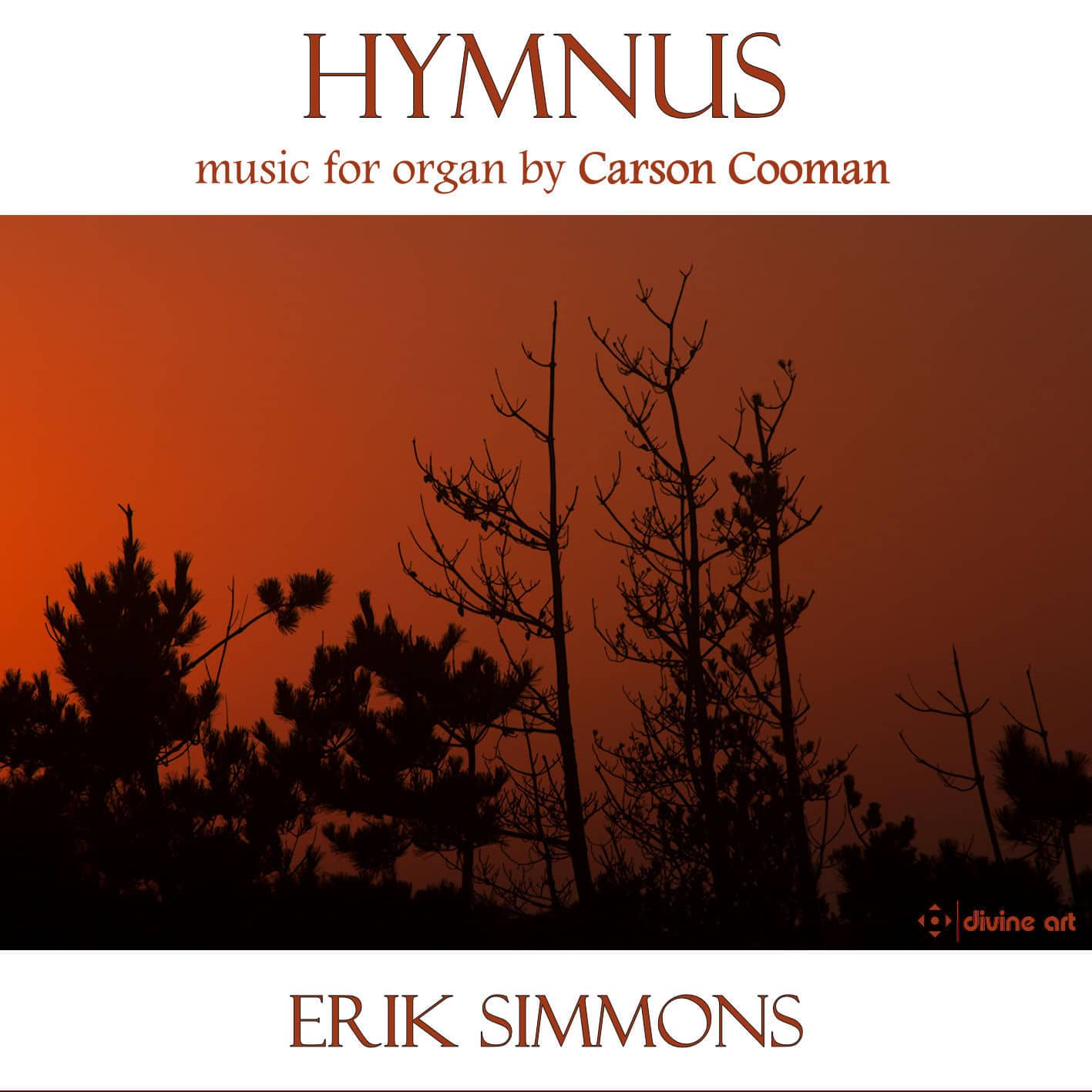
Hymnus: Music for Organ by Carson Cooman
Carson Cooman is many things musical – organist and Composer in Residence at the Memorial Church, Harvard University; writer, critic and consultant, concert organist, and above all a highly prolific composer of music in a wide variety of genres, from orchestral to song.
His organ compositions come in many styles, from those inspired by the Renaissance, to liturgical models, to more gritty and substantial pieces such as his organ symphonies and preludes and fugues. The music on this album is very suitable for both concert and church performance and is at the ‘traditional, tonal’ end of the Cooman spectrum: works of intense beauty and wide appeal.
Erik Simmons is a fine organist, making his fourth Cooman organ album for Divine Art. He is playing the organ of the Church of St. Peter & Paul in Weissenau, Germany (built 1787) in a live performance recorded through the Hauptwerk system.