Catalogue Connection: 25148

  • Music Notes review – Piano at the Ballet vol. 2

    “Leave it to DIVINE ART to bring much deserved attention to artists the likes of Anthony Goldstone (1944-2017), the late English pianist who during his life made it both his business and a labor of love to explore the rarely visited and undiscovered outer limits of the pianistic repertory.”

    I wrote that some time ago when I heard the divine art release of Goldstone’s Unheard Mozart. I am now listening to The Piano at the Ballet, volume II – The French Connection, which divine art is releasing and dedicating to the memory of their friend “Tony” Goldstone. It provides 80-minutes of sheer fun, while the scholarly though eminently accessible notes by Jeremy Nicolas, and Stephen Sutton’s mastering and design of the CD enhance the listening experience.

    The choice of music, as was always the hallmark with Goldstone is vast and informed throughout by a stylish and always tasteful approach to music that is inherently light-hearted, joyful, tongue-in-cheek, but never trivial.

    Starting with excerpts from Francis Poulenc’s 1923 ballet Les Biches this listener was transported to the Paris of the 1920’s, where the names of Jean Cocteau, Pablo Picasso, Coco Channel, and Sergei Diaghilev, among so many, were familiar to a savvy audience already accustomed to the new sights and sounds of Debussy and Stravinsky, the Impressionists, and the literary forays of Gertrude Stein and her coterie of American expatriate writers.

    The music of Henri Sauguet, Henri Françaix, Maurice Thiriet, and Boris Asafiev was not familiar to this listener prior to hearing it on this CD for the first time. Unpretentious, often satirical, unabashedly romantic in its post-Romantic melodic and harmonic languages, the writing of all four of these composers is perfectly suited to the madcap subject matters of their ballets.

    Claude Debussy’s early work Printemps is included in this CD. Composed in 1887, the music was submitted to the consideration of the august Académie des Beaux Arts, which pegged on to it the sobriquet of Impressionism, so detested by the composer, who later in need of cash had it played in a vaudeville show in London in the company of jugglers and acrobats, as if to expose the critics’ overreaching pretentiousness.

    Debussy’s substantial composition affords Goldstone the opportunity to show his mettle as a solid technician, as do tracks 26 through 28 of the CD, featuring excerpts from Stravinsky’s Pulcinella, which bring the splendid collection of ballet music in the divine art volume two of The French Connection’s The Piano at the Ballet to a lovely ending.
    Rafael de Acha

  • Piano at the Ballet II – review in Fanfare

    Sadly, this review must also serve as an obituary. Shortly after making this recording, Anthony Goldstone died at the age of 72. I think of him as a typically British pianist in the sense that his technique was as good as everyone else’s, broadly speaking, but he never went to the bank with it. He preferred to carve a niche for himself by playing and recording good old music that many flashier pianists would never bother with. (Just look at the headnote.) Yes, he was a Schubert specialist (he and his wife Caroline Clemmow recorded all of that composer’s four-hand music), but if you look at his Divine Art discography, you will find entire discs devoted to the music of Vladimir Rebikov, Reinhold Glière, Sergei Liapunov, and so on.

    “It is believed that all these pieces are receiving their premiere recording in piano form,” is what we are informed by the booklet. Elsewhere, “most [of these] works are existing transcriptions although amended and improved (especially in the Debussy) through Anthony Goldstone’s unerring skill.” So who did these transcriptions anyway? Your guess is as good as mine. The booklet note doesn’t tell us. This didn’t decrease my enjoyment of the music, though.

    I think a good phrase to describe much of this program is “cultured, but impudent.” There’s a lot of very French nose-thumbing in these works, especially from Francis Poulenc, Henri Sauguet, Jean Françaix, and Maurice Thiriet. All were born within 13 years of each other, and they had much in common. For example, Thiriet’s ballet (its title can be translated as “The Cooked Egg”) concerns three young ladies who arrive in Hell, having been turned into chickens. It ends with a “Cancan final endiablé.” Thiriet’s score, as presented here, nods not just at the cancan but also at Gershwin-like pop, French music hall genres, and mock sentimentality. It’s goofy, but never slipshod or gross. Now I am curious about the original versions, but good luck at finding recordings of most of those. Goldstone shows us a good time with this last disc of his, and he opens up several doors whose existence I was unaware of until now. He also makes a good case for Printemps, nobody’s favorite Debussy score.
    My only complaint is that the latter is the only score that Goldstone plays in toto—everything else comes to us in slices and chunks. Maybe he did us a favor by choosing the best bits!

    If Goldstone was ailing when he recorded this disc, there’s no sign of it in his playing. Everything is up to his high standards. You won’t exclaim over his technical prowess, and you won’t be scandalized over his interpretations. Instead, you’ll feel like you’ve been taken on a unique and interesting trip to France by an agreeable, experienced tour guide—someone with a sly twinkle in his eye who nevertheless would never make a “blue” joke, be rude to the vicar, or drink too much sherry. Thank you, Anthony Goldstone, and may all your pianos in heaven be in tune!

  • Piano at the Ballet 2 – review

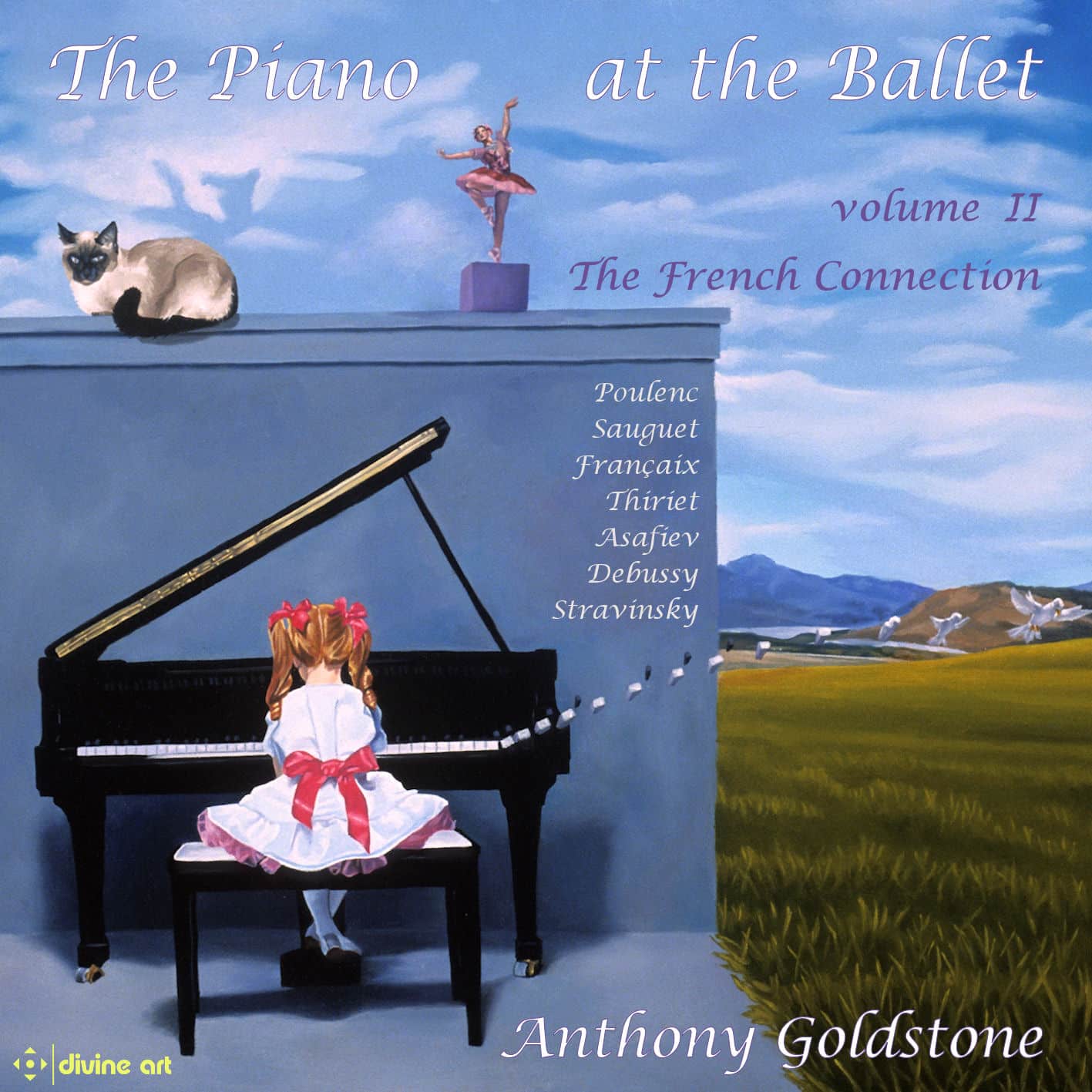
    Known as “Tony” to his friends, British pianist Anthony Goldstone passed away early this year (2017) and was unable to see his last CD released. A superb pianist equally appreciated as a soloist as well as half of the Goldstone and Clemmow Duo, his final recording, The Piano at the Ballet Volume II – The French Connection (Divine Art dda 25148) is dedicated to his memory.

    Goldstone delighted in transcriptions and recorded several featuring music from opera and ballet. This disc is the conclusion of the latter project and uses French composers as the thematic link. Most of the pieces are world premiere recordings, transcribed by various others, although the notes admit that Goldstone made a few improvements along the way.

    Goldstone’s playing at age 72 is simply incredible. Speed, reach, accuracy and, above all, unerring musicality mark every transcription he performs. The music tends, understandably, to be extremely athletic and Goldstone’s level of sustained energy is impressive. The finales of Poulenc’s Les Biches and Maurice Thiriet’s L’Oeuf à la coque are fine examples of this. He also captures the grandness of the orchestral score in these transcriptions. Claude Debussy’s Printemps (Suite Symphonique) is the best example of this, with its great washes of sound that conclude the second movement.

  • Piano at the Ballet vol. II review

    This is Anthony Goldstone’s (1944-2017) last recording. He made more than 80 of them and was an active performer since his debut in 1965. His duo partner of 33 years, Caroline Clemmow, was also his wife of 28 years. There are at least 30 reviews in the ARG index of this man’s wonderful work both as soloist and part of the duo. Repertoire was almost always away from the mainstream: often arrangements, rranscriptions, and piano versions that preceded the better-known orchestral work. He completed works left unfinished and dug up versions long deleted.

    I recently reviewed a remastered re-release of the complete Schubert Piano Duets (Divine Art 21201). Piano at the Ballet, Vol. 2 is a fitting finale to a great recording career. It is sort of an appendix to a trio of recordings titled “The Piano at the Ballet, Opera, and Carnival” There was plenty of additional material uncovered by Goldstone after doing the first Ballet volume (Divine Art 25073). The subtitle here is “The French Connection” and all the numbers here are believed to be premiere recordings. Goldstone also freely admitted that sometimes he used his own experience and abilities to modify the printed score for maximum effectiveness.

    While almost half of the program is by well-known composers (Poulenc, Debussy, Stravinsky), the others are truly obscure. The entire program is balanced and a continuous joy to listen to. The Debussy is the largest, most serious piece and has to be quite difficult for a single pianist bring off. Others have the kind of humor we often associate with Poulenc and even some Gershwin-inspired jazz moments. Recorded sound and liner notes are up to the highest standards. I will miss getting a disc or two every year from this immensely talented, now departed pianist.

  • MusicWeb International – John France – 25148

    Three things to say straightaway. Firstly, the playing on this disc by the late Anthony Goldstone (1944-2017) is stunning from the first note to the last. Secondly, do not try to hear this disc at a single sitting. Enjoy each ballet (or excerpt) at a time, and then come back a wee bit later for the next round. And, finally, despite point ‘1’ above, I would rather listen to the original orchestra version in every case. It is not the forum too argue for/against transcriptions, but there is a tendency for the music to appear less like a recital than a répétiteur in the ballet school. (I think someone else made this remark re. an earlier disc in this series.) On the other hand, a transcription can allow the listener to better appreciate the structure of a work: harmonic, formal and melodic. It is all a matter of opinion. But let me reiterate that this is a superb disc.

    I do not wish to give details of each ballet’s plots, business and action. Nor will I present a detailed description of the progress of the music. However, a few words on each piece may be of interest, as some are not quite as familiar as others.

    Poulenc’s Les Biches was first performed in Monte Carlo during January 1924 and explores the relationship between a group of ‘bright young things’ living in the South of France. The original featured choral settings of 17th century texts. Poulenc arranged the score for orchestra in 1939-40. The word ‘Biche’ is usually translated as does (adult female deer). It was also a slang French word for a ‘coquettish woman.’ (Wikipedia). The music is subtle, sparkling and largely neoclassical. There are many sly references to older composers: Mozart, Scarlatti, Tchaikovsky and even Stravinsky. Three movements are given here: Rondeau, Andantino and Final.

    Henri Sauguet’s contribution to this selection of French ballet music is the ‘charming’ score to Les Forains (The Fairground Entertainers or The Fairground People). This was a one-act ballet written in 1945 and first presented at the Theatre des Champs-Elysées in March 1945. The war was still raging, though Paris had been liberated on 25 August 1944. The music has nothing complex or modernistic about it. In fact, it has been said that the score is ‘sometimes verging on the trivial but never falling into vulgarity.’ I found it all a little dull.

    Jean Françaix is a composer who is sadly forgotten these days. Writer of much good, ‘neo-classical’ music for a wide range of genres whose influences included Ravel, Stravinsky, Chabrier and Poulenc. The present Serenade for orchestra was composed in 1934, when the composer was twenty-two years old. It is a delightful work and seems to have transcribed well for piano solo. I have never heard the original version. There are four short movements. The Serenade was used in the ballet A la Françaix which was devised by George Ballachine, and was premiered in New York in 1951.

    My musical discovery on this CD is the L’Oeuf à la coque (The Boiled Egg) (1949) by Maurice Thiriet (1906-72). I had previously heard of neither composer nor his music. Listening to this ballet score, there is much in common with Jean Françaix and Francis Poulenc in their exploitation of neo-classicism. To these allusions Thiriet adds jazz and popular song. Never mind the ‘book’ of the ballet: just enjoy this is a sparkling and often catchy score. Any of the four extracts presented here by Anthony Goldstone would make an ideal piano recital encore.

    St Petersburg-born composer Boris Asafiev (1884-1949) provided the score for the ballet The Flames of Paris. This is a work based on the French Revolution. Asafiev made use of songs from that era. Anthony Goldstone has presented a short suite of extracts from the original four act ballet. Not a particularly inspiring piece, although the ‘Introduction’ has a memorable tune.

    Printemps, by Debussy has seen several incarnations. Originally for choir, piano and orchestra, it was written whilst the composer was living in Rome. The score was destroyed by fire. Debussy rewrote the work for orchestra and piano but without the chorus (with the help of Henri Busser) and created a four-handed piano version. The work was inspired by Sandro Botticelli’s Primavera (Allegory of Spring): it is often deemed to represent one of the earliest examples of musical impressionism. It was adapted by the composer for piano duet and was further arranged for piano solo by Henri Busser in 1904. This is the version that is played on this disc, with many extra ‘twiddly bits’ by Anthony Goldstone. Printemps was used as a ballet score for the Alhambra Theatre in London. It was a part of a revue called Not Likely! The liner notes point out that this important early essay in impressionism was heard alongside performances by Minnie Kaufmann, the trick cyclist and ‘Chinko, the Chinese juggler. Apparently, Debussy had been commissioned to write a new piece for this venue, but failed to make headway. He offered Printemps instead, so as not to lose his fee.

    Finally, Igor Stravinsky’s Pulcinella makes use of the music of the Italian composer Giovanni Battista Pergolesi. The ballet tells of the adventures of Pulcinella, who is a stock character of Neapolitan theatre. In 1922 the composer presented an eight-movement orchestral suite of the ballet. It is well-known music that transcribes well for the piano.

    The liner notes by Jeremy Nicholas are excellent and give detailed information about these works which is often not easily available elsewhere. The sound quality of this Divine Art disc is first-rate.

    As noted above, despite my reservations about ‘transcriptions’ this is an outstanding disc that introduces the listener to a wide conspectus of French ballet music, either specifically composed for the genre, or skillfully adapted by the choreographer. I reiterate: every note is played with style, technical ability and downright enthusiasm.
  • The Chronicle – Jeremy Condliffe – 25148

    You get one piano transcription of orchestral scores and another two turn up. Like buses, piano transcriptions. A couple of weeks ago we had Enigmas, the work of Elgar; last week it was an excellent disc of performances of Mussorgsky, now this.

    On one hand it’s a charming piece of entertainment, in which complex music is reduced to an accessible essence so well crafted it almost seems lightweight. On the other; it’s a little bit sad, because Goldstone is no longer with us, having died aged 72 in January.

    A musician described by The New York Times as “a man whose nature was designed with pianos in mind”, Goldstone was one of Britain’s most respected pianists. Life: you’re just getting really good at something and then you’re gone.

    Looking at the composers — Francis Poulenc, Henri Sauguet, Jean Françaix, Maurice Thiriet, Boris Vladimirovich Asafiev, Henri Büsser and Igor Stravinsky — we guessed there was a French connection: if the composer isn’t French there’s a link; Asafiev contributes The Flames Of Paris while Stravinsky wrote Pulcinella in France.

    We’re not going to pretend familiarity with the original scores; we recognise some sections and not others but that doesn’t matter, because it’s all delightful. Goldstone plays superbly, as befits a man designed for pianos. If you know the scores, you’ll probably enjoy the piano version, and if you don’t, it’s a rather wonderful CD in its own right.

    It complements Goldstone CDs looking [at] the worlds of opera (DDA 25067), carnival (DDA 25076) and an earlier ballet one (DDA 25073). This is out on DDA 25148.

  • BBC Music Magazine – Oliver Condy – 25148

    Anthony Goldstone’s final recording is a rich serving of French and French-inspired delights, all recorded in their solo piano arrangements for the first time.

  • The Piano At The Ballet: Vol. 2

    The Piano At The Ballet: Vol. 2

    Anthony Goldstone died on January 2, 2017 after a year-long battle with illness. This was his last recording, and is issued now also as a tribute and memorial to one of the greatest pianists of our age who never achieved the international recognition he deserved. His immense musical knowledge, assiduous research, and skilful artistry in both performance and also transcription brought him great acclaim in musicological circles.

    Following the critical praise and commercial success of ‘Piano at the Ballet’ this sequel focuses on transcriptions of ballet music with French connections – through the composer or subject matter and includes both well known works and some refreshingly unfamiliar pieces, including program works by Debussy and Françaix later choreographed.